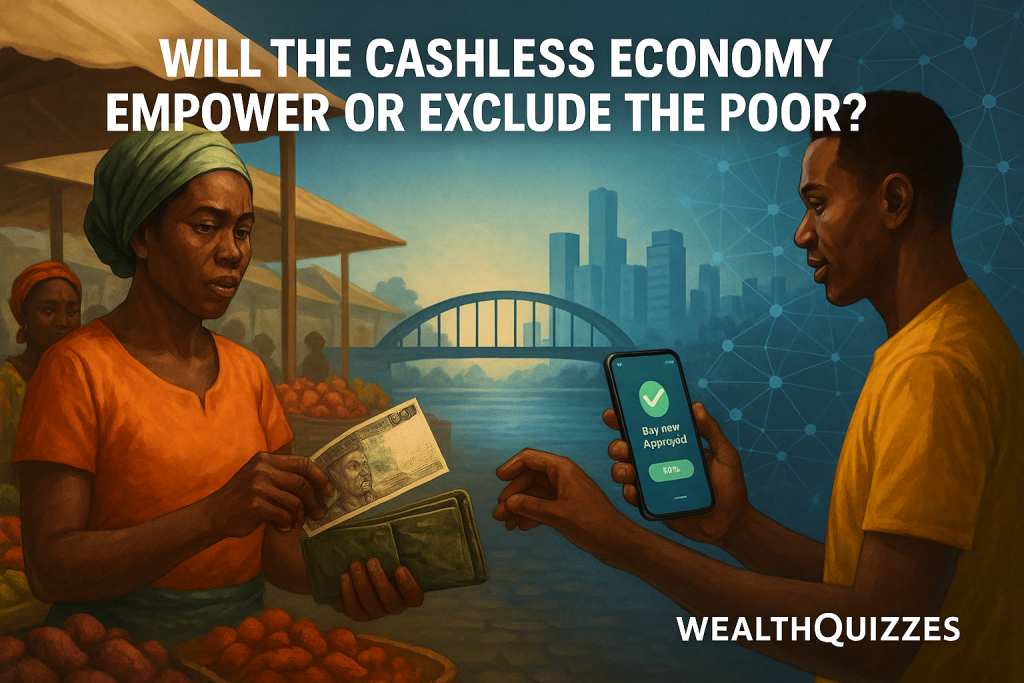
Will the Cashless Economy Empower or Exclude the Poor?
By WealthQuizzes Editorial Team
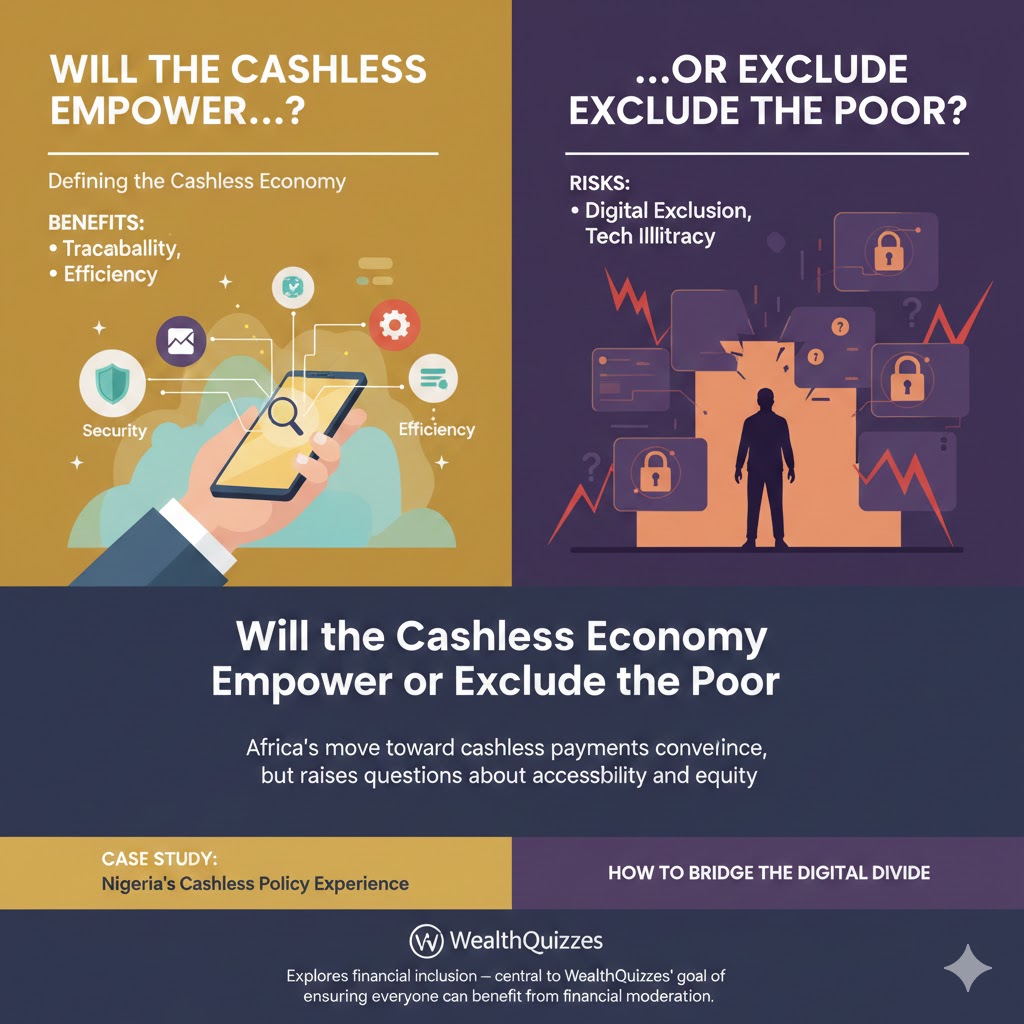
Defining the Cashless Economy
A cashless economy is one where financial transactions are conducted primarily through digital means — mobile transfers, debit cards, online payments, and other electronic systems — instead of physical cash.
It’s a vision where every purchase, from groceries to government fees, happens with a tap, click, or scan.
Across Africa, the momentum toward cashless systems has been accelerated by:
- Mobile money adoption,
- Fintech innovation,
- Government digitization policies, and
- The growing integration of digital platforms into everyday life.
Countries like Nigeria, Kenya, and Ghana are leading this shift, promoting digital transactions as the foundation of modern economic growth.
But as the transition accelerates, one question looms large:
Will a cashless Africa empower the many — or exclude the most vulnerable?
Benefits: Security, Traceability, and Efficiency
The advantages of a cashless economy are undeniable — and for governments, businesses, and consumers, they are transformative.
1. Security and Reduced Theft
Digital payments reduce the risks of carrying or storing large sums of cash, curbing theft, robbery, and counterfeiting.
2. Traceability and Transparency
Every digital transaction leaves a record. This traceability helps combat money laundering, corruption, and tax evasion. Governments can better monitor fiscal flows and allocate resources efficiently.
3. Efficiency and Cost Savings
Cashless systems speed up transactions, lower operational costs, and streamline business processes. For individuals, paying bills, receiving salaries, or buying products becomes instant and seamless.
4. Inclusion Through Fintech
Mobile money platforms like M-Pesa, Paga, and OPay have already connected millions of unbanked Africans to the financial grid, allowing them to save, send, and receive money digitally — sometimes for the first time in their lives.
In theory, then, a cashless society should promote efficiency, accountability, and inclusion.
But in practice, that promise comes with deep and urgent challenges.
Risks: Digital Exclusion and Tech Illiteracy
For every advantage, the cashless revolution carries risks — especially for low-income and rural populations.
1. Limited Digital Access
Millions of Africans still lack reliable internet access, smartphones, or electricity — essential tools for participating in a digital economy. Without them, “cashless” can quickly become “cash-stranded.”
2. Digital Illiteracy
Even when access exists, digital skills are unevenly distributed. Many older citizens or rural dwellers are unfamiliar with online transactions or mobile banking apps. Mistakes and scams can easily erode trust.
3. Exclusion of the Informal Economy
Africa’s informal sector — which employs over 80% of the workforce — often relies heavily on cash. Street vendors, artisans, and micro-entrepreneurs may struggle to adapt to digital-only systems.
4. Systemic and Infrastructural Gaps
Network failures, app downtimes, and transaction errors remain common. During such disruptions, those without cash alternatives are left stranded — unable to buy, sell, or survive.
5. Privacy and Data Risks
Digital transactions generate personal data, and in many African countries, data protection frameworks are still evolving. Without strict safeguards, users’ financial privacy could be compromised.
If the transition to cashless systems is not inclusive and equitable, it risks deepening the very inequalities it aims to solve.
Case Study: Nigeria’s Cashless Policy Experience
Nigeria’s experience provides valuable lessons on both the potential and pitfalls of cashless policies.
In 2012, the Central Bank of Nigeria (CBN) launched its Cashless Policy to promote electronic payments and reduce cash circulation. The initiative expanded rapidly, supported by fintechs like Flutterwave, Moniepoint, and Kuda Bank, and accelerated by mobile adoption and the COVID-19 pandemic.
However, challenges soon emerged.
In early 2023, the CBN implemented a currency redesign and withdrawal limit, forcing millions to rely on digital transfers. The result was widespread chaos — network failures, transaction delays, and economic hardship for citizens without access to smartphones or stable internet.
While the long-term goal of digitization remains valid, the short-term impact exposed a crucial truth:
Financial systems cannot outpace financial readiness.
Policymakers must ensure that digital transformations are inclusive — not disruptive — to the livelihoods of ordinary people.
How to Bridge the Digital Divide
For Africa to achieve a truly empowering cashless future, financial modernization must walk hand in hand with education, infrastructure, and inclusion.
Here’s what can make that possible:
- Expand Connectivity:
Governments and private sector players must invest in broadband access, mobile coverage, and reliable electricity — especially in rural areas. - Promote Digital Literacy:
Financial education campaigns should teach people how to safely use mobile apps, identify scams, and manage digital wallets. - Encourage Hybrid Models:
Cash and digital systems should coexist during the transition period. No citizen should be locked out of economic participation because they lack digital access. - Strengthen Regulation and Security:
Robust cybersecurity, fair transaction fees, and clear dispute-resolution systems will build trust in digital payments. - Empower Fintech Collaboration:
Fintech companies, telecoms, and regulators must work together to design inclusive financial ecosystems that reach low-income earners and micro-enterprises.
A cashless Africa must be an inclusive Africa — not one that divides citizens along technological lines.
WealthQuizzes Perspective: Financial Inclusion Through Knowledge
At WealthQuizzes, we believe that the foundation of financial inclusion is education — not technology alone.
The cashless revolution offers immense opportunities, but only if people understand how to navigate it confidently.
Through our platform, we teach individuals to:
- Master digital money tools,
- Protect themselves from scams,
- Manage cash and digital finances side by side, and
- Think critically about how financial systems affect their lives.
Because true inclusion means empowerment through understanding.
The cashless economy will shape Africa’s future — but whether it empowers or excludes depends on one thing:
How well we prepare our people for the money of tomorrow.