

Can Crypto and Fintech Bridge Africa’s Cross-Border Trade Gaps?
By WealthQuizzes Editorial Team
The Challenge of Intra-African Trade Payments
Africa trades more with the rest of the world than with itself — a paradox for a continent of over 1.4 billion people and vast economic potential. One of the biggest reasons is not production capacity, but payments friction.
Cross-border trade within Africa is notoriously complex. Businesses face:
- Multiple currencies with volatile exchange rates,
- High transaction fees,
- Slow settlement times, and
- Dependence on foreign correspondent banks.
A trader in Ghana paying a supplier in Kenya often has to route the transaction through U.S. dollars or euros, involving overseas banks and adding unnecessary costs and delays.
These inefficiencies disproportionately hurt small and medium-sized enterprises (SMEs) — the backbone of African economies — limiting the promise of the African Continental Free Trade Area (AfCFTA).
Without seamless payment systems, free trade remains theoretical.
How Crypto Enables Instant, Low-Cost Transfers
Cryptocurrency introduces a radically different approach to cross-border payments.
Unlike traditional banking systems, crypto transactions:
- Do not rely on correspondent banks,
- Are settled directly on blockchain networks, and
- Operate 24/7 without geographical restrictions.
A business in Nigeria can send value to a partner in Rwanda within minutes — often at a fraction of traditional costs. Stablecoins, in particular, have emerged as powerful tools for trade settlements because they are pegged to stable assets like the U.S. dollar, reducing volatility risks.
For cross-border commerce, crypto offers:
- Speed: Near-instant settlement,
- Cost efficiency: Lower fees, and
- Accessibility: Minimal documentation compared to traditional banking.
However, crypto is not a silver bullet. Price volatility, regulatory uncertainty, and security risks mean it must be used with understanding, not speculation.
In this context, crypto works best as infrastructure, not a gambling instrument.
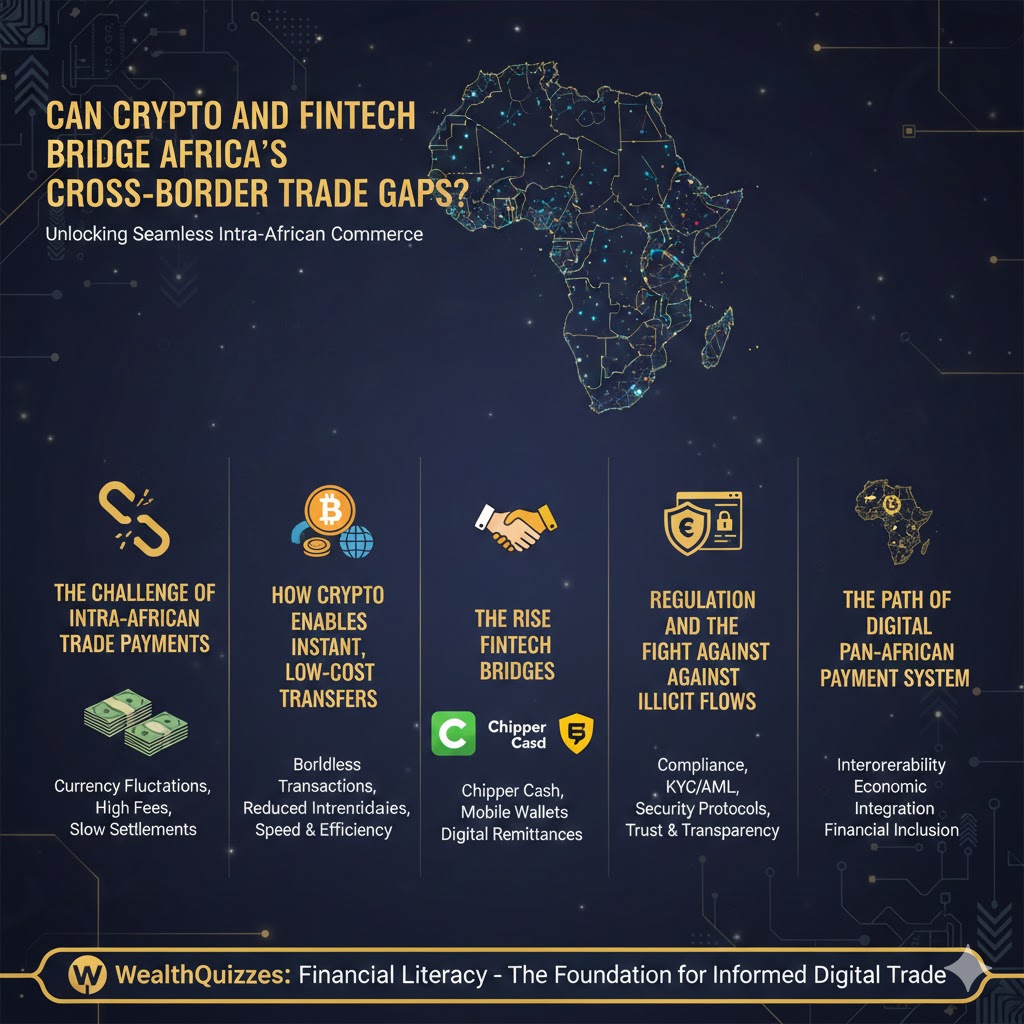
The Rise of Fintech Bridges like Chipper Cash and Yellow Card
While crypto lays the foundation, fintech companies are building the bridges that make digital trade practical and user-friendly.
Platforms like Chipper Cash, Flutterwave, Paystack, and Yellow Card are simplifying cross-border payments across African countries.
Chipper Cash
Chipper Cash enables instant, low-cost transfers across multiple African markets, allowing users to send and receive money without complex bank routing. It supports both fiat and crypto-enabled transactions.
Yellow Card
Yellow Card focuses on providing regulated crypto access in Africa, helping businesses and individuals use stablecoins for cross-border payments while complying with local laws.
These fintechs solve real problems by:
- Abstracting complex blockchain processes,
- Providing compliance layers (KYC/AML), and
- Integrating with local banking and mobile money systems.
In effect, they translate advanced financial technology into everyday usability — a critical step for mass adoption.
Regulation and the Fight Against Illicit Flows
The promise of crypto and fintech cannot be separated from regulation.
African governments are rightly concerned about:
- Money laundering,
- Terrorism financing,
- Capital flight, and
- Tax evasion.
Without safeguards, digital payment systems can be exploited. That is why regulatory clarity is essential — not to stifle innovation, but to protect the financial system and its users.
Many African countries are now taking balanced steps:
- Nigeria’s SEC has introduced digital asset guidelines,
- South Africa is classifying crypto service providers under financial laws, and
- Kenya and Ghana are exploring fintech regulatory sandboxes.
Effective regulation achieves three things:
- Builds trust among users and investors,
- Encourages responsible innovation, and
- Integrates digital finance into formal economies.
The goal is not to ban crypto or fintech — but to domesticate them.
The Path Toward a Digital Pan-African Payment System
True transformation lies not in isolated platforms, but in continental integration.
The future of African trade depends on systems that allow countries to transact directly in local currencies — supported by digital rails.
Initiatives like the Pan-African Payment and Settlement System (PAPSS) are critical. PAPSS allows instant cross-border payments in local currencies, reducing reliance on foreign intermediaries.
When combined with fintech innovation and blockchain infrastructure, such systems could:
- Lower trade costs,
- Increase intra-African commerce,
- Support AfCFTA implementation, and
- Keep value circulating within Africa.
The destination is clear:
A digital, interoperable, Pan-African payment ecosystem that is fast, secure, regulated, and inclusive.
WealthQuizzes Perspective: Financial Literacy as the Gateway to Digital Trade
At WealthQuizzes, we believe technology alone does not create opportunity — understanding does.
Crypto and fintech are powerful tools, but without financial literacy, they can become sources of risk rather than growth.
By educating Africans on:
- How digital payments work,
- The risks and rewards of crypto usage, and
- The regulatory responsibilities of digital finance,
WealthQuizzes positions learners to participate safely and intelligently in Africa’s digital trade future.
The bridge between fragmented markets and integrated prosperity is not just technology —
it is knowledge applied wisely.
And in Africa’s next phase of economic growth, those who understand the systems will shape the outcomes.