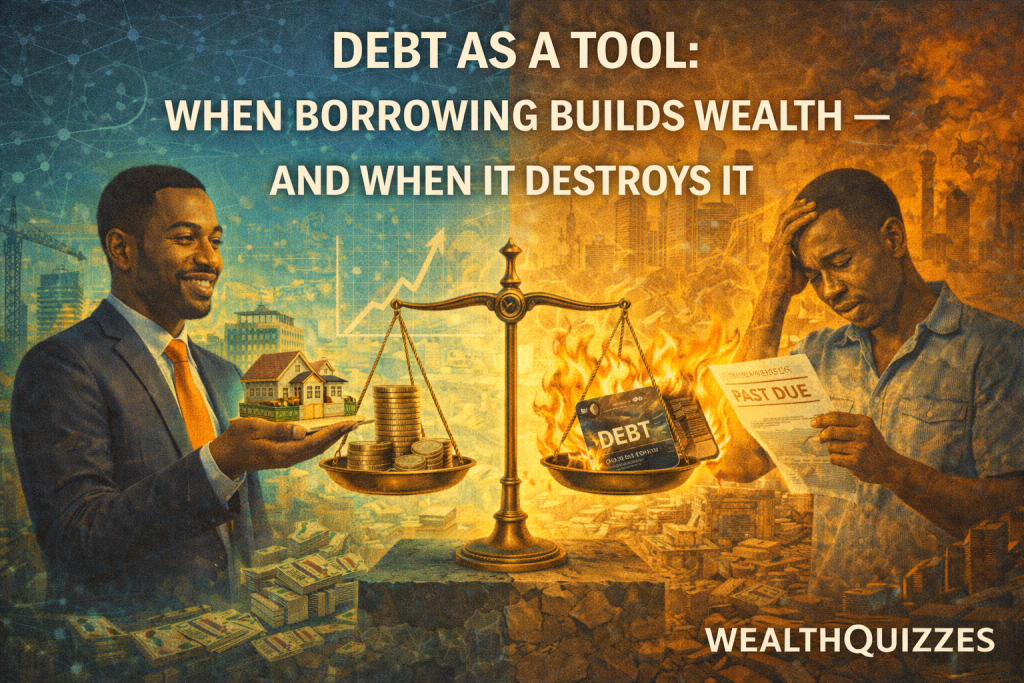
Debt as a Tool: When Borrowing Builds Wealth — and When It Destroys It
By WealthQuizzes Editorial Team
Introduction: The Most Misunderstood Financial Instrument
Few financial concepts generate as much fear, confusion, and contradiction as debt.
Some people believe debt is evil and must be avoided at all costs. Others borrow recklessly, assuming growth will magically cover their obligations. Both extremes are dangerous.
The truth is simpler—and more uncomfortable:
Debt is neither good nor bad. It is a multiplier.
Used wisely, debt accelerates growth, productivity, and wealth creation. Used poorly, it compounds losses, stress, and economic collapse.
Understanding when debt works—and when it doesn’t—is a foundational financial skill.
What Debt Really Is: Leverage, Not Income
At its core, debt is borrowed future income.
When you borrow, you are making a bet that:
- Future cash flow will be higher than today’s, and
- That increase will be sufficient to repay the loan plus interest.
Debt magnifies outcomes:
- If returns exceed borrowing costs → wealth grows
- If returns fall short → losses compound
Debt does not create value on its own. It only amplifies the quality of decisions behind it.
Productive Debt vs. Destructive Debt: The Fundamental Divide
The most important distinction in debt literacy is this:
Productive Debt
Debt that:
- Generates income or productivity
- Improves future cash flow
- Builds assets or capacity
- Pays for itself over time
Destructive Debt
Debt that:
- Funds consumption without returns
- Has no sustainable repayment source
- Grows faster than income
- Relies on hope instead of cash flow
This distinction applies universally—to individuals, businesses, and nations.
Personal Debt: When Borrowing Builds or Breaks Lives
Productive Personal Debt
Examples include:
- Education that increases earning capacity
- A mortgage for a reasonably priced home
- A business loan with clear cash flow
- Skills or tools that generate income
These debts:
- Expand future income
- Create long-term assets
- Improve financial resilience
Destructive Personal Debt
Examples include:
- High-interest consumer loans
- Lifestyle debt for status purchases
- Credit card balances without repayment plans
- Borrowing to cover recurring expenses
This type of debt:
- Produces no income
- Shrinks future options
- Turns time into an enemy
- Traps people in repayment cycles
At the personal level, debt becomes dangerous when income does not grow faster than obligations.
Corporate Debt: Fuel for Growth or a Silent Killer
Businesses use debt constantly—but the difference between success and failure lies in purpose and structure.
Productive Corporate Debt
Used for:
- Expanding operations
- Purchasing productive assets
- Entering profitable markets
- Improving efficiency or scale
Well-managed corporate debt:
- Matches repayment to cash flow
- Is supported by predictable revenue
- Is used to grow margins, not just size
Destructive Corporate Debt
Occurs when companies:
- Borrow to cover losses
- Use debt to mask poor management
- Over-leverage during booms
- Ignore cash flow volatility
Many corporate collapses are not due to lack of profit—but excessive leverage.
Debt doesn’t kill businesses.
Mismatch between debt and cash flow does.
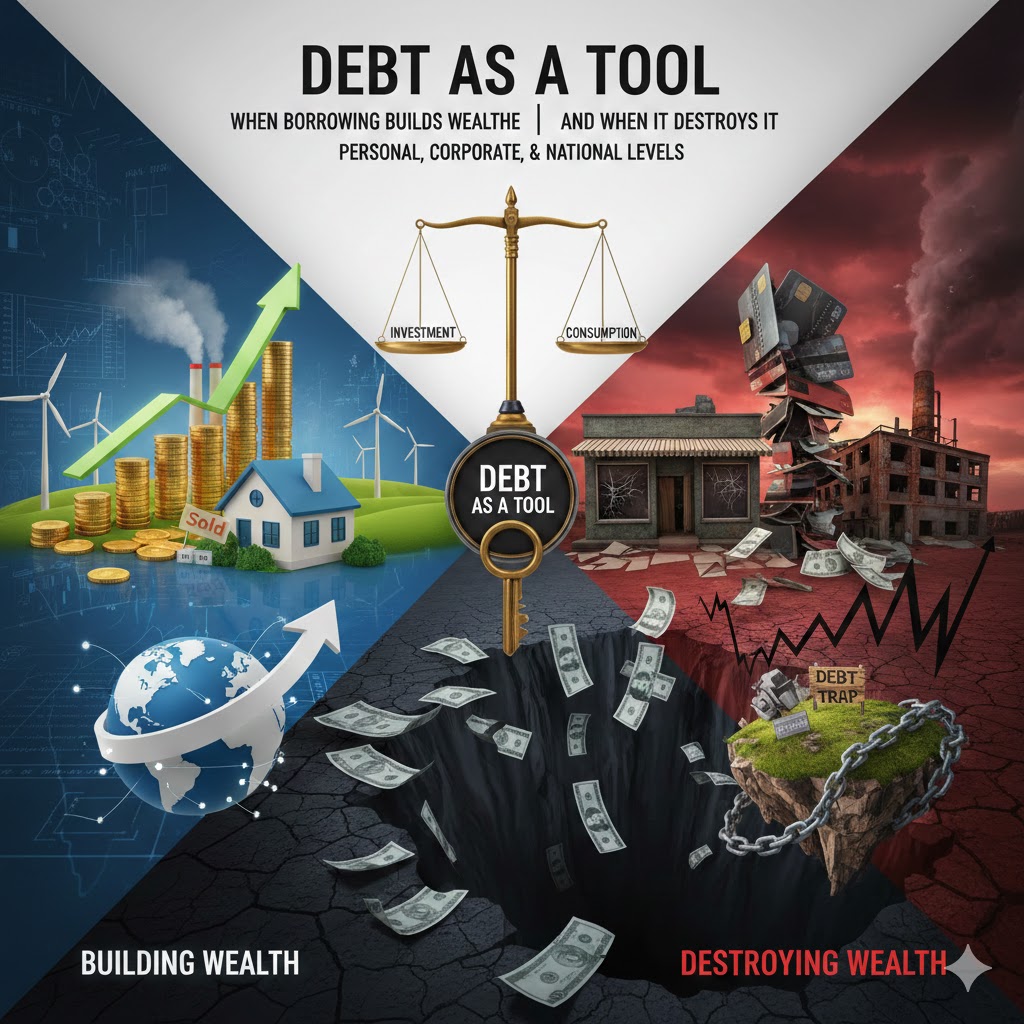
National Debt: Development Tool or Economic Trap
At the national level, debt becomes even more complex—and more dangerous.
Productive National Debt
Used for:
- Infrastructure that boosts productivity
- Education and healthcare systems
- Industrial capacity
- Long-term economic transformation
When managed well, national debt:
- Expands the economic base
- Increases future tax capacity
- Improves competitiveness
- Pays for itself over time
Destructive National Debt
Occurs when borrowing:
- Funds recurrent consumption
- Covers inefficiencies
- Supports corruption or waste
- Is denominated in volatile foreign currencies
This leads to:
- Debt servicing crises
- Currency pressure
- Inflation
- Reduced sovereignty
Countries do not fail because they borrow.
They fail because borrowed money does not increase productive capacity.
The Interest Rate Reality: The Silent Decider
Debt becomes destructive when interest outpaces growth.
At any level, the critical question is:
Is the return on borrowed money higher than the cost of borrowing?
If not:
- Wealth erodes
- Options shrink
- Risk compounds
This is why:
- High-interest consumer loans are dangerous
- Floating-rate debt can be lethal in inflationary periods
- Currency-mismatched debt is risky for nations
Ignoring interest is how debt quietly turns toxic.
Why Poor Decisions Turn Debt into a Weapon
Debt becomes destructive when driven by:
- Emotion instead of analysis
- Optimism instead of projections
- Short-term thinking
- Lack of financial literacy
Many debt crises—personal, corporate, and national—are not caused by borrowing itself, but by poor understanding of cash flow, risk, and timing.
How to Know Whether Debt Will Build or Destroy Wealth
Before taking on any debt, ask:
- What exactly will this money produce?
- How and when will it generate cash flow?
- Is repayment dependent on growth or speculation?
- What happens if income falls?
- Is this debt optional—or survival-driven?
If these questions cannot be answered clearly, the debt is likely destructive.
African Context: Debt, Development, and Discipline
Across Africa:
- SMEs struggle due to lack of productive credit
- Individuals fall into high-interest lending traps
- Governments borrow without structural reforms
The problem is not access to debt.
It is access to disciplined, productive borrowing frameworks.
Financial literacy is the missing link between debt and development.
WealthQuizzes Perspective: Debt Literacy Is Wealth Literacy
At WealthQuizzes, we believe understanding debt is not optional—it is survival knowledge.
When people understand:
- How debt works
- When to use it
- When to avoid it
- How to structure it
Debt stops being a trap and becomes a tool.
We teach that:
- Borrowing is not failure
- Avoiding all debt is not wisdom
- Strategic debt is leverage
- Undisciplined debt is destruction
Because wealth is not built by avoiding tools—
it is built by using them intelligently.
And debt, when understood, is one of the most powerful tools of all.