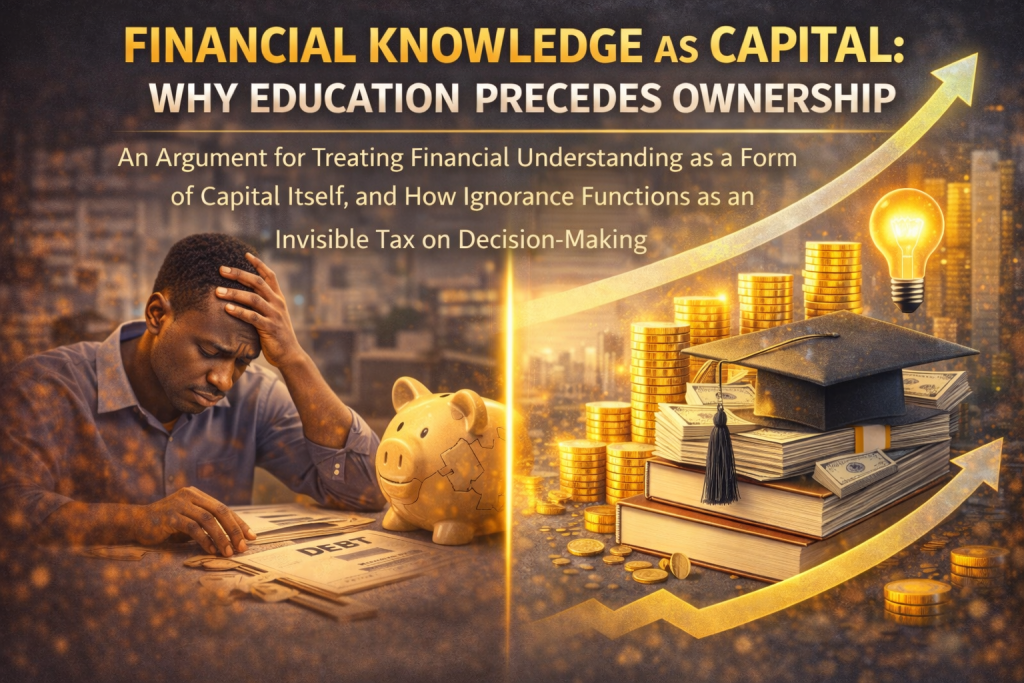
Financial Knowledge as Capital: Why Education Precedes Ownership
Modern economies often treat education as a social good, a pathway to employment, or a signal of competence. Yet in financial reality, education — specifically financial understanding — functions as something more precise and powerful: a form of capital.
Before people accumulate assets, manage businesses, or preserve intergenerational wealth, they first acquire — or fail to acquire — the intellectual framework required to interact correctly with economic systems. In this sense, the sequence of wealth formation is not:
work → income → savings → wealth
but rather:
understanding → decision quality → asset ownership → wealth persistence.
This article explains why financial knowledge itself operates as capital, how ignorance imposes measurable economic costs, and why ownership almost never precedes comprehension.
1. What Economists Mean by “Capital”
In classical economics, capital does not merely mean money. It refers to resources that generate future value.
Adam Smith in The Wealth of Nations (1776) distinguished between:
- consumption (resources used once), and
- productive stock (resources that create future income).
Later economists expanded the concept:
- Physical capital — machines, buildings, infrastructure
- Financial capital — money, securities, credit
- Human capital — skills, training, and knowledge
Gary Becker, Nobel laureate (1964), formalized human capital theory, arguing that education and knowledge improve productivity and lifetime economic outcomes just like machinery improves output.
But Becker’s work understates something crucial:
Not all knowledge is economically equal.
Literacy allows employment.
Professional skill allows income.
Financial understanding allows ownership.
And ownership — not income — is what produces durable wealth.
2. Financial Knowledge Changes Economic Behavior
Financial systems are not intuitive. They are institutional constructs governed by compounding mathematics, risk allocation, and incentive design. Without understanding them, individuals make decisions that feel rational but are structurally harmful.
Daniel Kahneman (Nobel Prize, 2002) demonstrated in Thinking, Fast and Slow that humans systematically misunderstand probability, risk, and long-term outcomes. People overweight short-term certainty and underweight long-term compounding.
In finance, this produces predictable behaviors:
- preferring salary certainty over equity participation
- holding cash during inflation
- avoiding investment due to volatility
- selling appreciating assets prematurely
- accumulating consumptive debt
These are not moral failures.
They are information failures.
Financial knowledge therefore does not merely inform decisions — it reprograms decision-making under uncertainty.
3. Ownership Requires Understanding
Across countries and centuries, the dividing line between the middle class and the wealthy has rarely been effort. It has been ownership of productive assets.
Thomas Piketty, in Capital in the Twenty-First Century (2014), demonstrated empirically that returns on capital (r) historically exceed economic growth (g). This principle — often summarized as r > g — explains why asset owners accumulate wealth faster than wage earners.
But ownership is not simply a legal event. It is a conceptual leap.
To own assets effectively, an individual must understand:
- compounding returns
- reinvestment
- valuation
- risk vs volatility
- leverage
- inflation erosion
- time horizons
Without this framework, ownership is often liquidated. This explains a well-documented phenomenon: lottery winners frequently become bankrupt. The issue is not lack of money. It is lack of financial cognition.
Economist Hyman Minsky similarly argued that financial stability depends on agents understanding leverage and risk cycles. When participants do not understand the system, they behave pro-cyclically — borrowing at peaks and liquidating at downturns.
Thus:
Wealth without understanding is unstable.
4. Ignorance as an Invisible Tax
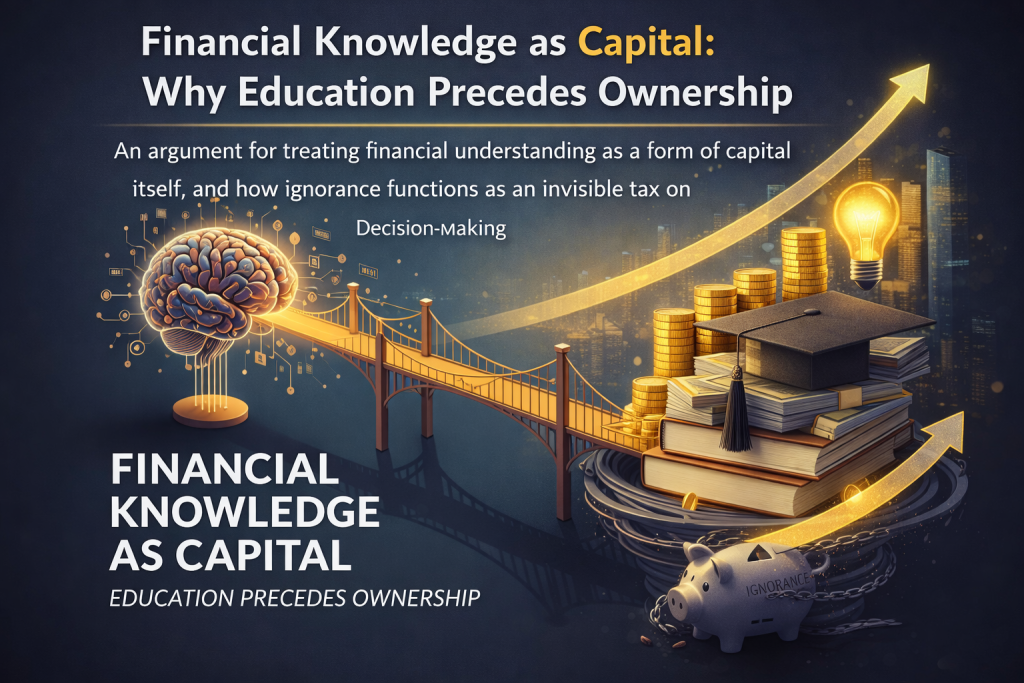
Taxes reduce income explicitly.
Financial ignorance reduces wealth implicitly.
The costs appear in several forms.
a) Inflation Misinterpretation
John Maynard Keynes observed that inflation “confiscates, secretly and unobserved, an important part of the wealth of citizens.”
People who keep savings in cash during inflation experience real wealth loss even while nominal balances remain unchanged.
This is not merely poor saving — it is failure to understand real vs nominal value.
b) Opportunity Cost
Economist Friedrich Hayek emphasized dispersed knowledge in markets. Those who understand capital allocation capture opportunities invisible to others.
For example:
- investing early in productive assets
- purchasing appreciating land
- acquiring equity in a growing enterprise
Individuals lacking financial literacy often see only price, not future value. The foregone gains constitute a measurable economic loss.
c) Debt Misuse
Debt can be productive (business expansion, investment) or consumptive (depreciating consumption).
Financially educated actors differentiate between the two. Others do not.
As a result:
- one group uses leverage to amplify returns
- another uses credit to accelerate depreciation
The same financial instrument produces opposite outcomes.
5. Why Education Must Precede Ownership
Across emerging economies — including many African countries — programs frequently attempt to increase wealth through:
- loans
- grants
- subsidies
- credit schemes
Yet many fail to produce durable prosperity. Hernando de Soto, in The Mystery of Capital (2000), explained why: ownership systems require understanding of property, contracts, and formal finance. Without institutional and cognitive frameworks, capital cannot compound.
This reveals a consistent pattern:
Access to capital without financial understanding produces consumption.
Financial understanding produces capital formation.
Education therefore performs three critical functions:
- Interpreting incentives — understanding how financial systems actually behave
- Extending time horizon — valuing long-term compounding over short-term certainty
- Protecting assets — preventing liquidation through panic or misuse
Ownership is not simply acquisition.
It is sustained stewardship.
6. Financial Knowledge as the First Investment
Warren Buffett repeatedly emphasizes that the most powerful investment is understanding compounding early. Charlie Munger similarly argues that wealth accumulation depends primarily on rational capital allocation decisions over time, not extraordinary intelligence.
This reframes financial education:
It is not motivational content.
It is economic infrastructure within the individual.
Before a person acquires:
- real estate,
- businesses,
- equities,
- or intellectual property,
they must first acquire the mental model necessary to interpret them correctly.
In this way, financial knowledge behaves exactly like capital:
- it produces future returns,
- it compounds,
- and it changes opportunity access.
7. The Wealth Sequence
Empirical observation across societies suggests a recurring order:
- Financial understanding
- Improved decision-making
- Asset acquisition
- Compounding
- Wealth stability
- Intergenerational transfer
When the sequence is reversed — when assets precede understanding — wealth often dissipates.
This is why families, not just individuals, maintain wealth over generations: they transmit financial cognition, not merely financial assets.
Conclusion
Financial systems reward comprehension before participation. Money, credit, and assets operate according to rules — mathematical, institutional, and behavioral. Individuals who understand those rules accumulate capital; those who do not often circulate within income cycles regardless of effort.
Therefore, financial education should not be viewed as optional self-improvement. It is a prerequisite to ownership.
Financial knowledge is capital because it:
- improves allocation decisions,
- extends time horizons,
- protects against inflation and predatory structures,
- and enables productive ownership.
Ultimately, the most significant divide in modern economies is not between rich and poor, nor employed and unemployed.
It is between those who understand the system they live in and those who do not.
Ownership almost always follows the former — and rarely the latter.