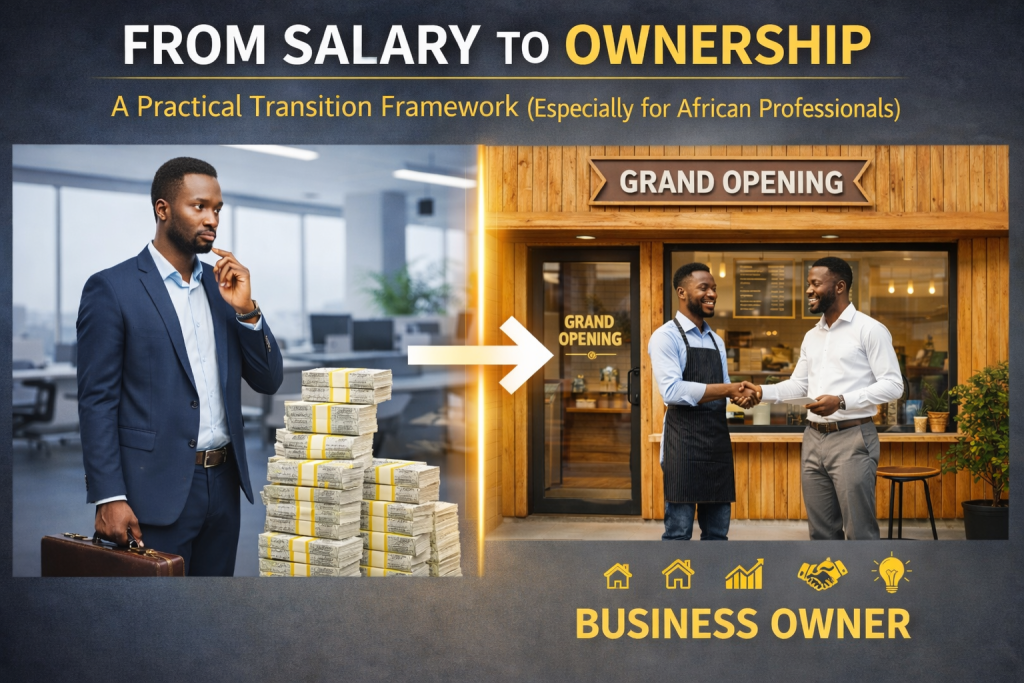
From Salary to Ownership: A Practical Transition Framework
(Especially for African Professionals)
Introduction: The Hidden Ceiling of the Professional Class
Across Africa today, a paradox is quietly unfolding.
Never before have so many people been educated, professionally employed, and credentialed — lawyers, engineers, doctors, bankers, civil servants, and tech workers. Yet many of these professionals, even after 10–25 years of disciplined work, still struggle to achieve lasting financial security.
They earn income.
They maintain lifestyle stability.
But they rarely accumulate enduring wealth.
This is not a personal failure.
It is a structural reality.
Modern economics distinguishes sharply between earning money and owning capital. The transition from salary dependence to asset ownership is not merely a motivational journey — it is an economic reclassification. And historically, this transition is the single most important step in wealth formation.
The goal of this article is to explain why, and then provide a practical framework for how African professionals can realistically make that shift.
1. The Economic Difference Between Income and Ownership
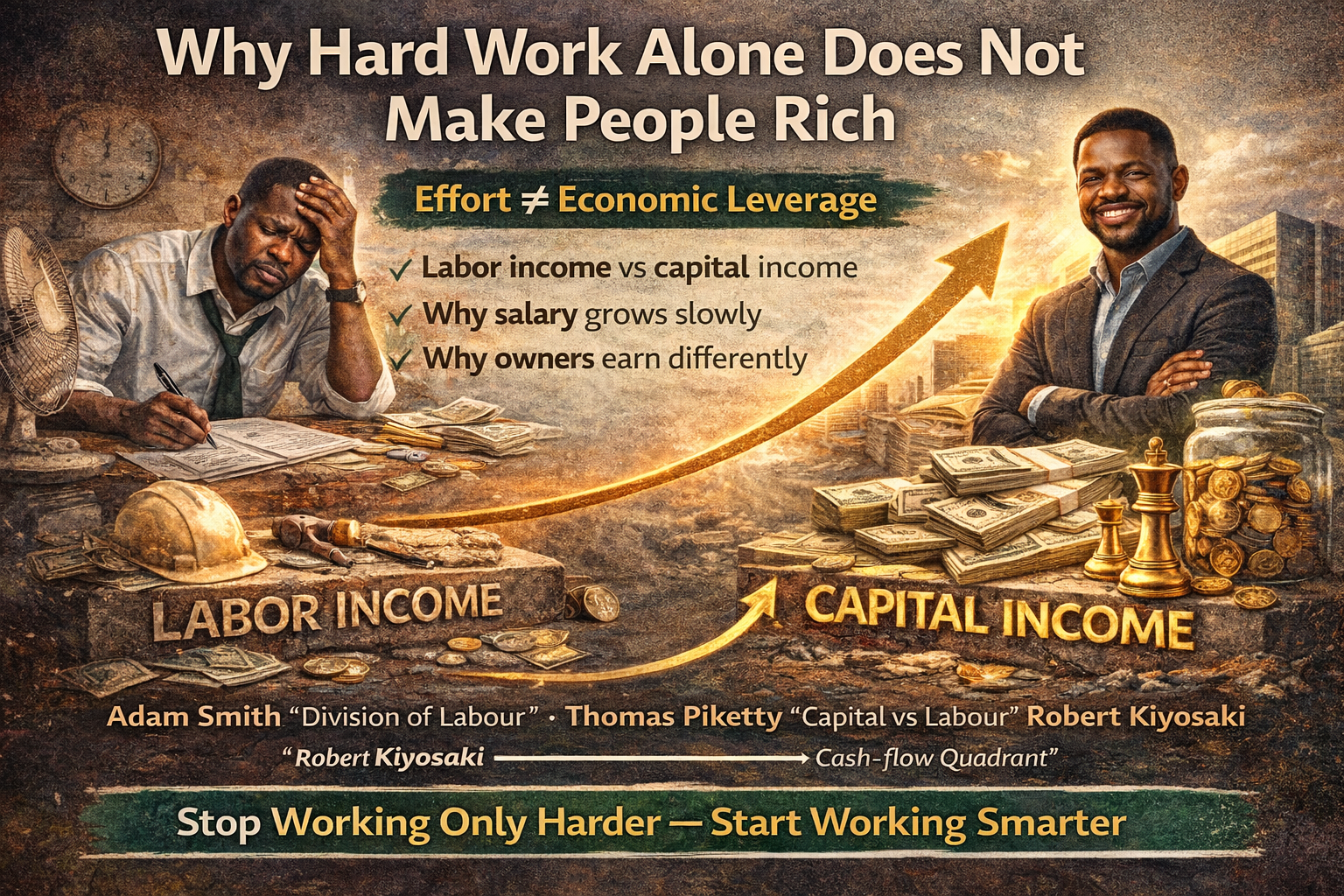
Economists define two fundamentally different ways of participating in an economy:
| Participation Type | Economic Position | Source of Earnings |
|---|---|---|
| Labor | Worker | Wages / Salary |
| Capital | Owner | Profits, rents, dividends, equity appreciation |
Thomas Piketty’s landmark research shows a critical insight:
Wealth accumulates faster through returns on capital than through labor income.
His famous inequality r > g — the return on capital exceeding the growth of wages and the economy — explains why asset owners systematically pull ahead of wage earners over time. (Wikipedia)
In practical terms:
- A salary pays for living
- Capital pays for the future
A professional who depends only on earned income must keep working to survive. An owner can stop working and still earn.
That is the dividing line between income and wealth.
2. Why High Income Does Not Automatically Become Wealth
Many professionals believe:
“If I just earn more, I will eventually become wealthy.”
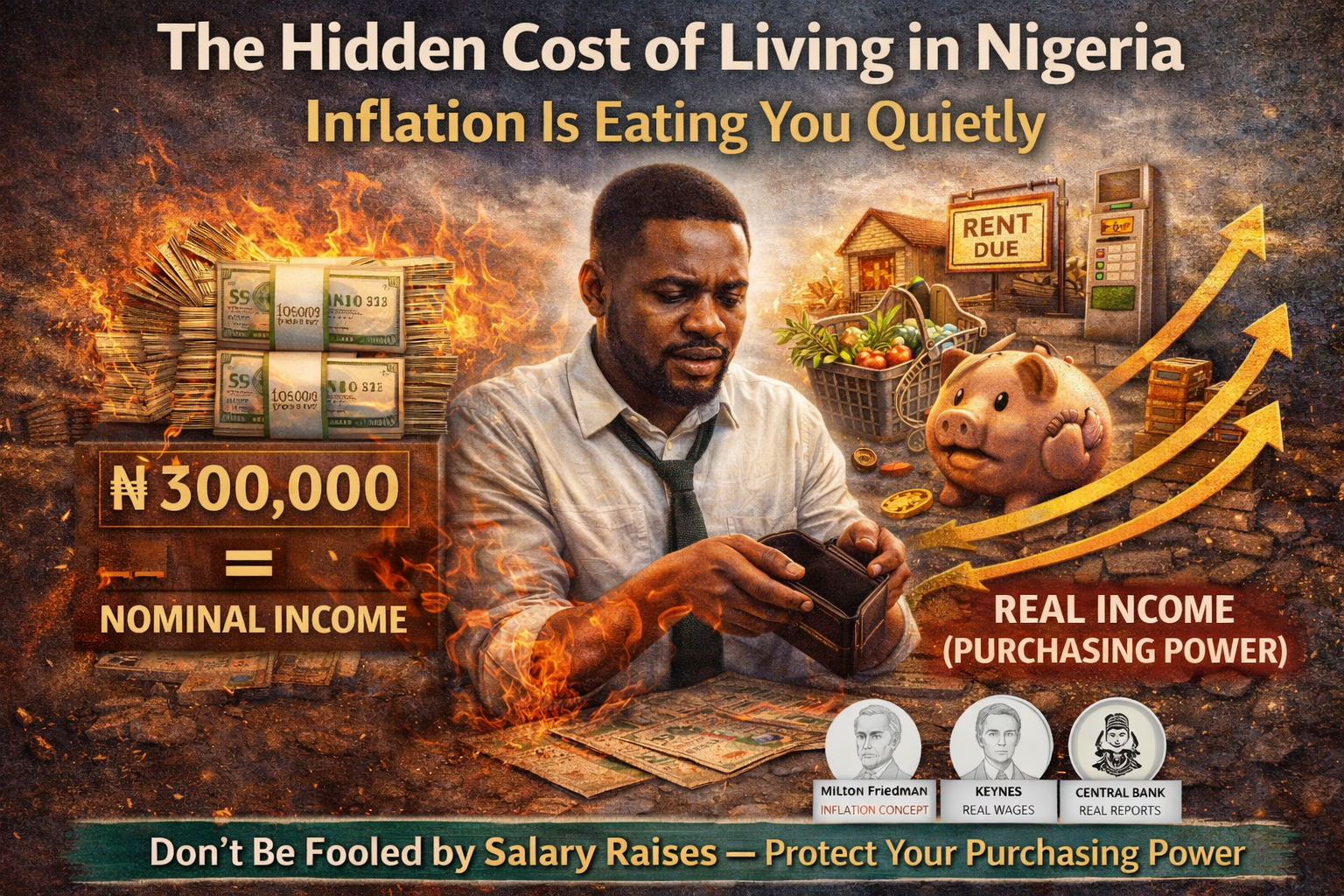
This rarely happens — especially in inflationary and currency-weak environments.
Here’s why:
A Salary Is a Linear System
Income grows slowly and stops when work stops.
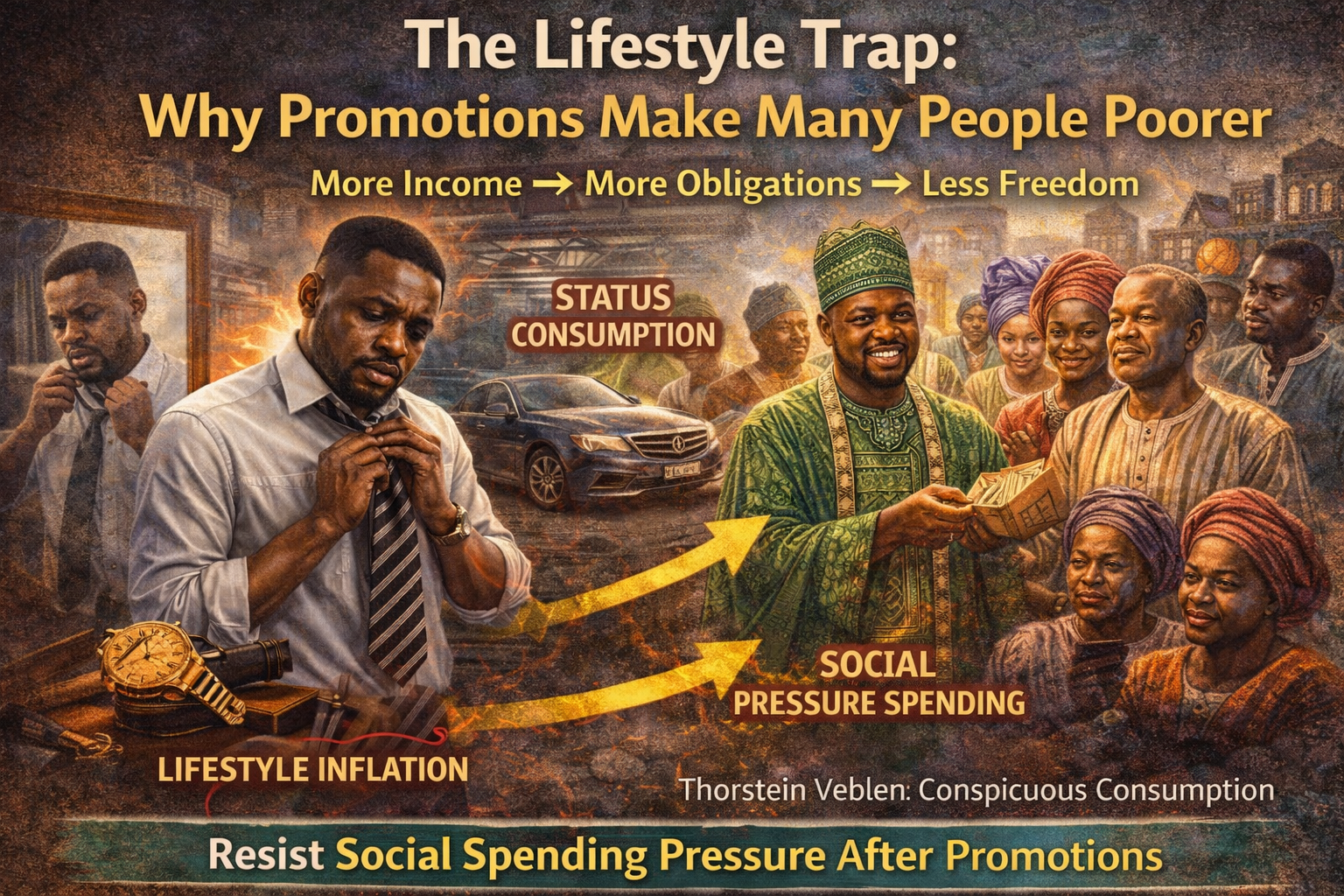
Capital Is a Compounding System
Assets grow independently of your time.
Research on wealth accumulation shows compound returns — not wages — are the primary drivers of long-term inequality and wealth concentration. (arXiv)
So the real issue is not income level.
It is economic structure.
A highly paid employee without assets remains financially fragile.
A moderate earner with productive assets steadily becomes secure.
3. The African Constraint: The Problem of “Dead Capital”
Peruvian economist Hernando de Soto introduced one of the most important ideas for understanding developing economies: dead capital.
Dead capital refers to assets people possess but cannot legally leverage — such as:
- Unregistered land
- Informal businesses
- Customary property
- Non-documented housing
Because they lack formal recognition, they cannot be used as collateral, financed, or scaled.
Globally, trillions of dollars in assets exist in this informal state, particularly in developing economies. (Wikipedia)
This explains a major African paradox:
People own things — but cannot turn ownership into financing.
In developed economies, property unlocks loans.
In many African economies, property often only provides shelter.
Therefore, transitioning to ownership requires formal, finance-recognizable assets — not just possession.
4. Why Professionals Get Stuck in the Salary Trap
Professional employment is designed primarily for stability, not wealth.
A job economically performs three functions:
- Income smoothing
- Risk reduction
- Consumption financing
It does not automatically produce capital accumulation.
The structural trap looks like this:
- Salary increases
- Lifestyle expands
- Savings remain small
- Inflation erodes value
- Retirement risk appears
The professional becomes economically stable — but not economically independent.
This is not accidental. Salaries compensate time; wealth compensates ownership.
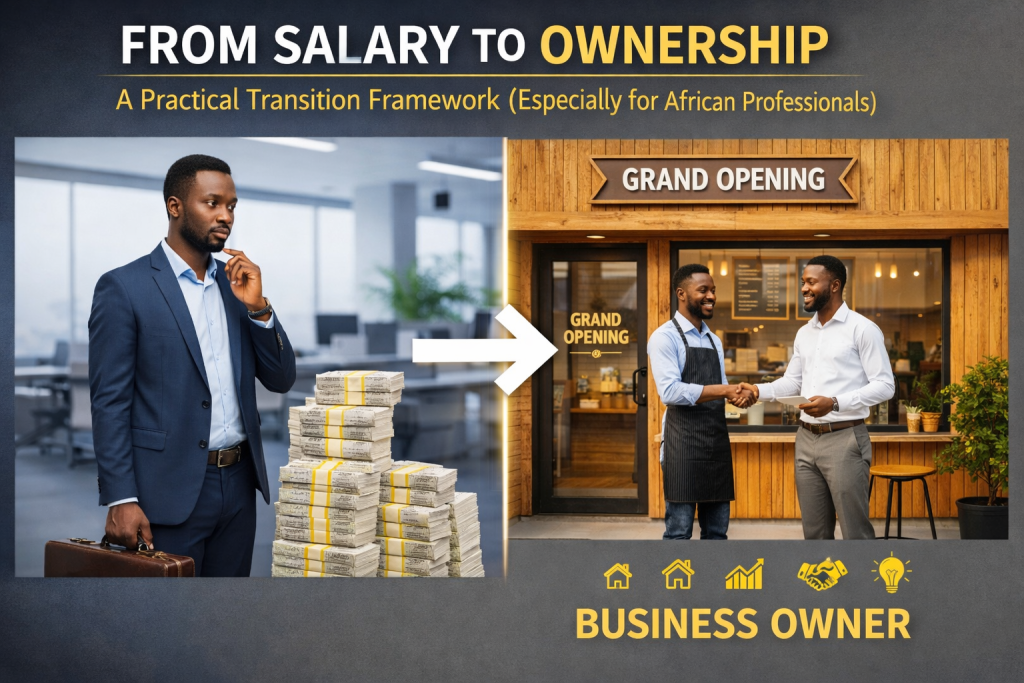
5. The Transition Framework: Moving From Worker to Owner
The shift to ownership is not sudden. It is staged.
Below is a realistic, sequential framework tailored to African professionals.
Stage 1 — Stability (Income Discipline)
Objective: Prevent income volatility from destroying progress.
Actions:
- Maintain emergency liquidity (3–6 months expenses)
- Eliminate high-interest consumer debt
- Separate consumption from investment accounts
At this stage, the goal is not wealth yet — it is financial survival capacity.
You cannot build assets while financially fragile.
Stage 2 — Savings (But With a Purpose)
Savings alone does not create wealth.
Savings create investment capacity.
Savings are the seed capital required to enter ownership markets.
The mistake many professionals make:
They save indefinitely but never deploy.
Savings must be viewed as temporary capital awaiting allocation.
Stage 3 — First Ownership (Small, Real Assets)
Your first ownership step matters more than its size.
The objective is psychological and financial reclassification — moving from consumer to asset holder.
Entry-level ownership options:
- Small rental property participation
- Equity stake in a small enterprise
- Agricultural production partnerships
- Dividend-paying securities
- Intellectual property or digital assets
The key principle:
The first asset matters more than the first million.
Because once returns begin coming from capital, behavior changes permanently.
Stage 4 — Leveraged Ownership
Here is where wealth formation truly begins.
The wealthy do not primarily buy assets with cash.
They use credit backed by assets.
Why?
Assets generate returns.
Debt amplifies asset acquisition.
When used productively, debt accelerates ownership expansion.
This is why banks lend more readily to those who already own.
Ownership reduces perceived risk.
Stage 5 — System Ownership (Businesses & Equity)
The highest wealth tier is not property — it is control of cash-flow systems.
This includes:
- Businesses
- Platforms
- Networks
- Licensed operations
- Financial vehicles
Here, income shifts from:
earning money → controlling money flows
At this stage, work becomes optional.
6. Why This Transition Is Harder in Africa — and More Necessary
African professionals face additional barriers:
- Currency depreciation
- Limited long-term financing
- Policy instability
- Informal economies
- Weak credit systems
These conditions actually make ownership more important, not less.
In unstable currencies, cash loses value.
Assets preserve value.
In uncertain labor markets, employment risk rises.
Ownership provides independence.
In inflationary economies, wages lag.
Capital adjusts.
7. The Most Important Mindset Shift
The transition requires a mental shift:
You are not trying to earn enough to stop working.
You are trying to own enough that work becomes optional.
That is the real definition of financial freedom.
Conclusion: The Real Career Path
Modern education trains people for professions.
Modern economies reward ownership.
A career, therefore, has two phases:
Phase 1: Employment — to generate capital
Phase 2: Ownership — to generate wealth
Professionals who never enter Phase 2 often remain financially vulnerable regardless of income.
The objective is not abandoning work.
It is ensuring that:
Your income eventually comes from what you own, not only from what you do.
The true journey is not from poor to rich.
It is from earner to owner.
And historically, that single transition has separated stability from lasting wealth in every economy.