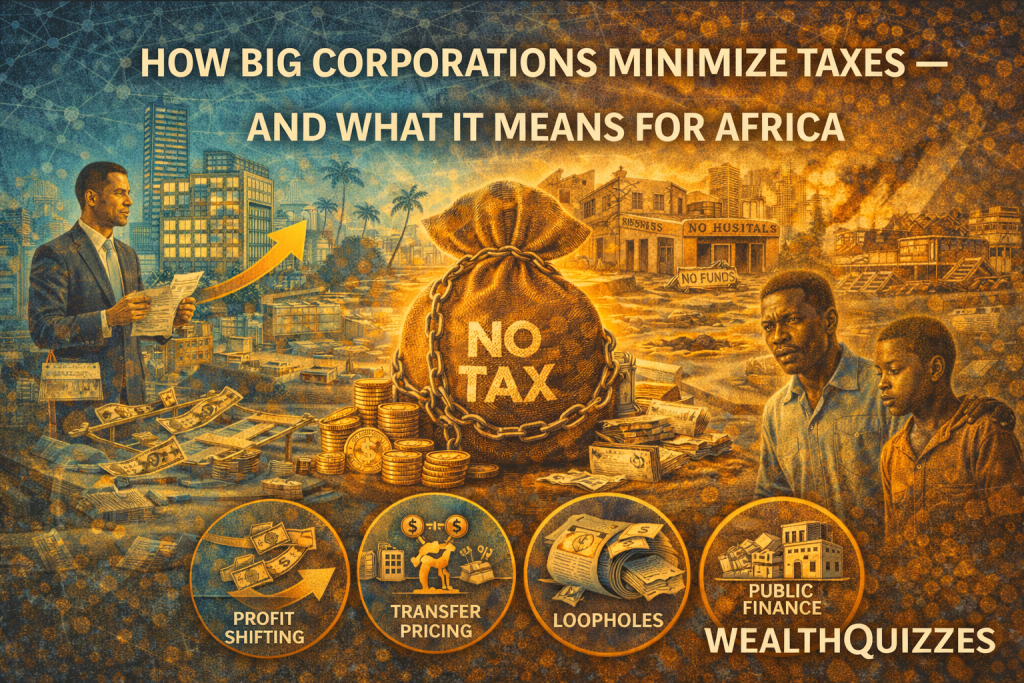
How Big Corporations Minimize Taxes — And What It Means for Africa
By WealthQuizzes Editorial Team
Introduction: Tax Avoidance Is Legal — But Its Consequences Are Real
Across the world, large corporations report record profits while governments struggle to fund basic services. Roads deteriorate, schools remain underfunded, and hospitals lack resources—yet the companies operating in these economies often pay surprisingly little tax.
This disconnect fuels public anger and policy debate. But to understand it properly, we must separate illegal tax evasion from legal tax avoidance, and examine how sophisticated tax planning works—especially in Africa, where public finance needs are acute.
This article explains how big corporations minimize taxes, the mechanisms they use, and what it means for African economies.
Tax Avoidance vs. Tax Evasion: A Crucial Distinction
Before going further, clarity matters.
- Tax evasion is illegal—hiding income, falsifying records, or bribing officials.
- Tax avoidance is legal—using existing laws, incentives, and loopholes to reduce tax liability.
Most multinational corporations operate firmly in the second category. They employ armies of lawyers and accountants to ensure compliance—while paying as little tax as the law allows.
The issue, therefore, is not criminality. It is structure.
The Core Tools of Corporate Tax Minimization
Large corporations minimize taxes through a combination of strategies that exploit differences between national tax systems.
1. Profit Shifting
Profit shifting involves moving profits from high-tax countries to low-tax jurisdictions, often called tax havens.
This is typically achieved by:
- Charging subsidiaries high fees for “management services”
- Licensing intellectual property (IP) from low-tax jurisdictions
- Manipulating internal prices between related entities
The economic activity happens in one country; the profit appears in another.
2. Transfer Pricing
Multinationals operate across borders through related companies. Transfer pricing determines how much these entities charge each other for goods and services.
While transfer pricing is legal, it becomes abusive when prices are set primarily to shift profits, not reflect market reality.
This is one of the most difficult practices for tax authorities to challenge—especially in countries with limited technical capacity.
3. Intellectual Property (IP) Migration
Intellectual property—brands, patents, software, algorithms—is highly mobile and difficult to value.
Corporations often:
- Register IP in low-tax jurisdictions
- Charge operating subsidiaries royalties
- Drain profits from high-tax countries legally
For digital and technology companies, IP-based strategies are particularly powerful.
4. Thin Capitalization
In this structure, a subsidiary is funded more with debt than equity.
Interest payments on debt are usually tax-deductible. So:
- Profits are reduced through interest expenses
- Payments flow to related entities in low-tax countries
This strategy is common in capital-intensive sectors such as mining, telecoms, and infrastructure.
5. Tax Incentives and Special Regimes
Many African countries offer:
- Tax holidays
- Pioneer status incentives
- Free trade zones
- Investment allowances
While designed to attract investment, these incentives are often:
- Overused
- Poorly targeted
- Weakly monitored
The result is long periods of minimal tax contribution—sometimes without clear economic benefits.
Why Africa Is Particularly Vulnerable
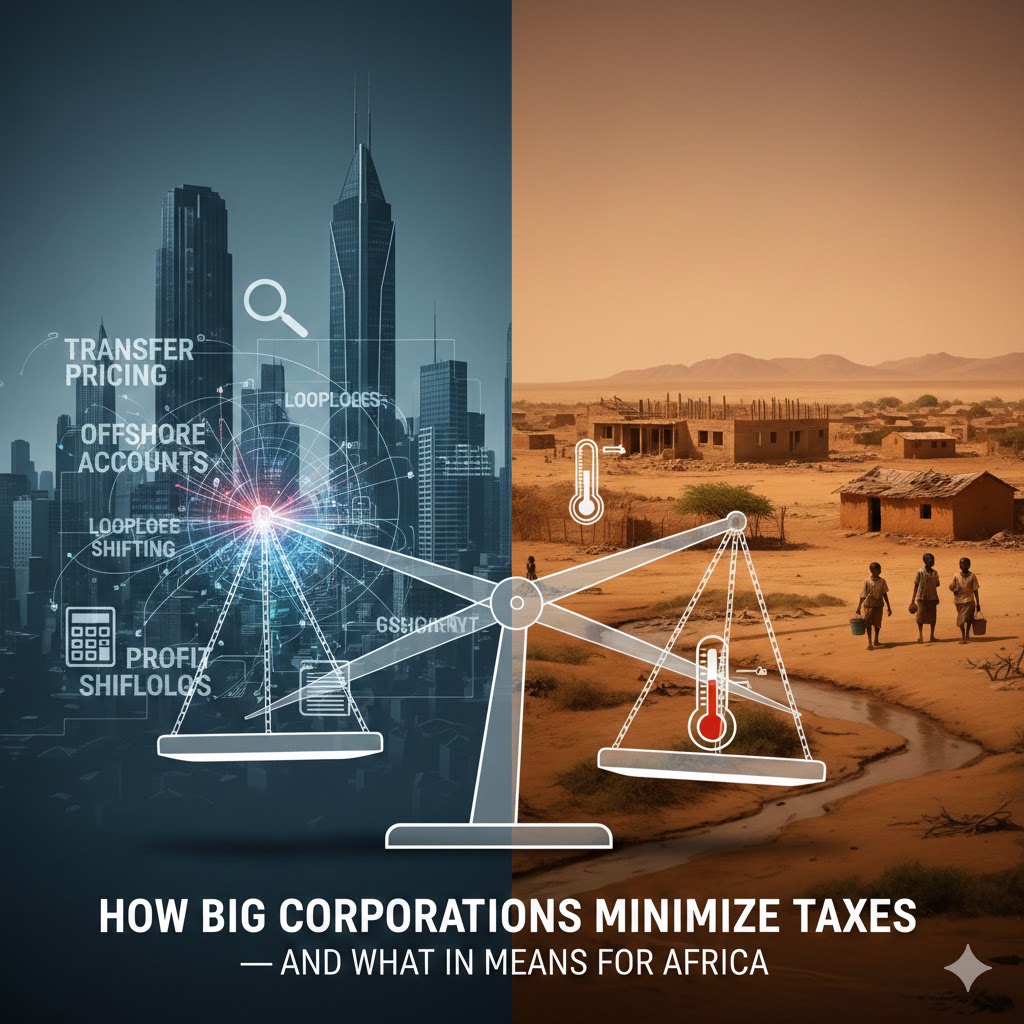
Africa is not uniquely exploited—but it is structurally disadvantaged.
Several factors make tax minimization especially costly for African economies:
- Heavy reliance on multinational corporations
- Limited tax administration capacity
- Weak access to global financial data
- High competition for foreign investment
- Fragmented tax systems across countries
When profits leave Africa, they rarely return.
The Impact on Public Finance
The consequences are profound.
1. Reduced Government Revenue
Lost tax revenue means fewer resources for:
- Infrastructure
- Education
- Healthcare
- Security
- Climate adaptation
Governments compensate by increasing:
- Consumption taxes (VAT)
- Fuel levies
- Fees and charges
These fall disproportionately on ordinary citizens.
2. Unfair Tax Burden
When multinationals minimize taxes:
- SMEs pay relatively more
- Workers shoulder indirect taxes
- Informal businesses face enforcement pressure
The system becomes regressive, not progressive.
3. Weak State Capacity
Sustained revenue losses undermine:
- Institutional development
- Regulatory enforcement
- Long-term planning
Over time, this weakens governance itself.
Global Reform Efforts — And Their Limits
Internationally, reforms are underway.
Organizations like Organisation for Economic Co-operation and Development have promoted:
- Base Erosion and Profit Shifting (BEPS) frameworks
- Global minimum corporate tax proposals
- Information-sharing agreements
These efforts are meaningful—but implementation remains uneven, and many African countries lack negotiating power at the global table.
What Can African Countries Do Differently?
Effective responses require strategy, not slogans.
Key actions include:
- Strengthening transfer pricing capacity
- Limiting excessive tax incentives
- Improving regional coordination
- Investing in tax technology and data analytics
- Aligning tax policy with industrial policy
Tax justice is not anti-business. It is pro-development.
The Corporate Perspective: Why This Is Not a Moral Debate
Corporations respond to incentives. They do not design tax systems; governments do.
Blaming companies without reforming structures misses the point.
The solution lies in better rules, not moral outrage.
WealthQuizzes Perspective: Understanding Power Through Finance
At WealthQuizzes, we believe financial literacy must include how power operates through money.
Understanding corporate tax behavior helps citizens:
- Interpret policy debates intelligently
- Demand better governance
- Recognize trade-offs in development
- Move beyond simplistic narratives
Tax systems shape societies.
Those who understand them are better positioned to protect public interest and private opportunity.
Because in modern economies, wealth is not just created—it is allocated by rules.
And the future belongs to those who understand how those rules work.