How Can Africa Build Its Own Financial Infrastructure?
By WealthQuizzes Editorial Team
Understanding Financial Infrastructure (Payment Rails, Clearing Houses, etc.)
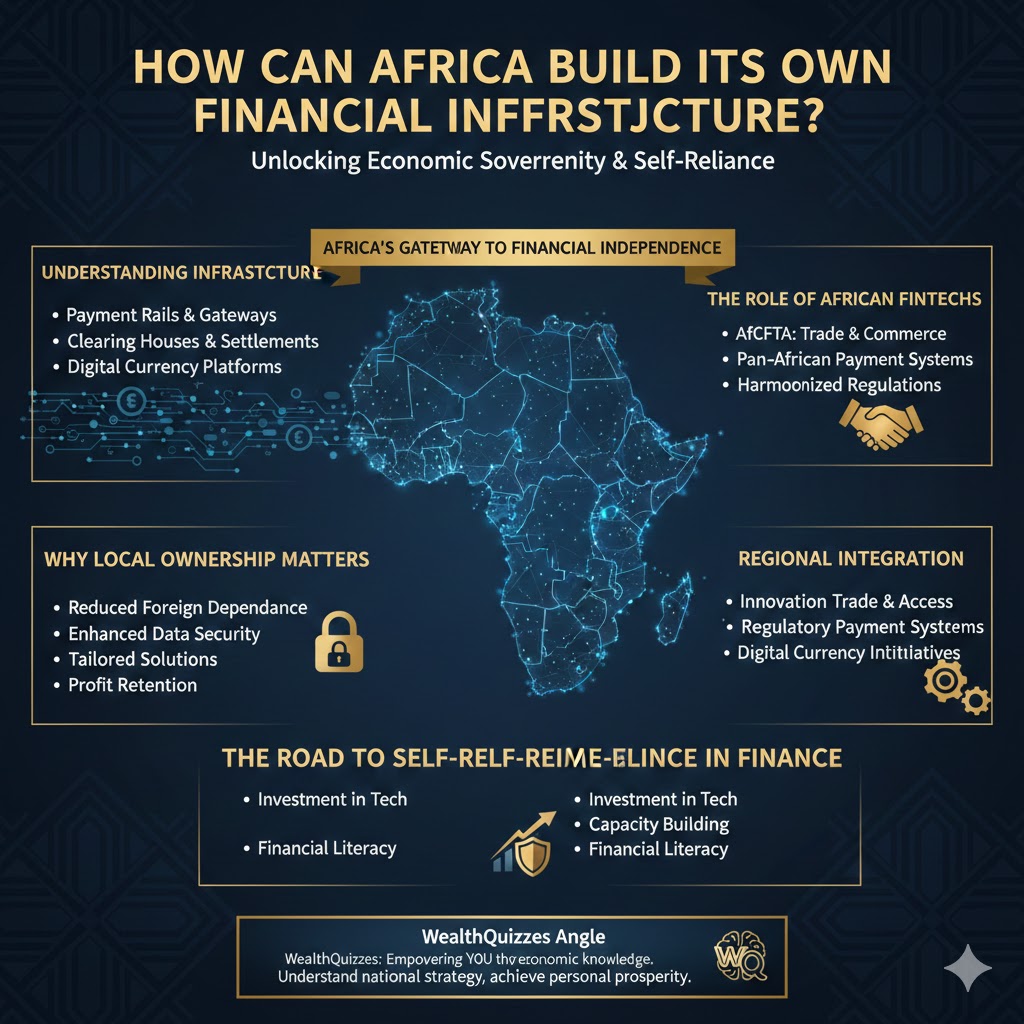
To understand Africa’s financial independence, we must first understand financial infrastructure — the hidden framework that keeps money moving.
Financial infrastructure refers to the core systems and institutions that support the flow of money within and across borders. These include:
- Payment rails (the digital pathways for transactions),
- Clearing and settlement systems,
- Switching networks for card and mobile payments,
- Interbank transfer frameworks, and
- Regulatory institutions that oversee transparency and security.
When you send money through your mobile app or swipe a card at a store, that transaction rides on a payment rail — often owned or controlled by foreign corporations or networks like Visa, Mastercard, or Swift.
The problem? Africa’s financial backbone still relies heavily on external infrastructure.
This dependence limits control, raises transaction costs, and exposes local economies to external disruptions.
For Africa to secure its financial future, it must own the rails, not just ride them.
Why Local Ownership Matters
Local financial ownership is not merely about pride — it’s about power, sovereignty, and sustainability.
When foreign entities dominate transaction networks, Africa loses more than fees; it loses strategic control over data, innovation, and policy direction.
1. Economic Sovereignty
Dependence on international systems means local economies are vulnerable to sanctions, network shutdowns, or global policy changes beyond their control.
Building local infrastructure ensures that African transactions stay within African systems, strengthening economic autonomy.
2. Data Control
Every transaction generates valuable financial data. When this data is processed abroad, Africa forfeits critical insights into its own economic activity.
Local ownership ensures that financial data becomes an African asset, not an exported commodity.
3. Lower Costs and Local Innovation
Foreign payment processors often charge high fees that burden African merchants and consumers. Homegrown systems can cut costs, localize pricing models, and reinvest profits into domestic innovation.
In short, whoever owns the pipes owns the future — and Africa must start building its own.
The Role of African Fintechs and Central Banks
Africa’s fintech boom is already laying the foundation for this independence. From Nigeria’s Paystack to Kenya’s M-Pesa, these innovators are creating systems that move money faster, cheaper, and more efficiently than ever before.
However, fintechs alone cannot create a sovereign financial system — they need alignment with central banks and regional policies.
1. Central Banks as Enablers
Central banks must evolve from regulators to digital enablers — promoting open banking, data sharing, and domestic payment innovation.
The Central Bank of Nigeria (CBN) and South African Reserve Bank (SARB) are already experimenting with digital currencies and sandbox environments for fintech collaboration.
2. Fintechs as Builders
Fintech startups bring agility, creativity, and user-focused design — exactly what legacy banking lacks.
By developing domestic payment switches, blockchain-based settlement systems, and AI-driven risk platforms, fintechs can localize the infrastructure currently outsourced abroad.
3. Public-Private Collaboration
A sustainable system requires both state support and private-sector innovation.
When fintechs and regulators collaborate rather than compete, the result is a resilient financial ecosystem that serves people, not just profits.
Regional Integration Through AfCFTA and Pan-African Payments Systems
Africa’s strength lies in unity — and nowhere is this truer than in finance.
The African Continental Free Trade Area (AfCFTA) is one of the most ambitious economic projects in modern history, aiming to connect 54 nations into a single market. But trade cannot thrive without efficient payment systems.
That’s where the Pan-African Payment and Settlement System (PAPSS) comes in.
PAPSS: The Engine of Continental Finance
Launched by Afreximbank in partnership with the AfCFTA Secretariat, PAPSS enables instant, cross-border payments in local currencies, eliminating the need for U.S. dollars or euros as intermediaries.
This system reduces transaction costs, accelerates trade, and retains value within the continent.
For example:
- A trader in Ghana can pay a supplier in Kenya directly in cedis and shillings, without conversion through London or New York.
Regional Collaboration Models
Other promising regional efforts include:
- SADC Integrated Regional Electronic Settlement System (SIRESS) in Southern Africa,
- West African Monetary Zone initiatives, and
- East African Payment System (EAPS).
These frameworks are not just about technology — they are about vision: a self-sufficient, connected Africa capable of managing its own financial destiny.
The Road to Self-Reliance in Finance
Building Africa’s own financial infrastructure will take vision, investment, and cooperation. Here’s what that roadmap looks like:
1. Policy Harmonization
African nations must align fintech regulations, payment standards, and cross-border data policies. Fragmentation weakens the continent’s collective power.
2. Infrastructure Investment
Public and private capital should fund the creation of continental data centers, payment switches, and interoperable networks.
3. Skills and Capacity Building
Digital sovereignty requires technical expertise. Universities and training institutes should focus on blockchain engineering, cybersecurity, and financial data analytics.
4. Strengthening Local Capital Markets
Encouraging investment in African fintechs and payment companies ensures ownership remains local and value circulates within the region.
5. Trust and Public Awareness
Citizens must trust local systems as much as international ones. Building that trust requires reliability, transparency, and robust consumer protection.
When Africa controls its financial infrastructure, it not only gains independence — it gains confidence.
WealthQuizzes Perspective: Linking National Strategy to Personal Empowerment
At WealthQuizzes, we believe that economic sovereignty begins with financial literacy.
Understanding financial systems — how money moves, who controls it, and why it matters — empowers individuals to think critically about their role in the economy.
Africa’s journey to financial independence mirrors the personal journey of financial education:
- Awareness leads to control.
- Control leads to freedom.
- Freedom leads to prosperity.
By teaching Africans to understand digital payments, capital flows, and data-driven finance, WealthQuizzes bridges the gap between national progress and personal empowerment.
Because the future of money in Africa will not be written in foreign systems — it will be built, owned, and understood by Africans themselves.