How Digital Currencies Will Redefine the Future of Banking in Africa
By WealthQuizzes Editorial Team
What Are Central Bank Digital Currencies (CBDCs)?
Money is evolving faster than ever. Across the world, governments are reimagining what it means to hold, move, and store value. The latest innovation leading this change is the Central Bank Digital Currency (CBDC) — a digital version of a nation’s official currency issued and regulated by its central bank.
Unlike cryptocurrencies, which are decentralized and often volatile, CBDCs are government-backed. They have the same legal status as physical cash but exist purely in electronic form.
Think of it this way: if paper money represents the 20th century, digital currency represents the 21st. It’s money you can’t touch — but can trust, because it’s backed by the same authority that issues traditional currency.
For Africa, where access to cashless infrastructure is growing but still uneven, CBDCs promise to bridge the gap between financial inclusion and technological innovation.
How Digital Currencies Differ from Cryptocurrency
While both digital currencies and cryptocurrencies exist in electronic form, they are fundamentally different in structure and purpose.
| Feature | CBDC | Cryptocurrency |
|---|---|---|
| Issuer | Central Bank | Private/Decentralized Network |
| Value Stability | Stable — backed by national reserves | Volatile — driven by market forces |
| Legal Tender | Yes | Usually No |
| Regulation | Fully Regulated | Largely Unregulated |
| Purpose | Improve payment efficiency, inclusion | Decentralize finance and assets |
Cryptocurrencies like Bitcoin and Ethereum are built to challenge traditional financial systems. CBDCs, on the other hand, are designed to enhance and modernize them.
In simple terms, cryptocurrency disrupts, while CBDCs reform.
For African economies, where trust in fiat money and banking institutions varies, CBDCs could provide the best of both worlds — digital innovation anchored in stability.
Nigeria’s eNaira Experiment — Lessons Learned
In October 2021, Nigeria became the first African country (and one of the first globally) to launch a Central Bank Digital Currency — the eNaira.
The eNaira was designed to:
- Promote financial inclusion for the unbanked,
- Facilitate faster and cheaper transactions,
- Improve cross-border trade, and
- Enhance transparency in government payments.
However, adoption has been mixed. Many Nigerians remain skeptical or unaware of how to use the eNaira. Factors such as limited internet access, low digital literacy, and initial technical challenges slowed uptake.
Still, the experiment holds valuable lessons:
- Digital trust must be built, not imposed.
- Infrastructure and education are as important as technology itself.
- Public-private collaboration (banks, fintechs, telecoms) is key to adoption.
Nigeria’s bold step opened the door for others. Ghana is piloting the e-Cedi, while South Africa and Kenya are exploring their own CBDC frameworks.
These pioneers are shaping the blueprint for how Africa can digitize money responsibly.
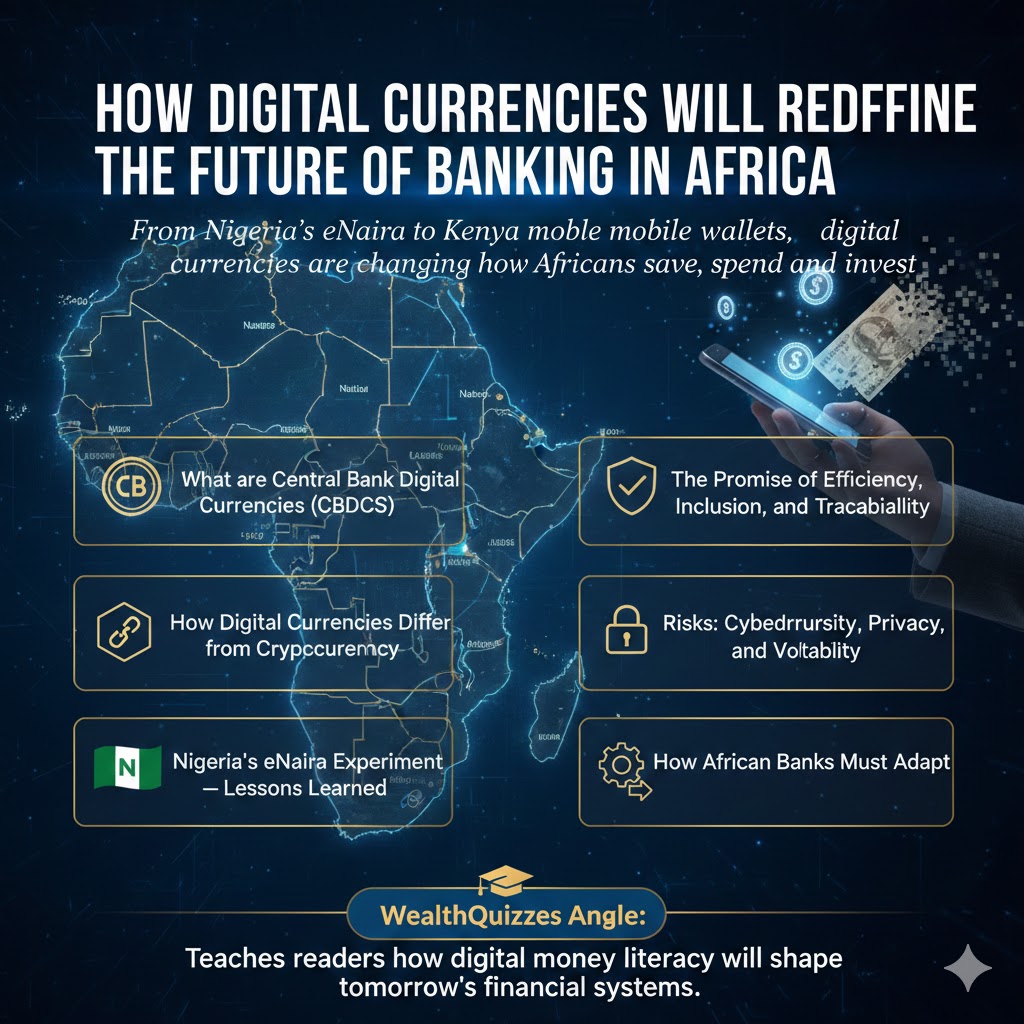
The Promise of Efficiency, Inclusion, and Traceability
The greatest promise of digital currencies lies in their ability to make finance faster, fairer, and more transparent.
1. Efficiency
CBDCs eliminate intermediaries, reducing transaction times and costs. Imagine paying a supplier or transferring funds across borders in seconds — without expensive fees.
2. Inclusion
In Africa, over 350 million adults remain unbanked, yet mobile phone penetration exceeds 80%. A digital currency integrated with mobile technology could extend formal financial services to millions previously excluded from banking.
3. Traceability and Governance
Every CBDC transaction is recorded, reducing fraud and enhancing public accountability. Governments can track spending, reduce leakages, and implement more effective fiscal policies.
4. Cross-Border Trade
With the African Continental Free Trade Area (AfCFTA) taking shape, CBDCs could simplify regional payments, reducing reliance on the U.S. dollar for intra-African trade.
In short, CBDCs could become the infrastructure for Africa’s financial future — uniting technology, transparency, and trust.
Risks: Cybersecurity, Privacy, and Volatility
No innovation comes without challenges. For digital currencies, the main concerns revolve around:
- Cybersecurity:
Digital systems are vulnerable to hacking, fraud, and technical outages. Central banks must invest heavily in secure networks and data protection. - Privacy:
Because transactions are traceable, users worry about surveillance. Balancing transparency with individual privacy rights will be critical. - Volatility and Transition Risks:
Moving from cash-based to digital ecosystems requires time, education, and public confidence. Sudden shifts could destabilize informal economies if not managed gradually. - Regulatory Gaps:
Without consistent continental standards, CBDCs risk fragmentation — making cross-border payments complicated instead of seamless.
These risks are manageable, but only through careful policy design and financial education.
How African Banks Must Adapt
For traditional banks, digital currencies represent both a threat and an opportunity.
1. The Threat:
CBDCs could reduce the need for intermediaries, potentially bypassing commercial banks in some payment processes.
2. The Opportunity:
Banks can evolve into digital service providers, integrating with CBDC platforms to offer faster, smarter, and more personalized solutions — from instant lending to digital investment portfolios.
Forward-thinking banks are already partnering with fintechs to stay competitive. The future banking model will rely on:
- Data analytics for personalized banking,
- Blockchain integration for secure transactions, and
- Collaboration with central banks on digital currency ecosystems.
In short, banks that embrace innovation will lead; those that resist will fade.
The Future of Digital Money in Africa
Africa’s transition to digital currencies will not happen overnight. But the direction is clear.
As infrastructure improves and digital literacy expands, CBDCs will redefine the relationship between governments, banks, and citizens.
We’ll see:
- Governments collecting taxes digitally,
- SMEs transacting across borders seamlessly,
- Youth using mobile wallets for saving, investing, and even earning in digital tokens.
This transformation won’t just modernize banking — it will reshape how Africans perceive and use money.
WealthQuizzes Perspective: Digital Money Literacy for the Future
At WealthQuizzes, we believe the future of finance belongs to those who understand it.
Digital currencies are more than a trend — they are a paradigm shift in financial thinking. Understanding how CBDCs, fintech, and blockchain work prepares individuals and entrepreneurs to:
- Adapt early,
- Use digital tools responsibly, and
- Participate confidently in the global economy.
WealthQuizzes is committed to helping Africans build financial intelligence for the digital age — transforming knowledge into empowerment, and learning into lasting wealth.
Because in the future of money, those who understand the system will always stay ahead of it.