
How Financial Planning Drives Business Survival in Tough Economies
By WealthQuizzes Editorial Team
Why Financial Planning Is a Survival Skill, Not a Luxury
When the economy tightens, businesses don’t fail because they’re bad ideas — they fail because they run out of money or fail to anticipate change.
In uncertain times — whether it’s inflation, exchange rate volatility, or supply disruptions — financial planning becomes a survival skill, not a luxury.
A solid financial plan doesn’t just manage money; it maps the future. It helps business owners anticipate risks, adjust quickly, and make informed decisions that protect both profit and people.
As the saying goes, “Those who fail to plan, plan to fail.” In tough economies, that truth becomes even more evident.
The Anatomy of a Solid Business Financial Plan
A robust financial plan goes far beyond bookkeeping or expense tracking. It’s a strategic blueprint that aligns money with business goals.
Every business, regardless of size, should have these core components in place:
- Budgeting:
Establish realistic revenue and expense targets. A budget helps prioritize spending and eliminate waste. - Cash Flow Management:
Ensure liquidity — having enough cash to pay suppliers, employees, and creditors even when revenue dips. - Forecasting:
Use historical data and market trends to project future performance. Good forecasts prepare a business for both growth and crisis. - Break-even Analysis:
Identify the exact point where your business covers costs — this helps in setting the right pricing and sales targets. - Emergency Fund / Reserves:
Always maintain contingency cash to cushion against unexpected expenses or downturns. - Debt Management Strategy:
Plan how to use loans wisely without over-leveraging the business.
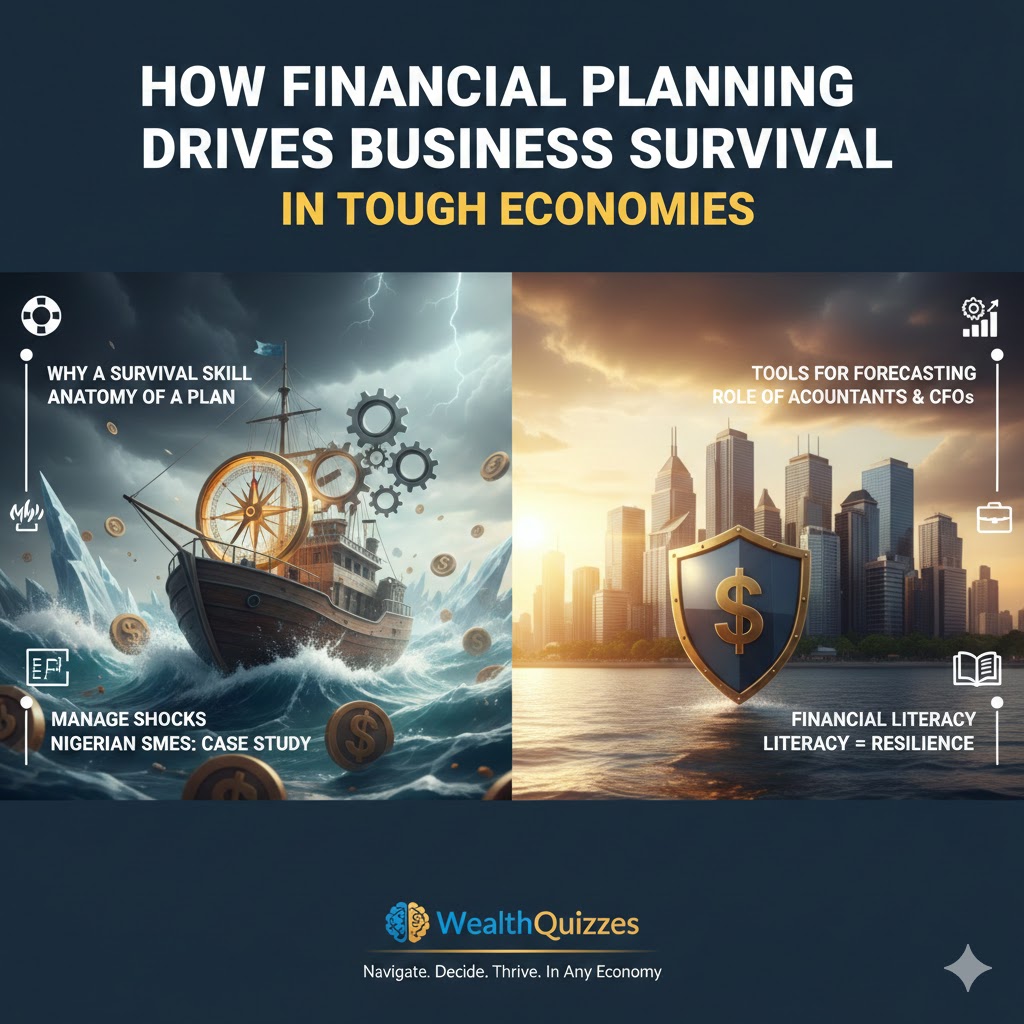
A business without a financial plan is like a ship without a compass — one storm away from sinking.
How to Manage Costs, Liquidity, and Revenue Shocks
When the economy gets tough, agility and discipline are everything. Here’s how successful businesses stay afloat:
- Cut Costs Smartly:
Review all expenses and separate “needs” from “wants.” Renegotiate supplier contracts, reduce overheads, and adopt energy-efficient operations. - Preserve Cash:
Cash is king — especially in a downturn. Convert receivables faster, delay non-essential capital expenditure, and ensure collections are prompt. - Diversify Revenue Streams:
Don’t depend on one product, market, or customer. Explore new income channels, such as digital sales or partnerships. - Monitor Exchange Rates and Inflation:
For import-based businesses, hedge against foreign exchange (FX) risks and factor inflation into pricing. - Maintain Customer Loyalty:
In lean times, retention is cheaper than acquisition. Offer loyalty incentives, flexible payment plans, and exceptional service.
Ultimately, financial planning allows businesses to stay proactive rather than reactive — managing risks before they turn into crises.
Case Study: How Nigerian SMEs Survive Inflation and FX Instability
Nigeria’s small and medium-sized enterprises (SMEs) are some of the most resilient in the world. Despite double-digit inflation and fluctuating exchange rates, many continue to thrive — thanks to disciplined financial planning.
Consider a Lagos-based fashion manufacturer that relies on imported fabrics. When the naira weakens, costs rise sharply. Instead of panicking, the business owner:
- Renegotiates bulk purchases with suppliers,
- Increases local sourcing to reduce FX exposure, and
- Adjusts product pricing strategically while maintaining brand quality.
Another example is a logistics startup in Abuja that uses financial forecasting tools to model different fuel price scenarios. This allows them to set delivery rates that preserve margins regardless of inflation.
These businesses show that financial intelligence — not luck — is the true secret to survival.
Tools for Financial Forecasting and Scenario Planning
Modern technology has made financial planning more precise and accessible. Businesses no longer need to rely on guesswork; they can model the future.
Here are key tools used by forward-thinking companies:
- Microsoft Excel / Google Sheets:
Classic but powerful for budgeting, break-even analysis, and financial modeling. - QuickBooks and Xero:
Simplify accounting, automate reports, and give real-time visibility into cash flow. - Power BI and Tableau:
Offer visual analytics to track revenue trends, margins, and spending patterns. - Scenario Planning Software (e.g., Anaplan, Planful):
Helps simulate “what-if” situations — for instance, what happens if inflation rises by 10% or sales drop by 20%?
By forecasting different scenarios, leaders can prepare plans A, B, and C — ensuring no economic shock catches them off guard.
The Role of Accountants and CFOs in Strategy
In the past, accountants were seen merely as “number crunchers.” Today, they are strategic navigators.
A competent accountant or Chief Financial Officer (CFO) helps a business:
- Interpret financial data into strategic insights,
- Balance profitability with sustainability,
- Identify investment opportunities and risk exposures, and
- Guide leadership through turbulent financial decisions.
They turn numbers into narratives — and narratives into actionable strategies.
In short, finance leaders are the architects of survival.
Financial Literacy as the Foundation for Economic Resilience
Financial literacy is the cornerstone of effective planning.
It’s not enough to know what the numbers are — one must understand what they mean. Business owners who understand finance can make smarter, faster decisions when it matters most.
This skill becomes invaluable in economies where inflation erodes value overnight or where exchange rates shift unpredictably.
When people understand budgeting, forecasting, and capital allocation, they’re not just surviving tough times — they’re building resilience.
African Relevance: Planning Amid Uncertainty
Africa’s economic environment is full of potential — but also unpredictability. Currency devaluation, political shifts, and infrastructure constraints constantly test business stability.
Yet, across Nigeria, Kenya, Ghana, and South Africa, a new generation of entrepreneurs is proving that planning beats panic.
Those who plan financially — anticipating market changes and diversifying income — don’t just survive; they grow stronger in adversity.
That’s the power of strategic financial thinking.
WealthQuizzes Perspective: Teaching Financial Foresight for the Future
At WealthQuizzes, we believe that financial intelligence is the ultimate competitive advantage — for individuals and for businesses.
Through our learning ecosystem, we equip Africans to:
- Think critically about money and risk,
- Understand how financial systems work, and
- Use planning as a tool for growth and stability.
Financial planning is not just about numbers — it’s about foresight.
It’s how great businesses — and great nations — turn economic pressure into progress.