
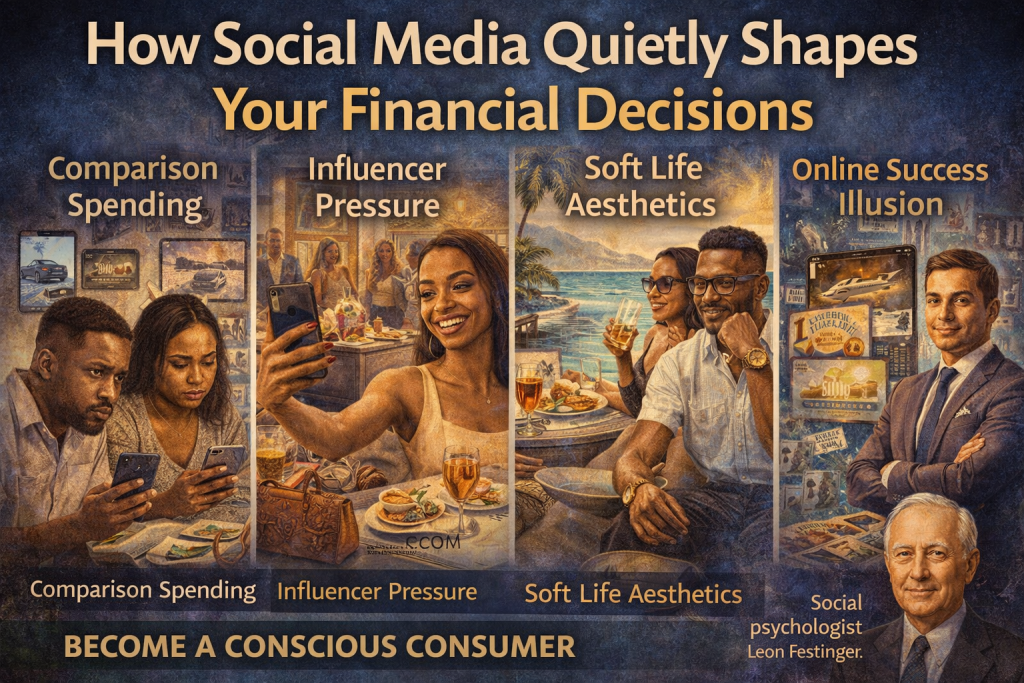
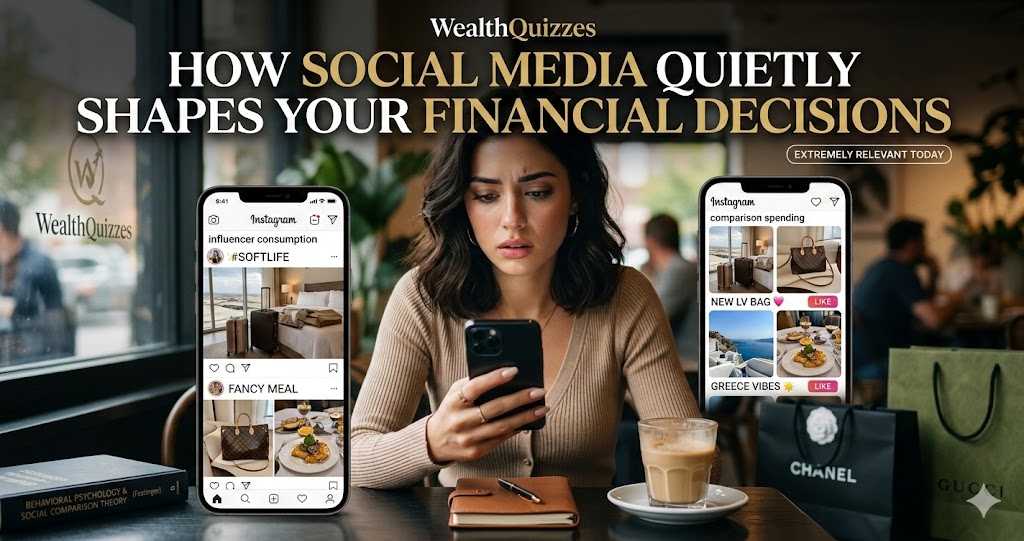
How Social Media Quietly Shapes Your Financial Decisions
In today’s digital economy, social media is no longer just a platform for communication. It has become a powerful psychological environment that influences how people think, behave, and—most importantly—how they spend.
For many young professionals, civil servants, and entrepreneurs, financial decisions are no longer made in isolation. They are subtly shaped by what is seen daily on platforms like Instagram, TikTok, and X (formerly Twitter). From luxury lifestyles to “soft life” aesthetics, social media creates a constant stream of curated realities that can quietly distort financial judgment.
The result is a growing but often unrecognized problem: people are making financial decisions based not on their economic reality, but on digital perception.
The Psychology Behind Social Media Influence
To understand how social media affects financial behavior, it is essential to examine social comparison theory, developed by Leon Festinger.
Festinger’s theory explains that individuals determine their own value and success by comparing themselves to others. In traditional settings, these comparisons were limited to immediate social circles—friends, colleagues, and neighbors.
Social media has dramatically expanded this comparison pool.
Today, individuals compare themselves not just with peers but with:
- influencers
- celebrities
- entrepreneurs showcasing success
- curated lifestyles from across the world
These comparisons are rarely neutral. They often lead to feelings of inadequacy, aspiration, or pressure to “keep up.”
This psychological dynamic directly influences spending behavior.
Comparison Spending: The Invisible Trigger
One of the most significant financial effects of social media is comparison spending.
This occurs when individuals spend money not because of genuine need or planned intention, but because they have seen others doing the same.
Examples include:
- upgrading phones after seeing influencers with the latest models
- booking vacations because peers are traveling
- purchasing luxury items to match perceived social status
- attending expensive events to maintain visibility
The key feature of comparison spending is that it is externally triggered.
The decision does not originate from personal financial strategy but from external observation.
Over time, this behavior creates a cycle where spending becomes reactive rather than intentional.
Influencer Consumption Pressure
Influencers play a central role in shaping modern consumption patterns.
Through sponsored posts, product placements, and lifestyle content, influencers present a version of life that appears aspirational and desirable.
However, it is important to understand that much of this content is commercially driven.
Influencers are often paid to promote products, services, or experiences. Their role is not merely to share their lives but to influence purchasing behavior.
This creates a subtle but powerful pressure:
- viewers begin to associate certain products with success
- ownership of these products becomes a symbol of status
- consumption is framed as a pathway to a better life
Because the promotional nature of the content is often understated, viewers may perceive these lifestyles as organic rather than strategic marketing.
The result is increased spending driven by perceived social validation rather than financial necessity.
The “Soft Life” Aesthetic
In many African contexts, the concept of the “soft life” has gained significant popularity.
This aesthetic emphasizes comfort, luxury, and ease:
- high-end restaurants
- premium fashion
- travel experiences
- leisure-focused lifestyles
While there is nothing inherently wrong with enjoying comfort, the problem arises when the appearance of ease masks the underlying economic reality.
Social media rarely shows:
- the income required to sustain such lifestyles
- the debt that may be involved
- the financial trade-offs behind the scenes
- the years of work or privilege that made it possible
Instead, the viewer sees only the outcome—an effortless, enjoyable life.
This creates a distorted perception that such lifestyles are easily attainable, leading individuals to spend beyond their means in pursuit of a similar image.
The Online Success Illusion
Another critical factor is the illusion of widespread success.
Social media platforms are designed to highlight exceptional outcomes. Users are more likely to share:
- business wins
- financial breakthroughs
- luxury purchases
- major life achievements
Failures, struggles, and financial setbacks are far less visible.
This creates a skewed perception of reality where success appears more common—and easier—than it actually is.
For example:
- a trader posts profits but not losses
- an entrepreneur shares revenue milestones but not operational challenges
- a professional showcases promotions but not years of effort
This selective visibility leads to overestimation of others’ success and underestimation of their own progress.
In response, individuals may make impulsive financial decisions to “catch up,” often without understanding the true context behind what they see.
The Cost of Reactive Spending
When financial decisions are influenced by social media, several negative outcomes can emerge:
- increased debt
- reduced savings
- lack of investment discipline
- financial stress and anxiety
- delayed long-term financial goals
Because the spending is reactive, it is rarely aligned with personal financial strategy.
Over time, this creates a disconnect between income and financial stability.
An individual may earn a reasonable salary yet struggle financially because spending patterns are driven by external stimuli rather than internal planning.
From Awareness to Control
The solution is not to abandon social media entirely. Instead, it is to develop conscious awareness of its influence.
Once individuals recognize that social media is designed to shape perception and behavior, they can begin to respond more strategically.
This involves shifting from reactive consumption to intentional decision-making.
Practical Strategies for Conscious Consumption
To reduce the financial impact of social media, several practical strategies can be adopted:
1. Separate Inspiration from Action
Not everything seen online requires immediate response. Appreciating content does not require replicating it.
2. Question the Economic Reality Behind Content
Before making a purchase, consider whether the lifestyle being observed reflects sustainable financial behavior or curated presentation.
3. Limit Exposure to Triggering Content
Unfollowing or muting accounts that consistently trigger unnecessary spending can significantly improve financial discipline.
4. Align Spending with Personal Goals
Financial decisions should be guided by long-term objectives rather than short-term impressions.
5. Track Spending Patterns
Monitoring expenses helps identify whether purchases are driven by need or by social influence.
A New Financial Mindset
The most important behavioral shift is moving from social comparison to self-alignment.
Instead of asking:
“Am I keeping up with others?”
The more powerful question becomes:
“Is this decision aligned with my financial goals?”
This shift restores control over financial life.
Final Thought
Social media is one of the most powerful behavioral forces in modern society. It shapes perceptions, influences desires, and subtly directs financial decisions.
As Leon Festinger demonstrated, humans naturally compare themselves to others. In the digital age, this instinct operates on a global scale.
Without awareness, this can lead to financial choices that prioritize appearance over stability.
But with awareness comes control.
When individuals learn to separate perception from reality and align spending with personal goals, they transform from reactive consumers into intentional wealth builders.
And in a world driven by images, that discipline becomes a powerful financial advantage.