How to Think Before Starting a Business
(Why Most People Start Too Early — and Pay for It Later)
Across Nigeria, one phrase has become almost automatic advice: “Don’t work for anyone. Start your own business.” It is repeated by relatives, motivational speakers, and social media influencers. For many young people, entrepreneurship is presented not merely as a career option but as the only respectable path to financial success.
Yet, despite this enthusiasm, small business failure rates remain extremely high. Shops open and close within months. Online stores disappear quickly. Imported goods go unsold. Partnerships collapse. The issue is often blamed on the economy, government policy, or competition. While these factors matter, they are usually not the real cause.
People rarely fail because business itself is impossible.
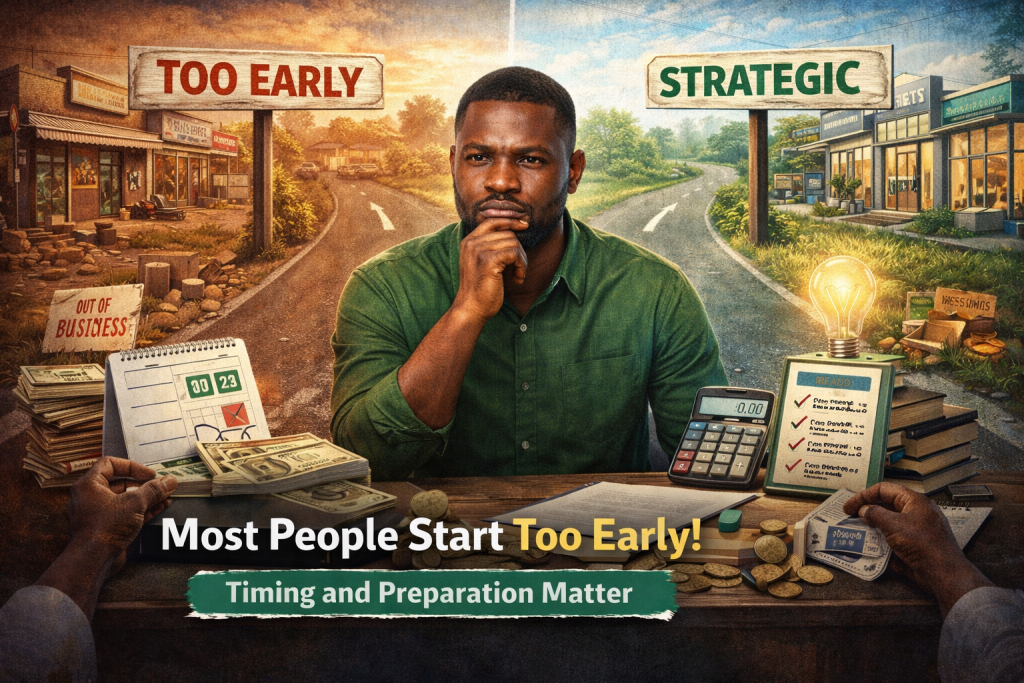
They fail because they started at the wrong time.
The decision to start a business is not just about courage. It is about preparedness. Management thinker Peter Drucker, widely regarded as the father of modern management, warned that entrepreneurship is not gambling; it is a disciplined process of identifying and exploiting opportunity. When individuals enter business without preparation, they are not taking a calculated risk — they are taking blind risk.
The Nigerian Entrepreneurship Pressure
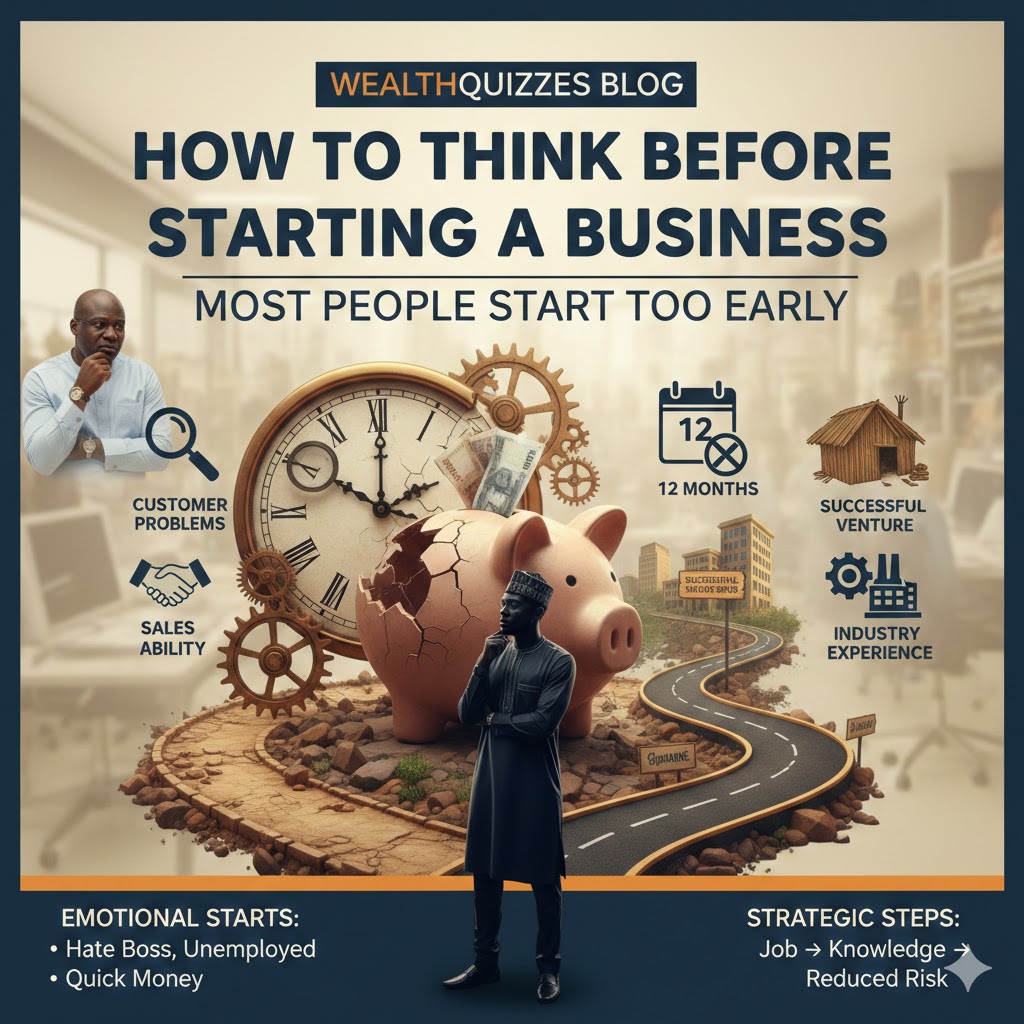
In Nigeria, social pressure encourages early entrepreneurship for emotional reasons rather than economic ones. Many people start businesses because:
- they dislike their boss
- they are unemployed
- they want fast income
- they see others apparently succeeding
These motivations are understandable, but they are not strategic. They are reactions to discomfort, not responses to opportunity.
Economists distinguish between necessity entrepreneurship and opportunity entrepreneurship. Necessity entrepreneurship occurs when a person starts a business because they have no alternative income. Opportunity entrepreneurship occurs when a person identifies a real market need and prepares to serve it profitably. Research consistently shows that opportunity-driven businesses survive far longer.
In practical terms, this means timing matters more than enthusiasm.
The Four Readiness Tests
Before starting a business, a potential entrepreneur should pass four readiness tests. These are not theoretical questions. They are risk-reduction tools.
1. Do You Understand Customer Problems?
Many businesses fail because they are built around the owner’s ideas rather than the customer’s needs.
A common scenario: someone notices that mini importation is trending and begins selling random items online. Another opens a shop simply because others in the area appear busy. But demand cannot be assumed; it must be understood.
Harvard Business School professor Clayton Christensen emphasized that customers do not buy products; they “hire” products to solve problems. If you cannot clearly state the specific problem your business solves, you do not yet have a business — you have an assumption.
Understanding customers requires:
- observing purchasing behavior
- speaking directly with potential buyers
- knowing why they choose alternatives
- identifying what frustrates them
Businesses that start with real problems have a foundation. Businesses that start with imitation struggle immediately.
2. Can You Survive 12 Months Without Profit?
Many new entrepreneurs expect immediate income. When revenue does not appear quickly, panic begins. They slash prices, take bad loans, or abandon the venture prematurely.
In reality, a business usually experiences a formation period. During this time:
- customers are discovering you
- systems are being refined
- reputation is being built
Amazon operated for years with minimal profit while building infrastructure. On a smaller scale, even a local Nigerian service business requires months to develop consistent patronage.
Financial experts therefore advise a basic rule:
Do not depend on a new business for immediate personal survival.
If your feeding, rent, and transportation rely entirely on a brand-new business, you are under pressure to make poor decisions. Desperation is the enemy of good entrepreneurship.
A salary, savings buffer, or secondary support during the first year significantly increases survival probability.
3. Do You Have Sales Ability?
Many people assume business is primarily about products. In reality, business is primarily about persuasion.
You can have a good product and still fail if you cannot convince customers to buy. Sales is not manipulation; it is communication — the ability to explain value clearly and confidently.
Entrepreneur and investor Mark Cuban often states that sales skill is the one ability every entrepreneur must learn. Without it:
- customers do not trust you
- suppliers do not prioritize you
- investors do not support you
In Nigeria especially, relationships influence commerce strongly. A business owner must be able to:
- present benefits clearly
- handle objections
- follow up consistently
- build credibility
An individual who has never practiced selling — even within a job — is starting business at a disadvantage.
4. Have You Ever Worked in That Industry?
This is perhaps the most overlooked test.
A job is not merely a paycheck. It is an education paid for by someone else.
Working inside an industry teaches:
- customer behavior
- supplier networks
- pricing structures
- operational mistakes
- seasonal patterns
Many restaurant failures occur because owners never worked in food service. Many retail failures occur because owners never learned inventory management. Experience reduces uncertainty.
Henry Ford himself worked as a machinist before building automobiles. He learned processes, costs, and limitations firsthand.
The principle is simple:
Knowledge reduces business risk.
A job provides industry knowledge without personal financial exposure.
Why Starting Too Early Is Dangerous
When a person starts business prematurely, three risks appear simultaneously:
- Financial risk — capital is lost quickly.
- Emotional risk — discouragement and self-doubt develop.
- Reputation risk — customers lose trust after inconsistent service.
Early failure does not only cost money; it can permanently reduce willingness to try again.
This is why a job should not be seen as an obstacle to entrepreneurship but as preparation for it.
The Strategic Role of Employment
Many people believe employment delays success. In reality, it often accelerates it.
Employment provides:
- industry learning
- stable income
- business observation
- networking
- supplier relationships
During employment, a future entrepreneur can quietly gather information, test small ideas, and build skills. When they eventually start a business, they are no longer guessing.
Peter Drucker explained that successful entrepreneurs are rarely reckless innovators; they are observant problem-solvers who prepare before acting.
Strategic Entrepreneurship
The goal is not to discourage business ownership. The goal is to practice strategic entrepreneurship.
Instead of asking:
“How quickly can I leave my job?”
A better question is:
“When will I be ready to succeed independently?”
Starting a business should occur when:
- you understand a clear customer need
- you have survival capacity without early profit
- you can sell confidently
- you know the industry from inside
At that point, entrepreneurship stops being a gamble and becomes a calculated expansion of your abilities.
Final Thought
Entrepreneurship is powerful, but timing determines whether it creates wealth or debt. Courage is important, yet preparation is decisive.
A job is not the opposite of a business.
For many people, it is the training ground for one.
The wisest entrepreneurs are not the fastest starters. They are the most prepared starters. When preparation meets opportunity, business success stops depending on luck and begins depending on competence.