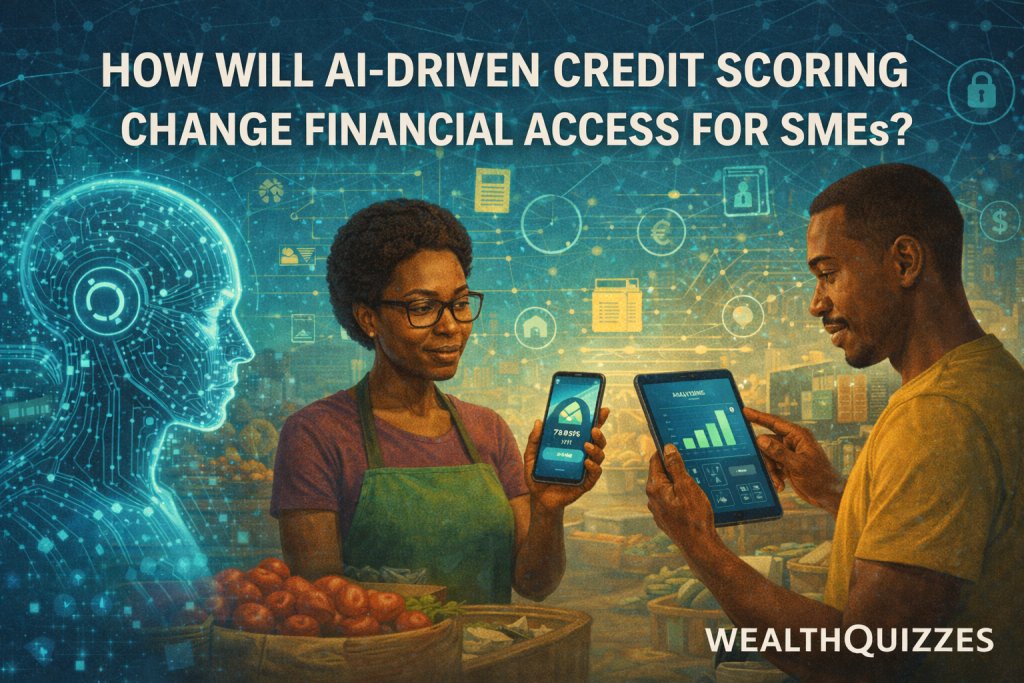
How Will AI-Driven Credit Scoring Change Financial Access for SMEs?
By WealthQuizzes Editorial Team
The Problem with Traditional Credit Systems
Small and Medium-Sized Enterprises (SMEs) are the backbone of African economies. They account for over 80% of employment and a significant share of GDP across the continent. Yet, paradoxically, they remain the most underfunded segment of the financial system.
Traditional credit systems were not built for SMEs. They rely heavily on:
- Physical collateral (land, buildings, fixed assets),
- Formal financial statements,
- Long credit histories, and
- Rigid risk assessment models.
For many African businesses—especially informal and micro-enterprises—these requirements are unrealistic. A market trader, logistics startup, or small manufacturer may be profitable but lack audited accounts or registrable collateral.
As a result, banks often label these businesses as “high risk,” not because they are unviable, but because the system cannot properly see them.
This is the gap AI-driven credit scoring is beginning to close.
How AI Credit Models Work
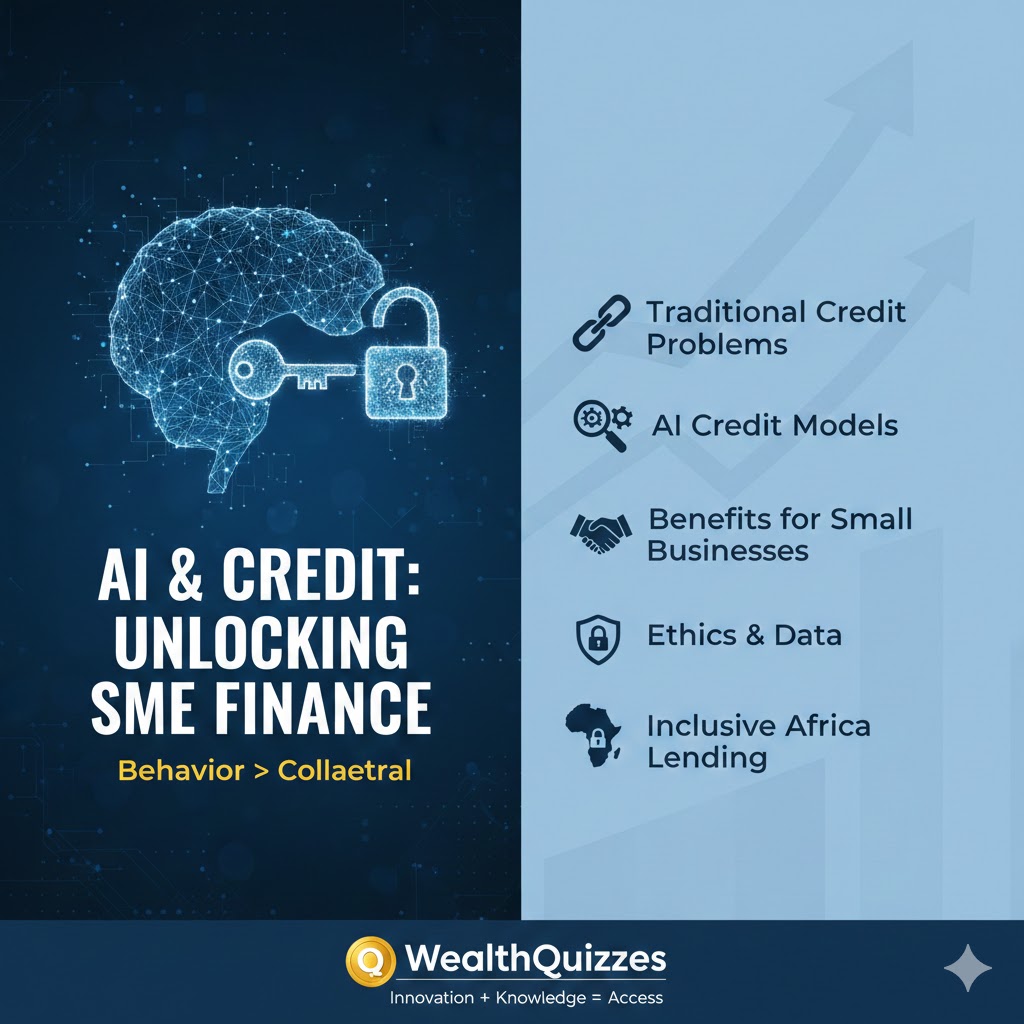
Artificial Intelligence transforms credit assessment by shifting the focus from what a business owns to how it behaves.
Instead of relying solely on collateral and paperwork, AI-driven models analyze vast amounts of alternative data to predict creditworthiness. These may include:
- Transaction patterns from mobile money and bank accounts,
- Sales consistency and cash-flow cycles,
- Supplier and customer payment behavior,
- Inventory turnover,
- Utility and rent payment records,
- Digital footprints from e-commerce and POS systems.
Using machine learning algorithms, these systems identify patterns and correlations that humans and traditional models cannot easily detect. Over time, the models continuously improve as more data is processed.
In simple terms:
AI doesn’t ask, “What do you own?”
It asks, “How do you operate?”
This approach allows lenders to make faster, more accurate credit decisions—often in minutes rather than weeks.
Benefits for Small and Informal Businesses
AI-driven credit scoring is already reshaping access to finance across Africa, particularly for businesses long excluded from formal lending.
1. Expanded Access to Credit
SMEs without collateral or formal documentation can now qualify for loans based on performance and consistency rather than assets alone.
2. Faster Loan Decisions
Automated credit assessments reduce approval times dramatically, enabling businesses to respond quickly to opportunities or cash-flow needs.
3. Lower Cost of Lending
With better risk prediction, lenders experience fewer defaults. These efficiencies can translate into lower interest rates for borrowers.
4. Financial Inclusion for the Informal Sector
Informal businesses—market traders, artisans, transport operators—can build credit profiles simply by using digital payment tools.
5. Growth-Driven Lending
As businesses grow and generate more data, their access to larger credit facilities improves organically.
Platforms like Carbon, FairMoney, Branch, and PayDay already use AI-based scoring models to extend credit to individuals and SMEs across Nigeria, Kenya, and other African markets.
For many entrepreneurs, this represents the first real bridge between hustle and scalable growth.
Ethical and Data Protection Concerns
While AI-driven credit scoring offers immense promise, it also raises serious ethical and regulatory questions that cannot be ignored.
1. Data Privacy
AI systems rely on sensitive personal and business data. Without strong data protection laws, users risk exploitation or unauthorized data sharing.
2. Algorithmic Bias
If AI models are trained on biased or incomplete datasets, they may unintentionally reinforce exclusion rather than reduce it.
3. Transparency
Many AI decisions are made inside “black boxes,” making it difficult for borrowers to understand why they were approved or rejected.
4. Consent and Awareness
Many small business owners do not fully understand how their data is collected, analyzed, or used in credit decisions.
African countries are beginning to respond. Frameworks like the Nigeria Data Protection Act (2023) and fintech regulatory sandboxes aim to balance innovation with consumer protection.
The challenge ahead is clear:
AI must be inclusive, fair, and accountable—not just efficient.
The Future of Inclusive Lending in Africa
AI-driven credit scoring is not a temporary trend—it is a foundational shift in how finance works.
In the coming years, we are likely to see:
- Deeper integration between fintechs, banks, and mobile money platforms,
- AI-powered SME lending linked directly to POS and inventory systems,
- Cross-border SME credit profiles supporting AfCFTA trade,
- Smarter pricing of loans based on real-time business performance,
- Increased regulatory oversight to ensure fairness and transparency.
When combined with open banking, digital identity systems, and mobile money data, AI has the potential to unlock billions of dollars in productive capital for African businesses.
This is how financial systems evolve—from exclusionary gatekeepers to intelligent enablers of growth.
WealthQuizzes Perspective: Where Knowledge Unlocks Access
At WealthQuizzes, we believe access to finance begins with understanding how financial systems work.
AI-driven credit scoring proves a powerful truth:
Opportunity flows to those who understand the system—and position themselves within it.
When entrepreneurs understand:
- How digital behavior affects credit scores,
- Why transaction discipline matters,
- How data builds financial identity,
they move from being credit-seekers to credit-ready.
This is the essence of WealthQuizzes’ learning-to-earning philosophy:
- Knowledge builds awareness,
- Awareness builds access,
- Access builds wealth.
AI may power the engines of modern finance—but financial intelligence remains the steering wheel.
And in Africa’s next chapter of economic growth, those who master both will lead.