Money and Time: Why Long-Term Thinking Is the Real Wealth Advantage
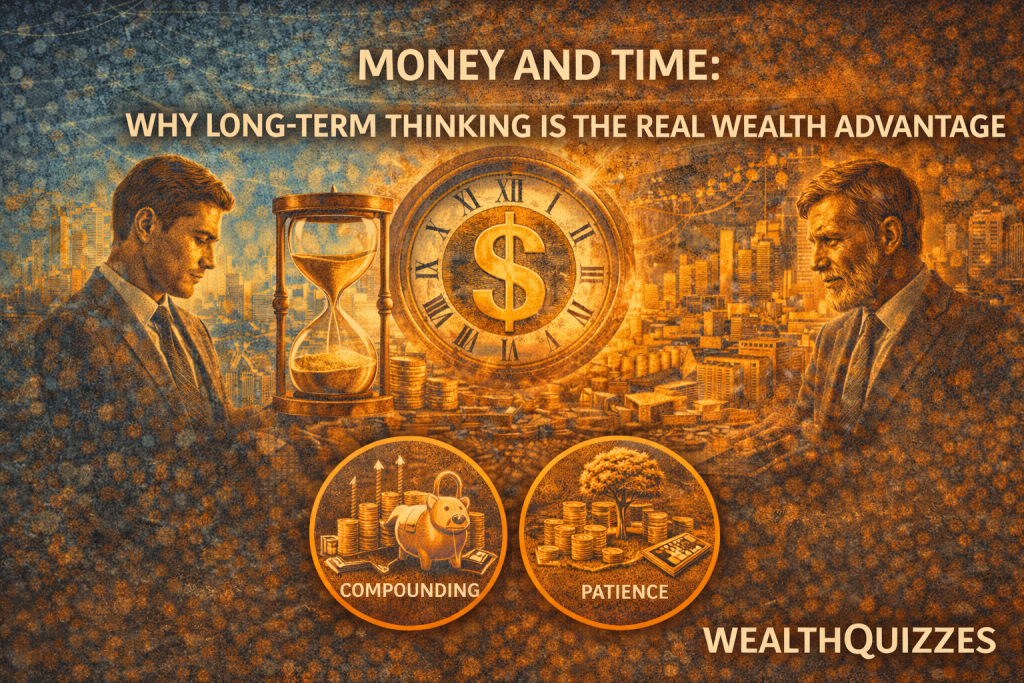
In an era dominated by instant gratification, viral success stories, and overnight wealth narratives, the most powerful force in finance is often overlooked: time. Money, when combined with time and discipline, becomes exponentially more powerful. Without time, even large sums can evaporate. With time, even modest resources can transform into generational wealth.
The real divide between wealthy individuals, resilient economies, and those trapped in cycles of scarcity is not intelligence, effort, or opportunity alone—it is long-term thinking. This article explores how compounding, patience, and delayed gratification create sustainable wealth, and why short-termism keeps individuals, businesses, and societies poor.
Time: The Most Undervalued Asset in Finance
Money is measurable. Time is not easily priced—yet it is far more valuable. Time allows capital to grow, strategies to mature, institutions to stabilize, and mistakes to be absorbed without collapse.
In financial systems, time multiplies outcomes. A business with consistent reinvestment over ten years outperforms one chasing quick profits. An investor who stays invested through cycles benefits more than one who constantly enters and exits the market. Economies that invest patiently in infrastructure, education, and institutions outperform those seeking immediate political or financial wins.
Short-term thinking, by contrast, treats money as something to be consumed quickly rather than cultivated strategically.
The Power of Compounding: How Wealth Really Grows
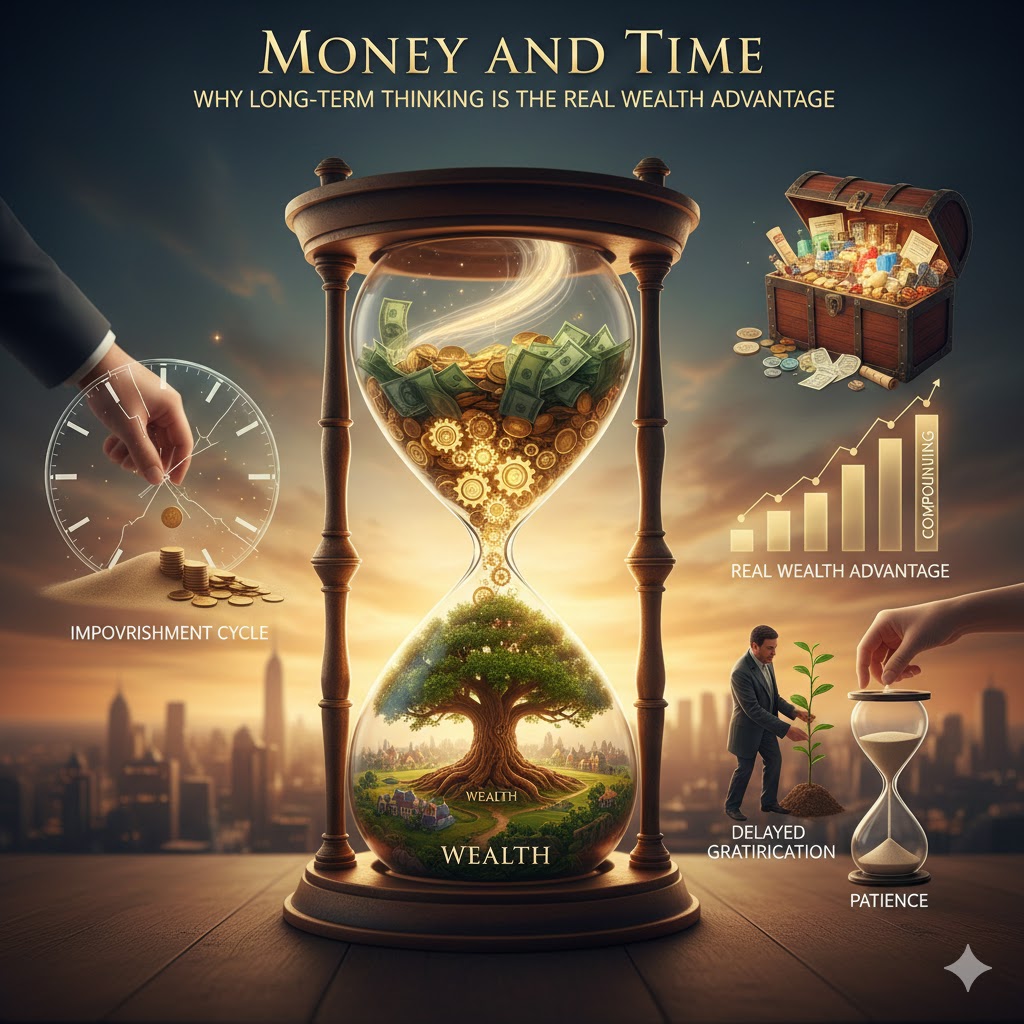
Compounding is not merely an investment concept; it is a law of financial physics. It occurs when earnings generate further earnings over time.
A simple illustration:
- A one-time gain creates a temporary improvement.
- A compounding gain creates a permanent advantage.
Compounding applies to:
- Savings and investments
- Skills and knowledge
- Business reinvestment
- Institutional credibility
- National economic capacity
The critical insight is this: compounding rewards patience disproportionately. Those who start early and remain consistent benefit more than those who start late with larger amounts but shorter time horizons.
This is why individuals who understand compounding focus less on speed and more on sustainability and continuity.
Delayed Gratification: The Discipline Behind Every Fortune
Behind every enduring fortune lies a pattern of delayed gratification. This is the ability to postpone immediate consumption in favor of long-term benefit.
Delayed gratification manifests as:
- Reinvesting profits instead of spending them
- Choosing skill acquisition over luxury
- Accepting slower growth to reduce risk
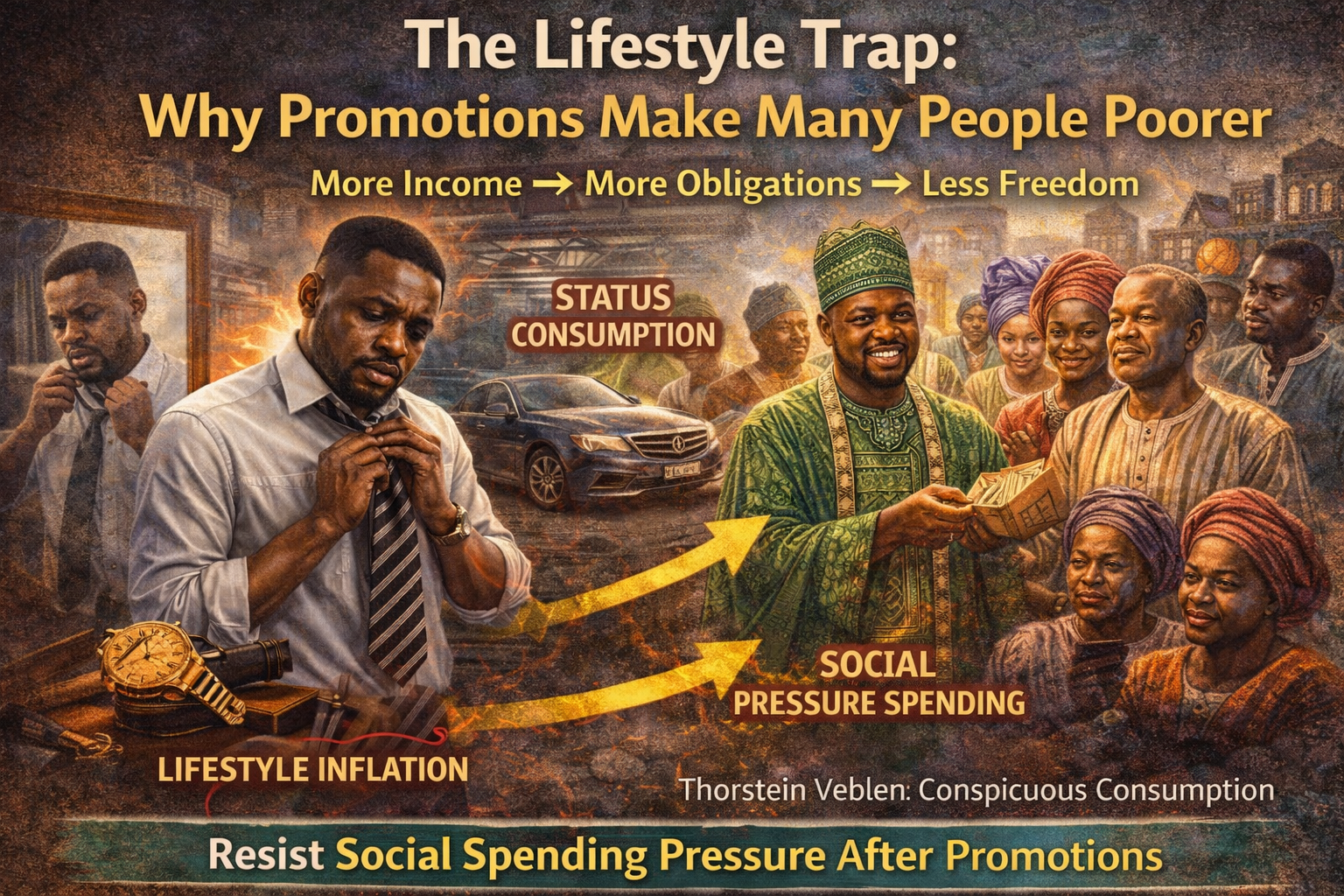
- Prioritizing assets over lifestyle inflation
Short-term gratification feels rewarding but is financially expensive. Long-term discipline feels restrictive initially but becomes liberating over time.
At a societal level, delayed gratification is reflected in:
- Long-term policy planning
- Infrastructure investment
- Education systems designed for future productivity
- Fiscal restraint during economic booms
Where delayed gratification is absent, fragility emerges.
Why Short-Termism Keeps Individuals and Societies Poor
Short-term thinking is not merely a personal weakness; it is a systemic problem.
At the individual level, it leads to:
- High consumption, low savings
- Debt-driven lifestyles
- Speculative behavior without strategy
- Constant financial stress
At the business level, it results in:
- Profit extraction over reinvestment
- Poor governance
- Weak balance sheets
- Collapse during economic downturns
At the national level, short-termism manifests as:
- Populist economic policies
- Unsustainable subsidies
- Chronic budget deficits
- Infrastructure decay
- Currency instability
When decisions are optimized for immediate comfort or political gain, long-term prosperity becomes impossible.
Time Horizons: The Difference Between Wealth and Income
Income is immediate. Wealth is cumulative.
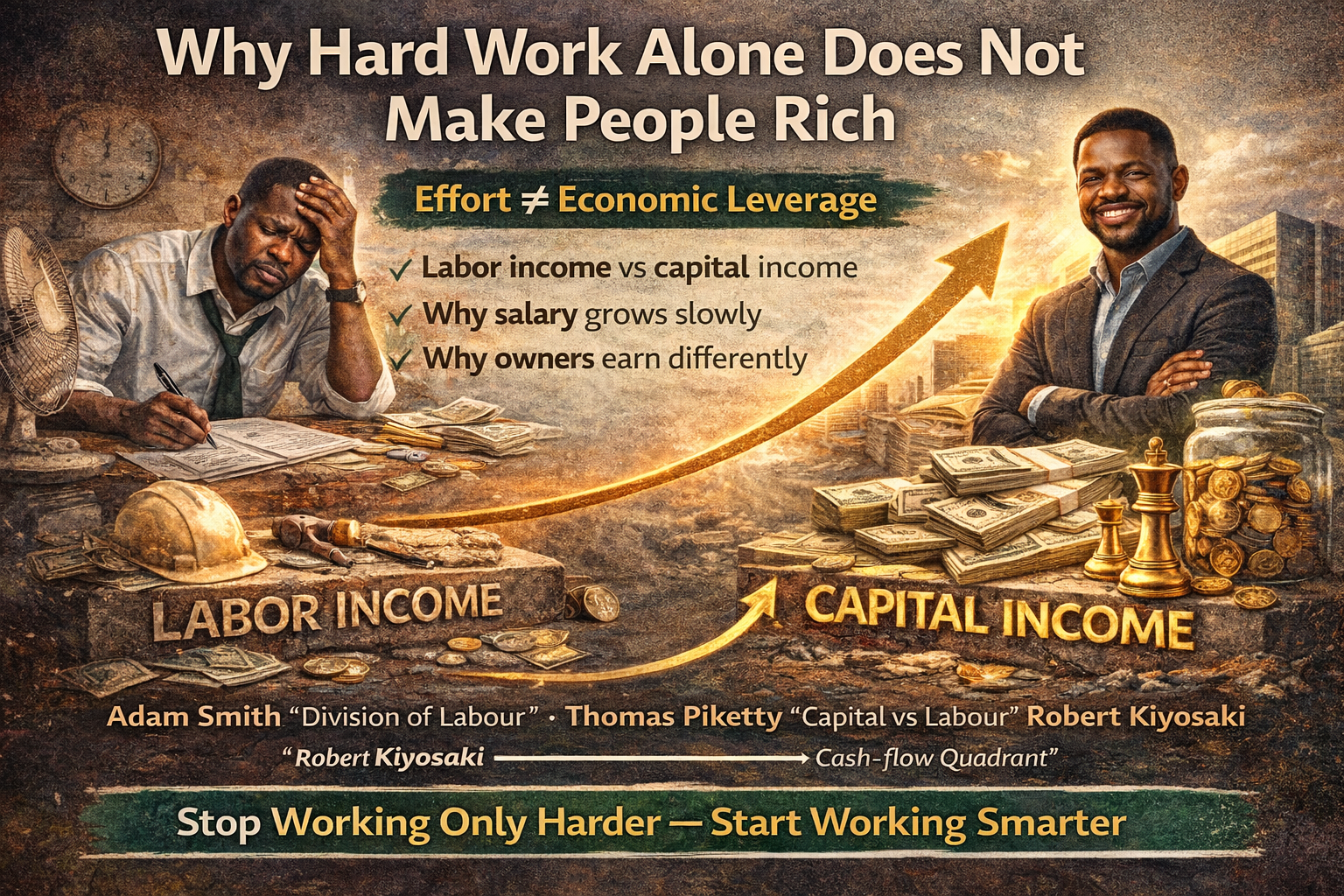
Many people earn income without building wealth because income alone does not guarantee ownership, leverage, or durability. Wealth emerges when income is consistently converted into assets that appreciate or generate future cash flows.
Long-term thinkers ask different questions:
- How will this decision affect me in 10 years?
- Does this asset grow or depreciate with time?
- Am I building something that outlasts my effort?
Short-term thinkers ask:
- How much can I get now?
- What gives me immediate relief or status?
- How fast can I cash out?
The answers determine outcomes.
The African Context: Time, Development, and Missed Compounding
Across Africa, the cost of short-termism is particularly visible.
Frequent policy reversals, underinvestment in long-term infrastructure, and consumption-driven economies limit the continent’s ability to compound growth. Capital formation is weak not because of lack of potential, but because time is undervalued in decision-making.
Yet Africa also has an advantage: demographics. A young population means time is abundant—if harnessed correctly. Long-term thinking in education, digital infrastructure, manufacturing, and financial systems can unlock compounding effects that redefine economic trajectories.
The challenge is not resources, but patience and continuity.
WealthQuizzes Perspective: Training the Mind for Long-Term Wealth
WealthQuizzes exists to develop the most critical financial skill of all: strategic thinking over time.
Financial literacy is incomplete without time literacy. Understanding how money behaves over long horizons empowers individuals to:
- Resist short-term traps
- Make informed investment decisions
- Build resilient financial lives
- Participate intelligently in economic systems
True wealth is not built by reacting to the moment, but by designing for the future.
Conclusion: Time Is the Ultimate Financial Advantage
Money comes and goes. Markets rise and fall. Technologies change. But time, when paired with discipline and foresight, remains the most reliable wealth-building force known to finance.
Those who master long-term thinking do not merely accumulate money—they accumulate optionality, stability, and freedom.
In the end, wealth is not about how fast you move, but how long you stay strategically positioned.
Time, not speed, is the real advantage.