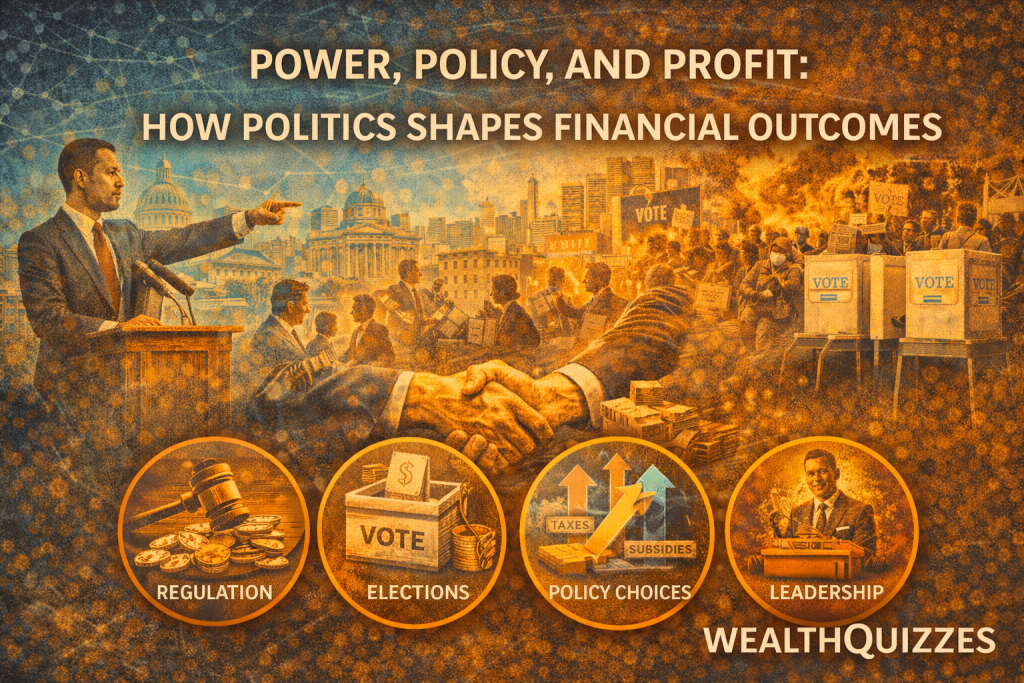
Power, Policy, and Profit: How Politics Shapes Financial Outcomes
Introduction: Money Does Not Move in a Political Vacuum
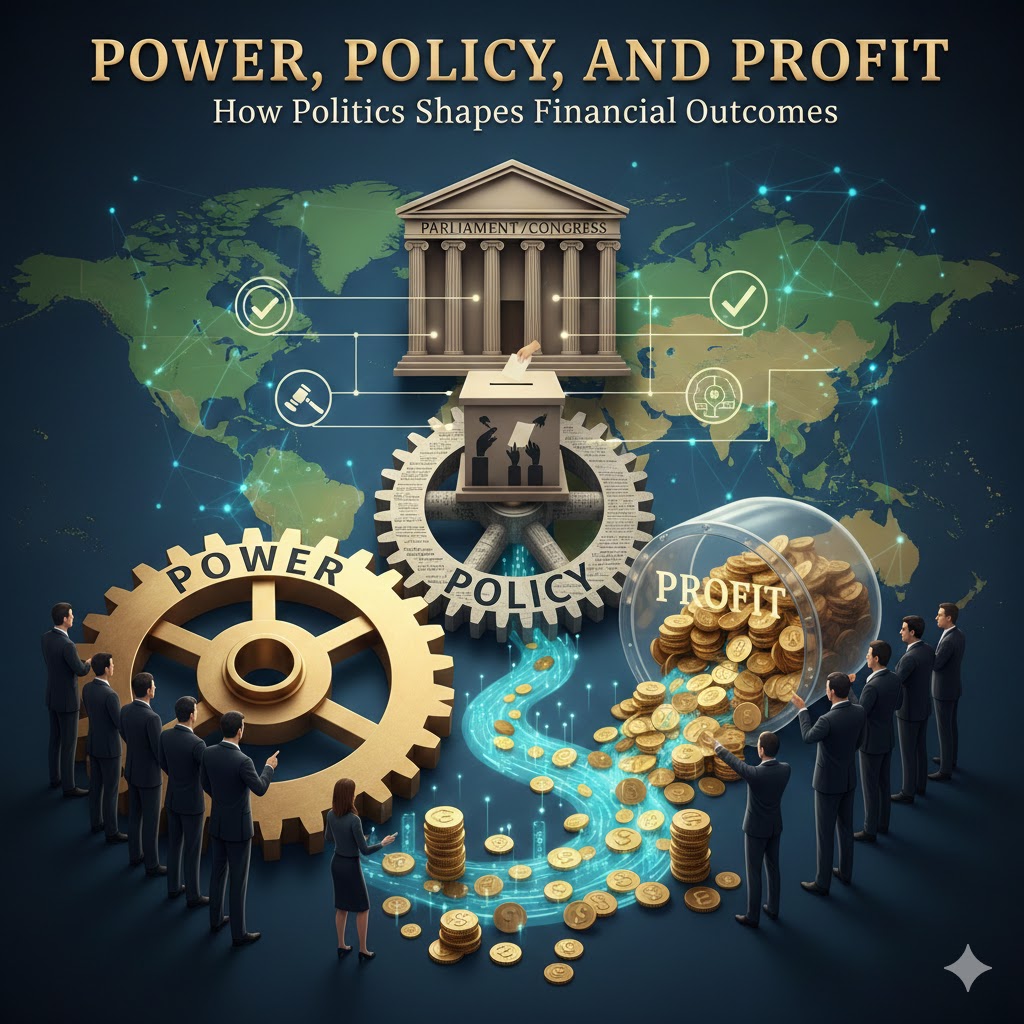
Financial markets often present themselves as neutral, rational, and driven purely by numbers. In reality, money follows power. Behind every interest rate decision, tax regime, subsidy, trade policy, or capital flow lies a political choice. Governments may not directly control markets, but they set the rules that determine who wins, who loses, and where profits accumulate.
Understanding the relationship between politics and finance is therefore not optional. It is essential for investors, businesses, entrepreneurs, and citizens—especially in emerging economies like Africa, where policy shifts can dramatically alter economic outcomes overnight.
The Political Foundations of Financial Systems
At the core of every financial system are institutions created by political authority: central banks, regulatory agencies, tax authorities, and courts. These institutions define property rights, enforce contracts, regulate risk, and manage currency stability.
When political systems are stable and credible, capital flows more freely. When institutions are weak or politicized, investors demand higher returns—or avoid the market entirely. In this sense, finance is a mirror of governance quality.
Countries with strong rule of law, predictable policies, and independent regulators consistently attract cheaper capital and deeper investment pools.
Regulation: The Invisible Hand That Shapes Markets
Regulation determines who can operate, how risks are priced, and which sectors thrive. Banking regulations affect lending behavior. Capital market rules influence IPOs and foreign investment. Energy and telecom regulations decide whether infrastructure expands or stagnates.
Over-regulation can stifle innovation. Under-regulation can create bubbles and crises. The most successful economies strike a balance—protecting consumers and stability without killing incentives.
In Africa, regulatory uncertainty remains a major constraint. Sudden policy reversals, unclear licensing regimes, or politically motivated enforcement increase risk premiums and raise the cost of capital.
Monetary Policy: Politics Behind Interest Rates and Liquidity
Central banks are designed to be independent, yet they operate within political realities. Decisions on interest rates, money supply, and exchange rate management have direct distributional effects—benefiting borrowers or savers, exporters or importers.
Election cycles often pressure governments to pursue short-term growth over long-term stability. When monetary policy becomes politicized, inflation accelerates, currencies weaken, and investor confidence erodes.
Nigeria’s experience with inflation, FX controls, and liquidity management illustrates how political priorities can override economic fundamentals, with lasting consequences for businesses and households.
Fiscal Policy: Who Pays, Who Benefits, Who Profits
Budget decisions are inherently political. Choices about taxation, public spending, subsidies, and debt determine who bears the cost of government and who receives economic support.
Tax incentives can attract investment—or enable profit shifting. Subsidies can support growth—or distort markets. Public debt can finance development—or crowd out private investment.
Across Africa, fiscal policy often reflects political compromise rather than economic efficiency, leading to chronic deficits, weak infrastructure, and underfunded social services.
Elections, Leadership, and Market Confidence
Markets react swiftly to political transitions. Elections introduce uncertainty; leadership changes reset expectations. Pro-business reforms can trigger capital inflows, while populist rhetoric can spark capital flight.
Investors assess not only policies but credibility—whether leaders can implement reforms, manage institutions, and maintain stability. This is why leadership quality matters as much as ideology.
Stable democracies with policy continuity tend to outperform politically volatile states, even when resource endowments are similar.
Policy Choices and Capital Allocation
Governments influence where money flows through industrial policy, trade agreements, and public procurement. Strategic sectors—energy, agriculture, technology—rise or fall based on policy support.
Successful examples show that targeted, disciplined policy can catalyze private investment. Failed examples reveal how patronage and rent-seeking divert capital into unproductive channels.
Africa’s challenge is not lack of capital, but misallocation driven by weak policy discipline.
The Cost of Political Risk
Political risk raises borrowing costs, discourages long-term investment, and shortens planning horizons. Businesses respond by demanding higher returns, delaying projects, or exiting markets.
For citizens, this translates into fewer jobs, higher prices, and slower growth. Political instability is therefore not an abstract concept—it is a direct economic tax on society.
Why Financial Literacy Must Include Political Awareness
Understanding finance without understanding politics is incomplete. Interest rates, inflation, exchange rates, and market cycles are not purely technical phenomena—they are shaped by human decisions made within political systems.
Financially intelligent individuals and businesses learn to read policy signals, assess political risk, and anticipate regulatory change. This skill is increasingly critical in volatile global and African markets.
WealthQuizzes Perspective: Knowledge Is Strategic Power
At WealthQuizzes, financial literacy goes beyond personal budgeting or investing tips. It includes understanding the systems that shape economic outcomes.
By teaching how power, policy, and profit intersect, WealthQuizzes equips learners to think strategically—whether as investors, entrepreneurs, professionals, or informed citizens. True financial intelligence is not just about earning money, but understanding who sets the rules of the game—and how to navigate them wisely.
Conclusion: Follow the Power to Understand the Profit
Money flows toward stability, clarity, and credible leadership. Where policy is sound, profit follows. Where governance fails, wealth leaks away.
In the end, finance is not just about numbers—it is about choices. And those choices are political.
Understanding that reality is the first step toward economic empowerment.