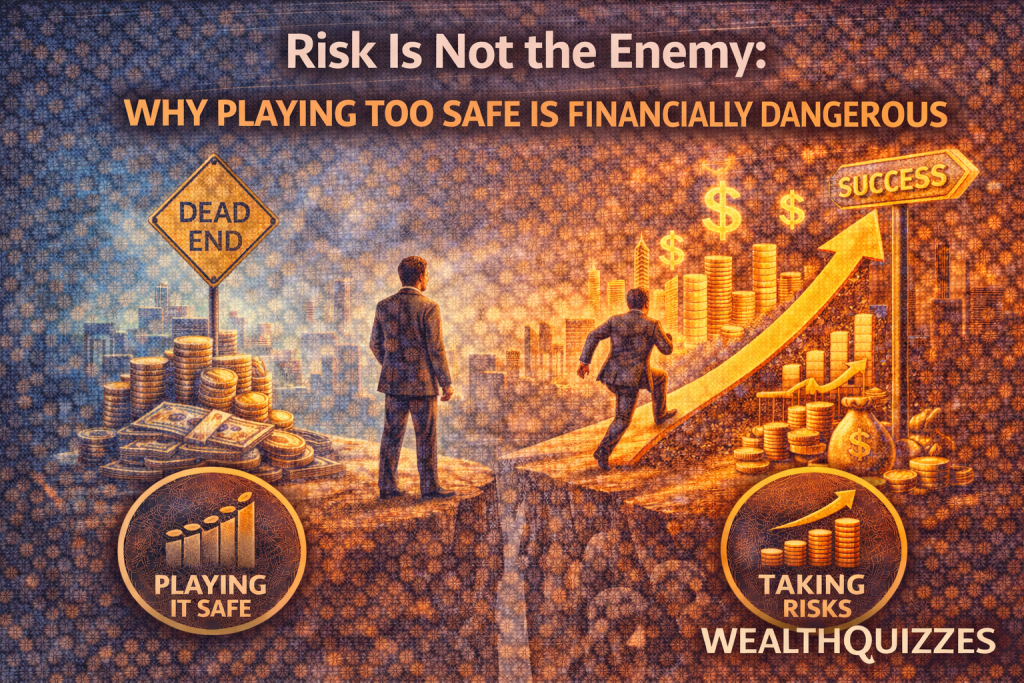
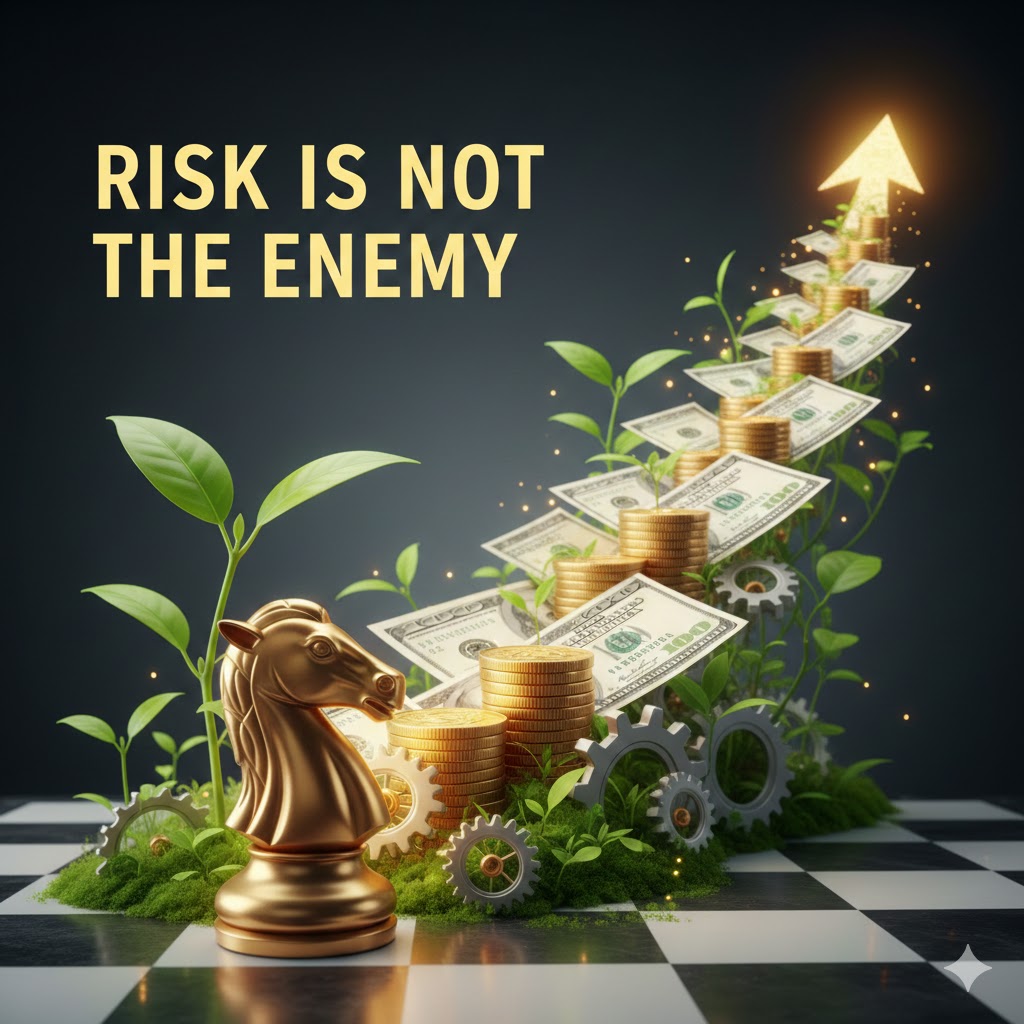
Risk Is Not the Enemy: Why Playing Too Safe Is Financially Dangerous
Introduction: The Great Misunderstanding About Risk
For decades, individuals, institutions, and even governments have been taught to fear risk. Conventional wisdom frames risk as something to be minimized, avoided, or eliminated entirely. “Play it safe,” we are told. Yet history, economic theory, and empirical evidence reveal a paradox: excessive risk aversion is itself one of the greatest financial risks of all.
As Nobel Prize–winning economist Harry Markowitz, the father of Modern Portfolio Theory, famously demonstrated, wealth creation is not about eliminating risk, but about optimally managing it. Avoiding risk altogether often guarantees stagnation, erosion of purchasing power, and missed opportunity.
This article reframes risk—not as an enemy—but as an essential instrument of growth when properly understood and controlled.
Understanding Risk: Not All Risk Is the Same
One of the most damaging misconceptions in finance is the idea that all risk is bad. In reality, economists distinguish between productive risk and destructive risk.
- Productive risk is calculated, intentional, and tied to expected returns—such as investing in education, entrepreneurship, equities, or innovation.
- Destructive risk is blind exposure without analysis—such as over-leverage, speculation without understanding, or fraud-driven schemes.
According to Frank Knight, whose work Risk, Uncertainty, and Profit laid the foundation for modern economic thought, profit exists because risk exists. If outcomes were guaranteed, there would be no reward for decision-making or capital deployment.
In other words, risk is the price paid for progress.
The Hidden Cost of Playing Too Safe
While risky behavior can cause losses, excessive caution produces quieter but equally damaging consequences.
1. Inflation Risk: The Silent Wealth Eroder
Holding money in “safe” assets such as cash or low-yield savings accounts often feels prudent. However, as John Maynard Keynes warned, inflation acts as a hidden tax on idle capital.
When returns fail to outpace inflation:
- Purchasing power declines
- Savings lose real value
- Long-term goals become unattainable
The irony is clear: what feels safe in the short term becomes dangerous over time.
2. Opportunity Cost: The Risk You Don’t See
Economist Thomas Sowell repeatedly emphasized opportunity cost as a central concept in economic decision-making. When capital is locked in ultra-safe instruments, it forgoes the potential gains of more productive uses.
Avoiding investment risk may prevent losses—but it also prevents participation in:
- Business ownership
- Capital appreciation
- Compounding returns
The greatest financial damage often comes not from losses incurred, but from returns never earned.
Why Risk Drives Growth at Every Level
Individuals
At the personal level, nearly every meaningful financial breakthrough involves risk:
- Starting a business
- Investing in equities

Risk Is Not the Enemy: Why Playing Too Safe Is Financially Dangerous - Acquiring new skills
- Changing careers
As Howard Marks, co-founder of Oaktree Capital, explains:
“You can’t eliminate risk. You can only decide which risks to take and which to avoid.”
Those who refuse all risk often cap their income at wages and their wealth at savings.
Businesses
Corporate history confirms that innovation requires risk. Companies that avoid uncertainty eventually lose relevance. Joseph Schumpeter’s theory of creative destruction shows that economic progress occurs when new risk-takers displace outdated models.
Firms that over-optimize for safety:
- Underinvest in innovation
- Lose competitive advantage
- Eventually decline
Nations
At the national level, economic development itself is a risk-taking exercise. Infrastructure investment, industrial policy, and technological advancement all involve uncertainty.
Countries that remain overly conservative in capital allocation often suffer from:
- Low productivity
- Capital flight
- Youth unemployment
As the World Bank and IMF repeatedly note, under-investment can be as damaging as mis-investment.
Risk vs. Volatility: An Important Distinction
One reason people fear risk is confusion between risk and volatility.
- Volatility refers to short-term fluctuations.
- Risk refers to the probability of permanent loss.
Legendary investor Warren Buffett clarified this distinction succinctly:
“Risk comes from not knowing what you’re doing.”
Well-understood, diversified, long-term investments may fluctuate, but they are often less risky than holding depreciating cash.
The Role of Education: Turning Risk Into Strategy
Risk becomes dangerous primarily in the absence of knowledge. Financial literacy transforms uncertainty into structured decision-making.
According to Benjamin Graham, the father of value investing:
“The investor’s chief problem—and even his worst enemy—is likely to be himself.”
Education enables individuals to:
- Assess downside realistically
- Price risk correctly
- Separate speculation from investment
- Avoid emotional decision-making
This is where platforms like WealthQuizzes play a critical role—bridging financial understanding with intelligent risk engagement.
Smart Risk Management, Not Risk Avoidance
Effective financial actors do not avoid risk; they manage it through:
- Diversification
- Time horizon planning
- Liquidity buffers
- Continuous learning
Modern portfolio theory, behavioral finance, and institutional investing all converge on one truth: zero-risk strategies rarely lead to wealth.
Conclusion: The Real Danger Is Standing Still
In an uncertain world, refusing to engage with risk may feel comforting—but it is often the most hazardous choice of all. Inflation, stagnation, and missed opportunity quietly erode wealth when capital is left idle.
Risk, when understood and managed, is not recklessness—it is the engine of growth.
As history, theory, and experience show, wealth does not reward caution alone. It rewards informed courage.
The goal, therefore, is not to eliminate risk—but to learn how to use it intelligently.
WealthQuizzes Perspective
True financial empowerment comes from understanding risk, not fearing it. By educating users on how capital grows, compounds, and responds to uncertainty, WealthQuizzes reinforces a central truth of wealth creation:
Knowledge does not remove risk—it transforms it into opportunity.