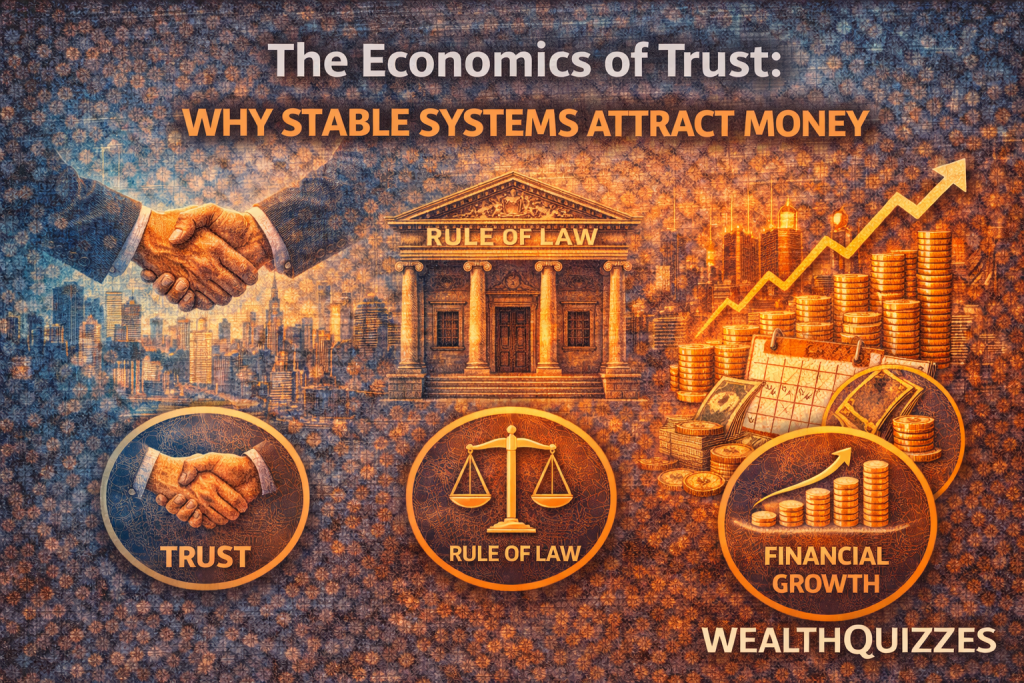
The Economics of Trust: Why Stable Systems Attract Money
Introduction: Trust as an Economic Asset
In economics, trust is often treated as an abstract social concept. In reality, it is one of the most powerful — and undervalued — economic assets a society can possess. Capital does not simply chase high returns; it seeks predictability, enforceable rules, and confidence that agreements will be honored. Where trust exists, money flows. Where it is absent, capital retreats or never arrives.
From global investors deciding where to allocate billions, to small businesses choosing whether to reinvest profits locally, trust underpins virtually every financial decision. This article examines how trust functions as an economic force, why stable systems consistently attract capital, and what this means for developing economies, particularly in Africa.
Trust as the Foundation of Economic Systems
Economist Douglass North, Nobel Laureate and institutional theorist, famously argued that institutions are the “rules of the game” in a society, shaping incentives and reducing uncertainty in human interaction. Trust emerges when these rules are clear, consistent, and enforced.
Trust in an economic system means:
- Contracts are enforceable
- Property rights are protected
- Policies are predictable
- Disputes are resolved fairly
Without these assurances, economic actors must price in risk — raising costs, reducing investment, and slowing growth.
Francis Fukuyama, in Trust: The Social Virtues and the Creation of Prosperity, further explains that high-trust societies lower transaction costs. Businesses spend less on security, litigation, and verification, freeing capital for productivity and innovation.
Rule of Law: The Bedrock of Financial Confidence
The rule of law is not merely a legal principle; it is a financial signal.
According to the World Bank, countries with strong legal systems attract significantly higher levels of foreign direct investment (FDI). Investors care deeply about:
- Independent courts
- Contract enforcement timelines
- Protection against arbitrary government action
When laws change unpredictably or enforcement is selective, capital becomes defensive. Investors shorten time horizons, demand higher returns, or avoid the market entirely.
Daron Acemoglu and James Robinson, in Why Nations Fail, demonstrate that inclusive institutions, which constrain power and protect economic rights, create long-term prosperity. Extractive systems, by contrast, erode trust and repel capital — regardless of natural resources or population size.
Predictability Over Perfection
Markets do not require perfection. They require consistency.
Countries with moderate tax rates but frequent policy reversals often perform worse than those with higher taxes but stable frameworks. Monetary policy credibility, regulatory continuity, and transparent governance reduce uncertainty — and uncertainty is the enemy of investment.
The International Monetary Fund (IMF) consistently emphasizes that policy credibility lowers borrowing costs. Governments trusted by markets issue debt at lower interest rates, while those viewed as unstable pay a premium — effectively a “trust tax” on their economies.
Nigeria’s recurrent struggles with exchange rate policy credibility illustrate this dynamic. When market participants doubt policy direction, capital hoards dollars, liquidity dries up, and inflation accelerates — reinforcing distrust in a vicious cycle.
Financial Systems as Trust Machines
Banks, capital markets, and payment systems are essentially trust-processing institutions. Depositors trust banks to safeguard money. Lenders trust borrowers to repay. Investors trust disclosures to be accurate.
When trust breaks down:
- Bank runs occur
- Credit dries up
- Informal finance expands
- Capital flight accelerates
This is why financial regulation matters. Effective regulation does not stifle markets; it reassures participants. The 2008 global financial crisis demonstrated that even advanced economies suffer when trust in financial institutions collapses, requiring massive public intervention to restore confidence.
Trust, Capital Flight, and Africa’s Development Challenge
Capital flight from Africa is not primarily driven by lack of opportunity. It is driven by perceived risk.
African elites themselves often hold assets offshore — a powerful signal of domestic distrust. According to the African Development Bank, Africa loses tens of billions of dollars annually to capital flight, weakening currencies and reducing domestic investment capacity.
This creates a paradox:
- Africa is capital-hungry
- African capital avoids Africa
The missing link is trust — in institutions, policy stability, and long-term governance.
Trust Is Built Slowly — and Lost Quickly
Trust is cumulative. It is built through:
- Consistent policy behavior
- Transparent institutions
- Respect for contracts and court rulings
- Peaceful political transitions
But it is fragile. A single episode of bank confiscation, retroactive taxation, or arbitrary regulation can undo years of credibility.
Singapore, often cited as a development success, did not attract capital by accident. It deliberately prioritized rule of law, regulatory clarity, and institutional discipline — transforming trust into a national competitive advantage.
Why Trust Determines the Cost of Capital
In financial terms, trust directly affects:
- Interest rates
- Currency stability
- Investment duration
- Risk premiums
High-trust environments enjoy cheaper capital. Low-trust systems pay more for money — if they can access it at all.
This is why two countries with similar resources can experience vastly different outcomes. Trust compounds economically, just like capital itself.
Implications for Individuals and Businesses
The economics of trust is not only a macro concept. Individuals and firms operate within trust environments.
Entrepreneurs in unstable systems:
- Prefer short-term profits over scaling
- Avoid long-term investments
- Rely on cash rather than formal finance
By contrast, trust enables planning, leverage, and long-term wealth creation.
WealthQuizzes Perspective: Trust as Financial Literacy
Understanding trust is essential to financial literacy. Wealth is not created in isolation; it is built within systems. Knowing how institutions, policies, and credibility affect money flows empowers individuals to make smarter decisions — from where to invest, to how to assess risk beyond returns.
At WealthQuizzes, financial education is not just about numbers. It is about understanding the invisible forces — like trust — that shape economic outcomes and determine who prospers and who struggles.
Conclusion: Trust Is the Ultimate Investment Climate
Money is cautious. It moves toward safety, predictability, and fairness. Stable systems do not attract capital because they are lucky — they attract it because they have earned trust.
For countries seeking growth, the lesson is clear: infrastructure matters, resources matter, but trust matters more. Without it, capital hesitates. With it, wealth multiplies.
In the long run, trust is not a soft virtue. It is hard economics.