The First Asset You Should Ever Own (It’s Not a Car or a Shop)
When people think about their “first asset,” they usually imagine something visible.
A car.
A shop.
A plot of land.
A small business.
In many communities, ownership is equated with status. The earlier you can point to something tangible and say, “This is mine,” the more successful you appear.
But this mindset confuses possession with productivity.
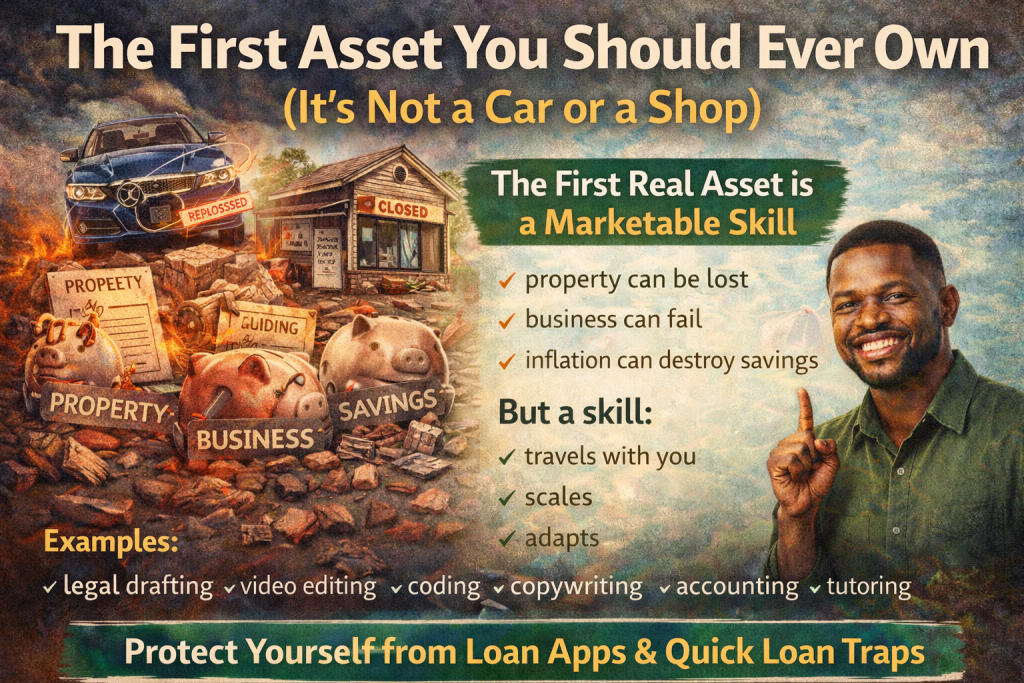
The first real asset you should ever own is not a car or a shop.
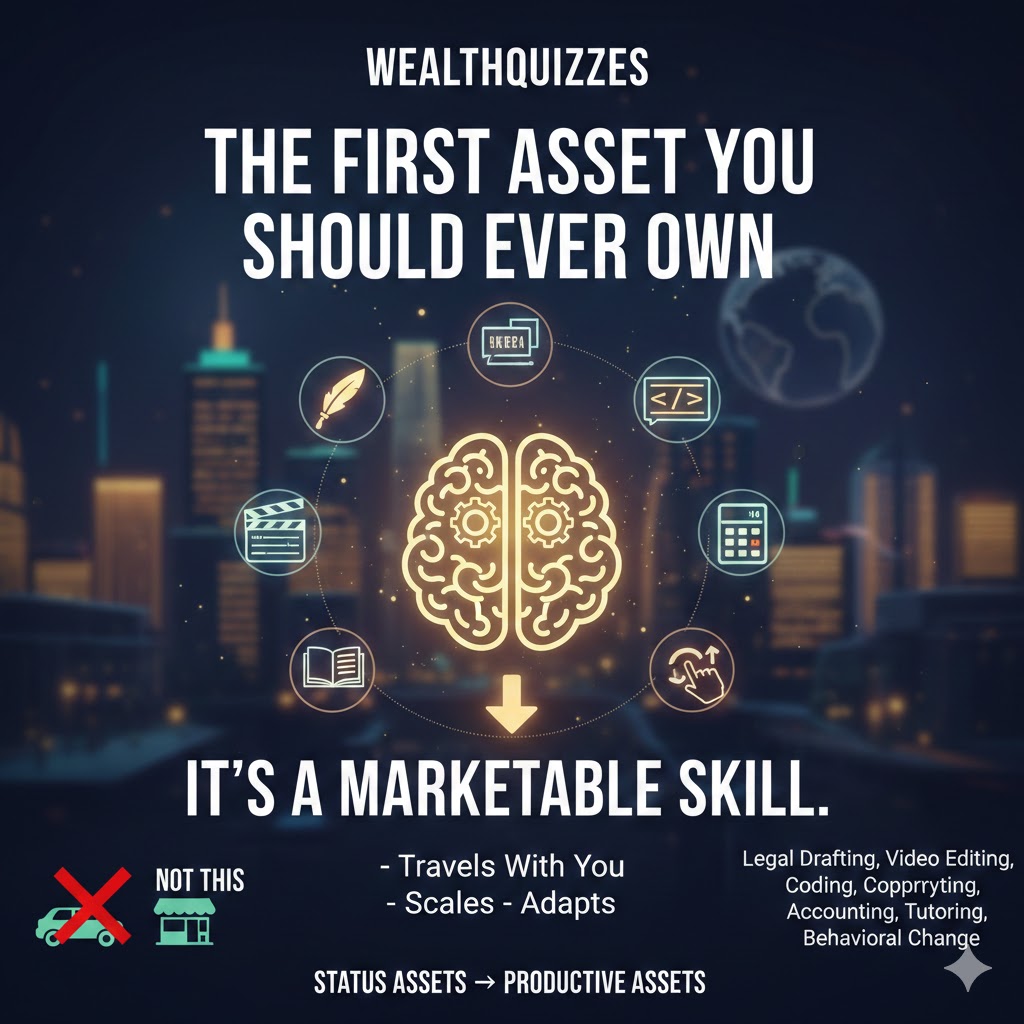
It is a marketable skill.
This may sound underwhelming at first. A skill is invisible. It cannot be photographed or parked outside your house. But economically speaking, it is the most resilient, portable, and scalable asset you can acquire.
And unlike many physical assets, it cannot be easily taken away.
What Is an Asset, Really?
Before going further, we must define terms precisely.
Warren Buffett describes an asset as something that generates cash flow or has the capacity to do so. Robert Kiyosaki frames it even more simply: an asset puts money in your pocket.
By that definition, many things people proudly call “assets” are not assets at all. A car that depreciates is a liability unless it produces income. A shop without customers is overhead. Land that cannot be monetized is dormant capital.
An asset must either:
- produce income,
- increase earning capacity,
- or appreciate reliably over time.
A marketable skill satisfies at least the first two — often all three.
Why Physical Assets Are Fragile
Consider three common assumptions.
1. Property Is Security
Property can be powerful, but it is not invincible. Markets fluctuate. Legal disputes arise. Maintenance costs accumulate. In some regions, land documentation issues can undermine ownership.
Property can be lost.
2. Businesses Guarantee Income
Businesses fail frequently. According to global entrepreneurship studies, a significant percentage of new businesses close within five years. Markets change. Consumer behavior shifts. Regulations evolve.
A business without adaptive capability is fragile.
3. Savings Are Safe
Inflation erodes purchasing power. As economist Milton Friedman repeatedly emphasized, inflation is a monetary phenomenon — and when it rises, cash loses real value.
Savings alone are not growth; they are preservation at best.
The Resilient Asset: A Marketable Skill
Unlike property, a skill travels with you.
Unlike savings, it adapts.
Unlike a single business, it can be redeployed across industries.
Nobel laureate Gary Becker developed the concept of human capital — the idea that education, training, and abilities are forms of capital because they increase an individual’s productivity and income potential.
This is not motivational language. It is economic theory.
A skill is human capital.
And human capital compounds.
What Makes a Skill an Asset?
Not every ability qualifies. A skill becomes an asset when it is:
- Marketable — there is demand.
- Transferable — usable in multiple contexts.
- Monetizable — it directly generates income.
Examples include:
- Legal drafting
- Video editing
- Coding
- Copywriting
- Accounting
- Tutoring
- Digital marketing
- Data analysis
Each of these has clear demand in both local and global markets.
More importantly, they scale.
A lawyer who can draft contracts can work independently or with firms.
A coder can build products, freelance, or join companies.
A video editor can serve brands, creators, or agencies.
A tutor can teach offline or online, locally or internationally.
The skill remains valuable even if the platform changes.
Skills Scale in Ways Physical Assets Cannot
A shop has fixed capacity.
A car depreciates with usage.
A skill, by contrast, improves with usage.
The more you practice legal drafting, the more efficient and accurate you become. The better you code, the more complex problems you can solve. As your competence increases, so does your pricing power.
Economist Thomas Piketty discusses how returns on capital often exceed wage growth. But skills blur that line. High-value skills allow individuals to convert labor into capital-like returns through leverage — especially in digital markets.
When a copywriter masters persuasive writing, they can serve multiple clients. When a software developer builds a digital product, it can be sold repeatedly with minimal additional cost.
That is scale.
Skills Adapt to Economic Shifts
Entire industries can collapse.
Technology disrupts sectors constantly. The taxi industry changed with ride-hailing platforms. Retail transformed with e-commerce. Media shifted with digital distribution.
But individuals with adaptable skills survive transitions better than those tied solely to one asset or structure.
Charles Darwin’s observation about survival — often paraphrased as survival belonging to the most adaptable — applies economically.
A skilled accountant can transition from manual bookkeeping to digital systems. A video editor can adapt from television formats to short-form social media content.
The underlying capability remains useful even as platforms evolve.
Status Assets vs. Productive Assets
Many people pursue what can be called status assets.
A new car signals progress.
A physical shop signals entrepreneurship.
A large office signals success.
But status assets often precede income stability. The order becomes inverted.
Instead of building earning capacity first, individuals acquire visible symbols and hope income catches up.
Productive assets operate differently.
They are often invisible at first. A laptop, a certification, a skill set — these do not attract attention socially. But they generate cash flow quietly and consistently.
The behavioral shift required is profound:
Move from impressing others to strengthening earning power.
The Skill-First Financial Strategy
Imagine two individuals starting at the same financial level.
Person A buys a car on credit to begin a transport business without understanding the market fully.
Person B invests in learning a high-demand skill — for example, coding or accounting — and begins earning freelance income.
If the car business fails, Person A still has debt and depreciation.
If Person B’s first clients are slow, the skill remains. It can be refined, marketed differently, or applied elsewhere.
Over time, Person B’s earning ceiling increases.
This is not theory. It reflects how modern labor markets reward specialized competence.
Behavioral Change: Redefining Ownership
The mindset shift is this:
Ownership is not about what you can touch.
Ownership is about what you can produce.
When individuals invest first in skill acquisition:
- They increase income stability.
- They reduce dependency on borrowing.
- They gain leverage in negotiations.
- They build resilience against economic shocks.
The World Bank consistently highlights skills development as one of the most powerful drivers of poverty reduction and economic mobility.
Skills increase bargaining power.
Bargaining power increases income.
Income creates optionality.
Optionality creates freedom.
When Should You Buy Property or Start a Shop?
After your skill generates stable income.
After you understand cash flow.
After you have a savings buffer.
After you can deploy capital strategically rather than emotionally.
Then property becomes a portfolio decision — not a status symbol.
Then business expansion becomes calculated — not hopeful.
Final Principle
The first asset you should ever own is a marketable skill.
Because:
Property can be lost.
Businesses can fail.
Inflation can destroy savings.
But a skill:
Travels with you.
Improves with practice.
Scales across markets.
Adapts to change.
It is the foundation upon which every other asset rests.
Before chasing visible assets, build invisible capital.
When your earning power is strong, every other acquisition becomes easier, safer, and more strategic.
That is not merely advice.
It is economic reality.