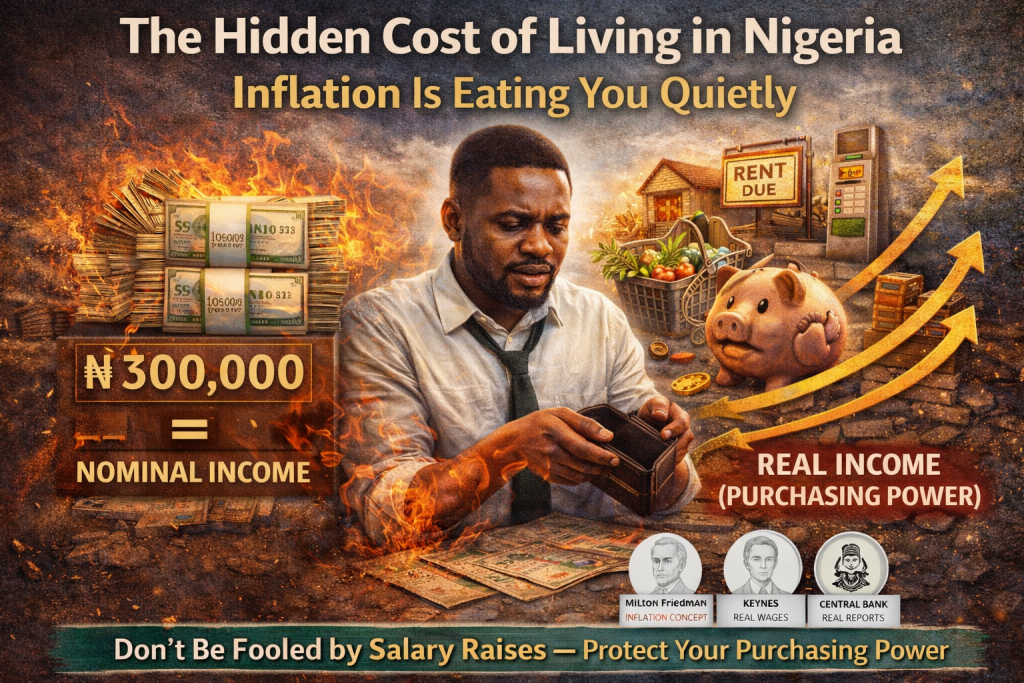
The Hidden Cost of Living in Nigeria
Inflation Is Eating You Quietly
Most Nigerians measure progress in nominal terms.
“My salary increased.”
“My business revenue doubled.”
“I’m earning more than I did last year.”
But here is the uncomfortable truth:
You can earn more money and still become poorer.
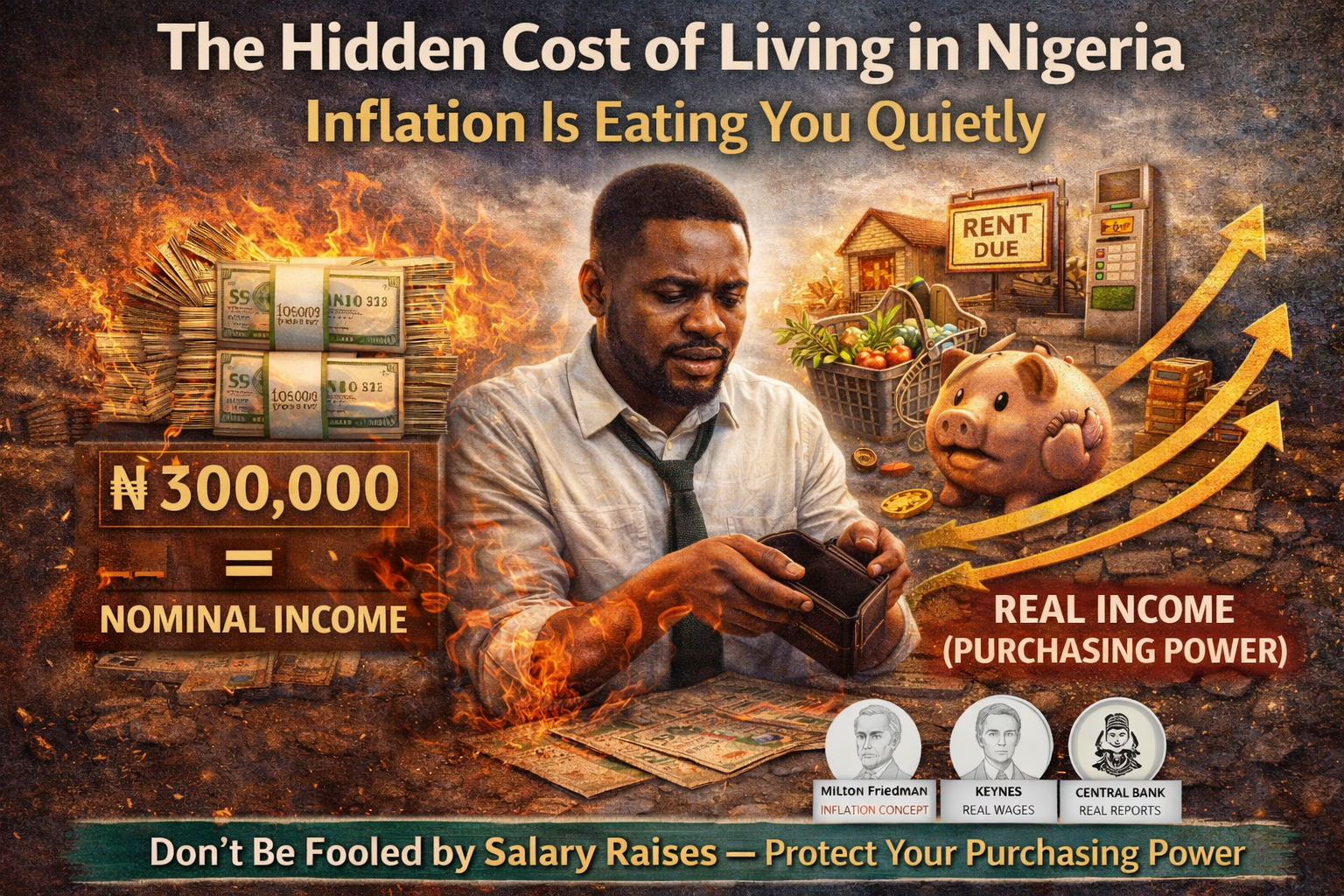
The hidden cost of living in Nigeria is not always visible in your bank alert. It is embedded in rising food prices, rent increases, transport fares, school fees, and medical bills. It is inflation — and it is quietly eroding purchasing power every single day.
Understanding this concept is not academic theory. It is financial survival.
Nominal Income vs Real Income
The first distinction every financially aware adult must understand is this:
- Nominal income is the amount of money you earn.
- Real income is what that money can actually buy.
The difference determines whether you are advancing or regressing economically.
The economist John Maynard Keynes emphasized that what ultimately matters to workers is not money wages, but real wages — that is, the goods and services those wages can purchase.
If your salary increases from ₦200,000 to ₦250,000, that looks like progress. But if food, rent, transport, and utilities have increased by 40% within the same period, your real income has declined.
You feel this decline as financial pressure, even though your bank statement says you are earning more.
This is the silent squeeze.
Inflation: A Monetary Phenomenon with Real Consequences
The late Nobel laureate Milton Friedman famously argued that inflation is “always and everywhere a monetary phenomenon.” In simplified terms, when the supply of money grows faster than the supply of goods and services, prices rise.
But while inflation may originate in macroeconomic policy, its consequences are deeply personal.
In Nigeria, inflation has not been theoretical. It has been visible:
- Food prices rising monthly
- Rent renegotiated upward annually
- Transport fares fluctuating with fuel prices
- School fees adjusted mid-session
- Medical costs increasing unpredictably
When inflation accelerates, the purchasing power of the naira declines. Each naira buys less than it did before.
This is the hidden tax no one invoices you for.
The Nigerian Reality: Food, Rent, and Transport
Three categories dominate household spending in Nigeria:
- Food
- Rent
- Transport
When these rise simultaneously, financial stability becomes fragile.
Food inflation has been especially severe in recent years. Items considered staples — rice, garri, beans, bread, cooking oil — have experienced significant price jumps. Households that once allocated 30% of income to food may now allocate 50% or more.
Rent inflation compounds the pressure. In major cities such as Lagos, Abuja, and Port Harcourt, landlords adjust rents upward in response to currency depreciation, building material costs, and broader economic uncertainty.
Transport inflation follows fuel price adjustments. A single fuel policy shift can instantly affect commuting costs, logistics, and food distribution — creating a multiplier effect across the economy.
The result is simple:
Income may be static or rising slowly, but essential expenses are rising rapidly.
The Illusion of a Salary Raise
Many workers celebrate salary increments without calculating inflation-adjusted income.
If inflation is 25% and your salary increases by 10%, you are not ahead. You are 15% behind in real terms.
This phenomenon explains why:
- Workers feel financially stuck despite promotions.
- Middle-income earners struggle to save.
- Households increasingly rely on debt to bridge gaps.
The problem is not always laziness or poor budgeting. Sometimes it is arithmetic.
Purchasing Power: The Concept That Changes Everything
Purchasing power is the true measure of wealth.
It answers one question:
What can your money buy today compared to yesterday?
When purchasing power falls:
- Savings lose value.
- Cash holdings shrink in real terms.
- Fixed salaries become weaker.
- Financial stress increases.
The concept is widely reflected in macroeconomic analysis, including periodic reports issued by the Central Bank of Nigeria, which track inflation, money supply, and price stability indicators.
But individuals rarely apply these macro concepts to personal finance decisions.
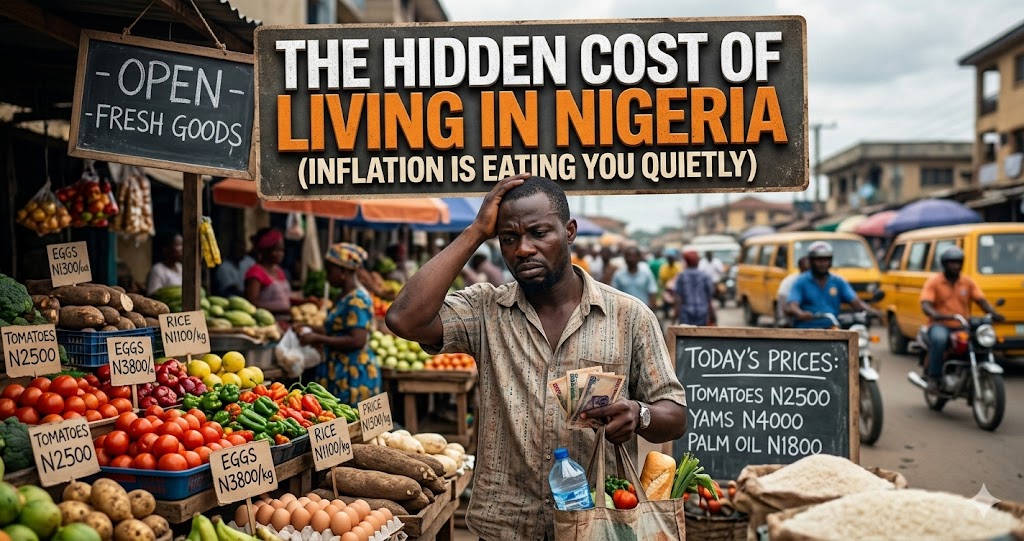
Inflation Is Eating You Quietly
They should.
Why Saving in Cash Alone Is Dangerous
Inflation punishes idle cash.
If you store ₦1,000,000 in physical cash for two years in a high-inflation environment, the nominal amount remains ₦1,000,000. But its purchasing power may fall dramatically.
You have not lost money visibly.
But you have lost value.
This is why financial literacy must move beyond “save money” to “protect purchasing power.”
Cash has utility — for liquidity and emergencies. But long-term wealth preservation requires assets that can adjust with inflation or grow faster than it.
Without this understanding, disciplined savers can unknowingly become poorer.
The Psychological Impact of Inflation
Inflation does more than reduce numbers.
It alters behavior.
When people notice prices rising faster than income, they:
- Hoard goods.
- Rush into speculative investments.
- Fall for “quick profit” schemes.
- Take unnecessary loans to maintain lifestyle.
This environment makes populations vulnerable to:
- Ponzi schemes promising high returns.
- Risky foreign exchange trading.
- Unregulated crypto speculation.
- Loan apps offering instant relief.
Inflation increases anxiety. Anxiety reduces rational decision-making.
Understanding inflation restores rationality.
Why Many Nigerians Feel They Are “Working Harder for Less”
This feeling is not imaginary.
If wages lag behind inflation, workers must expend more effort to maintain the same standard of living. In macroeconomic terms, real wages decline.
Keynes analyzed how wage rigidity and price changes interact. When prices rise faster than wages, the burden shifts onto workers.
This is not simply an emotional complaint. It is structural.
And once you understand the structure, you can adjust strategy.
Strategic Response: Protecting Purchasing Power
To respond intelligently to inflation, individuals must adopt layered financial thinking:
1. Increase Income in Real Terms
Focus on skills and income streams that can adjust with inflation — businesses, commission-based roles, or scalable digital services.
2. Avoid Excessive Idle Cash
Maintain emergency savings, but avoid holding large sums in depreciating currency without a purpose.
3. Own Assets That Can Adjust
Assets that can reprice — such as productive businesses or income-generating investments — often adapt better to inflation than fixed cash savings.
4. Budget with Inflation in Mind
Assume prices will rise. Plan rent, food, and transport projections conservatively.
5. Think in Purchasing Power, Not Salary
Ask: “Is my lifestyle becoming easier or harder to maintain?”
That is the real indicator.
Behavioral Shift: From Complacency to Awareness
The greatest damage inflation causes is not financial — it is cognitive.
When people do not understand inflation:
- They blame themselves excessively.
- They feel stuck without clarity.
- They misallocate savings.
- They panic-invest.
When people understand inflation:
- They measure real income.
- They pursue income growth intentionally.
- They build buffers intelligently.
- They avoid emotional financial decisions.
Awareness changes behavior.
Behavior changes outcomes.
The Hidden Cost — Now Visible
Inflation is not dramatic. It is gradual.
It does not announce itself loudly. It creeps.
But over time, it reshapes:
- Household budgets
- Retirement plans
- Educational affordability
- Wealth accumulation
The hidden cost of living in Nigeria is not merely high prices. It is the erosion of purchasing power without strategic response.
Once you understand the difference between nominal and real income, once you recognize that a salary raise can still mean decline, and once you internalize that cash alone does not preserve value — you move from reaction to strategy.
Inflation may be a monetary phenomenon.
But preparedness is a personal decision.
And the Nigerians who understand purchasing power will not just survive inflation.
They will outpace it.