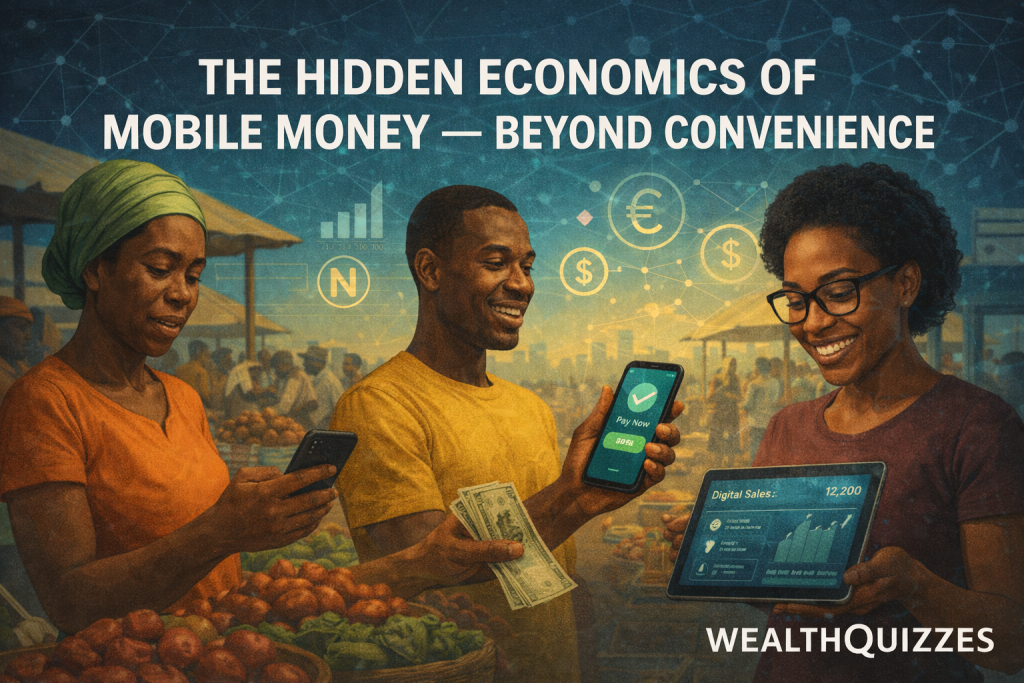
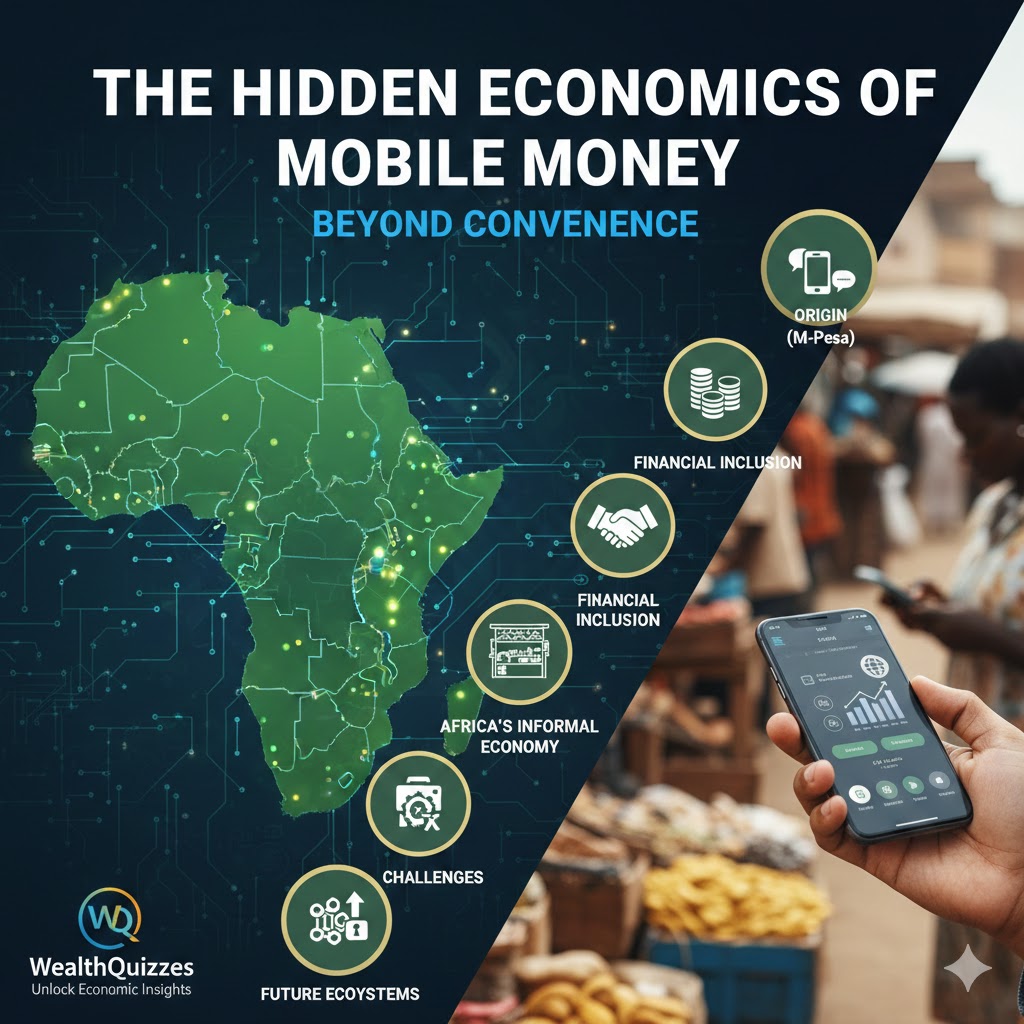
The Hidden Economics of Mobile Money — Beyond Convenience
By WealthQuizzes Editorial Team
The Origin of Mobile Money (M-Pesa and Beyond)
Mobile money did not begin as a luxury innovation — it was born out of necessity.
In the early 2000s, millions of Africans lacked access to traditional banking services. Branches were scarce, documentation requirements were strict, and transaction costs were high. Yet mobile phone adoption was rising rapidly.
The breakthrough came in 2007 with the launch of M-Pesa in Kenya by Safaricom. What started as a simple system for sending money via SMS quickly evolved into a full financial ecosystem — enabling payments, savings, credit, and even insurance.
M-Pesa proved something revolutionary:
People didn’t need banks to access finance — they needed connectivity.
Since then, mobile money has spread across the continent, with platforms such as MTN MoMo, Airtel Money, Paga, OPay, and Wave transforming how money moves in Africa.
Today, Africa accounts for over 70% of the world’s mobile money transactions, making it the undisputed global leader in mobile financial innovation.
Its Role in Financial Inclusion and Micro-Entrepreneurship
Mobile money has done what decades of banking reforms struggled to achieve — financial inclusion at scale.
With just a basic mobile phone, individuals can now:
- Send and receive money instantly
- Save securely without a bank account
- Access micro-loans and overdrafts
- Pay bills and school fees digitally
For millions of Africans, mobile money represents their first interaction with formal finance.
More importantly, it has empowered micro-entrepreneurs — market traders, artisans, transport operators, and freelancers — who previously operated entirely in cash.
A roadside food vendor can now:
- Receive digital payments
- Track daily income
- Build transaction history
- Qualify for micro-credit
This transaction data becomes financial identity, unlocking opportunities that were previously unreachable.
In effect, mobile money has turned phones into banks and transactions into creditworthiness.
How Mobile Money Fuels Africa’s Informal Economy
Africa’s informal economy is not a weakness — it is a parallel economic engine. In many countries, it contributes over 50% of GDP and employs the majority of the population.
Mobile money has quietly become its backbone.
Here’s how:
1. Liquidity and Speed
Money circulates faster when it’s digital. Traders can pay suppliers instantly, restock quickly, and respond to demand in real time.
2. Reduced Transaction Risk
Digital payments reduce cash theft, counterfeit currency, and loss — critical for small businesses operating on thin margins.
3. Cross-Border Informal Trade
Mobile money platforms increasingly support cross-border transfers, enabling regional trade without expensive bank intermediaries.
4. Resilience During Shocks
During crises — pandemics, fuel shortages, currency instability — mobile money keeps commerce alive when physical banking systems slow down.
In many African communities, mobile money is not an alternative to the economy — it is the economy.
Challenges: Interoperability, Regulation, and Taxation
Despite its success, mobile money faces structural challenges that must be addressed to sustain growth.
1. Interoperability Gaps
In many countries, mobile money platforms do not seamlessly interact with one another. This fragmentation limits efficiency and increases transaction costs.
True financial inclusion requires platform-to-platform connectivity, not isolated digital silos.
2. Regulatory Balance
Governments face a difficult task:
- Over-regulate, and innovation slows
- Under-regulate, and consumers are exposed
Clear, adaptive regulatory frameworks are essential to protect users without stifling growth.
3. Taxation Pressures
As mobile money transactions grow, governments increasingly view them as tax targets. Poorly designed transaction taxes, however, risk discouraging usage — especially among low-income earners.
Tax policy must recognize that mobile money is infrastructure, not luxury consumption.
4. Consumer Protection and Fraud
As usage expands, so do scams, SIM swaps, and social engineering fraud. Digital literacy and strong security systems are no longer optional — they are foundational.
The Future of Mobile Money Ecosystems
Mobile money is evolving from a transaction tool into a financial ecosystem.
The future will likely include:
- Embedded credit and insurance based on transaction data
- Integration with digital currencies (CBDCs)
- Cross-border settlement systems aligned with AfCFTA
- Interoperable super-apps combining payments, commerce, and investments
As AI, blockchain, and open banking mature, mobile money will become the gateway to Africa’s broader digital economy — not just for payments, but for wealth creation.
The platforms that succeed will be those that move from convenience to economic intelligence.
WealthQuizzes Perspective: Understanding the Systems That Shape Wealth
At WealthQuizzes, we believe financial literacy must go beyond personal budgeting and savings.
Understanding how money systems work — who controls them, how value moves, and how data creates opportunity — is essential for true empowerment.
Mobile money is a powerful example of how everyday tools quietly shape entire economies. When people understand this, they:
- Use digital finance more strategically
- Protect themselves from exploitation
- Leverage systems for growth rather than survival
Because wealth is not built by convenience alone —
it is built by understanding the systems behind convenience.
And in Africa today, mobile money is one of the most important systems of all.