
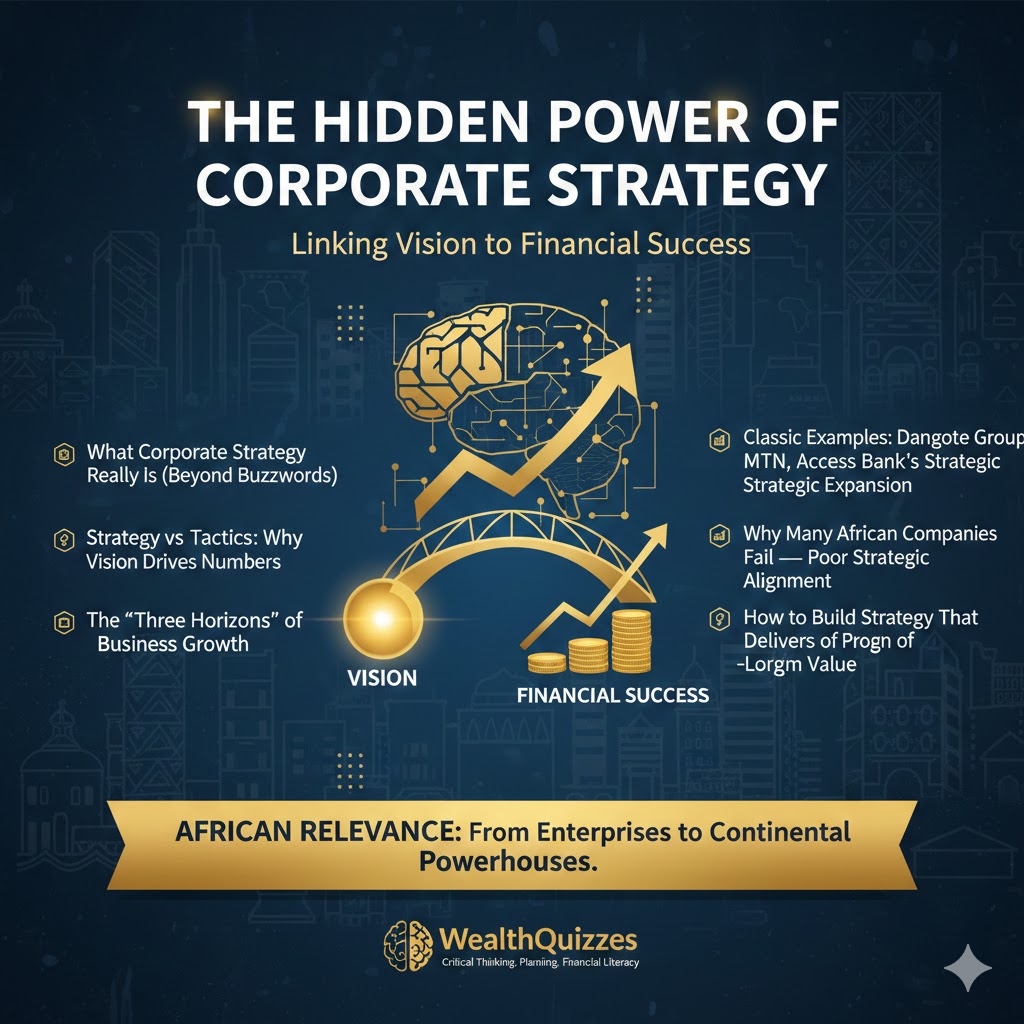
The Hidden Power of Corporate Strategy: Linking Vision to Financial Success
By WealthQuizzes Editorial Team
What Corporate Strategy Really Is (Beyond Buzzwords)
In business circles, few words are thrown around as often — and misunderstood as deeply — as “strategy.”
For many, it’s reduced to fancy PowerPoint slides or lofty mission statements. But in reality, corporate strategy is the invisible architecture of success — the framework that connects a company’s vision to its financial outcomes.
It answers the hard questions:
- What business are we in?
- Where should we compete?
- How do we sustain growth and profitability over time?
At its core, corporate strategy is about choice — deciding what not to do is often as important as deciding what to pursue. It’s the guiding compass that aligns people, capital, and processes toward a common purpose.
Strategy vs. Tactics: Why Vision Drives Numbers
Too often, businesses confuse strategy with tactics.
- Strategy is the plan — the long-term vision and direction.
- Tactics are the actions — the short-term steps to execute that plan.
For instance, reducing marketing costs or increasing sales volume are tactical decisions. But deciding which markets to enter, which customer segments to serve, and how to differentiate — that’s strategic thinking.
When strategy drives decisions, financial performance becomes predictable and scalable. When tactics replace strategy, companies lose focus and drift into short-term reactions.
As Harvard Business School’s Michael Porter famously said:
“The essence of strategy is choosing what not to do.”
The “Three Horizons” of Business Growth
Successful organizations balance the present, the near future, and the distant future simultaneously. This is where the Three Horizons Model comes in — a simple but powerful framework for corporate strategy.
- Horizon 1 — Core Business:
Focus on strengthening and optimizing what’s already working. Example: A bank improving its loan portfolio quality. - Horizon 2 — Emerging Opportunities:
Explore adjacent markets or new products that complement existing strengths. Example: A telecom company launching mobile banking services. - Horizon 3 — Future Growth Engines:
Invest in innovations that could redefine the business in 5–10 years. Example: A manufacturing firm adopting AI for production efficiency.
Strategic leaders know how to balance all three — keeping today’s profits healthy while investing in tomorrow’s breakthroughs.
Classic Examples: Dangote Group, MTN, and Access Bank’s Strategic Expansion
Africa’s most successful corporations owe much of their growth to clear and disciplined strategic planning.
Dangote Group: Integration and Scale
Aliko Dangote built a multi-billion-dollar conglomerate by mastering vertical integration — controlling every stage of his value chain. From cement production to oil refining, Dangote’s strategy ensures cost efficiency, supply security, and market dominance.
That’s not luck; it’s long-term strategic design.
MTN: Regional Diversification and Digital Evolution
MTN’s success stems from two strategic choices — expanding aggressively across Africa and evolving into a digital services company.
Today, MTN is not just a telecom operator; it’s a fintech and data solutions provider. By anticipating how communication would blend with financial services, MTN turned vision into sustained financial growth.
Access Bank: Mergers, Acquisitions, and Pan-African Ambition
Access Bank’s expansion strategy is a textbook case in strategic clarity. Through mergers, digital transformation, and cross-border acquisitions, it has grown from a mid-tier Nigerian bank into a leading African financial institution.
Each move was deliberate, data-driven, and aligned with a clear long-term objective — becoming Africa’s gateway to global finance.
How Data and Finance Teams Translate Vision into Action
A great strategy is meaningless without measurement.
That’s where data and finance teams come in — they are the translators of vision into numbers. They analyze:
- Market trends and competitive dynamics
- Financial forecasts and capital requirements
- Cost efficiency and profitability metrics
- Return on investment (ROI) from strategic initiatives
In practice, this means turning a CEO’s broad vision (“expand into East Africa”) into a detailed roadmap with budgets, timelines, and financial projections.
Data-driven strategy ensures decisions are based not on intuition alone but on evidence — and that’s how modern businesses stay both agile and accountable.
Why Many African Companies Fail — Poor Strategic Alignment
Many businesses across Africa struggle not because of lack of opportunity but because of strategic disconnection.
They often:
- Chase every opportunity instead of focusing on core strengths.
- Fail to adapt to changing market conditions.
- Treat strategy as an annual exercise instead of a living process.
Without strategic alignment, departments work in silos, budgets are wasted, and leadership loses clarity.
In contrast, high-performing firms constantly revisit their strategies — ensuring every decision, from HR to marketing, supports one unified direction.
How to Build a Strategy That Delivers Long-Term Value
Building an effective corporate strategy doesn’t require magic — it requires discipline, analysis, and leadership.
Here’s a roadmap every business can follow:
- Define a Clear Vision: What’s your ultimate purpose? What impact do you want to make?
- Assess Your Environment: Understand your competitors, customers, and regulatory landscape.
- Identify Core Strengths: Focus on what you do best and build around it.
- Set Measurable Objectives: Convert your vision into quantifiable goals (e.g., market share, revenue growth, ROI).
- Allocate Capital Wisely: Fund the initiatives that align with strategy — and cut what doesn’t.
- Monitor and Adjust: Use data and regular reviews to keep strategy alive, not static.
When strategy, execution, and financial discipline align, long-term value is not just achievable — it’s inevitable.
African Relevance: Strategic Thinking as a Growth Engine
Africa’s business landscape is dynamic and competitive. From fintech to agriculture, logistics to energy, the continent rewards strategic foresight.
The next generation of African leaders must think like strategists — understanding global trends, building scalable models, and creating sustainable impact.
Companies that master strategy won’t just survive Africa’s volatility; they’ll lead its transformation.
WealthQuizzes Perspective: Strategy Meets Financial Intelligence
At WealthQuizzes, we believe that financial literacy is not just about money — it’s about mindset.
Corporate strategy represents the highest level of financial intelligence: the ability to connect a vision with measurable results.
By teaching strategic and analytical thinking, WealthQuizzes helps learners understand:
- How decisions affect financial outcomes,
- How long-term planning drives wealth creation, and
- How great leaders think, plan, and execute for success.
Because in business — just like in life — strategy is the bridge between dreams and results.