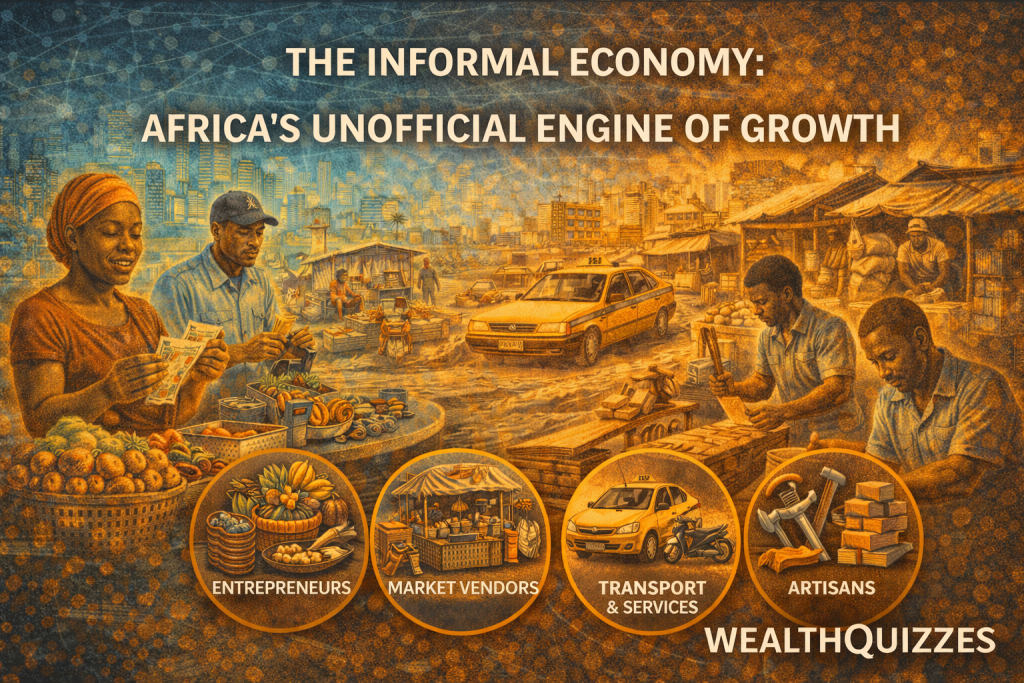
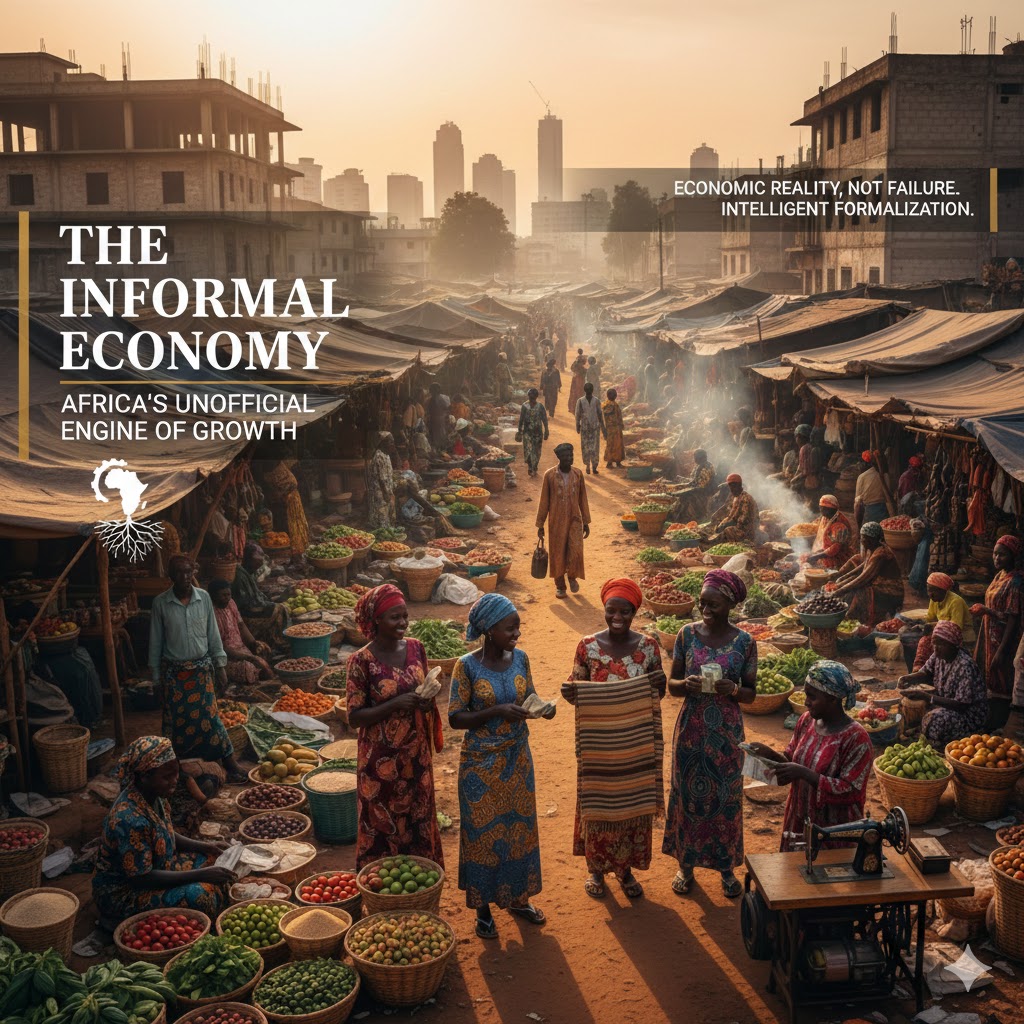
The Informal Economy: Africa’s Unofficial Engine of Growth
By WealthQuizzes Editorial Team
Introduction: Informality Is Not Failure
Across Africa, the informal economy is often spoken about as a problem to be solved—a sign of underdevelopment, weak institutions, or regulatory failure. Policymakers promise to “formalize” it, economists measure it as a gap, and commentators treat it as a temporary phase.
Yet this framing misses a crucial truth:
Africa’s informal economy is not a breakdown of the system—it is the system for millions of people.
Far from being marginal, the informal economy employs the majority of Africa’s workforce, feeds urban populations, supports rural livelihoods, and keeps commerce moving where formal structures fall short. Understanding it properly is essential to understanding African growth.
What the Informal Economy Really Is
The informal economy consists of economic activities that are not fully regulated, registered, or taxed by the state, but are nonetheless productive and income-generating.
It includes:
- Market traders and street vendors
- Artisans, mechanics, tailors, and builders
- Small-scale farmers and processors
- Transport operators
- Home-based enterprises
- Micro-retail and services
Informality does not mean illegality. It usually reflects:
- High barriers to formal registration
- Complex or costly regulation
- Weak enforcement capacity
- Limited access to finance and documentation
In many cases, informality is a rational response to institutional constraints—not a rejection of legality.
Scale and Significance: The Backbone of African Economies
In most African countries:
- The informal sector employs 60–90% of the workforce
- It contributes 30–60% of GDP
- It dominates agriculture, retail, transport, and services
Without the informal economy:
- Urban food systems would collapse
- Youth unemployment would explode
- Household incomes would shrink dramatically
Calling Africa’s informal economy “unproductive” ignores its role as the primary shock absorber in times of crisis—economic downturns, pandemics, inflation, and conflict.
Why Informality Persists: Structural, Not Cultural
Informality is often blamed on attitudes or “resistance to formality.” In reality, it persists because of structural incentives.
1. High Cost of Formality
Registering a business can involve:
- Multiple agencies
- High fees
- Time-consuming processes
- Ongoing compliance costs
For a micro-entrepreneur earning thin margins, these costs are prohibitive.
2. Weak Benefits of Formality
In many contexts, formalization does not guarantee:
- Access to credit
- Reliable infrastructure
- Legal protection
- Government support
When benefits are unclear, informality becomes the rational choice.
3. Inconsistent Enforcement
Selective enforcement encourages partial compliance:
- Informal enough to avoid costs
- Visible enough to operate
This grey zone sustains informality indefinitely.
Productivity in the Informal Economy: Misunderstood, Not Absent
The informal economy is often described as “low productivity.” This is partially true—but misleading.
Low productivity is not due to lack of effort or intelligence. It reflects:
- Limited access to capital
- Poor infrastructure
- Small operating scale
- Cash-based transactions
- Lack of technology
Given these constraints, informal enterprises often display remarkable efficiency and resilience.
Productivity is suppressed by environment—not capability.
The Costs of Informality
While informality sustains livelihoods, it also imposes real costs.
For Workers
- No social protection
- Income volatility
- Limited upward mobility
For Businesses
- No access to affordable credit
- Difficulty scaling
- Exposure to harassment or extortion
For Governments
- Narrow tax base
- Weak planning data
- Limited fiscal capacity
The challenge, therefore, is not whether to formalize—but how.
Why Traditional Formalization Fails
Many formalization efforts fail because they are:
- Top-down
- Punitive
- Bureaucratic
- Disconnected from reality
Forcing informal businesses into rigid frameworks often:
- Pushes them further underground
- Destroys livelihoods
- Reduces trust in institutions
Formalization that ignores incentives becomes economic disruption, not development.
Smart Formalization: A Gradual, Incentive-Based Approach
Intelligent formalization starts from a different premise:
Meet people where they are—not where policy expects them to be.
Effective strategies include:
1. Simplified Registration
- Low-cost, one-step business IDs
- Mobile and digital platforms
- Local-language processes
2. Tangible Benefits
Formal status must unlock:
- Access to credit
- Secure payment systems
- Business training
- Market access
Without benefits, formality is symbolic.
3. Digital Financial Integration
Mobile money, POS systems, and digital wallets create:
- Transaction records
- Financial identity
- Creditworthiness
This allows businesses to formalize economically before doing so legally.
4. Graduated Taxation
Instead of immediate tax burdens:
- Small levies
- Turnover-based systems
- Threshold exemptions
This builds compliance without killing growth.
Fintech and the New Path to Formality
Technology is quietly reshaping the formalization debate.
Digital tools now allow:
- Informal businesses to build credit profiles
- Governments to map economic activity
- Lenders to price risk accurately
In many cases, financial inclusion precedes legal inclusion—and that’s a feature, not a flaw.
African Reality: Informality as a Development Phase, Not a Dead End
Every developed economy passed through periods of informality. What matters is transition, not eradication.
Africa’s challenge is not to eliminate the informal economy—but to:
- Reduce its vulnerability
- Increase its productivity
- Integrate it into growth pathways
Informality is a starting point. Development is the journey.
WealthQuizzes Perspective: Understanding the Economy as It Is
At WealthQuizzes, we believe financial literacy must reflect economic reality, not textbook ideals.
Understanding the informal economy helps people:
- See opportunity where others see disorder
- Make smarter business decisions
- Navigate systems strategically
- Engage policy debates intelligently
Africa’s growth story will not be written solely in boardrooms or stock exchanges.
It is already being written—in markets, workshops, farms, and streets.
Recognizing that truth is not lowering standards.
It is building development on solid ground.
Because real economies grow from where people are—not from where we wish they were.