
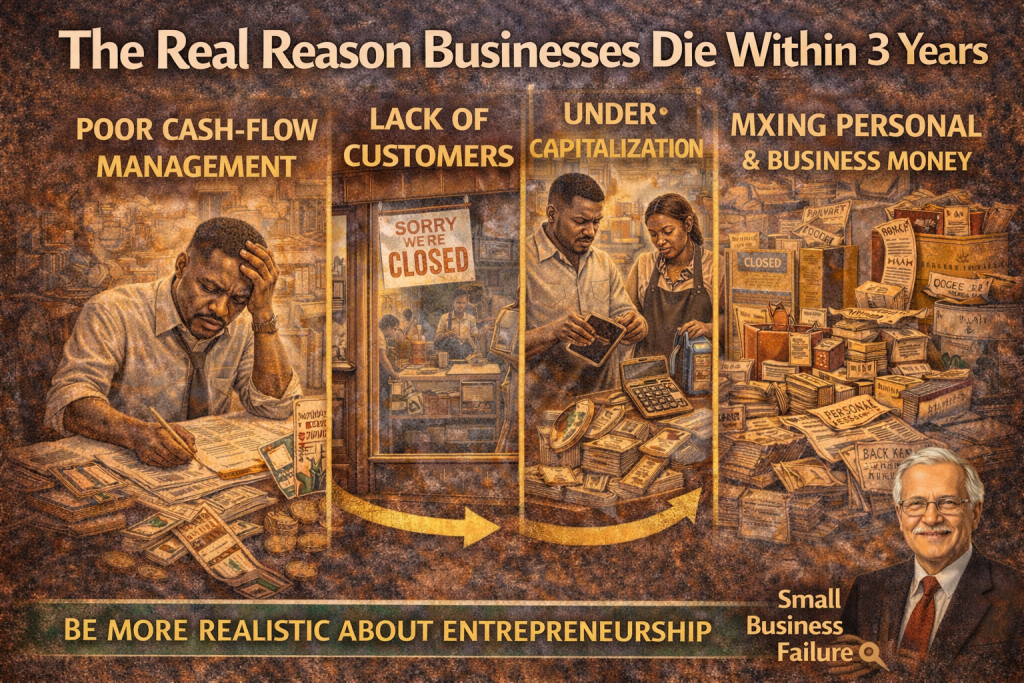
The Real Reason Businesses Die Within 3 Years
Across many economies, starting a business is often celebrated as a symbol of ambition, independence, and economic opportunity. From small retail shops and restaurants to technology startups and consulting services, entrepreneurship promises the possibility of financial freedom and personal achievement.
Yet the reality of business survival is far more difficult than the dream.
A widely cited pattern in global entrepreneurship research shows that a large percentage of new businesses fail within their first three years. While the exact numbers vary by country and industry, the pattern is remarkably consistent: the early years of a business are the most dangerous.
The reasons behind these failures are rarely mysterious. In fact, they have been documented repeatedly in business research around the world. Most businesses fail not because the founders lacked passion or intelligence, but because they underestimated several fundamental economic realities of running a business.
Understanding these factors can help entrepreneurs avoid costly mistakes and build more resilient enterprises.
The Cash-Flow Problem
The most common reason businesses fail is poor cash-flow management.
Cash flow refers to the movement of money into and out of a business. Even profitable businesses can collapse if they do not manage cash flow properly.
A business may generate revenue through sales, but those sales do not always produce immediate cash. Customers may delay payments, inventory may remain unsold, or operational costs may exceed incoming revenue.
At the same time, expenses continue regardless of sales performance. Businesses must regularly pay:
- rent
- employee salaries
- inventory suppliers
- utilities
- transportation costs
- marketing expenses
If cash leaves the business faster than it enters, the business will eventually run out of money—even if it appears successful on the surface.
This problem is so common that many business experts describe cash flow as the lifeblood of any enterprise.
Research from organizations such as the U.S. Small Business Administration consistently highlights cash-flow mismanagement as one of the leading causes of small business failure.
Successful entrepreneurs therefore focus not only on revenue but also on timing, liquidity, and financial discipline.
The Customer Shortage
Another major reason businesses collapse is lack of customers.
Many entrepreneurs start businesses based on personal enthusiasm rather than verified market demand. They may believe strongly in their product or service, but belief alone does not guarantee that customers will pay for it.
Businesses exist to solve problems for customers. If a business does not attract enough people willing to pay for its solution, revenue will remain too small to sustain operations.
Customer shortages often arise from several issues:
- poor market research
- weak marketing strategies
- misunderstanding customer needs
- excessive competition
- poor product-market fit
Entrepreneurs sometimes focus heavily on product development while neglecting the equally important task of customer acquisition.
In reality, the success of a business depends less on how impressive the product appears and more on whether people are willing to buy it consistently.
A simple rule often cited in entrepreneurship circles is this: a business without customers is not a business—it is an idea.
Undercapitalization
Many businesses fail simply because they begin with too little capital.
Starting a business requires more financial resources than many new entrepreneurs initially expect. Beyond the obvious costs of equipment or inventory, businesses also face numerous operational expenses during their early stages.
These include:
- rent and facility costs
- employee wages
- marketing campaigns
- regulatory compliance
- supply chain logistics
- product development
It may take months—or even years—for a new business to generate stable revenue. During this period, the company must rely on its initial capital reserves to survive.
When businesses start with insufficient funding, they may run out of money before the enterprise has enough time to grow.
Research on small business survival frequently highlights undercapitalization as a major contributor to early failure. Entrepreneurs often underestimate both the amount of money required and the length of time needed before profitability emerges.
A realistic financial plan must therefore include significant operating reserves to withstand the uncertain early stages of business development.

Mixing Personal and Business Money
Another critical mistake that destroys many businesses is mixing personal finances with business finances.
In the early stages of entrepreneurship, it is common for business owners to rely on personal funds to support operations. While this may be unavoidable at the beginning, failing to maintain clear financial separation can create serious problems.
When personal and business money are mixed, several risks emerge:
- inaccurate financial records
- inability to track true profitability
- tax complications
- uncontrolled spending
- difficulty attracting investors or lenders
Without clear accounting, entrepreneurs may believe their business is performing well even when it is quietly losing money.
Maintaining separate accounts, budgets, and financial records is essential for understanding the real financial health of a business.
Professional financial management is not just for large corporations—it is a fundamental discipline for even the smallest enterprise.
The Psychological Side of Business Failure
Beyond financial and operational factors, psychological elements also play a role in business survival.
Many entrepreneurs start businesses with extraordinary enthusiasm but underestimate the persistence and discipline required for long-term success.
Running a business often involves:
- uncertainty
- long working hours
- financial pressure
- slow growth
- repeated setbacks
Without realistic expectations, entrepreneurs may become discouraged when success does not appear quickly.
This is why experienced business mentors often emphasize that entrepreneurship is not merely about ideas—it is about execution, patience, and resilience.
The Importance of Financial Literacy
A recurring theme behind many business failures is limited financial literacy.
Entrepreneurs may possess excellent technical or creative skills yet lack training in financial management. Without understanding cash flow, budgeting, pricing strategies, and cost control, businesses become vulnerable to avoidable mistakes.
Learning the fundamentals of finance can significantly improve a business’s chances of survival.
This includes understanding:
- profit margins
- operating costs
- break-even analysis
- cash-flow forecasting
- pricing strategy
When entrepreneurs understand these concepts, they can make informed decisions that strengthen their businesses rather than weaken them.
Building a More Realistic Approach to Entrepreneurship
Recognizing why businesses fail does not mean entrepreneurship is futile. On the contrary, millions of successful businesses exist precisely because their founders learned how to navigate these challenges.
The key difference between struggling businesses and thriving ones often lies in preparation and realism.
Entrepreneurs who increase their chances of success typically focus on several important principles:
First, they manage cash flow carefully and monitor finances regularly.
Second, they prioritize customer acquisition and ensure genuine demand for their products.
Third, they secure sufficient capital to sustain the business during its early stages.
Fourth, they maintain strict separation between personal and business finances.
These practices may seem simple, but they dramatically improve the probability of long-term survival.
Final Thought
The failure of many small businesses within their first three years is not primarily due to lack of intelligence or effort. Instead, it reflects the complex financial and operational realities of entrepreneurship.
Running a successful business requires far more than a good idea. It demands financial discipline, strategic planning, customer understanding, and patience.
Entrepreneurs who approach business with realistic expectations—and who learn from the documented patterns of business failure—are far more likely to build companies that endure.
In the end, sustainable entrepreneurship is not about chasing quick success.
It is about building systems strong enough to survive the difficult early years and grow into lasting economic value.