
The Rise of Neobanks: Are Traditional Banks Becoming Obsolete?
By WealthQuizzes Editorial Team
What Neobanks Are and How They Operate
Imagine a bank without queues, paper forms, or physical branches — just your phone, an internet connection, and an app that gives you total control of your finances. That’s the world of Neobanks.
Neobanks, also known as digital-only banks, are financial technology (fintech) institutions that operate entirely online. They provide traditional banking services — savings, payments, loans, and investments — but with the speed and convenience of mobile technology.
Unlike traditional banks that require costly physical infrastructure, neobanks rely on software, automation, and cloud systems to deliver seamless user experiences.
Their model is simple:
- Low fees (or no fees at all),
- Instant account setup,
- User-friendly apps, and
- Financial insights powered by data analytics.
By removing the friction of paperwork and bureaucracy, neobanks are redefining how individuals and small businesses interact with money.
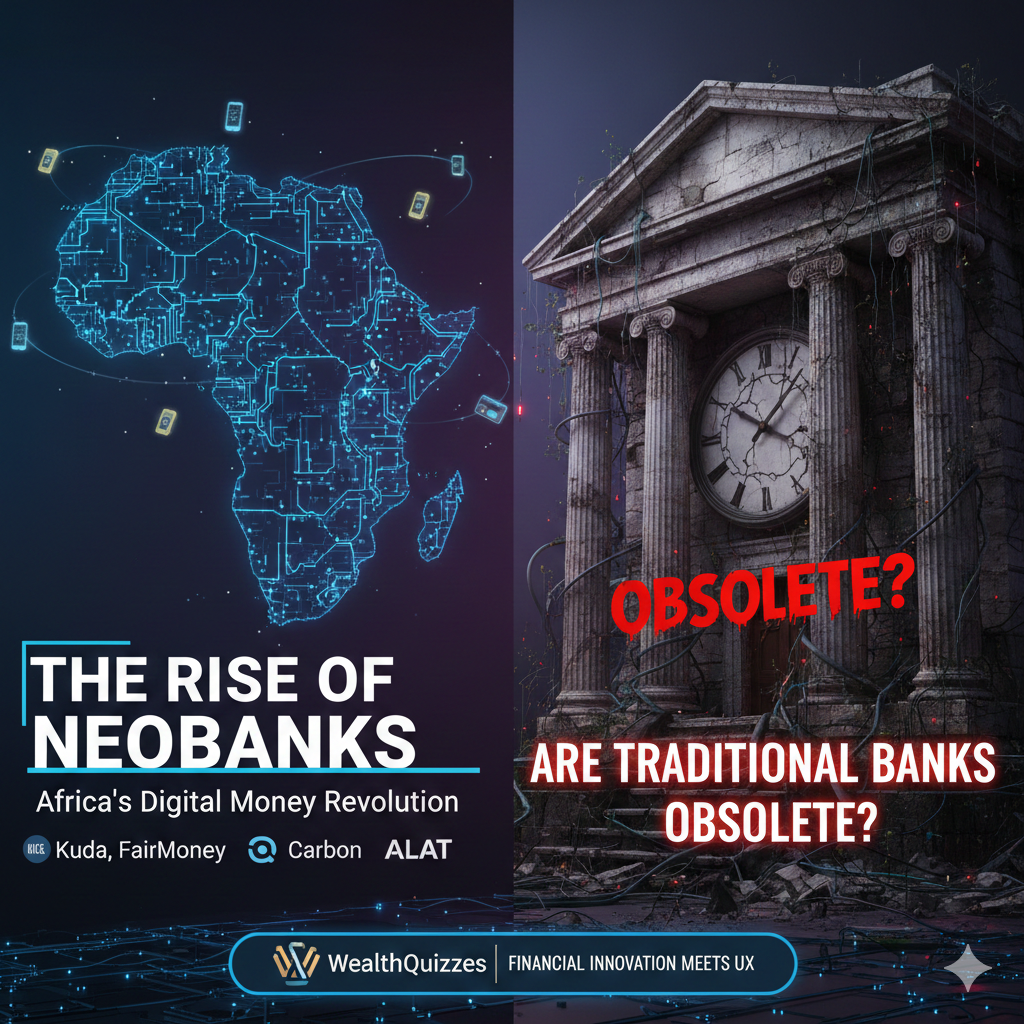
Key Players: Kuda, FairMoney, Carbon, and ALAT
Africa’s neobank scene has grown rapidly in the past five years, fueled by mobile penetration, fintech innovation, and youthful consumer demand. Some of the most successful examples include:
Kuda Bank (Nigeria)
Often dubbed “the bank of the free,” Kuda offers a no-fee banking experience with instant transfers, smart budgeting tools, and automatic savings features. It’s licensed by the Central Bank of Nigeria (CBN) and has attracted millions of users across the country.
FairMoney
Initially a digital lender, FairMoney evolved into a full-service neobank, offering instant loans, bill payments, and debit cards. Its focus on financial inclusion makes it particularly attractive to underserved customers.
Carbon (formerly Paylater)
Carbon is one of Africa’s earliest fintech success stories. It offers credit, payments, investments, and insurance — all digitally. Its AI-driven credit scoring system gives users fast, data-based access to financial services.
ALAT by Wema Bank
ALAT holds the distinction of being Nigeria’s first fully digital bank — launched by a traditional institution that decided to reinvent itself. It bridges the gap between legacy banking and fintech agility.
Together, these platforms show how innovation, design, and customer-centricity are driving the future of finance in Africa.
Why Millennials Prefer Neobanks
For Africa’s young, mobile-first generation, traditional banking feels outdated. Millennials and Gen Z — who make up more than 60% of Africa’s population — are not just customers; they are digital natives.
Here’s why they’re choosing neobanks:
- Convenience: Account opening takes minutes — no forms, no branches.
- Low Fees: Digital efficiency means lower operational costs, and savings are passed on to customers.
- Transparency: Neobanks provide real-time notifications, balance updates, and clear fee structures.
- Speed: Transfers, loans, and payments happen instantly.
- Personalization: Apps use data to provide insights — from spending habits to smart savings tips.
In short, neobanks speak the same language as their users: fast, simple, and digital.
They empower customers to manage money actively rather than reactively — a major leap toward financial literacy and independence.
Trust, Regulation, and Consumer Protection Issues
But innovation brings new questions.
Can consumers trust banks they can’t see? Who protects users when systems fail or data leaks occur?
These are critical challenges facing neobanks and regulators alike.
- Trust: Many customers still feel safer depositing money in physical banks they can visit. Neobanks must earn trust through reliability, transparency, and customer support.
- Regulation: Some neobanks operate under partnership models, using the licenses of traditional banks. Clear, updated frameworks are needed to protect users and ensure accountability.
- Data Security: Since neobanks rely on cloud computing and digital identities, cybersecurity and data privacy are paramount.
- Financial Education: Many users adopt neobanks for convenience but lack awareness of their rights and obligations in digital finance.
African regulators — like the Central Bank of Nigeria (CBN) and Bank of Ghana — are increasingly issuing guidelines for fintechs and digital banks. The goal is to balance innovation with consumer protection, ensuring progress doesn’t outpace safety.
Can Traditional Banks Compete in a Digital Age?
The rise of neobanks doesn’t mean the death of traditional banking — but it’s forcing the industry to evolve faster than ever before.
Traditional banks have advantages:
- Established customer bases,
- Strong capital reserves, and
- Deep regulatory experience.
But they also face challenges:
- High operating costs,
- Legacy systems, and
- Slower decision-making.
Many traditional institutions are responding strategically:
- Digitizing services: Launching mobile apps and e-channels.
- Partnering with fintechs: To accelerate innovation.
- Creating hybrid models: Offering both physical and digital experiences.
The future of banking in Africa is not neobanks versus traditional banks, but collaboration — where agility meets trust, and innovation meets stability.
Ultimately, customers will decide who wins — and they’re voting with their smartphones.
The African Relevance: A Revolution Rooted in Inclusion
Africa’s banking revolution is not about luxury — it’s about access.
For decades, millions of Africans were excluded from formal finance due to distance, bureaucracy, or lack of documentation. Neobanks are breaking those barriers, offering financial inclusion at scale.
From rural traders using mobile wallets to freelancers receiving payments online, digital banking is unlocking new forms of entrepreneurship, savings, and investment.
This democratization of finance may be one of the most important socio-economic shifts of our time.
WealthQuizzes Perspective: Financial Innovation Meets Empowerment
At WealthQuizzes, we believe that financial literacy is the foundation of digital empowerment.
The rise of neobanks shows that innovation only becomes meaningful when people understand how to use it wisely.
Our mission is to help Africans:
- Grasp new financial technologies,
- Make informed digital banking choices, and
- Manage money confidently in the modern economy.
By learning how fintech and neobanks operate, users move from being passive consumers to active participants in Africa’s financial evolution.
Because true wealth in the digital age doesn’t just come from access to technology — it comes from the intelligence to use it well.