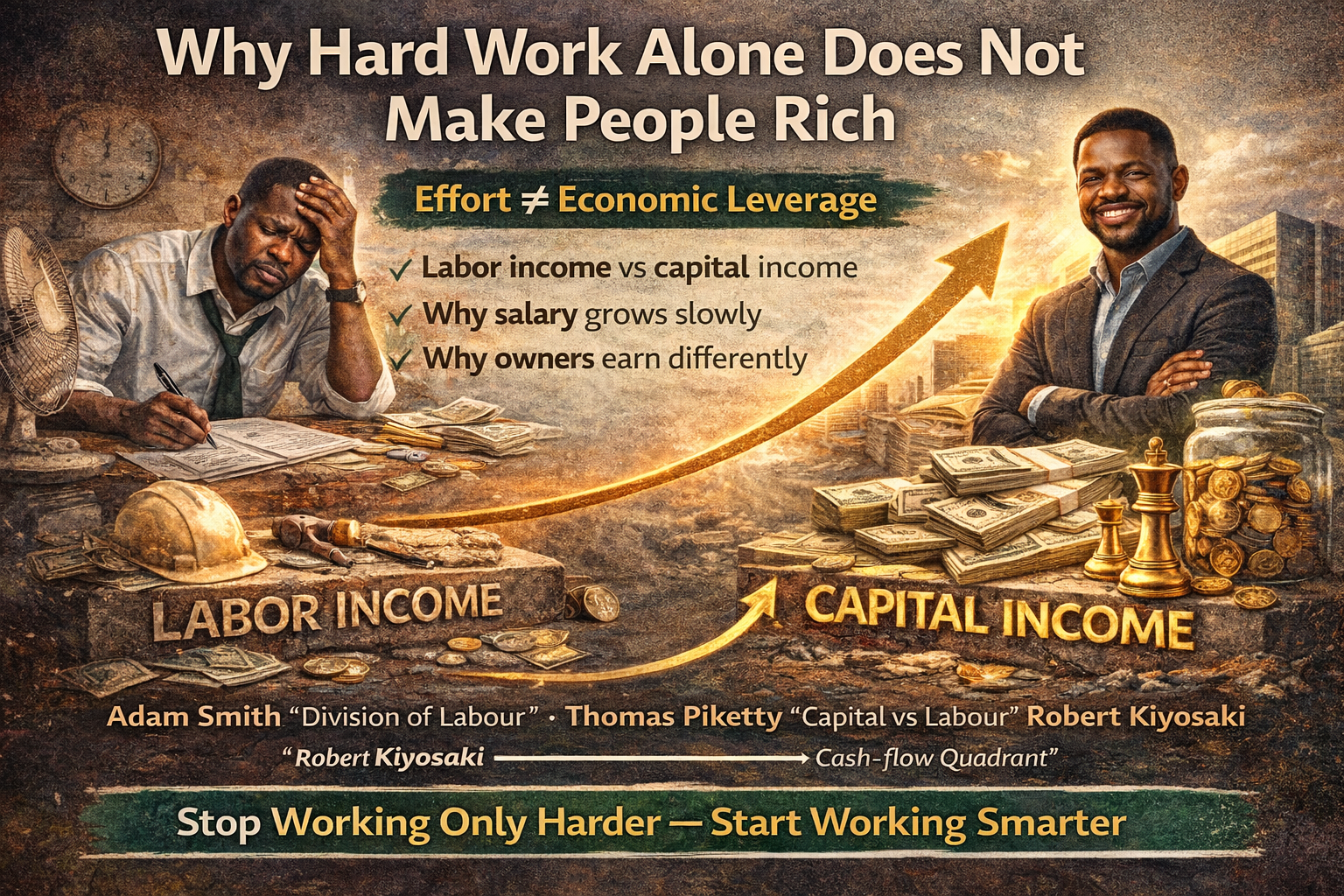
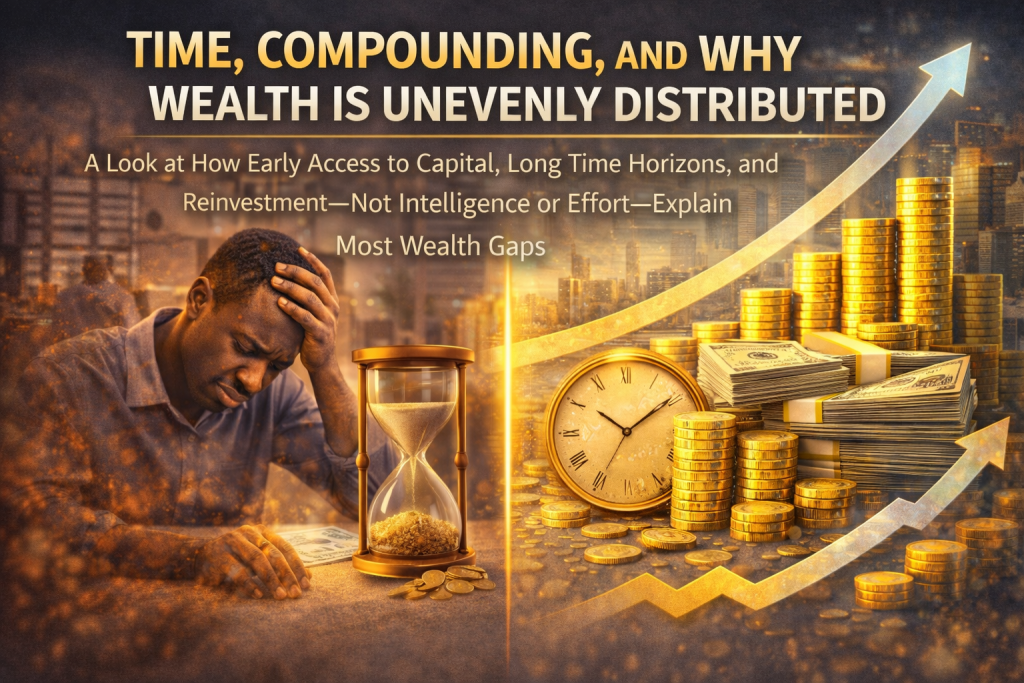
Time, Compounding, and Why Wealth Is Unevenly Distributed
Introduction
Across societies, one question persistently appears: why do a small number of individuals accumulate vast wealth while the majority work their entire lives without achieving financial security?
The common explanation points to effort, intelligence, education, or discipline. Yet economic history, finance theory, and empirical research consistently suggest a different answer. Wealth inequality is not primarily a moral story about virtue and laziness. It is largely a mathematical and structural story about time, compounding, and access to capital.
In simple terms:
Wealth does not grow linearly — it grows exponentially.
And exponential systems always produce unequal outcomes.
This article explains how compounding works, why early access to capital matters more than effort, and why long time horizons—not talent—explain most persistent wealth gaps.
1. The Mathematics of Compounding
Albert Einstein is often (perhaps apocryphally) credited with calling compound interest “the eighth wonder of the world.” Whether or not he said it, finance theory treats the statement as economically accurate.
Compounding occurs when returns generate additional returns. Instead of growth adding value, growth begins multiplying value.
A wage grows arithmetically:
Salary + salary + salary = linear progress
An invested asset grows geometrically:
Capital × (1 + return)^time = exponential progress
The distinction is decisive.
Benjamin Graham, the foundational figure in modern investment analysis and mentor to Warren Buffett, emphasized in The Intelligent Investor that long-term investing is less about brilliant decisions and more about remaining invested long enough for compounding to operate.
Warren Buffett himself provides a real-world demonstration. Over 99% of his net worth was accumulated after his 50th birthday—not because he suddenly became more intelligent, but because compounding finally had sufficient time to magnify earlier capital.
2. Time: The Most Important Financial Asset
In finance, capital has a partner: time.
Without time, capital cannot compound.
Economist Irving Fisher, one of the pioneers of intertemporal choice theory, explained that interest rates fundamentally reflect the relationship between present consumption and future consumption. People who can delay consumption allow capital to accumulate.
However, this ability is not equally distributed.
A worker living paycheck-to-paycheck cannot invest consistently because income must meet immediate survival needs. An individual born into financial security can invest early and remain invested through volatility.
This leads to a structural reality:
Wealth inequality often begins not with different incomes, but with different starting times.
Thomas Piketty, in Capital in the Twenty-First Century, formalized this observation with his now famous inequality:
r > g
Where:
- r = rate of return on capital
- g = growth rate of the economy (and typically wages)
When returns on capital exceed economic growth, owners of capital grow richer faster than workers can catch up.
In other words, labor progresses — capital accelerates.
3. Early Access to Capital
Consider two individuals:
- Person A starts investing at age 22
- Person B starts investing at age 40
- Both invest the same yearly amount
Finance calculations consistently show that Person A will end up with multiples of Person B’s wealth — even if Person B invests more aggressively.
Why?
Because compounding rewards time in the system more than effort inside the system.
Economist John Maynard Keynes described interest as a reward not merely for saving but for liquidity preference — the willingness to defer immediate spending. Those with economic stability can do this. Those without cannot.
This explains a persistent social pattern:
Children of wealthier households invest earlier, take risks earlier, and recover from mistakes earlier. The poor cannot afford early mistakes, and therefore often cannot participate in compounding at all.
4. Reinvestment: The Engine of Wealth
Compounding only works if gains are reinvested.
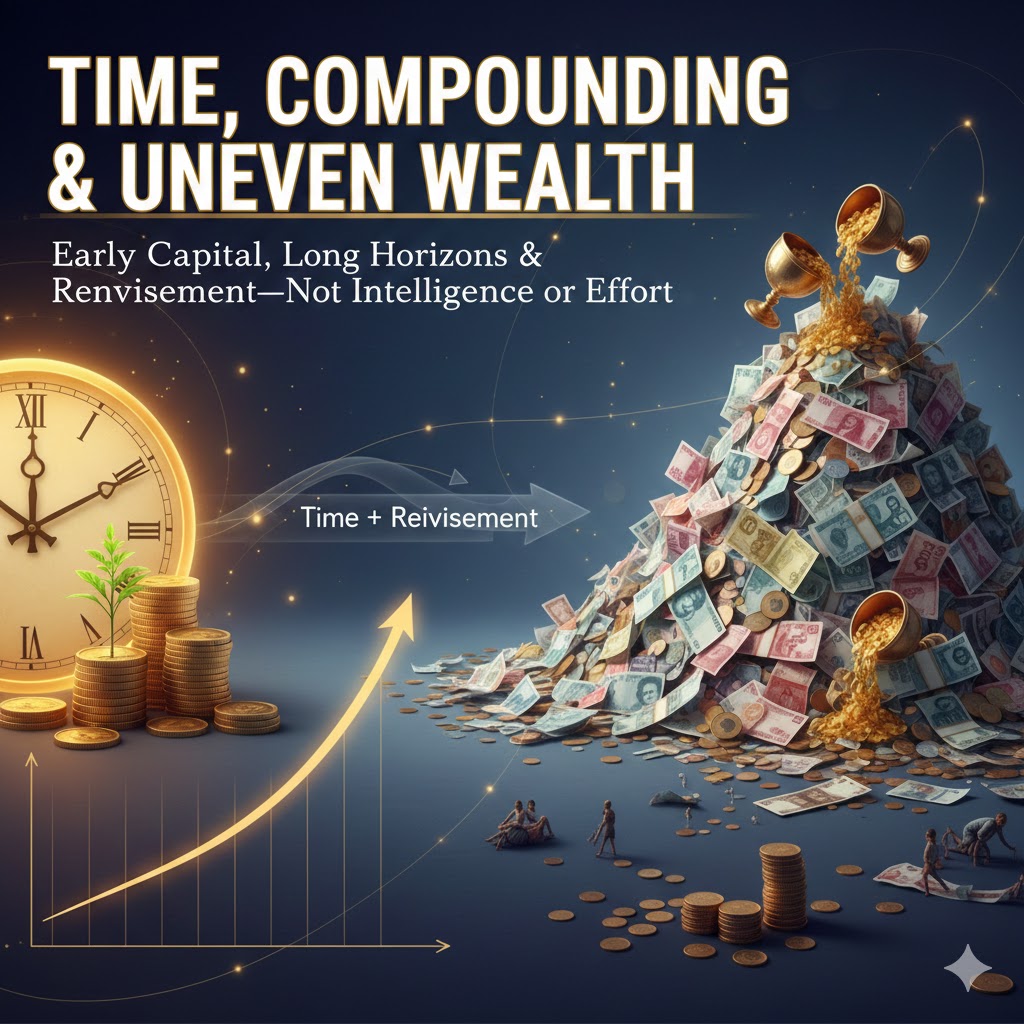
A wage is consumed.
A profit can be reinvested.
This distinction was central to classical economics. Adam Smith in The Wealth of Nations emphasized that capital accumulation—not labor alone—drives economic expansion. Profits that are saved and reinvested expand productive capacity, which then generates further profits.
Modern finance agrees. Corporate finance theory treats retained earnings as one of the most powerful drivers of firm valuation. Companies that continuously reinvest cash flows grow far faster than those distributing all earnings.
Individuals operate similarly:
- Spending income maintains lifestyle
- Reinvesting income builds wealth
The wealthy typically reinvest.
The financially constrained must consume.
5. Why Effort Cannot Catch Exponential Growth
Human labor is biologically constrained. A person can work only a fixed number of hours.
Capital has no such limitation.
A factory can operate 24 hours.
Software can scale to millions of users.
Financial assets earn returns continuously.
Economist Robert Solow’s growth model distinguished between labor-driven growth and capital-driven growth. Long-run increases in output depend primarily on capital accumulation and productivity, not additional labor hours.
This produces a structural asymmetry:
| Labor | Capital |
|---|---|
| Linear | Exponential |
| Time-limited | Time-independent |
| Consumed | Reinvested |
| Active effort | Passive growth |
This is why two individuals with equal intelligence and equal work ethic can experience radically different financial outcomes.
6. Volatility and the Advantage of Patience
Compounding requires surviving downturns.
Behavioral economist Daniel Kahneman showed that humans are loss-averse — losses feel psychologically stronger than gains. As a result, many individuals exit investments during volatility.
Those without financial buffers must withdraw during crises. Those with capital reserves remain invested.
The consequence is profound:
The ability to stay invested is often more important than the ability to choose investments.
This explains why long-term institutional investors — pension funds, sovereign wealth funds, and endowments — systematically outperform individuals. They possess time horizons measured in decades, not months.
7. The African Context
In many African economies, compounding faces additional obstacles:
- High inflation
- Currency depreciation
- Limited capital markets access
- Informal employment structures
When inflation is high, savings lose real value. Without accessible investment vehicles, individuals cannot convert savings into productive assets. Thus, large populations remain trapped in income cycles rather than capital cycles.
Economist Hernando de Soto observed that many developing economies contain vast “dead capital” — assets such as land or enterprises that cannot easily be leveraged due to weak property rights or legal frameworks. Without formalization, assets cannot compound.
Therefore, wealth inequality is not merely personal — it is institutional.
8. Why Wealth Concentrates
Combine all the elements:
- Early access to capital
- Long time horizons
- Continuous reinvestment
- Ability to survive downturns
- Institutional support
The result is predictable: wealth concentrates.
French economist Thomas Piketty’s historical datasets spanning centuries show that large fortunes rarely come primarily from labor income. They come from accumulated capital that compounds across generations.
This is not accidental. It is a direct consequence of exponential mathematics.
Conclusion
Wealth inequality is often explained using moral narratives — discipline versus laziness, intelligence versus ignorance. Economic theory, however, provides a clearer answer.
Wealth is shaped primarily by:
- Time
- Compounding
- Access to capital
- Reinvestment
- Institutional structure
Hard work can generate income.
But time multiplied by capital generates wealth.
Those who enter the compounding system early experience accelerating financial growth. Those who enter late — or never — remain dependent on linear income.
Understanding this changes financial thinking. The key question is no longer:
“How hard should I work?”
The better question becomes:
“How quickly can I begin owning assets that compound over time?”
Because in finance, effort matters — but time in compounding matters far more.