
What To Do With Your First ₦100,000
(The Financial Fork in the Road for Young Nigerians)
For many young Nigerians, the first time they accumulate ₦100,000 feels like a breakthrough moment. It may come from a first job salary, NYSC allowance savings, a freelance payment, a small contract, or a business deal. Emotionally, it feels like arrival — a signal that life is finally “starting to move.”
Yet financially, this moment is far more significant than it appears. The first meaningful money a person controls often determines their lifelong financial behavior. It is not merely a spending decision; it is the formation of a financial identity.
Behavioural economists have long observed that early financial choices become habits. Nobel Prize–winning economist Daniel Kahneman explains that humans rely on mental shortcuts, called heuristics. Once a pattern is formed — especially one tied to reward — the brain repeats it automatically. In simple terms, your first serious money teaches your brain what money is for.
This is why the first ₦100,000 is not small money. It is the first real financial fork in the road.
What Usually Happens
In practice, the ₦100,000 rarely survives long. It typically goes into:
- a new smartphone
- clothing and fashion upgrades
- parties and outings
- a “soft life” weekend
- lending money to friends and relatives
Afterward, a powerful psychological loop forms:
“Whenever I receive money, I must spend it.”
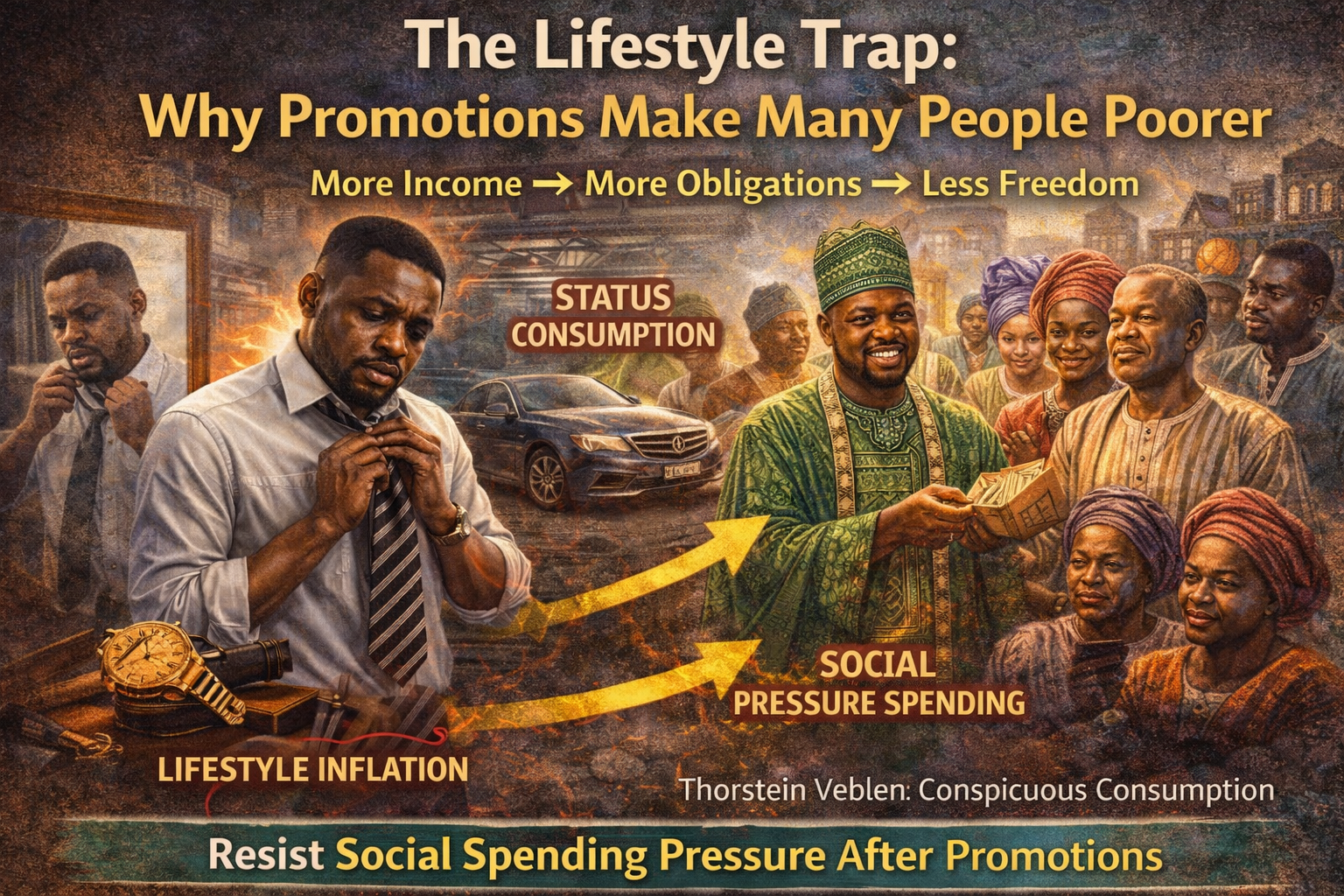
The individual may not consciously decide this. But the brain connects money with immediate pleasure and social validation. From that moment forward, income triggers consumption. Promotions, bonuses, and future earnings follow the same path.
Financial historians such as Thomas Stanley, author of The Millionaire Next Door, observed that many high earners never accumulate wealth because they consistently raise their lifestyle with each increase in income — a phenomenon economists call lifestyle inflation.
The tragedy is not the ₦100,000 spent.
The tragedy is the habit created.
The First Financial Identity
At this stage, a person unknowingly chooses between two identities:
| Identity | Mindset |
|---|---|
| Consumer | Money is for enjoyment and appearance |
| Builder | Money is for capability and independence |
A consumer asks:
“What can I buy now?”
A builder asks:
“What can this money become?”
The difference determines whether future income multiplies or disappears.
What the ₦100,000 Should Actually Do
The first ₦100,000 should not be treated as spending money. It should be treated as foundational capital. Its purpose is to upgrade your financial capacity, not your lifestyle.
A practical framework is to divide the money into four strategic allocations.
1. Emergency Buffer — Psychological Safety
The first allocation is a small emergency reserve.
Many Nigerians live financially exposed. A minor medical bill, transportation crisis, or salary delay immediately creates debt. Without a buffer, people make desperate financial decisions — borrowing at high interest, selling possessions, or interrupting productive plans.
Personal finance expert Dave Ramsey calls this the “starter emergency fund.” Its primary function is not investment. Its function is stability.
Why this matters psychologically:
When a person has even a modest reserve, their decision-making changes. They stop operating in survival mode. They can refuse exploitative loans and avoid panic spending. The brain shifts from fear to planning.
This is the first step toward wealth: not investment, but control.

2. Learning — Skill or Certification
The second portion should be invested in knowledge or skill acquisition.
Economists refer to this as human capital — the productive ability inside the individual. Nobel laureate Gary Becker demonstrated that skill investment consistently produces higher long-term returns than most financial assets.
Examples include:
- digital skills (design, editing, coding)
- professional certifications
- trade skills
- writing or tutoring ability
- specialized software competence
Unlike money, skill cannot be stolen, inflated away, or easily lost. It produces income repeatedly.
This is crucial in Nigeria’s economic environment, where job stability is uncertain. A skill creates a second income stream independent of an employer.
3. Productivity Tool — Earning Equipment
The third allocation purchases a tool that enables income generation.
This could be:
- a modest laptop
- reliable internet setup
- a camera
- professional software
- work equipment
Here lies an important distinction:
A phone bought for status is consumption.
A tool bought for production is an asset.
Warren Buffett once remarked that the best investments increase earning power. A productivity tool does exactly that — it converts knowledge into revenue.
Your first ₦100,000 should not improve how you look.
It should improve what you can do.
4. Seed Capital — Small Income Experiment
The final portion becomes seed capital for a controlled earning experiment.
Not a large business.
Not a risky investment.
An experiment.
This could be:
- selling a specialized service online
- tutoring
- offering document preparation
- small digital products
- structured freelancing
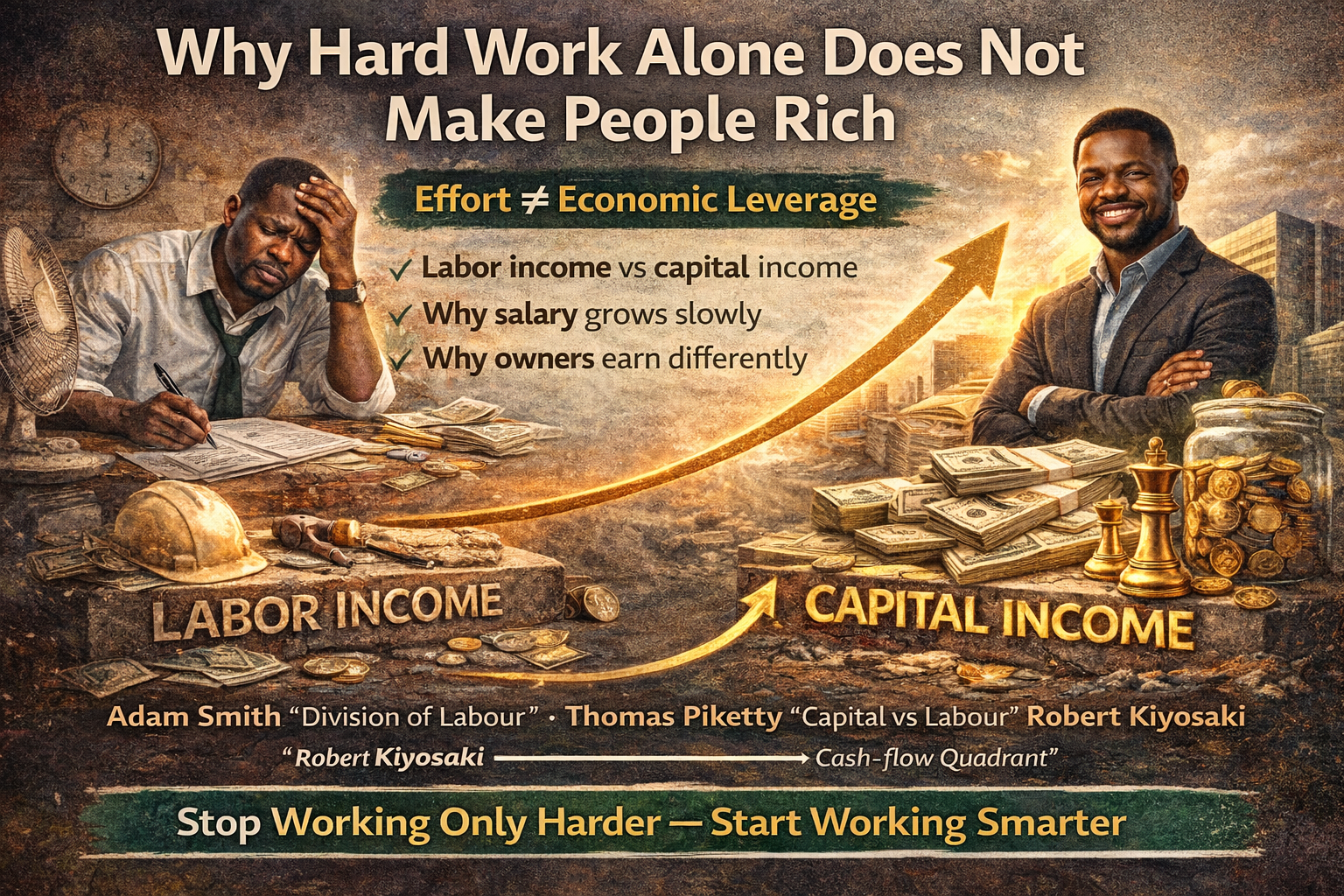
The goal is not immediate profit. The goal is learning how money is created outside employment. This is the moment a person stops being only a worker and becomes a producer.
Entrepreneurship scholars note that successful businesses rarely begin with large capital. They begin with small, repeatable transactions that validate demand. The first ₦100,000 introduces the reader to this principle safely.
The Key Principle
The first ₦100,000 should not upgrade your lifestyle.
It should upgrade your earning capacity.
Most people attempt to look financially successful before becoming financially stable. The wiser approach reverses the order: build capability first, appearance later.
Why This Stage Determines the Future
If the first money becomes consumption, future money will also become consumption.
If the first money becomes productive capacity, future money will multiply.
Psychologists call this habit anchoring. The initial behavior becomes the template for all subsequent financial behavior.
A person who learns early to convert money into earning power develops financial confidence. They are less vulnerable to economic downturns, job loss, or inflation.
The Real Outcome
The goal is not merely saving ₦100,000.
The goal is a transformation:
From asking:
“What can I buy?”
To asking:
“What can start paying me?”
At that moment, the individual stops being only a salary earner and begins becoming an asset builder.
And that — not the amount earned — is the true beginning of wealth.