When to Invest vs When to Save vs When to Learn a Skill
A Practical Financial Ladder for Young Nigerians
One of the most dangerous financial misunderstandings among young Nigerians today is this: many people believe investing is the first step to financial progress.
It is not.
Across campuses, offices, and WhatsApp groups, you hear the same statements:
- “I just want a legit investment.”
- “Which crypto coin should I buy?”
- “Forex trading is the fastest way to grow money.”
Yet, paradoxically, the same people often have:
- no emergency savings,
- unstable income,
- and no monetizable skills.
This explains why thousands of Nigerians repeatedly lose money in Ponzi schemes, speculative crypto cycles, and unstructured forex trading communities. The problem is not intelligence. The problem is sequence.
Economist and Nobel Laureate Milton Friedman emphasized that economic stability depends not only on income but on predictability of income. Likewise, personal finance experts such as Dave Ramsey and Burton Malkiel (author of A Random Walk Down Wall Street) consistently stress a foundational principle: you cannot successfully invest money you still depend on for survival.
In simple terms:
You are not supposed to invest first. You are supposed to stabilize first.
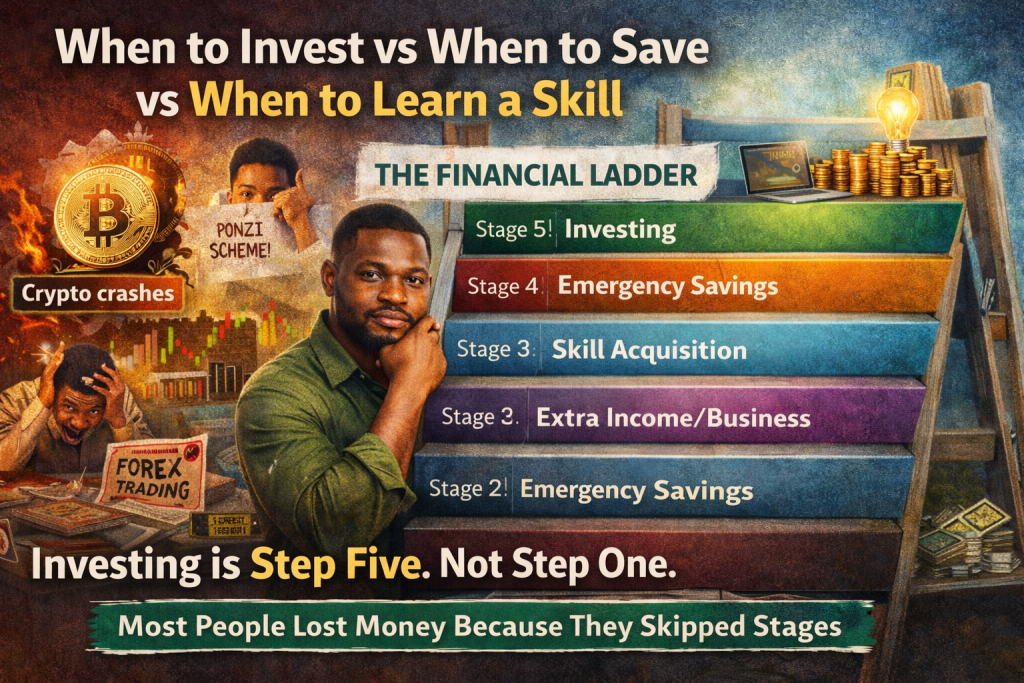
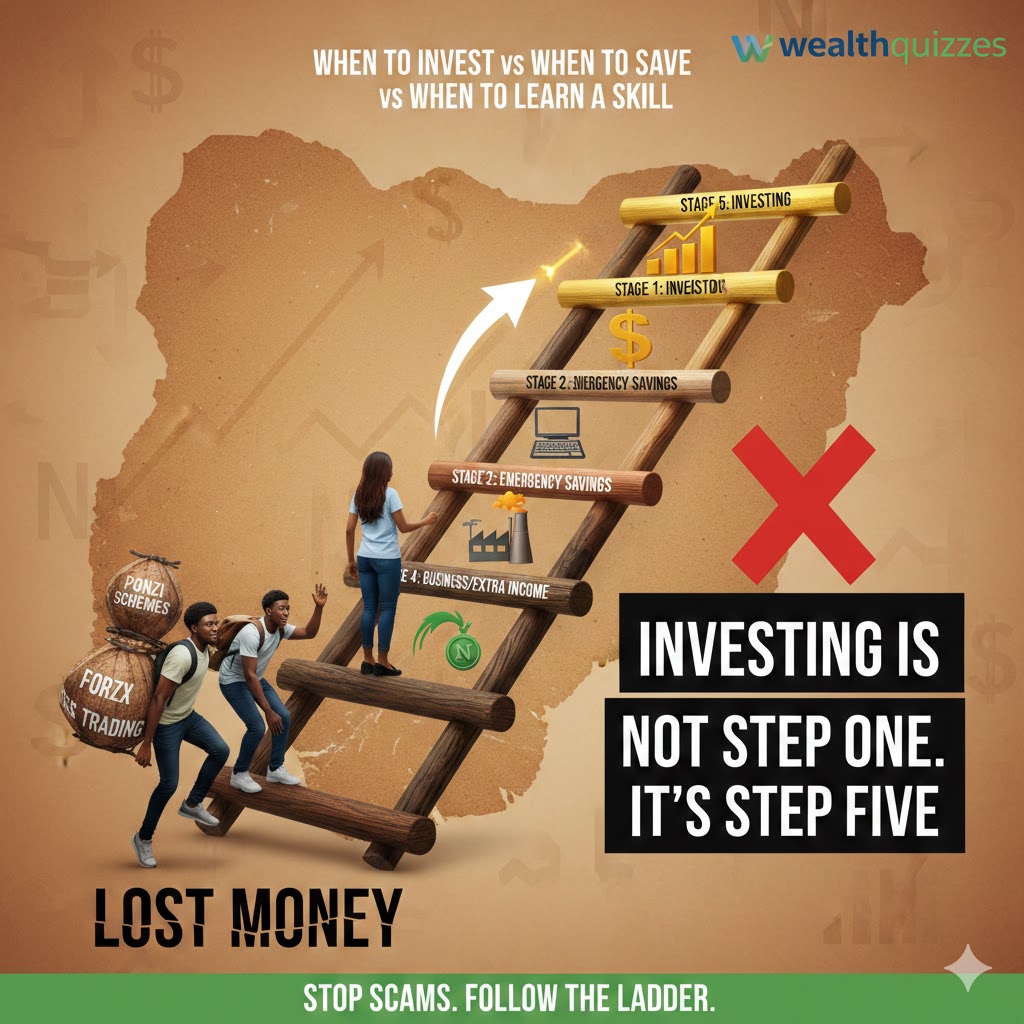
To understand this clearly, we introduce a framework I call The Financial Ladder.
The Financial Ladder
| Stage | Priority |
|---|---|
| Stage 1 | Survival income |
| Stage 2 | Emergency savings |
| Stage 3 | Skill acquisition |
| Stage 4 | Extra income/business |
| Stage 5 | Investing |
Each stage has a different objective. Financial confusion occurs when a person stands on Stage 1 but behaves as if they are already on Stage 5.
Stage 1 — Survival Income
This is where most people actually are.
At this stage:
- salary comes in,
- rent is paid,
- transport is paid,
- food is bought,
- money finishes.
There is no buffer. No margin. No resilience.
Thomas Stanley, co-author of The Millionaire Next Door, found that high earners who live paycheck-to-paycheck rarely accumulate wealth because they lack surplus capital — and wealth accumulation requires surplus, not effort alone.
A person in Stage 1 should not invest.
Why?
Because any loss becomes a crisis.
If ₦200,000 invested disappears, rent becomes impossible. The result is panic borrowing, high-interest loans, and long-term financial damage.
Primary goal at Stage 1:
Stabilize income and spending so life can continue even if salary delays.
Stage 2 — Emergency Savings
This is the most underestimated financial step in Nigeria.
An emergency fund is not an investment.
It is psychological insurance.
Behavioral economist Richard Thaler (Nobel Prize, 2017) showed that financial decision-making improves drastically when individuals are not under immediate survival pressure. In other words, financial intelligence increases when panic reduces.
An emergency fund typically covers 3–6 months of essential expenses:
- rent contribution
- feeding
- transportation
- utilities
Why this matters in Nigeria specifically:
- salaries delay
- layoffs occur suddenly
- medical emergencies are paid out-of-pocket
- inflation erodes purchasing power
Without an emergency buffer, every financial decision becomes desperate — and desperate people are prime targets for scams.
Important:
This money is not to be invested in crypto, forex, or cooperative schemes.
It must remain liquid and accessible.
Only after Stage 2 is complete does the next stage become rational.
Stage 3 — Skill Acquisition
Here is a counter-intuitive truth:
Your first real investment should be into yourself, not the market.
Economist Gary Becker’s Human Capital Theory explains that education and skills function as productive capital — they increase earning capacity the same way machinery increases factory output.
A monetizable skill may include:
- writing
- design
- video editing
- coding
- digital marketing
- data analysis
- tutoring
- technical trades
Why skill comes before investing:
Investing multiplies money.
A skill creates money.
If a person invests ₦100,000 and earns 15% annually, they gain ₦15,000.
But if a skill increases their income by ₦50,000 monthly, the financial impact is exponentially greater.
Warren Buffett himself calls skills “the best asset you can own,” because they cannot be taxed away, inflated away, or stolen.
Stage 4 — Extra Income / Business
At this stage, the individual now has:
- stable income
- emergency savings
- a monetizable skill
Now a side business or extra income becomes logical.
Why?
Because the person can now take controlled risk.
This is where freelancing, consulting, teaching, digital products, and structured small businesses make sense.
Notice the progression:
You did not quit your job impulsively.
You used your job as training capital.
Peter Drucker, the father of modern management, emphasized that successful enterprises begin with knowledge of customers and operations, not merely enthusiasm. Many businesses fail not because business is hard — but because founders enter without competence.
Stage 4 builds the final requirement for investing: surplus capital.
Stage 5 — Investing
Only now does investing become appropriate.
Investing means purchasing assets that produce future income:
- equities
- bonds
- funds
- real estate
- long-term diversified holdings
Burton Malkiel demonstrated that long-term diversified investment works reliably when money is patient capital — funds not needed for immediate living expenses.
Here is the key distinction:
If you need the money next month, it is savings.
If you can leave it untouched for years, it is investment.
Why People Lose Money in Nigeria
Losses in crypto crashes, Ponzi schemes, and informal forex groups rarely occur because investment itself is wrong.
They occur because people:
- skipped savings,
- skipped skills,
- skipped extra income,
- and jumped directly to speculation.
A person without financial stability treats investment as rescue.
A stable person treats investment as strategy.
The first is gambling.
The second is wealth building.
The Core Message
Investing is not step one.
It is step five.
Save first — to survive.
Learn a skill — to earn.
Create extra income — to generate surplus.
Then invest — to multiply.
The Behavioral Shift
Instead of asking:
“Where can I invest to make money quickly?”
The correct question becomes:
“Am I financially ready to invest?”
This single shift dramatically reduces vulnerability to scams — a critical issue in Nigeria’s financial environment.
Financial success is not about finding the fastest opportunity.
It is about following the correct order.
And the correct order is the difference between speculation and wealth.