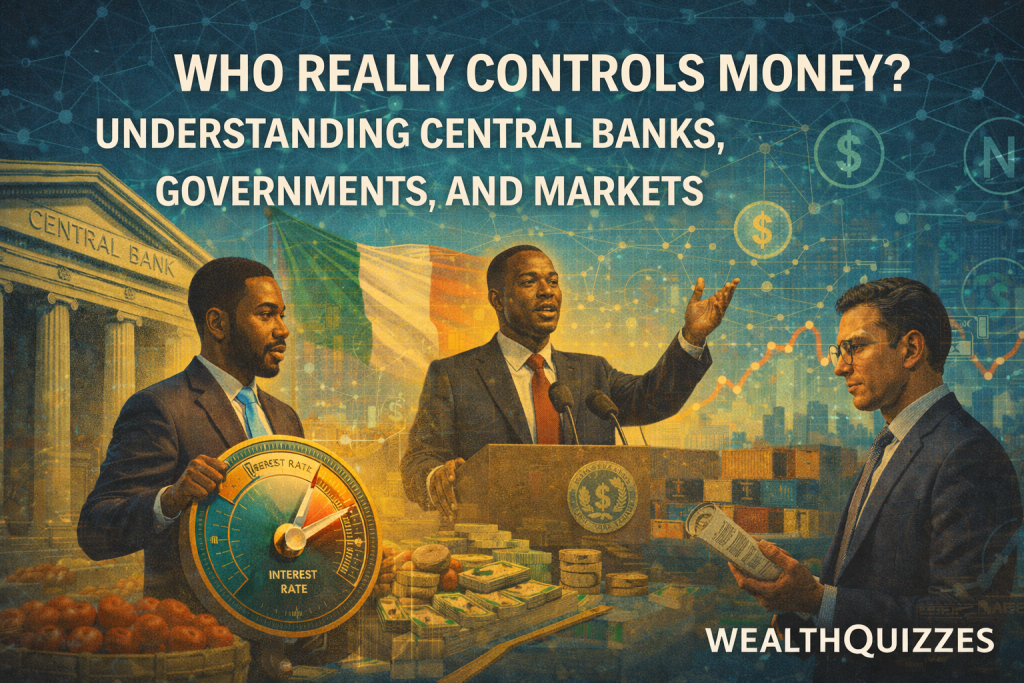
Who Really Controls Money? Understanding Central Banks, Governments, and Markets
By WealthQuizzes Editorial Team
Introduction: The Illusion of Simple Answers
When inflation rises, interest rates spike, or currencies weaken, people often ask a simple question:
“Who is responsible for this?”
Some blame governments. Others blame banks. Many say “the market.”
But the truth is more complex.
Money is not controlled by a single actor. It is governed by a delicate and often tense balance of power between central banks, governments, and financial markets. Understanding this power structure is essential for anyone who wants to make sense of inflation, borrowing costs, exchange rates, and economic stability.
This article explains who really controls money—and how that control actually works.
What Does “Controlling Money” Really Mean?
Before identifying who controls money, we must define what control means.
Control over money involves influence over:
- Money supply (how much money exists),
- Interest rates (the cost of borrowing),
- Liquidity (how easily money flows through the economy),
- Credit availability, and
- Confidence in the currency.
No single institution fully controls all of these at once. Instead, monetary power is shared, contested, and negotiated.
The Central Bank: The Architect of Monetary Conditions
At the heart of the system sits the central bank.
Central banks—such as the Central Bank of Nigeria (CBN), the U.S. Federal Reserve, or the European Central Bank—do not create wealth, but they shape the environment in which wealth is created or destroyed.
Their primary tools include:
- Interest rate policy (e.g., Monetary Policy Rate),
- Open market operations (buying or selling government securities),
- Reserve requirements for banks,
- Liquidity injections or withdrawals, and
- Currency management.
Through these tools, central banks influence:
- Inflation levels,
- Credit expansion or contraction,
- Exchange rate stability, and
- Financial system confidence.
However, central banks do not act in isolation.
They respond to economic conditions, political pressures, global capital flows, and market behavior. Their power is significant—but not absolute.
Governments: Spending Power Without the Printing Press
Governments are often accused of “printing money,” but in modern economies, governments do not directly control money creation.
What governments do control is:
- Fiscal policy (taxation and spending),
- Public borrowing, and
- Budget priorities.
When governments run deficits, they must borrow—often from:
- Domestic banks,
- Capital markets,
- Foreign lenders, or
- Multilateral institutions.
This borrowing influences money supply indirectly. Large government spending can:
- Increase demand in the economy,
- Put pressure on inflation,
- Push interest rates upward, and
- Increase reliance on central bank support.
In weak institutional settings, governments may pressure central banks to finance deficits—eroding monetary discipline. In stronger systems, central banks resist this pressure to protect currency stability.
Thus, governments influence money, but they do not fully control it.
Financial Markets: The Silent Enforcers
Perhaps the most underestimated force in monetary control is the market itself.
Financial markets—bond markets, currency markets, equity markets—respond instantly to:
- Policy decisions,
- Political instability,
- Inflation expectations, and
- Global economic signals.

Who Really Controls Money? Understanding Central Banks, Governments, and Markets
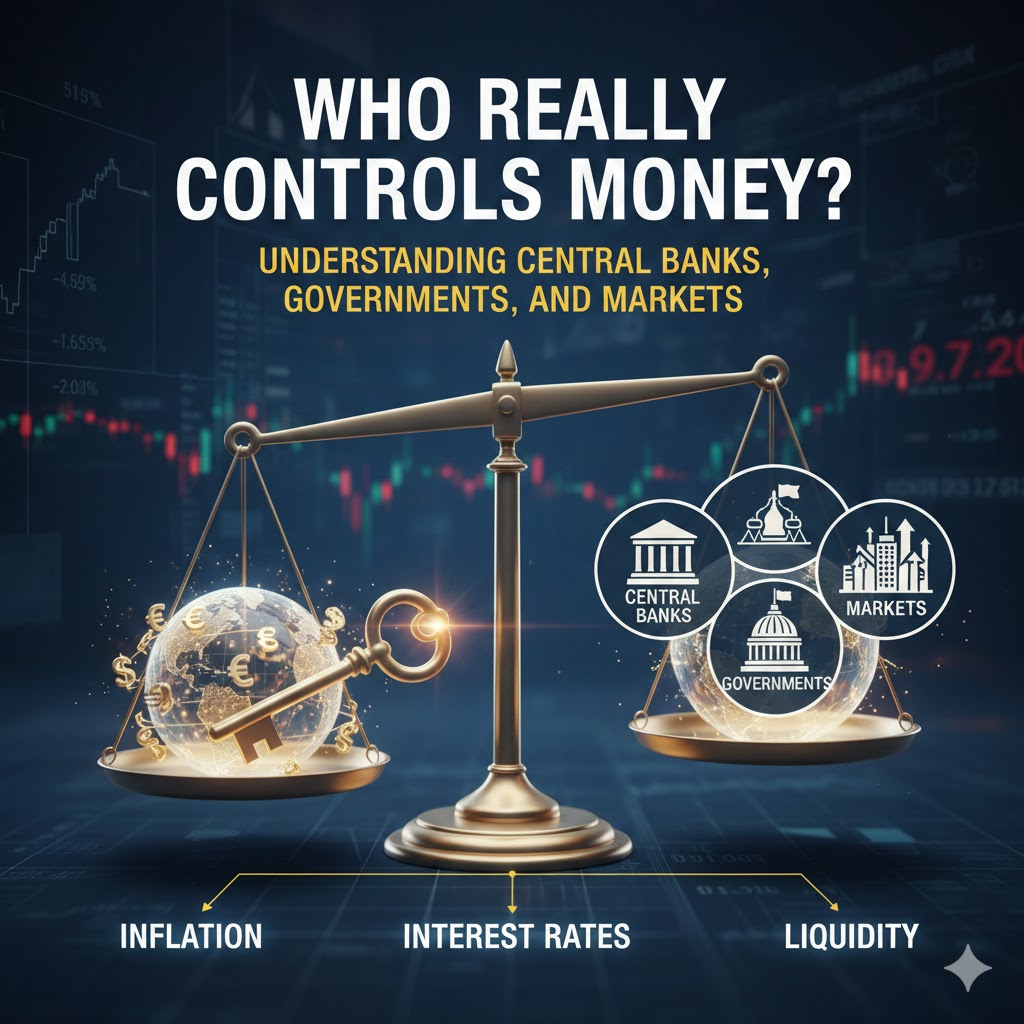
Markets influence money by:
- Setting long-term interest rates,
- Determining currency demand and exchange rates,
- Pricing government debt risk, and
- Rewarding or punishing policy credibility.
For example:
- If investors lose confidence, capital exits the economy.
- If inflation expectations rise, borrowing costs increase—even before central banks act.
- If fiscal policy appears reckless, currencies weaken regardless of official statements.
In this sense, markets discipline both governments and central banks.
Money ultimately flows where confidence exists.
Inflation: Where Power Struggles Become Visible
Inflation is the battleground where monetary power struggles are most visible.
- Central banks try to contain inflation by tightening liquidity.
- Governments may resist tightening if it slows growth.
- Markets react based on whether they believe inflation is truly under control.
Inflation is not caused by one actor alone. It emerges from:
- Excess demand,
- Supply shocks,
- Fiscal expansion,
- Currency depreciation, and
- Loss of confidence.
Whoever loses credibility in managing inflation loses control over money.
Global Forces: The External Constraint
For African and emerging economies, monetary control is further constrained by global financial forces.
These include:
- U.S. interest rate policy,
- Global commodity prices,
- Foreign investor sentiment,
- Dollar liquidity cycles, and
- External debt obligations.
Even the most disciplined local policy can be overwhelmed by external shocks.
This reality means that monetary sovereignty is relative, not absolute—especially in a globalized financial system.
So Who Really Controls Money? The Honest Answer
The honest answer is:
Money is controlled by an ecosystem, not a single authority.
- Central banks set the rules of the game.
- Governments influence outcomes through spending and borrowing.
- Markets enforce discipline through confidence and capital flows.
- Global forces impose external constraints.
Control exists only when credibility, coordination, and confidence align.
When they don’t, inflation rises, currencies weaken, and financial instability follows.
African Reality: Control Without Credibility Is Illusion
In many African economies, the real challenge is not lack of tools—but lack of institutional credibility.
Without:
- Independent central banks,
- Disciplined fiscal policy,
- Transparent governance, and
- Trustworthy data,
control over money becomes fragile.
This is why monetary literacy matters—not just for policymakers, but for citizens, businesses, and investors.
WealthQuizzes Perspective: Why This Knowledge Matters
At WealthQuizzes, we believe financial literacy must go beyond budgeting and saving.
Understanding **who controls money—and how—**helps people:
- Interpret inflation realistically,
- Make smarter investment decisions,
- Avoid emotional financial reactions, and
- Think structurally rather than politically about money.
When people understand systems, they stop chasing rumors and start reading signals.
Because wealth is not built by guessing who is in charge—
it is built by understanding how power flows through financial systems.
And those who understand that flow will always be better positioned to protect and grow their wealth.