
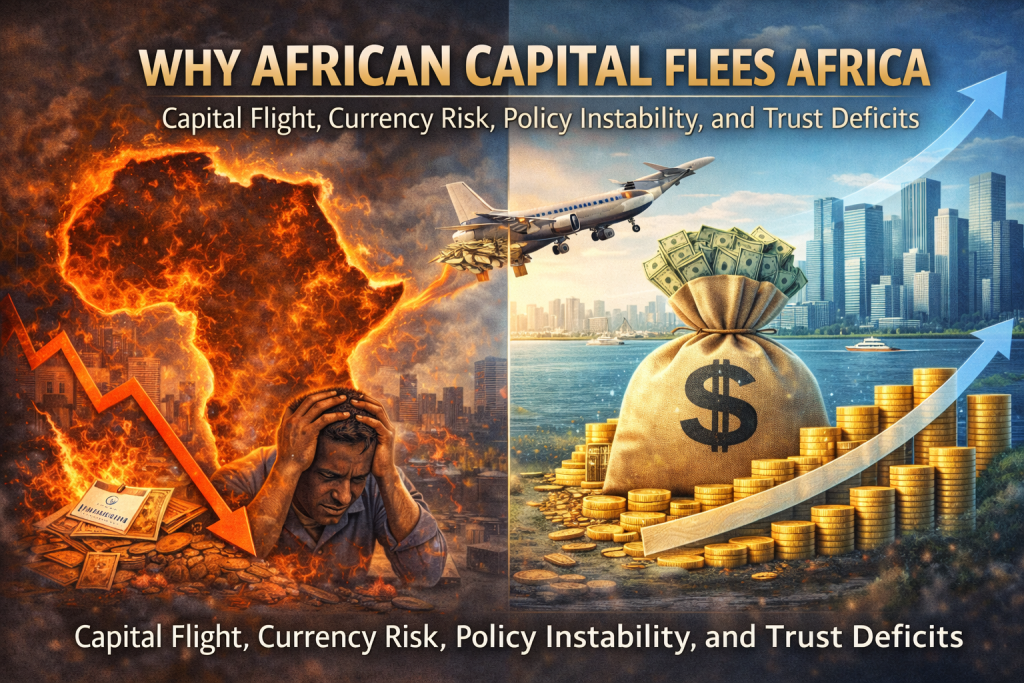
Why African Capital Flees Africa
Capital Flight, Currency Risk, Policy Instability, and the Structural Search for Safety
Introduction
Africa is often described as “capital-poor,” yet this framing conceals a more uncomfortable truth: Africa is not short of capital—it is short of confidence.
Each year, billions of dollars generated within African economies leave the continent through legal and illegal channels, seeking refuge in offshore financial systems. This phenomenon, commonly referred to as capital flight, undermines development, weakens currencies, constrains credit, and entrenches inequality.
As economist Ndikumana and Boyce have documented extensively, Africa has been a net creditor to the rest of the world when capital flight is properly accounted for—a paradox for a continent frequently labeled aid-dependent.
This article examines why African capital flees Africa, not as a moral failing of individuals, but as a systems-level response to risk, incentives, and institutional weakness.
1. What Capital Flight Really Is—and Is Not
Capital flight is not merely illegal money laundering or tax evasion. At its core, it is the movement of capital from perceived high-risk environments to lower-risk jurisdictions.
Forms include:
- Offshore bank deposits
- Foreign real estate purchases
- Foreign equity and bond holdings
- Dollarization of savings
- Trade misinvoicing and profit shifting
As Albert Hirschman explained in Exit, Voice, and Loyalty, when systems fail to inspire trust, rational actors choose exit over engagement.
Capital flight is economic exit.
2. Currency Risk: The First and Most Immediate Trigger
For most African investors and savers, the primary threat is not low returns—it is currency collapse.
Chronic Depreciation
Many African currencies exhibit:
- Persistent depreciation
- Import dependency
- Limited reserve buffers
- Weak export diversification
As Milton Friedman observed, unstable money destroys long-term planning. When local currency cannot reliably store value, capital seeks currencies that can.
Dollarization, euroization, and offshore savings are not speculative behaviors—they are defensive responses to monetary instability.
3. Inflation as a Wealth Transfer Mechanism
Inflation does not affect all economic actors equally.
As John Maynard Keynes warned, inflation “confiscates, arbitrarily and unjustly.” In African economies, inflation:
- Erodes savings
- Penalizes fixed incomes
- Rewards asset holders and political insiders
- Encourages capital to escape monetary erosion
When real interest rates are negative, holding local currency becomes a guaranteed loss. Capital flight becomes rational, not unpatriotic.
4. Policy Instability and Rule Uncertainty
Capital requires predictability more than generosity.
African economies frequently suffer from:
- Sudden policy reversals
- Retroactive taxation
- Capital controls imposed without warning
- Exchange-rate regime shifts
- Regulatory discretion rather than rule-based governance
As Douglass North emphasized, institutions—not resources—determine economic outcomes. Where property rights and contracts are weakly enforced, capital prices in that risk or leaves entirely.
Capital is cowardly by design.
5. Trust Deficits and Institutional Credibility
Financial systems operate on trust:
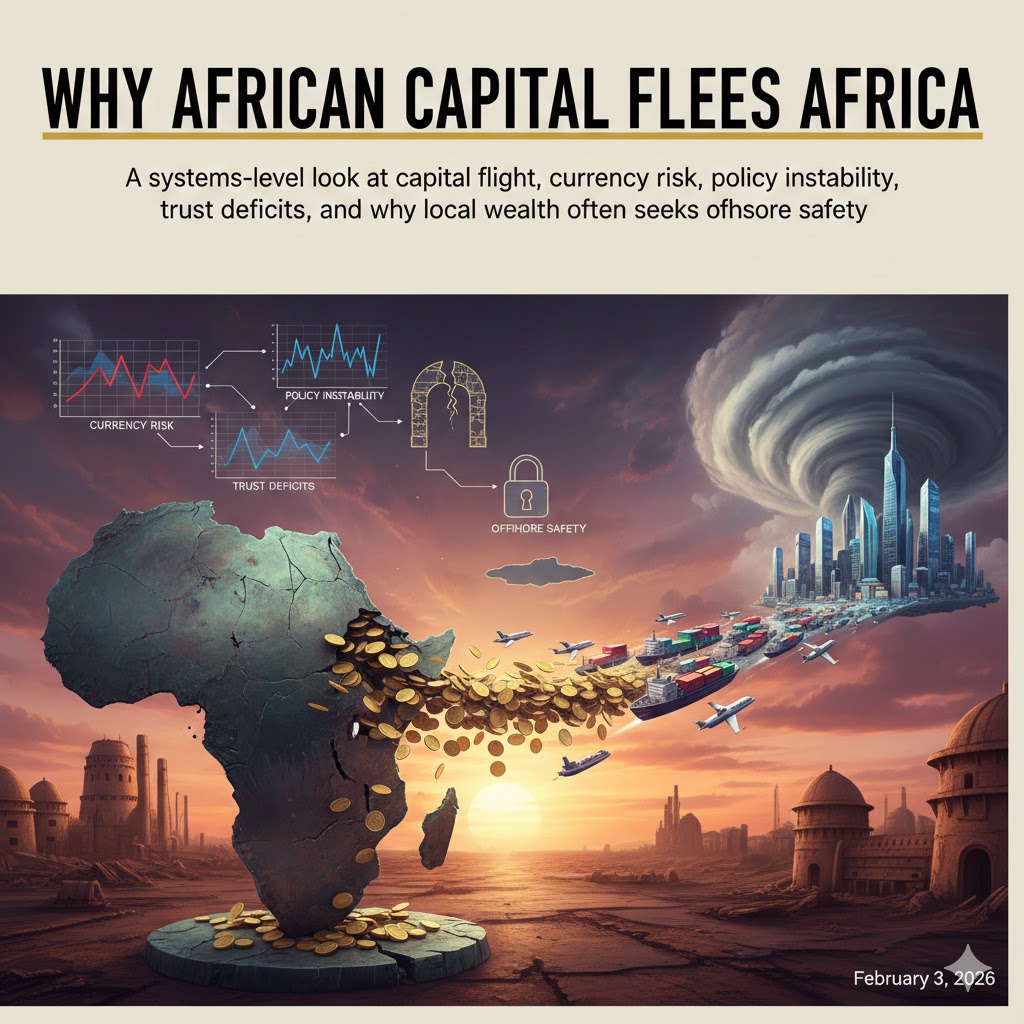
- Trust in courts
- Trust in regulators
- Trust in banks
- Trust in political continuity
Where trust is weak, financial depth remains shallow.
Hyman Minsky’s financial instability framework highlights how fragile institutions amplify risk perception. In such systems, even productive investments feel speculative.
Capital does not flee Africa because returns are low—but because enforcement is uncertain.
6. The Political Economy of Insider Advantage
One of the most under-discussed drivers of capital flight is elite asymmetry.
Those with political access often:
- Hedge currency risk early
- Move funds offshore legally
- Externalize domestic risk
- Leave systemic consequences behind
As Joseph Stiglitz has argued, unequal access to information and protection accelerates capital exit and undermines domestic investment.
When insiders do not trust the system they govern, outsiders take the signal seriously.
7. Weak Financial Markets and Limited Asset Options
Even willing capital often has nowhere to go domestically.
Many African economies lack:
- Deep equity markets
- Long-term bond markets
- Reliable mortgage systems
- Scalable venture financing
As a result, capital cannot easily convert into diversified, liquid, inflation-hedged assets at home. Offshore markets simply offer more instruments, better liquidity, and clearer exit paths.
Capital does not just seek safety—it seeks functionality.
8. Global Financial Architecture and Asymmetric Incentives
The global system encourages capital inflow to developed markets through:
- Strong legal systems
- Stable currencies
- Open capital accounts
- Tax havens and secrecy jurisdictions
Meanwhile, African states face:
- Capital account vulnerability
- Debt dependency
- Policy conditionalities
- Limited monetary autonomy
As Thomas Piketty notes, capital is inherently global while regulation remains national. This asymmetry ensures capital flows toward jurisdictions that protect it best.
9. Capital Flight Is a Symptom, Not the Disease
Attempts to stop capital flight through:
- Capital controls
- Moral appeals
- Financial repression
often fail because they treat symptoms, not causes.
As Keynes understood, confidence—not coercion—anchors capital.
Without:
- Stable money
- Predictable policy
- Enforceable property rights
- Credible institutions
capital will always find an exit.
10. Reversing Capital Flight: What Actually Works
Empirical evidence suggests that capital retention improves when countries:
- Stabilize currencies
- Maintain rule-based governance
- Protect investor rights equally
- Develop domestic capital markets
- Align elite incentives with national outcomes
Capital returns when systems become boring, predictable, and trustworthy.
Conclusion
African capital does not flee because Africa lacks opportunity. It flees because risk is mispriced, trust is weak, and institutions are fragile.
Capital flight is not betrayal—it is feedback.
Until African economies treat monetary stability, institutional credibility, and investor protection as non-negotiable foundations rather than optional reforms, capital will continue to vote with its feet.
As history repeatedly shows:
Capital stays where the rules are clear, the currency holds, and the future is legible.
WealthQuizzes Insight
Capital does not love Africa less.
It simply trusts other systems more.