
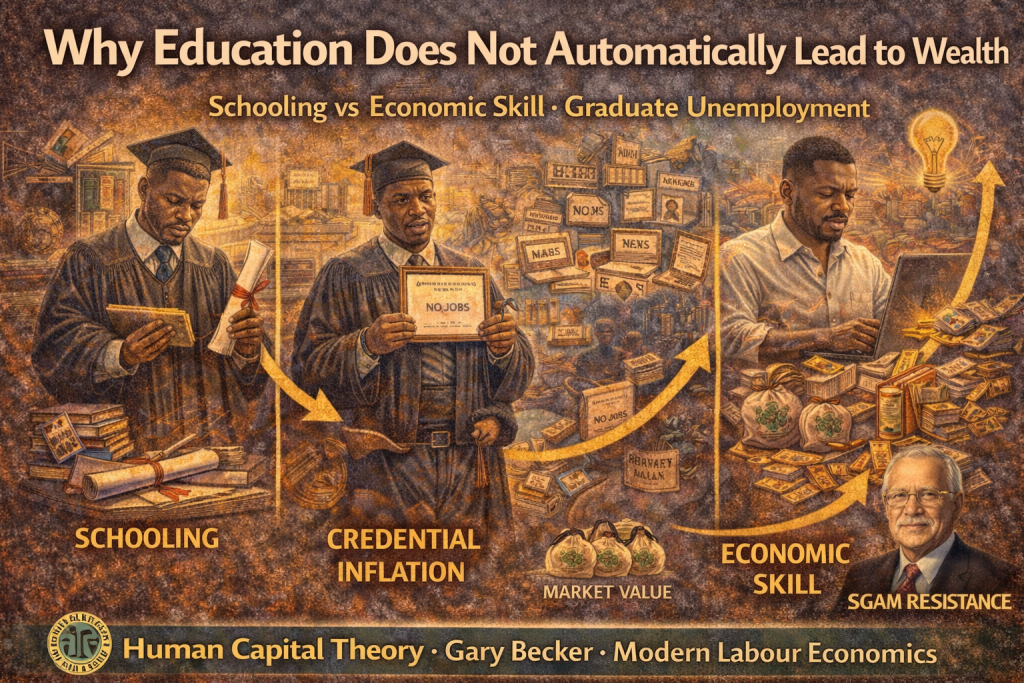
Why Education Does Not Automatically Lead to Wealth
For generations, one message has been repeated across households, classrooms, and public policy discussions: education is the pathway to success. Parents encourage children to study hard, teachers emphasize academic excellence, and governments invest heavily in educational institutions with the expectation that schooling will produce prosperity.
While education remains one of the most powerful tools for personal development and societal progress, an uncomfortable reality has become increasingly visible in many countries—especially in developing economies:
Education does not automatically lead to wealth.
Many highly educated individuals struggle financially, while others with modest academic backgrounds build significant economic success. Understanding this paradox requires examining the relationship between schooling, economic skills, and market value.
The Promise of Human Capital
Economists have long recognized the economic importance of education. One of the most influential scholars in this field, Gary Becker, developed Human Capital Theory, which explains how investments in education and training increase a worker’s productivity.
According to this theory, education improves skills, knowledge, and abilities, which should make workers more productive and therefore more valuable in the labor market. In principle, higher productivity should translate into higher earnings.
This idea has shaped global education policy for decades. Governments encourage schooling because educated citizens are expected to contribute more effectively to economic growth.
However, the real-world relationship between education and wealth is more complicated than the theory initially suggests.
Schooling vs Economic Skill
One key issue is the difference between schooling and economic skill.
Formal education typically focuses on academic knowledge—mathematics, literature, science, and theoretical disciplines. These subjects are intellectually valuable and socially important, but they do not always translate directly into income-generating capabilities.
Economic skills, by contrast, are abilities that produce measurable value in the marketplace. These may include:
- entrepreneurship
- negotiation
- sales and marketing
- technological innovation
- financial management
- product creation
While universities may teach elements of these skills, they are often not the central focus of traditional academic curricula.
As a result, many graduates leave school with impressive theoretical knowledge but limited experience applying that knowledge in ways that generate economic value.
This gap between academic learning and market demand is one reason education does not automatically produce wealth.
Credential Inflation
Another important factor is credential inflation.
As more people obtain university degrees, the degree itself becomes less distinctive in the labor market. When a bachelor’s degree was rare, it served as a powerful signal of competence and dedication. Today, however, millions of graduates compete for limited opportunities.
Employers often respond by raising the credential requirements for jobs that previously required lower levels of education.
For example:
- positions that once required secondary school education may now require a university degree
- jobs that previously required a bachelor’s degree may now demand a master’s degree
This phenomenon means that additional schooling sometimes functions less as a path to higher income and more as a minimum qualification for employment.
The economic advantage that education once provided can therefore diminish as the number of degree holders increases.
Graduate Unemployment
The challenge becomes even more severe when labor markets cannot absorb the growing number of graduates.
In many developing economies, universities produce large numbers of degree holders each year, but the number of high-skilled jobs grows more slowly.
This mismatch between education supply and job demand leads to graduate unemployment or underemployment.
Many graduates find themselves working in positions unrelated to their field of study, or in jobs that require far less education than they possess.
The result is a frustrating situation: years of academic investment without the financial outcomes that education was expected to deliver.
This pattern is not unique to any single country. Labor economists around the world have documented similar dynamics in various regions where education systems expand faster than labor markets.

Academic Intelligence vs Market Value
Another reason education does not automatically lead to wealth lies in the distinction between academic intelligence and market value.
Academic intelligence involves skills such as:
- analytical reasoning
- theoretical understanding
- critical thinking
- memory and comprehension
These abilities are essential for research, scientific progress, and intellectual advancement.
Market value, however, depends on something different: the ability to solve problems that people are willing to pay for.
An individual may be highly intelligent in academic terms yet struggle financially if their knowledge is not connected to real economic demand.
Conversely, someone with modest formal education but strong market insight—such as the ability to identify unmet needs or create valuable services—may achieve significant financial success.
This difference explains why some entrepreneurs with limited formal education build thriving businesses while some highly educated professionals struggle to accumulate wealth.
The Structure of Modern Labor Markets
Modern economies increasingly reward specialized and practical competencies rather than general academic credentials alone.
Technological change has accelerated this trend. Digital platforms, automation, and global competition mean that workers must continuously develop skills that remain economically relevant.
In many industries, employers prioritize:
- practical experience
- demonstrable results
- problem-solving ability
- adaptability
over purely academic qualifications.
This shift does not mean education is unimportant. Rather, it means that education must be connected to real-world application.
Knowledge becomes economically powerful when it can be translated into solutions that create value.
From Knowledge to Monetizable Competence
The key to bridging the gap between education and wealth is the development of monetizable competence.
Monetizable competence refers to skills and capabilities that directly produce economic value. These may involve creating products, delivering services, or solving problems in ways that customers or employers are willing to pay for.
Examples include:
- building software applications
- designing digital products
- providing specialized consulting services
- creating scalable businesses
- developing innovative technologies
In each case, the individual’s knowledge is converted into something the market recognizes as valuable.
This transformation—from knowledge to competence—is where education becomes economically powerful.
Rethinking the Purpose of Education
Recognizing that education does not automatically produce wealth should not lead to the conclusion that schooling is unnecessary.
Education remains essential for intellectual growth, civic participation, and technological progress.
However, individuals may benefit from viewing education not as a guaranteed path to prosperity but as one component of a broader economic strategy.
Academic learning becomes far more valuable when combined with:
- practical experience
- entrepreneurial thinking
- financial literacy
- adaptability in changing markets
When these elements work together, education becomes a foundation for innovation rather than merely a credential.
A Strategic Approach for the Modern Graduate
For students and graduates navigating modern labor markets, several strategic principles can improve economic outcomes.
First, focus on developing skills that solve real problems. Market demand ultimately determines financial value.
Second, gain practical experience early through internships, freelance work, or personal projects.
Third, cultivate adaptability. Economic conditions change rapidly, and the most successful individuals continuously update their skills.
Fourth, learn how value is created and exchanged in the marketplace. Understanding basic business and financial principles can significantly enhance career opportunities.
Final Thought
The belief that education automatically guarantees wealth is a powerful cultural narrative—but it is not an economic law.
Education provides knowledge and intellectual tools, but wealth is created when those tools are used to generate value in the marketplace.
As Gary Becker explained in his work on human capital, investments in skills and knowledge can increase productivity. Yet productivity alone is not enough; it must be connected to opportunities where that productivity can be economically rewarded.
The lesson for modern professionals and students is both challenging and empowering.
Education opens doors.
But monetizable competence determines which doors lead to prosperity.