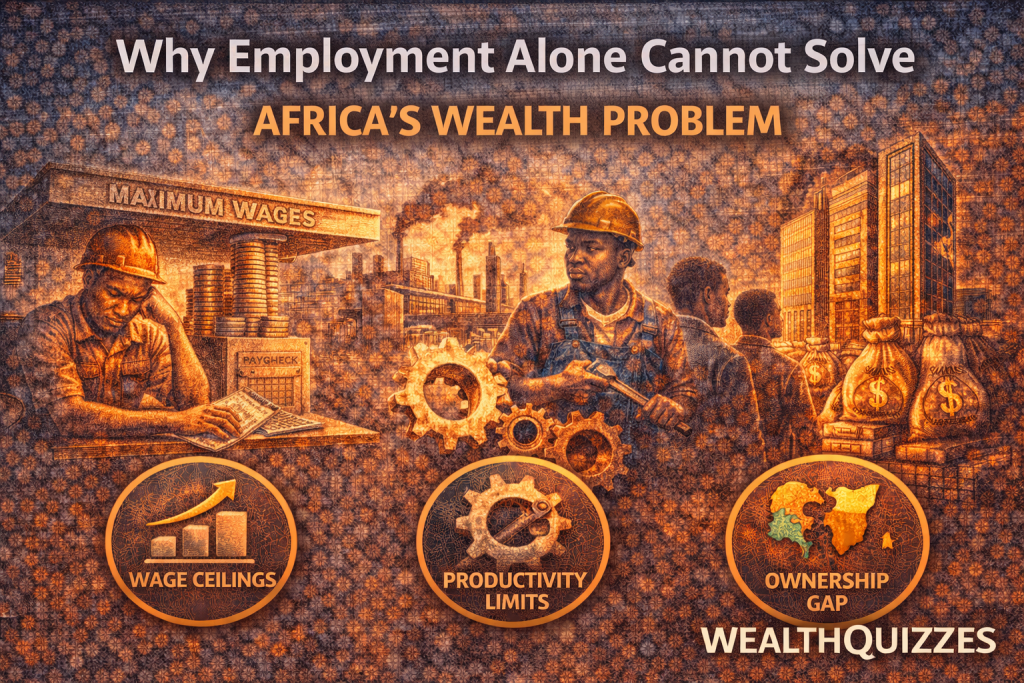
Why Employment Alone Cannot Solve Africa’s Wealth Problem
Introduction: The Job Creation Myth
For decades, African economic policy has revolved around a single mantra: create more jobs. Governments, development agencies, and political leaders routinely present employment growth as the primary solution to poverty and inequality. While job creation is undeniably important for social stability and income generation, employment alone cannot—and has never—solved a wealth problem.
Wealth is not merely about earning wages; it is about ownership, productivity, capital accumulation, and control over economic assets. As Nobel laureate Joseph Stiglitz has argued, income determines how people live today, but wealth determines how they live tomorrow. In Africa, the overreliance on employment as a pathway to prosperity masks deeper structural constraints that keep individuals, businesses, and entire nations economically fragile.
This article examines why jobs are necessary but insufficient, and what Africa must do to move from an income-based economy to a wealth-building one.
Employment Provides Income, Not Ownership
At its core, employment is a contractual exchange of time for money. Workers sell labor; employers retain ownership of the enterprise, its profits, and its appreciating assets. This distinction is critical.
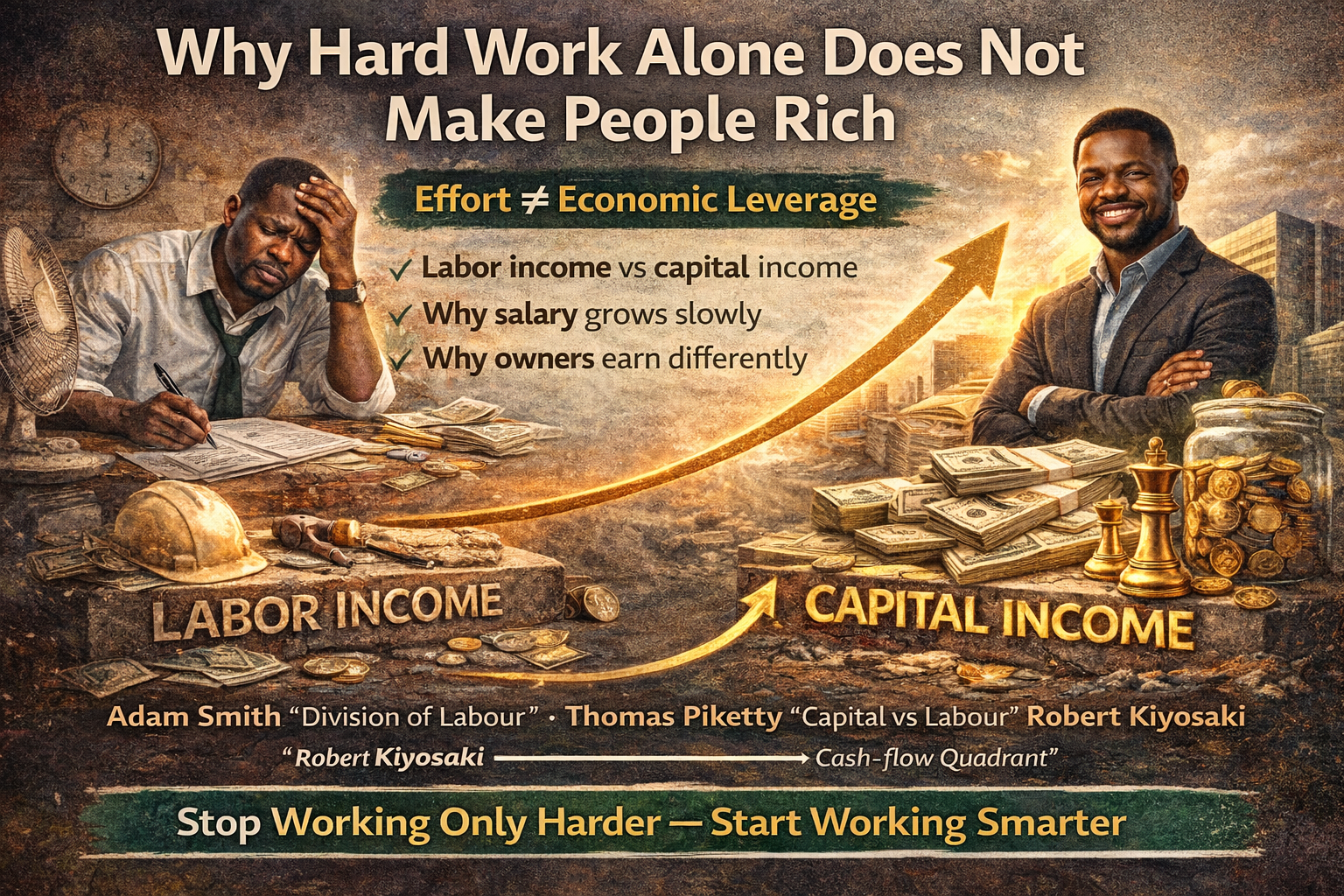
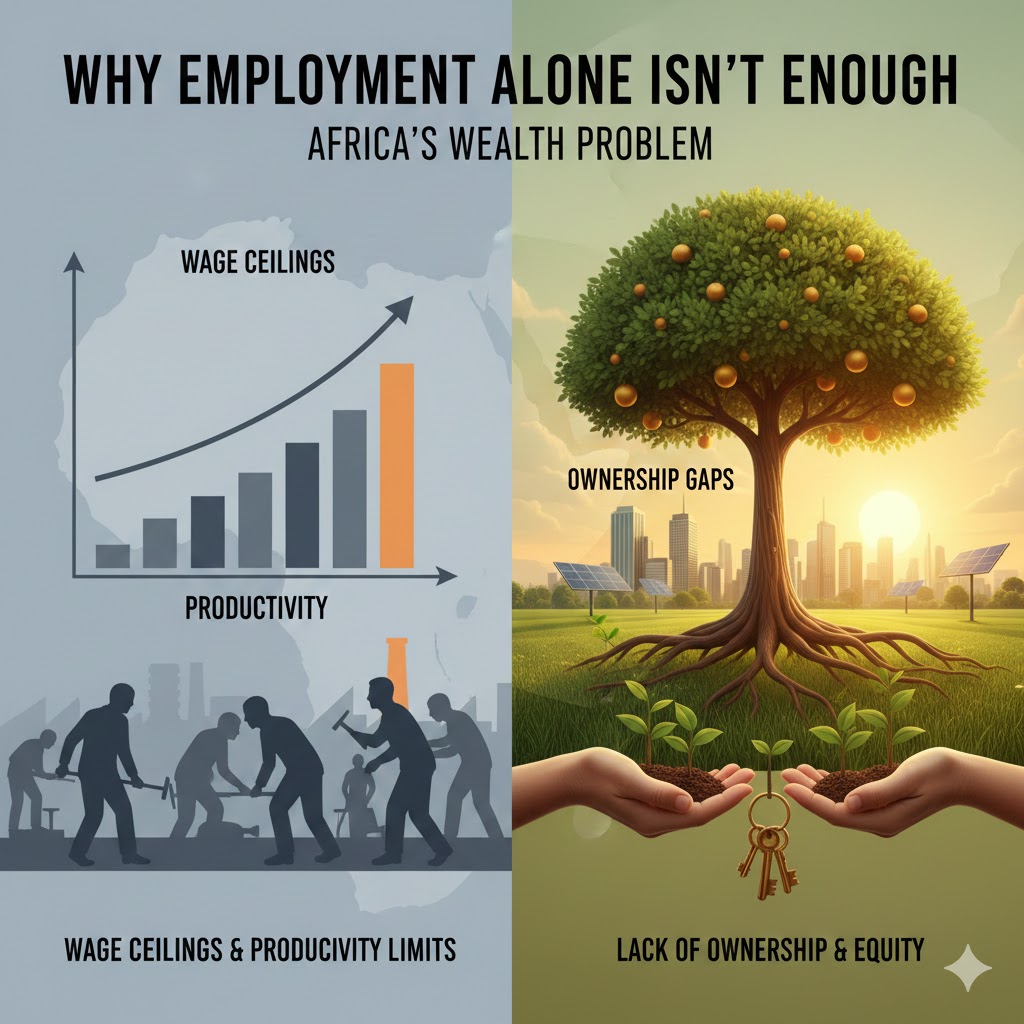
Economist Thomas Piketty, in Capital in the Twenty-First Century, demonstrates that wealth grows faster than wages over time because returns on capital consistently outpace income from labor. When people rely solely on employment, they remain exposed to wage ceilings, inflation erosion, and job insecurity.
In most African economies:
- Workers earn salaries that barely outpace inflation.
- They own little or no equity in productive enterprises.
- They are excluded from asset appreciation in land, technology, and intellectual property.
As a result, even fully employed individuals often remain asset-poor, unable to accumulate lasting wealth.
Wage Ceilings and the Productivity Trap
Wages are fundamentally constrained by productivity. According to the International Labour Organization (ILO), wage growth is limited by:
- Output per worker
- Capital intensity
- Technological sophistication
- Market competitiveness
Many African economies operate at low productivity levels due to:
- Limited industrialization
- Weak infrastructure
- Low capital investment
- Informal business structures
This creates a productivity trap, where wages cannot rise meaningfully because workers are not supported by high-value systems. Economist Paul Krugman famously stated, “Productivity isn’t everything, but in the long run it is almost everything.”
Without structural productivity gains, employment growth simply expands the number of people earning modest incomes—not the number of people building wealth.
The Ownership Gap: Who Owns Africa’s Economy?
One of the most overlooked drivers of Africa’s wealth gap is ownership asymmetry.
While Africans provide labor and consume goods, ownership of:
- Banks
- Telecommunications infrastructure
- Extractive industries

Why Employment Alone Cannot Solve Africa’s Wealth Problem - Technology platforms
- Large-scale manufacturing
often rests with foreign investors, multinational corporations, or a narrow domestic elite.
Hernando de Soto, in The Mystery of Capital, emphasizes that wealth creation depends on formalized ownership systems that allow assets to be leveraged, traded, and scaled. Where people lack ownership rights—or access to capital to acquire ownership—economic participation remains shallow.
Employment without ownership produces:
- Dependency, not independence
- Consumption, not accumulation
- Stability, not prosperity
SMEs, Informality, and the Missing Capital Layer
Africa’s economy is dominated by small and informal enterprises. According to the World Bank, over 80% of employment in sub-Saharan Africa comes from the informal sector. While this demonstrates entrepreneurial energy, it also exposes structural weaknesses:
- Limited access to credit
- Poor scalability
- Absence of equity financing
- Weak legal protections
These businesses employ people but rarely accumulate capital or generate transferable wealth. Without formalization and access to investment, SMEs become income vehicles, not wealth engines.
As development economist Ha-Joon Chang notes, countries grow rich not by maximizing employment, but by building firms that move up the value chain.
Employment Is Fragile in a Shifting Global Economy
Another limitation of employment-driven wealth is vulnerability. Jobs are exposed to:
- Automation and AI
- Global supply chain disruptions
- Currency instability
- Policy shocks
The COVID-19 pandemic illustrated how quickly employment can vanish, while asset owners often recovered faster through capital markets and technology leverage.
Wealth resilience comes from:
- Diversified income streams
- Ownership of appreciating assets
- Access to financial systems
Employment alone provides none of these protections.
What Actually Builds Wealth: Beyond Jobs
To solve Africa’s wealth problem, employment must be complemented—not replaced—by deeper structural changes:
1. Capital Ownership
Encouraging equity participation, cooperative ownership models, and employee shareholding schemes.
2. Financial Market Access
Expanding access to savings instruments, pensions, investment products, and capital markets.
3. Productivity and Industrial Policy
Investing in sectors that generate high value per worker: manufacturing, technology, energy, and logistics.
4. Asset Formalization
Secure land titles, intellectual property rights, and business registration systems that convert effort into capital.
5. Financial Literacy with Leverage
Teaching not just how money works, but how wealth is built through compounding, risk, and ownership.
The African Imperative: From Workers to Capital Participants
Africa does not suffer from a lack of hard work. It suffers from limited participation in capital formation.
As economist Milton Friedman observed, “A society that puts equality before freedom will get neither. A society that puts freedom before equality will get a high degree of both.” In economic terms, freedom includes access to ownership, markets, and capital.
Jobs stabilize societies. Ownership transforms them.
WealthQuizzes Perspective: Learning Beyond Employment Thinking
At WealthQuizzes, this distinction is central. Financial literacy is not about budgeting salaries alone; it is about understanding:
- How capital flows
- Who controls assets
- How value compounds
- Why ownership matters more than income
By shifting thinking from earning to building, learners move from survival economics to strategic wealth creation.
Conclusion: Employment Is the Floor, Not the Ceiling
Employment is essential—but it is only the starting point. Without ownership, productivity growth, and capital access, jobs merely sustain life; they do not create wealth.
Africa’s true economic transformation will come not from counting jobs created, but from counting assets owned, enterprises scaled, and capital retained.
Until then, employment will remain a necessary tool—but an insufficient solution—to Africa’s wealth challenge.