Why Financial Crises Keep Repeating: Lessons the World Refuses to Learn
By WealthQuizzes Editorial Team
Introduction: Different Crises, Same Story
From the Great Depression of the 1930s to the Global Financial Crisis of 2008, from the Asian Financial Crisis to repeated emerging-market debt shocks, the world keeps experiencing financial collapses that look strangely familiar.
Each time, experts promise: “This will never happen again.”
And yet, it does.
Financial crises are not rare accidents. They are recurring features of modern economic systems. The uncomfortable truth is that the problem is not a lack of knowledge—it is a failure to learn, remember, and act consistently on what history already teaches us.
What Is a Financial Crisis, Really?
A financial crisis occurs when:
- Asset prices collapse suddenly,
- Credit dries up,
- Financial institutions face insolvency,
- Confidence evaporates,
- Economic activity contracts sharply.
At the core, a crisis is not just a financial breakdown—it is a trust failure. When trust disappears, money stops moving, and economies stall.
The Bubble Cycle: How Crises Are Born
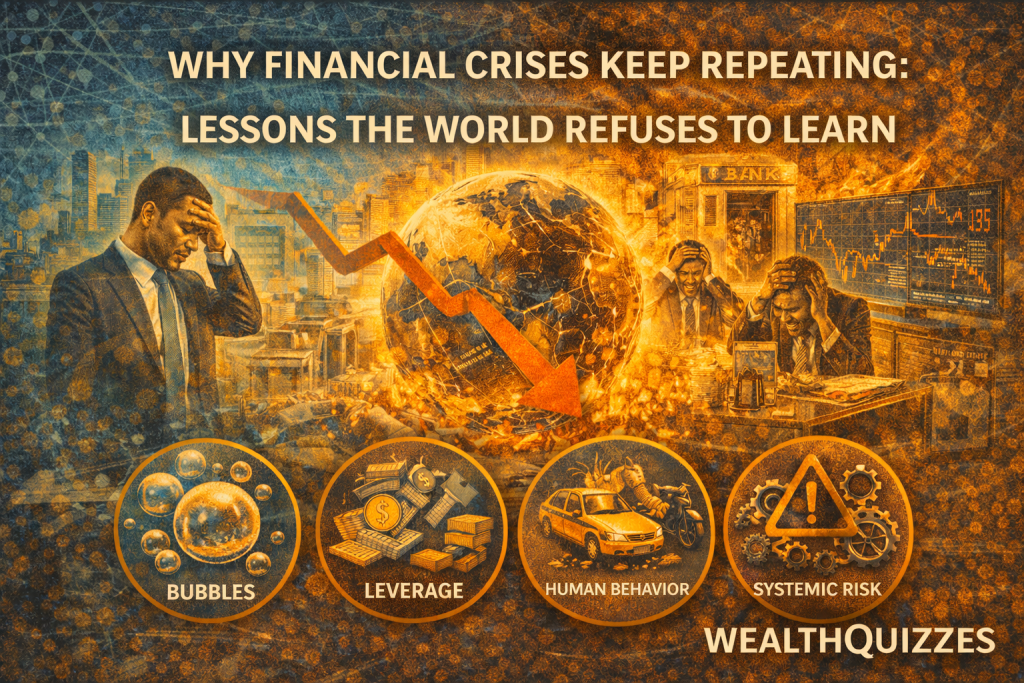
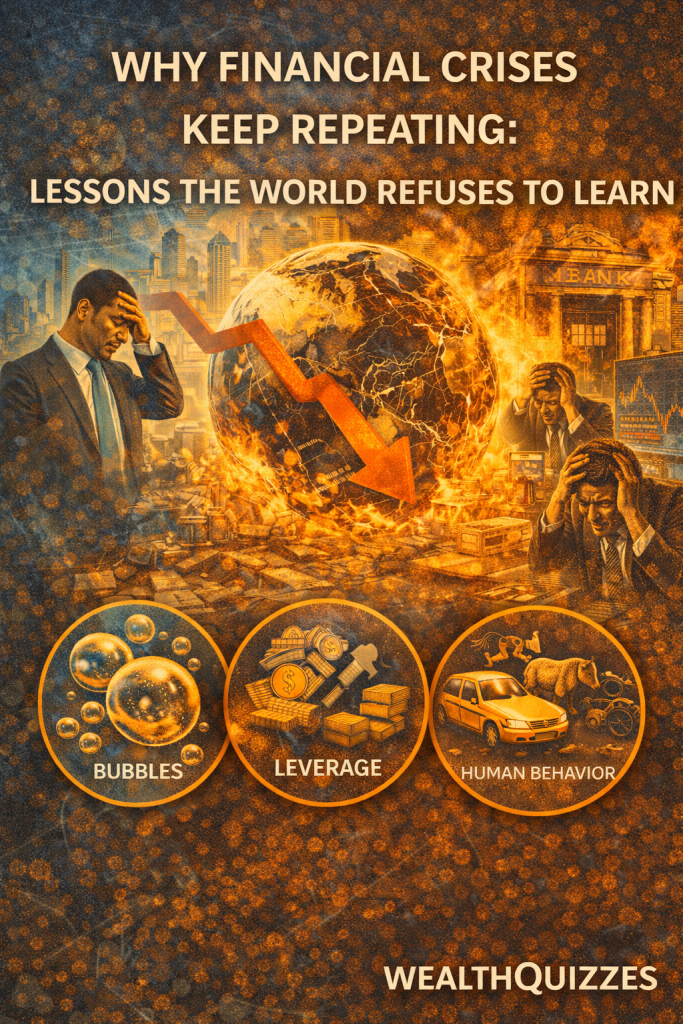
Almost every major financial crisis follows a predictable cycle:
- Innovation or Opportunity
A new opportunity emerges—real estate, tech stocks, commodities, crypto, sovereign debt. - Early Success
Early investors make profits. Confidence grows. - Speculation
Prices rise faster than underlying value. People buy not because assets are productive, but because prices are rising. - Leverage
Borrowed money floods the system. Debt magnifies gains—and risk. - Euphoria
Skepticism is dismissed. “This time is different” becomes the dominant narrative. - Trigger Event
Interest rates rise, earnings disappoint, liquidity tightens, or confidence cracks. - Collapse
Prices fall, leverage reverses, forced selling begins, institutions fail. - Blame and Reform
Investigations follow. Rules tighten. Memories fade.
Then the cycle quietly begins again.
Leverage: The Accelerator of Destruction
Leverage—using borrowed money to amplify returns—is the single most dangerous ingredient in every crisis.
Leverage:
- Makes small losses catastrophic,
- Forces asset sales during downturns,
- Transmits shocks across institutions,
- Turns local problems into systemic failures.
Crises rarely occur because assets lose value. They occur because debt-backed assets lose value.
Without excessive leverage, most market corrections would be painful—but survivable.
Human Behavior: The Constant Variable
Technology evolves. Markets globalize. Regulations change.
Human psychology does not.
Key behavioral forces behind recurring crises include:
Overconfidence
People consistently overestimate their ability to manage risk, especially during booms.
Herd Behavior
Individuals follow the crowd, assuming collective wisdom equals safety.
Short-Termism
Incentives reward short-term gains, even when long-term risks are obvious.
Moral Hazard
When institutions expect bailouts, they take greater risks.
Crises repeat because human incentives remain misaligned with long-term stability.
 Why Financial Crises Keep Repeating: Lessons the World Refuses to Learn
Systemic Risk: When Safety Becomes Fragile
Financial systems are designed for efficiency—but efficiency reduces resilience.
Highly interconnected systems:
- Spread shocks rapidly,
- Amplify errors,
- Create hidden dependencies.
In pursuit of profit and speed, financial systems often sacrifice buffers, redundancy, and caution. Stability becomes an illusion maintained only during calm periods.
When stress appears, fragility is exposed.
Why Regulation Always Falls Behind
After every crisis, regulation tightens. Over time:
- Markets adapt,
- New instruments emerge,
- Risks migrate to less regulated spaces,
- Political pressure weakens enforcement.
Regulation is reactive by nature. Innovation is proactive.
The result is a permanent gap between where risk exists and where rules apply.
The “This Time Is Different” Fallacy
Every crisis carries a unique narrative:
- New technology,
- New financial instruments,
- New economic model,
- New era of growth.
But while contexts change, structural dynamics do not:
- Excess leverage,
- Asset bubbles,
- Speculative behavior,
- Weak risk controls.
History repeats not because people forget facts—but because they reinterpret risk optimistically.
Emerging Markets and Recurrent Vulnerability
Developing economies face additional pressures:
- Currency mismatches,
- Foreign-denominated debt,
- Capital flow volatility,
- Weak institutional buffers.
These factors make crises:
- More frequent,
- More severe,
- Harder to recover from.
Without strong domestic financial systems, external shocks become internal disasters.
Why Crises Are Not Entirely Bad
While devastating, crises serve a function:
- They expose weak institutions,
- Correct mispriced risk,
- Reset incentives,
- Force reform.
The problem is not that crises occur—but that lessons fade before the next cycle begins.
What the World Refuses to Learn
The core lessons are simple—and consistently ignored:
- Debt amplifies fragility
- Risk cannot be eliminated, only shifted
- Human behavior drives markets more than models
- Stability requires sacrifice during booms
- Prevention is politically unpopular but economically essential
Crises persist because these truths are inconvenient during good times.
WealthQuizzes Perspective: Learning Is the Real Risk Management
At WealthQuizzes, we believe financial literacy is the strongest defense against systemic failure.
When individuals understand:
- How bubbles form,
- Why leverage is dangerous,
- How incentives distort behavior,
they become less vulnerable—not just financially, but psychologically.
Crises will continue to happen.
What changes outcomes is who understands them.
Because history does not punish ignorance—it simply repeats itself.
And in finance, those who learn early lose less when the cycle turns.