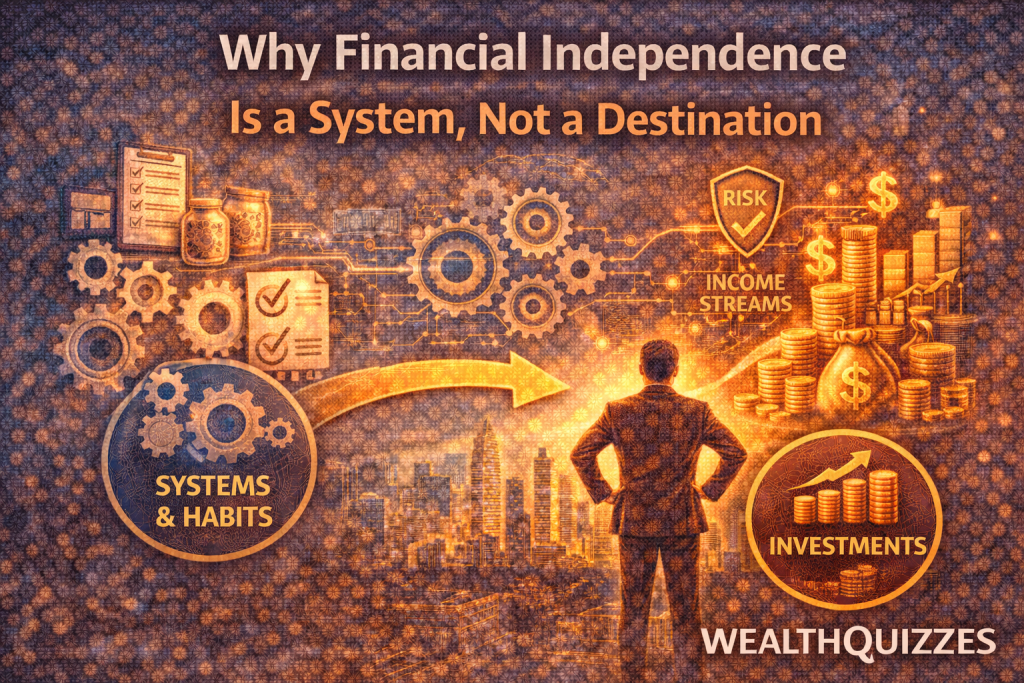
Why Financial Independence Is a System, Not a Destination
Introduction
Financial independence is often portrayed as a fixed endpoint: a specific net-worth figure, a retirement age, or the moment paid employment becomes optional. This framing is deeply ingrained in popular financial advice and media narratives. However, serious economic analysis and empirical evidence suggest a different reality. Financial independence is not a destination one arrives at and permanently occupies; it is a system—a continuously maintained framework of income flows, decision rules, institutional protections, and adaptive habits.
Economists, investors, and behavioral scientists increasingly converge on this view. Wealth that is not supported by resilient systems tends to erode through inflation, shocks, misallocation, or behavioral failure. Conversely, individuals and societies that embed financial independence into systems—rather than milestones—exhibit durability, flexibility, and long-term growth.
Defining Financial Independence Beyond the Popular Narrative
Traditional definitions focus on stock measures: net worth, savings multiples, or passive income thresholds. While useful, these metrics are incomplete. As Nobel laureate Robert Merton argues in his lifecycle finance framework, financial well-being should be assessed by the sustainability of consumption under uncertainty, not by static asset values.
Financial independence, therefore, is better understood as:
- A repeatable process of value creation
- A risk-managed structure for income and assets
- A behavioral system that aligns decisions with long-term objectives
This reframing shifts attention from “How much do I need?” to “What system ensures I remain independent across changing conditions?”
Systems Thinking and Wealth Durability
1. Income Systems, Not Income Events
Economist John Maynard Keynes emphasized that income stability matters more than income level. One-time windfalls—bonuses, inheritances, speculative gains—do not create independence unless converted into systems that reliably generate future cash flows.
Examples of income systems include:
- Businesses with defensible competitive advantages
- Diversified investment portfolios producing dividends or interest
- Intellectual property and royalties
- Scalable professional practices
Without systematization, income remains fragile. This explains why lottery winners and professional athletes frequently experience financial collapse despite high earnings.
2. Assets as Engines, Not Trophies
Warren Buffett famously distinguishes between assets that look valuable and assets that produce value. Financial independence depends on ownership of productive assets that generate cash flow, appreciate in real terms, or provide strategic optionality.
According to Thomas Piketty, wealth compounds when returns on capital exceed the growth rate of income. However, this compounding only persists when assets are embedded in legal, institutional, and managerial systems that preserve and reinvest returns.
Thus, asset ownership alone is insufficient. The governance, diversification, and reinvestment rules surrounding assets define whether independence is sustained or temporary.
Habits as the Operating Code of Financial Systems
Behavioral economists such as Richard Thaler and Daniel Kahneman have demonstrated that financial outcomes are heavily influenced by systematic biases rather than intelligence or information.
Financial independence systems rely on habits that:
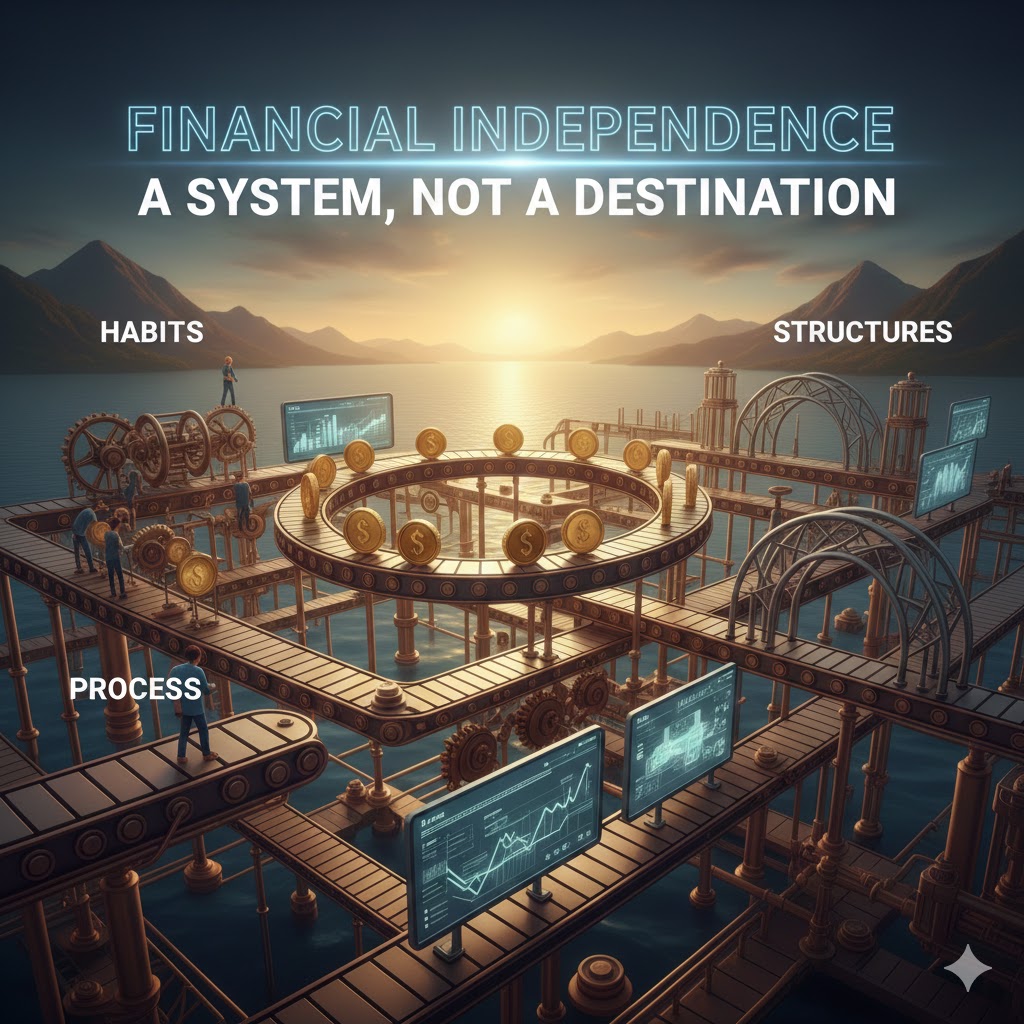
- Automate saving and investing decisions
- Reduce exposure to emotional market timing
- Enforce margin-of-safety principles
- Maintain spending discipline relative to income volatility
James Clear’s concept of habits as “compound interest of self-improvement” applies directly to wealth systems. Small, consistent behaviors—applied over decades—outperform sporadic high-effort actions.
The Role of Institutions and Rule-Based Structures
1. Legal and Regulatory Systems
Douglass North, Nobel laureate in institutional economics, established that economic prosperity depends on predictable legal frameworks. Financial independence is inseparable from:
- Property rights enforcement
- Contract reliability
- Transparent financial regulation
Individuals operating within strong institutional systems can rely on long-term planning. Where institutions are weak, independence requires additional layers of diversification, geographic hedging, or asset mobility.
2. Risk Management as a System, Not an Afterthought
Risk is unavoidable; unmanaged risk is catastrophic. Howard Marks emphasizes that superior investing is not about maximizing returns but about controlling downside risk consistently.
Financial independence systems integrate:
- Emergency liquidity buffers
- Insurance and risk transfer mechanisms
- Asset allocation aligned with time horizons
- Redundancy in income streams
This systemic approach explains why some individuals maintain independence through recessions while others lose it during the same macroeconomic shock.
Financial Independence as an Adaptive Process
Economic environments change. Inflation regimes shift. Technologies disrupt industries. Political risks emerge. A destination-based mindset fails under such conditions.
By contrast, systems adapt.
Nassim Nicholas Taleb’s concept of antifragility is particularly relevant. Well-designed financial systems do not merely survive volatility; they benefit from it by reallocating capital, exploiting optionality, and avoiding irreversible losses.
Financial independence, therefore, is not “set and forget.” It is:
- Periodically reviewed
- Continuously optimized
- Structurally resilient
Why the Destination Mindset Is Dangerous
Treating financial independence as a finish line leads to several systemic failures:
- Underestimating longevity risk
- Ignoring inflation erosion
- Overconcentrating assets
- Relaxing governance and discipline
History is replete with examples of fortunes lost after the perceived “arrival.” As Peter Drucker warned, the greatest danger in times of turbulence is not turbulence itself, but acting with yesterday’s logic.
Conclusion
Financial independence is not achieved; it is operated. It emerges from systems that integrate income generation, asset productivity, behavioral discipline, institutional support, and adaptive risk management.
Those who pursue a destination eventually confront erosion. Those who build systems develop resilience.
As modern finance increasingly confirms, wealth is not a static state of being—it is a dynamic, structured process. Financial independence belongs not to those who reach a number, but to those who design systems capable of sustaining freedom across time, uncertainty, and change.