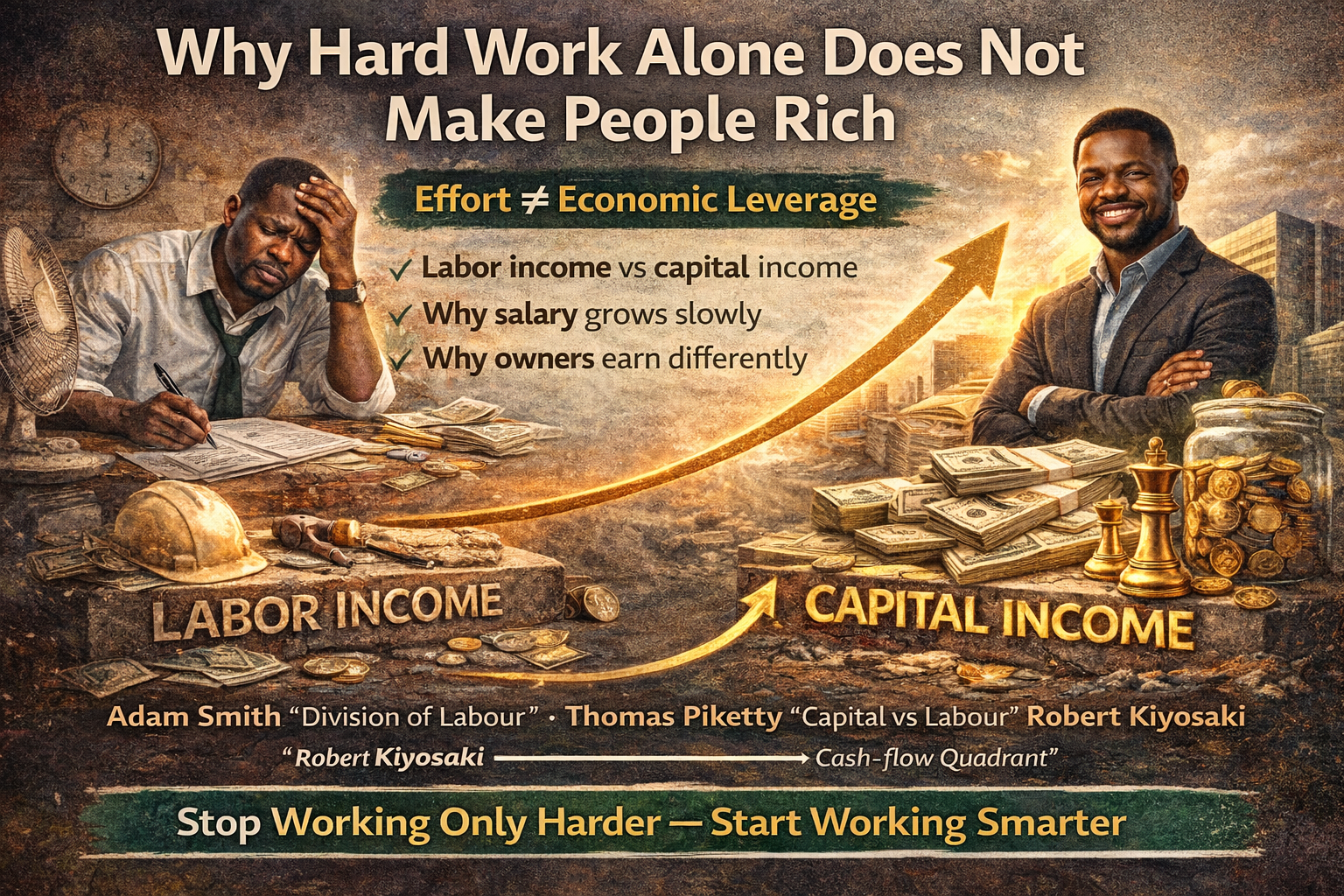

Why Financial Systems Reward Scale, Not Effort
Introduction: The Uncomfortable Truth About Wealth Creation
Modern financial systems are often framed as meritocratic arenas where hard work, discipline, and intelligence determine outcomes. Yet empirical evidence consistently contradicts this narrative. Across global markets, wealth and financial rewards flow disproportionately toward those who already operate at scale—large corporations, asset owners, dominant platforms, and capital-rich individuals—rather than toward those exerting the most effort.
This is not a moral failing of individuals, nor merely a consequence of corruption or poor ethics. It is structural. Financial systems, by design, reward scale more reliably than effort. Understanding this reality is essential for anyone serious about long-term wealth creation, economic policy, or financial reform.
Effort and Income: A Linear Relationship with Hard Limits
Effort primarily converts into labor income, which is inherently linear and capped.
An individual can only work a finite number of hours. Even highly skilled professionals—surgeons, lawyers, engineers—face ceilings imposed by time, physical capacity, and market saturation. As economist Thomas Piketty observes in Capital in the Twenty-First Century, labor income grows slowly and is constrained, while capital income compounds without such limits.
This is why wage growth, even when productivity rises, rarely keeps pace with asset appreciation. Effort earns income; scale multiplies it.
Economies of Scale: Lower Costs, Higher Power
One of the foundational reasons financial systems reward scale is economies of scale—the cost advantages that enterprises gain as they grow larger.
As firms scale:
- Fixed costs are spread over larger output
- Unit costs decline
- Bargaining power with suppliers improves
- Access to cheaper capital increases
According to Adam Smith, as early as The Wealth of Nations, division of labor and scale are central to productivity gains. Modern corporate finance extends this logic: large institutions borrow at lower interest rates, secure favorable regulatory treatment, and absorb shocks that would bankrupt smaller players.
Effort alone cannot replicate these advantages.
Network Effects: When Size Becomes Self-Reinforcing
Beyond scale efficiencies lies an even more powerful force: network effects.
As articulated by economists Carl Shapiro and Hal Varian (Information Rules), a network effect occurs when the value of a product or system increases as more people use it. Financial systems are saturated with such dynamics:
- Payment networks
- Stock exchanges
- Banking platforms
- Digital marketplaces
- Social and professional capital networks
Once a system reaches dominance, it attracts more users, more capital, and more data—making it increasingly difficult for smaller competitors to displace it, regardless of effort or quality.
This explains why large financial institutions become “too big to fail,” while smaller ones are allowed to collapse.

Capital Compounds; Effort Resets
Effort is episodic. Capital is cumulative.
When labor income is spent, it disappears. When capital income is reinvested, it compounds. Warren Buffett famously attributes his wealth not to extraordinary effort, but to three factors: a long time horizon, access to capital early in life, and compounding.
Financial systems are designed to:
- Reinvest surplus
- Leverage balance sheets
- Accumulate returns over time
As Albert Einstein (apocryphally but popularly) noted, compound interest is “the most powerful force in the universe.” Regardless of attribution debates, the mathematical truth remains: compounding rewards scale exponentially.
Risk Absorption: Scale as a Shock Buffer
Large actors can survive losses that would devastate individuals or small firms.
During financial crises, asset prices often fall—but those with scale can:
- Buy distressed assets
- Refinance cheaply
- Receive bailouts or policy support
The 2008 global financial crisis illustrated this vividly. As Joseph Stiglitz and other Nobel laureates have argued, systemic institutions were rescued, while individuals bore unemployment, foreclosures, and lost savings.
Scale converts volatility from a threat into an opportunity.
Policy Design and Structural Bias
Financial systems are not neutral. Regulations, tax codes, and monetary policy often favor scale—intentionally or otherwise.
Examples include:
- Capital gains taxed lower than labor income in many jurisdictions
- Access to leverage favoring asset holders
- Quantitative easing inflating asset prices more than wages
As Piketty demonstrates empirically, when the return on capital exceeds the growth rate of the economy (r > g), wealth concentrates structurally. This is not a failure of effort; it is a systemic outcome.
Why “Hard Work” Narratives Persist
Despite evidence, societies continue to promote effort-centric explanations for wealth. This serves several functions:
- It legitimizes inequality
- It preserves social stability
- It deflects attention from structural reform
Behavioral economists note that belief in effort-based success sustains participation in systems that statistically favor incumbents. As Daniel Kahneman has shown, humans are prone to narrative fallacies that oversimplify complex systems.
Implications for Individuals and Policymakers
Understanding that financial systems reward scale has practical consequences.
For individuals:
- Focus must shift from income maximization to asset accumulation
- Ownership matters more than hours worked
- Leverage, networks, and long-term positioning are decisive
For policymakers:
- Wage growth alone cannot solve inequality
- Broad asset ownership is critical
- Institutional design must address structural concentration
Ignoring scale dynamics leads to ineffective reforms and misplaced blame.
Conclusion: Wealth Is Structural Before It Is Personal
Effort matters—but not equally across financial systems. Effort determines survival; scale determines dominance.
Financial systems reward those who control capital, platforms, networks, and time horizons—not necessarily those who work hardest. This reality explains persistent inequality, capital concentration, and the recurring pattern of “the rich getting richer.”
True financial literacy, therefore, begins not with motivation or hustle, but with structural understanding. Until individuals and societies internalize that scale—not effort—is the primary driver of financial reward, wealth outcomes will continue to surprise, frustrate, and divide.