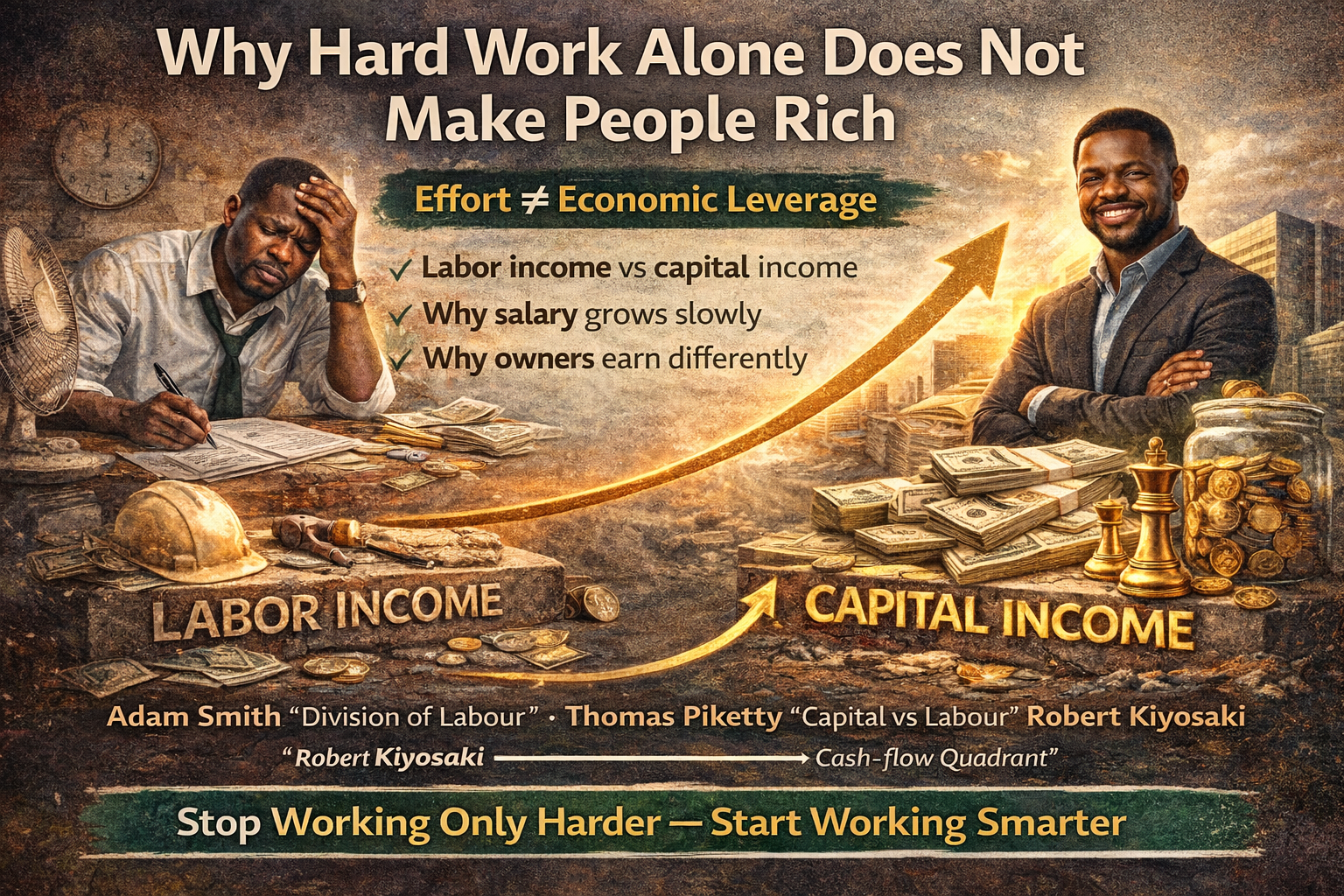
Why Hard Work Alone Does Not Create Wealth
A structural analysis of income versus wealth, productivity versus ownership, and why labor without assets rarely compounds
For generations, societies have promoted a simple formula: work hard, stay disciplined, and wealth will follow. While this belief is emotionally appealing and socially useful, it is economically incomplete—and often misleading.
Hard work is essential for survival and productivity, but hard work alone does not explain wealth creation. Across countries and over time, the people and groups that accumulate lasting wealth are not necessarily those who work the hardest, but those who own assets, control capital, and benefit from compounding systems.
Understanding this distinction requires separating income from wealth, labor from ownership, and effort from economic structure.
1. Income Is Not Wealth
Income is a flow. Wealth is a stock.
Income refers to money earned over a period—wages, salaries, fees, or commissions. Wealth refers to accumulated assets that generate value over time: land, businesses, equities, intellectual property, and financial capital.
Economist Thomas Piketty, in Capital in the Twenty-First Century, demonstrates that wealth grows primarily through returns on capital, not through wages. His central insight is simple but powerful:
When the rate of return on capital exceeds the rate of economic growth, wealth concentrates in the hands of asset owners.
This means that even highly productive labor, if not converted into ownership, rarely leads to sustained wealth accumulation.
A worker may earn income for decades, but once the work stops, the income stops. Assets, by contrast, continue to generate returns independent of daily labor.
2. Productivity Does Not Equal Prosperity
Productivity measures output per unit of labor. Prosperity depends on who captures the value of that output.
Modern economies are highly productive, yet many workers experience stagnant real wages. Nobel laureate Joseph Stiglitz has repeatedly emphasized that productivity gains often accrue disproportionately to capital owners rather than labor.
In practical terms:
- A factory worker may double output through efficiency.
- A software engineer may scale productivity through code.
- A farmer may increase yields through technology.
But unless these individuals own the factory, the platform, or the land, the surplus value largely flows elsewhere—to shareholders, landlords, or capital providers.
Hard work improves productivity. Ownership determines who benefits from productivity.
3. Labor Does Not Compound—Capital Does
One of the most important but least discussed realities of wealth creation is compounding.
Labor income is linear:
- You exchange time and effort for money.
- There are natural limits to hours, energy, and lifespan.
Capital income is exponential:
- Profits can be reinvested.
- Assets appreciate.
- Returns generate additional returns.
Albert Einstein is often (perhaps apocryphally) quoted as calling compound interest the “eighth wonder of the world.” Regardless of attribution, the principle is foundational to finance.
Warren Buffett has noted that the majority of his wealth was created after middle age, not because he worked harder, but because capital had time to compound.
Labor pays bills. Compounding builds wealth.

4. Inflation Quietly Punishes Labor
In inflationary environments, hard work becomes even less effective as a wealth strategy.
Inflation erodes the purchasing power of wages. When prices rise faster than salaries, workers effectively become poorer despite working just as hard—or harder.
John Maynard Keynes described inflation as a subtle method by which wealth is redistributed:
Inflation confiscates, arbitrarily and unjustly, wealth from those who save or earn fixed incomes.
Asset owners often benefit from inflation:
- Property values rise.
- Business revenues adjust upward.
- Debtors repay loans with devalued currency.
Workers dependent solely on wages are exposed. Without assets that inflate with prices, labor income struggles to keep pace.
5. Currency Weakness Amplifies the Problem
In currency-weak economies—common across much of Africa and the Global South—the limitations of hard work are even more pronounced.
When local currencies depreciate:
- Domestic wages lose global purchasing power.
- Imported goods become more expensive.
- Savings held in local currency decline in real value.
An individual may work diligently for years, yet see the real value of their earnings eroded by exchange rate movements beyond their control.
This is why economists emphasize store-of-value assets and exposure to productive capital as protection against macroeconomic instability.
6. Ownership Is the Structural Divider
The critical dividing line in wealth creation is ownership.
Ownership means:
- Claim on future cash flows
- Control over productive assets
- Legal rights enforceable by institutions
The economist Hernando de Soto highlighted that lack of formal property rights traps labor in unproductive systems, preventing assets from being leveraged or scaled.
Without ownership:
- Labor remains transactional.
- Income remains fragile.
- Economic mobility remains limited.
With ownership:
- Income becomes optional.
- Risk becomes manageable.
- Wealth becomes transferable across generations.
7. Why the Hard Work Narrative Persists
If hard work alone does not create wealth, why does the narrative persist?
Because it serves important functions:
- It encourages productivity and social order.
- It shifts responsibility from systems to individuals.
- It obscures structural advantages and disadvantages.
As sociologist Max Weber observed, moral narratives around work often reinforce existing economic arrangements, even when they do not lead to equitable outcomes.
Hard work is necessary—but it is not sufficient.
8. What Actually Turns Work into Wealth
Hard work becomes wealth-creating only when paired with:
- Ownership of productive assets
- Access to credit and capital
- Time for compounding
- Institutions that protect property and contracts
- Knowledge of financial systems
This is not an argument against effort. It is an argument for strategic effort—directed toward acquiring assets, equity, and leverage rather than relying solely on income.
Conclusion
Hard work fuels economies, but ownership builds wealth. Labor generates income, but capital compounds value. In inflationary and currency-weak environments, relying on wages alone is economically fragile.
Understanding this distinction is not cynical—it is empowering. It shifts the focus from endless effort to intelligent structure, from income chasing to asset building.
True financial literacy begins when people recognize that the goal is not merely to work harder, but to own more of what work produces.