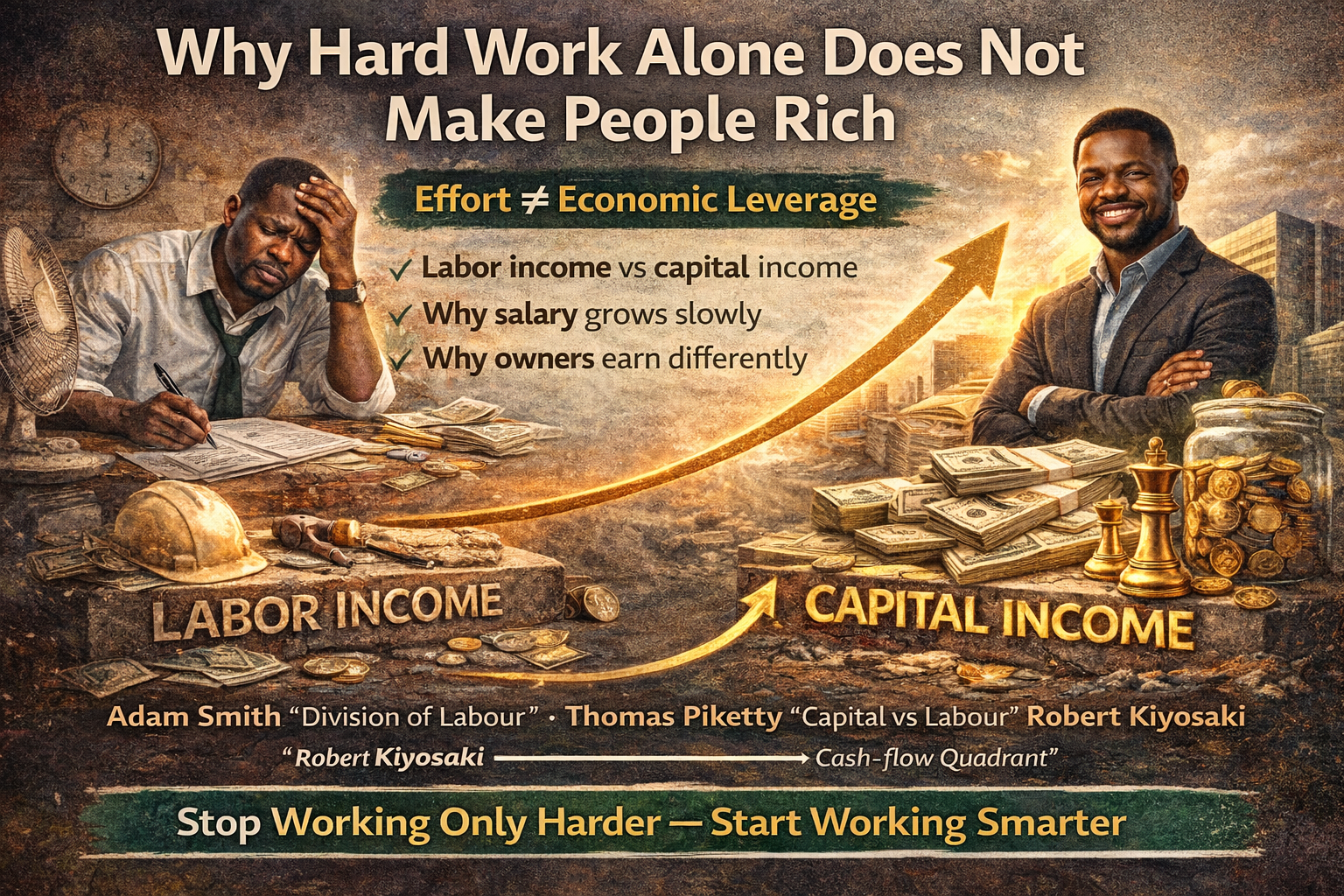
Why Hard Work Alone Does Not Make People Rich
One of the most persistent beliefs in modern society is simple:
If you work hard enough, you will become wealthy.
It is an attractive idea. It feels fair. It rewards discipline and moral effort. But economically, it is incomplete.
Hard work matters. It increases skill, builds reputation, and improves income. However, effort alone does not automatically produce wealth. The missing variable is economic leverage.
Effort and income are not the same thing as leverage.
To understand why hard work alone does not make people rich, we must distinguish between two fundamentally different ways money is earned:
- Labor income
- Capital income
Until this distinction becomes clear, many hardworking people will continue to feel confused about why they are not advancing financially at the pace they expected.
Labor Income vs. Capital Income
Labor income is money earned by exchanging time and skill for pay.
It includes salaries, wages, consulting fees, and professional compensation.
Capital income is money earned from ownership.
It includes profits, dividends, rent, business equity growth, and asset appreciation.
This distinction has deep roots in economic thought. In The Wealth of Nations, Adam Smith analyzed the division of income into wages, profits, and rent. Wages compensate labor. Profits compensate ownership. Rent compensates control of land and capital. These are structurally different streams.
In modern economic analysis, this division remains central. Thomas Piketty, in Capital in the Twenty-First Century, argues that over long periods, returns on capital tend to exceed the growth of wages. In simplified terms: owners often see their wealth grow faster than workers see their salaries increase.
This is not a moral judgment. It is a structural reality.
Why Salary Grows Slowly
Hardworking employees often assume that excellence will eventually translate into substantial wealth. Yet salaries tend to grow incrementally for several reasons:
1. Wages Are Tied to Labor Markets
Salary growth depends on supply and demand for specific skills. If many qualified individuals can perform the same job, wage growth is constrained. Even highly competent workers are subject to market pricing.
Labor markets reward scarcity, not effort alone.
2. Income Is Time-Bound
Labor income is inherently capped by time. There are only so many hours available per day. Even with overtime, productivity remains physically limited.
You can increase your hourly value through skill development, but you cannot multiply hours indefinitely.
Capital, however, operates differently. Capital does not require sleep. Investments can grow continuously. Businesses can operate beyond the owner’s direct involvement.
This is leverage.
3. Employers Capture Scale
When a company grows, revenue may double or triple. However, employee salaries rarely increase at the same rate. The gains from scale primarily accrue to owners and shareholders.
This is why founders, equity holders, and investors often accumulate wealth faster than employees — even highly skilled employees.
Why Owners Earn Differently
Ownership changes the structure of earnings.
When you own a business or an asset:
- Your upside is theoretically uncapped.
- Income is not strictly tied to hours worked.
- You benefit from scale, automation, and delegation.
This structural difference is sometimes illustrated in popular finance discourse by Robert Kiyosaki through his “Cashflow Quadrant,” which separates employees, self-employed individuals, business owners, and investors. While his framing is often motivational, the underlying economic insight is valid: income derived from ownership behaves differently from income derived from labor.
However, this concept should be understood critically, not romantically.
Not all ownership leads to wealth. Many businesses fail. Many investments underperform. The key insight is not that ownership guarantees riches, but that ownership introduces leverage.
Leverage allows income to grow independently of personal effort once systems are established.
The Division of Labour and Its Consequences
Adam Smith famously described how specialization increases productivity. In a factory setting, dividing tasks among workers multiplies output. However, while specialization increases efficiency, it also fragments control.
Workers specialize in one function. Owners coordinate the entire system.
The more specialized the worker, the more dependent they may become on the structure provided by owners. This dynamic reinforces the income gap between labor and capital.

Hard work inside a system does not automatically grant control over the system.
The Capital Advantage
Thomas Piketty’s central thesis — that returns on capital historically outpace economic growth — highlights a crucial mechanism of wealth accumulation.
If:
- Capital earns 5–8% annually,
- And wages grow 2–3% annually,
Over decades, the difference compounds dramatically.
This explains why individuals who own appreciating assets often experience exponential growth, while wage earners experience linear growth.
Linear growth is steady.
Exponential growth is transformative.
Hard work supports linear growth.
Leverage enables exponential growth.
The Psychological Trap
Believing that hard work alone guarantees wealth can create two damaging outcomes:
- Self-blame — Individuals assume personal failure when wealth does not materialize, even if they are disciplined and competent.
- Misallocation of effort — People double down on working longer hours instead of restructuring how they earn.
The issue is not insufficient effort. The issue is structural positioning.
Effort without leverage produces income.
Effort with leverage produces wealth.
What Economic Leverage Actually Means
Leverage is not merely borrowing money. It is the ability to use systems, assets, or ownership to amplify output.
Examples of leverage include:
- Owning equity in a growing company.
- Holding income-producing assets.
- Creating intellectual property that can be sold repeatedly.
- Building a business where others contribute labor.
Leverage separates income from direct time input.
Without leverage, income stops when work stops.
With leverage, income can continue — sometimes grow — independently.
Behavioral Shift: From Effort to Strategy
The correct conclusion is not “hard work is useless.” It is that hard work must be directed strategically.
Readers should stop asking:
“Am I working hard enough?”
And start asking:
“Where is my leverage?”
This may involve:
- Acquiring equity instead of only wages.
- Developing skills that allow profit-sharing.
- Building side income streams.
- Investing systematically.
- Transitioning from purely labor-based roles to ownership-based positions over time.
The goal is not instant entrepreneurship. It is gradual repositioning.
A Balanced Perspective
It is important to avoid romanticizing capital. Ownership involves risk. Employees often enjoy income stability that owners do not. Both roles serve essential economic functions.
However, if wealth accumulation is the objective, relying exclusively on labor income creates structural limitations.
Effort builds competence.
Competence increases income.
Ownership multiplies income.
That is the sequence.
Final Insight
Hard work is necessary.
But it is not sufficient.
Labor income provides stability.
Capital income provides scale.
Understanding this distinction removes unnecessary guilt and replaces it with clarity. Instead of blaming yourself for not being wealthy despite working diligently, you can shift focus toward building leverage.
When effort meets ownership, wealth becomes structurally possible.
Without leverage, even the hardest worker may remain financially constrained.
The path to wealth is not about abandoning hard work.
It is about directing hard work toward positions that generate ownership, scale, and long-term capital growth.