Why Most Businesses Fail Before Profit — And How to Think Like Capital
Introduction: Failure Rarely Comes from Bad Ideas
Most businesses do not fail because the founders are lazy, unintelligent, or lacking ideas. They fail because money runs out before the business model proves itself.
In reality, business failure is less about passion and more about capital mechanics — how cash flows, how fast it burns, and how long it takes before profits arrive. Entrepreneurs often think like operators or dreamers; investors think like capital. That difference determines survival.
To build durable businesses, founders must stop thinking only about products and start thinking about how capital behaves inside their businesses.
The Myth of “Profit First” in Early-Stage Businesses
Profit is important — but timing is everything.
Most viable businesses are not profitable at the beginning. They require upfront investment in:
- Product development
- Staff and talent
- Marketing and customer acquisition
- Infrastructure and compliance
The real question is not whether a business will make profit, but whether it can survive long enough to reach it.
Businesses fail when:
- Costs scale faster than revenue
- Cash inflows lag behind expenses
- Capital is misallocated early
Profitability is a destination. Liquidity is the journey.
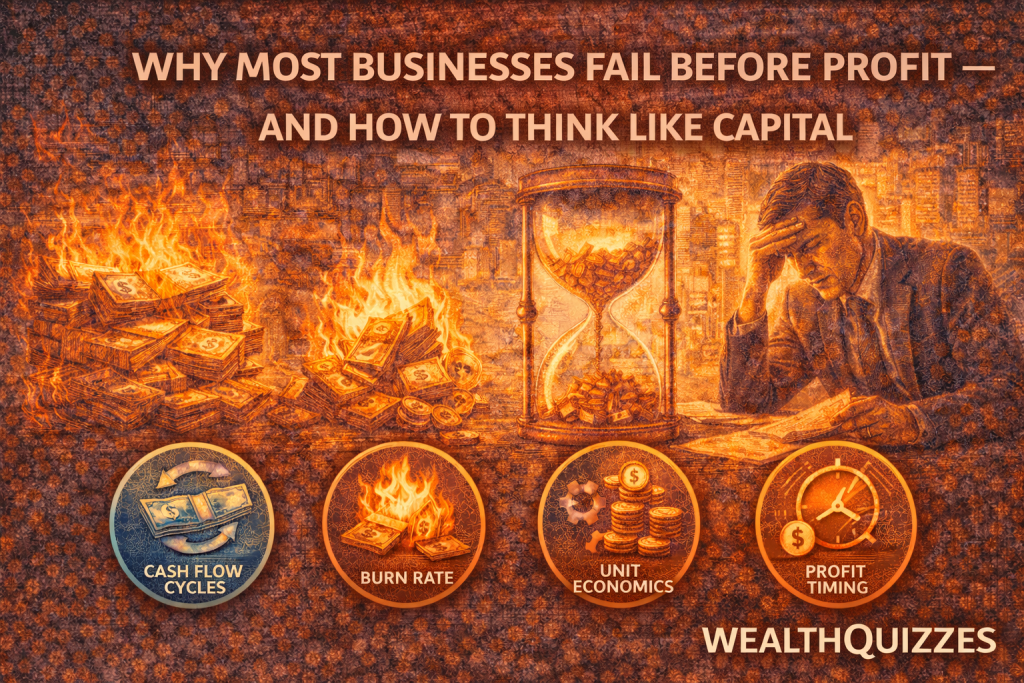
Understanding Cash Flow Cycles: The Oxygen of Business
Cash flow is the movement of money in and out of a business over time. Unlike profit, which is an accounting concept, cash flow is real, immediate, and unforgiving.
Many profitable businesses collapse because:
- Customers pay late
- Inventory locks up cash
- Operating costs are due monthly
- Debt repayments arrive before revenues
A business can show “profit” on paper and still be bankrupt in reality.
Cash flow keeps businesses alive. Profit keeps them attractive.
Burn Rate: How Fast Are You Consuming Capital?
Burn rate measures how quickly a business spends its available cash before becoming self-sustaining.
High burn rates are not inherently bad — but uncontrolled burn rates are lethal.
Common burn-rate mistakes include:
- Hiring too fast before product-market fit
- Overspending on branding instead of revenue generation
- Scaling operations without stable demand
- Assuming future funding will always arrive
Capital does not reward optimism. It rewards discipline.
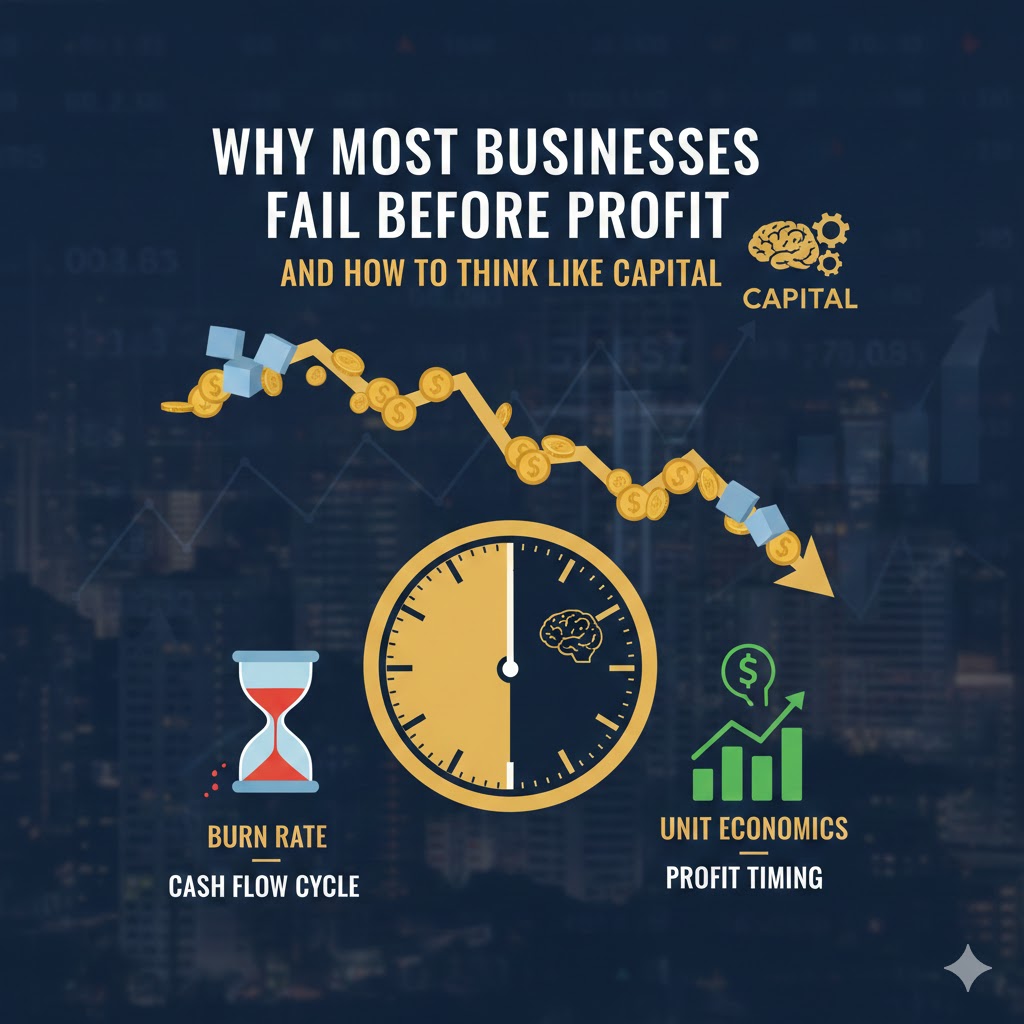
Unit Economics: The Truth Hidden Inside Each Sale
Unit economics answers a simple but brutal question:
“Do we make money every time we sell one unit?”
This includes:
- Cost of acquisition
- Cost of production or service delivery
- Operational overheads
If a business loses money on each unit sold, growth accelerates failure, not success.
Many founders chase scale while ignoring the fundamentals. Investors do the opposite: they examine unit economics before believing growth stories.
A broken unit cannot be fixed by volume.
Profit Timing: Why Being “Eventually Profitable” Is Not Enough
Profit timing refers to how long it takes before a business becomes cash-positive.
A business may have:
- A great product
- Strong demand
- Clear long-term profitability
Yet still fail because:
- The runway is too short
- Funding dries up
- Economic conditions change
Capital is impatient. Markets shift. Conditions tighten.
Businesses that survive understand how long they can afford to lose money — and why.
Thinking Like Capital: The Investor’s Perspective
Capital does not care about effort, emotion, or intention. It responds to:
- Risk-adjusted returns
- Predictability
- Scalability
- Governance and discipline
To think like capital, founders must ask:
- Where does money enter the system?
- Where does it leak out?
- How long before inflows exceed outflows?
- What assumptions are fragile?
This mindset transforms decision-making — from spending to pricing to growth strategy.
Why African Businesses Face an Even Tighter Margin for Error
In African markets, the stakes are higher:
- Interest rates are expensive
- Credit is limited
- FX volatility disrupts planning
- Infrastructure costs are elevated
This makes financial literacy and capital efficiency non-negotiable.
Survival depends not just on vision, but on financial intelligence under pressure.
WealthQuizzes Perspective: Learning to Think Like Capital
WealthQuizzes is built on a simple but powerful belief:
financial intelligence is a survival skill, not an academic subject.
Understanding:
- Cash flow logic
- Capital behavior
- Risk and timing
Empowers individuals and entrepreneurs to:
- Make better decisions
- Avoid predictable failure
- Build sustainable value
Learning is not just about knowledge — it is about economic awareness.
Conclusion: Businesses Don’t Die from Failure — They Die from Misunderstanding Money
Most businesses fail before profit, not because profit was impossible, but because capital reality was misunderstood.
Those who survive learn to:
- Respect cash flow
- Control burn rates
- Fix unit economics
- Think beyond passion
In the end, success belongs to those who understand one truth:
Ideas start businesses. Capital decides which ones live.