Why Most Side Hustles Fail — And Which Ones Actually Work
Across Nigeria today, the phrase “find a side hustle” has become almost a survival slogan. Students, civil servants, corps members, and young professionals are constantly advised to start “something on the side.” The intention is sensible: diversify income, reduce financial vulnerability, and escape dependence on salary alone.
Yet a simple observation explains the problem: most side hustles die quietly within months. Not because Nigerians are lazy. Not because the economy is uniquely hostile. And not even because business itself is unusually difficult.
They fail because they are copied rather than understood.
The majority of people do not analyze economic logic before starting a side hustle. They replicate whatever appears profitable in their social circle. But economics punishes imitation without competence.
Management thinker Peter Drucker warned that business failure rarely comes from effort; it comes from misdiagnosing the market. A venture fails when it is not solving a real problem for identifiable customers.
Most side hustles in practice violate this principle from day one.
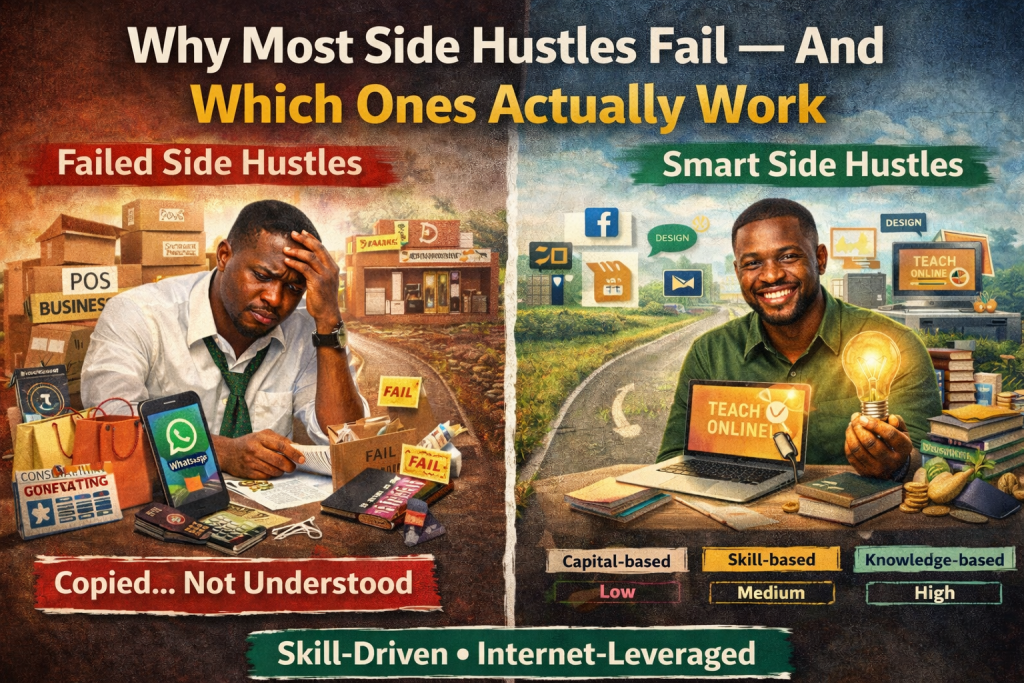
The Typical Failed Side Hustles
Consider some of the most common ones.
1. Mini-Importation Without Marketing
Many people import phone accessories, sneakers, or smart watches after seeing a TikTok video promising quick profit. The assumption is simple:
If others are selling, I can sell too.
But selling is not distribution. Selling requires demand access.
They discover the reality: products are easy to import but extremely difficult to move. Without an audience, they are not running a business — they are running a private warehouse.
As marketing strategist Seth Godin repeatedly emphasizes:
“You don’t find customers for your products; you build products for your customers.”
Most mini-importers do the opposite.
2. POS Business in Saturated Areas
A POS terminal once worked because it solved a scarcity problem: cash withdrawal access.
But economic opportunity depends on gap, not activity. When ten POS operators exist within a 30-meter radius, the scarcity disappears. Margins collapse. The business technically exists, yet profit vanishes.
This is a classic market saturation failure — not a moral failure.
Economist Joseph Schumpeter described entrepreneurship as exploiting new combinations in markets. When everyone enters the same low-barrier activity, innovation disappears and profit follows it.
3. Selling Random Products on WhatsApp
Another common attempt: posting perfumes, watches, waist trainers, or handbags on WhatsApp status.
The logic is emotional: “People already know me, so they will buy.”
But social familiarity is not commercial demand.
Customers do not buy because they know you. They buy because you solve a specific problem better than alternatives. Without product positioning or defined target audience, the business becomes noise.
4. Dropshipping Without Audience
Dropshipping is often advertised as “zero capital business.” Technically true — economically misleading.
The real capital in dropshipping is not inventory.
It is attention.
Entrepreneur and investor Naval Ravikant explains that modern wealth is created through “specific knowledge plus leverage.” In online commerce, leverage equals distribution — followers, subscribers, or traffic.
Without audience leverage, dropshipping becomes paid advertising losses.
The Core Reason: Copying Without Economic Logic
The common thread is simple:
People are not starting businesses — they are starting activities.
They see what others are doing but never study why it works for them. They copy the visible behavior but not the invisible structure: customer acquisition, skill advantage, and positioning.
Venture capitalist Paul Graham famously advises founders to “make something people want.”
Most side hustles instead attempt to “sell something people happen to see.”
That difference determines survival.
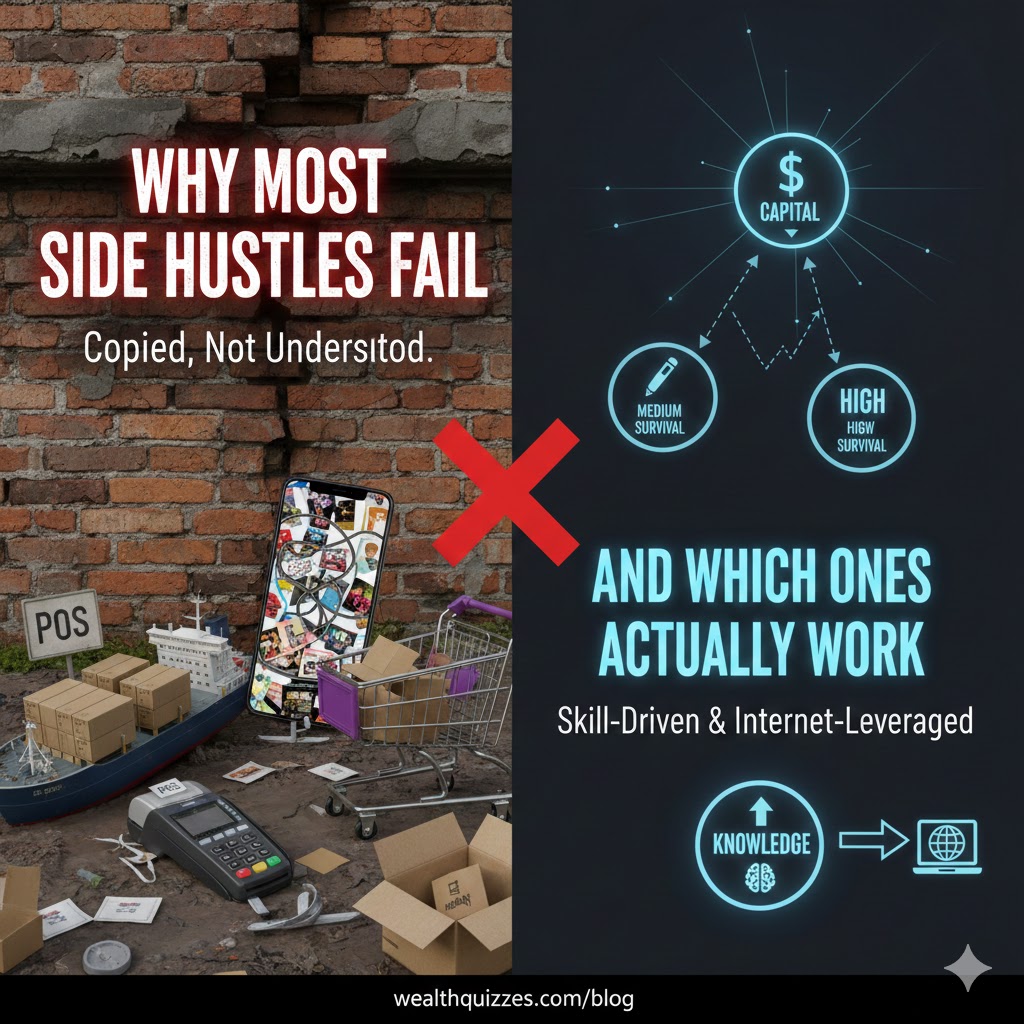
The Three Types of Side Hustles
Not all side hustles are equal. They fall into three economic categories:
| Type | Example | Survival Rate |
|---|---|---|
| Capital-based | Buying & reselling goods | Low |
| Skill-based | Writing, editing, design, video | Medium |
| Knowledge-based | Teaching, consulting, digital content | High |
Let’s examine why.
1. Capital-Based Hustles (Low Survival)
These rely primarily on money. You purchase inventory and hope to sell at a margin.
The challenge is structural:
- Low entry barriers
- Heavy competition
- Price wars
- Thin profit margins
Anyone with ₦50,000 can start. That also means everyone can start. When entry barriers are low, profit barriers are also low.
Retail works best at scale — supply chains, branding, and logistics. Individuals rarely possess those advantages.
2. Skill-Based Hustles (Medium Survival)
Examples include:
- Copywriting
- Graphic design
- Video editing
- Website building
- Social media management

Why Most Side Hustles Fail — And Which Ones Actually Work
These survive more often because skill creates differentiation. Not everyone can produce high-quality output. Customers choose competence over price alone.
Economist Gary Becker’s human capital theory explains this: education and skills increase productivity, which increases earning potential. A skilled individual competes less on price and more on value.
However, skill businesses still depend on client acquisition and time exchange. Income grows slowly.
3. Knowledge-Based Hustles (High Survival)
This is where the strongest side hustles exist.
Examples:
- Teaching a specialized subject
- Creating courses
- Educational YouTube channels
- Professional consulting
- Niche newsletters
- Information products
Why do they survive?
Because they scale.
Once knowledge is packaged — a video, guide, class, or training — it can serve many people simultaneously. Income becomes less tied to hours worked.
Technology writer Chris Anderson described the modern economy as the “long tail,” where niche expertise can reach global audiences via the internet. A person in Port Harcourt can teach Excel skills to buyers in Ghana, Kenya, or the UK.
Knowledge travels. Inventory does not.
The Real Secret: Skill-Driven + Internet-Leveraged
The best side hustles share two properties:
- They rely on a skill advantage
- They use internet distribution
This combination removes two major risks:
- physical location limitations
- local market saturation
A POS business competes with neighbors.
An online educator competes globally — but also sells globally.
Why People Choose the Wrong Hustles
Most side hustles are selected emotionally rather than economically.
Typical motivations:
- frustration with salary
- peer pressure
- unemployment
- desire for quick money
These are understandable human reactions, but they are not business strategy.
Business decisions require market analysis, not emotional relief.
Drucker again emphasized: entrepreneurship is not gambling. It is systematic opportunity recognition.
A Better Approach
Instead of asking:
“What business can I start?”
Ask:
“What problem can I consistently solve?”
Then:
- Learn the skill
- Prove the solution
- Build an audience
- Monetize gradually
Notice the sequence. Income comes last, not first.
What Actually Works
The most reliable side hustles today include:
- educational YouTube channels
- professional service freelancing
- specialized tutoring
- technical writing
- software or data skills
- niche consulting
- digital products
All share one feature: they compound.
Your effort today increases future earning capacity.
Mini-importation spends capital.
Knowledge businesses accumulate capital.
Final Insight
Side hustles fail when they are treated as shortcuts. They succeed when they are treated as skill deployment systems.
The purpose of a side hustle is not immediate cash.
It is the construction of earning power.
The individual who builds competence plus audience will eventually earn more predictably than the individual who repeatedly chases trending businesses.
The lesson is simple but powerful:
Do not chase a hustle.
Build an advantage — then attach income to it.