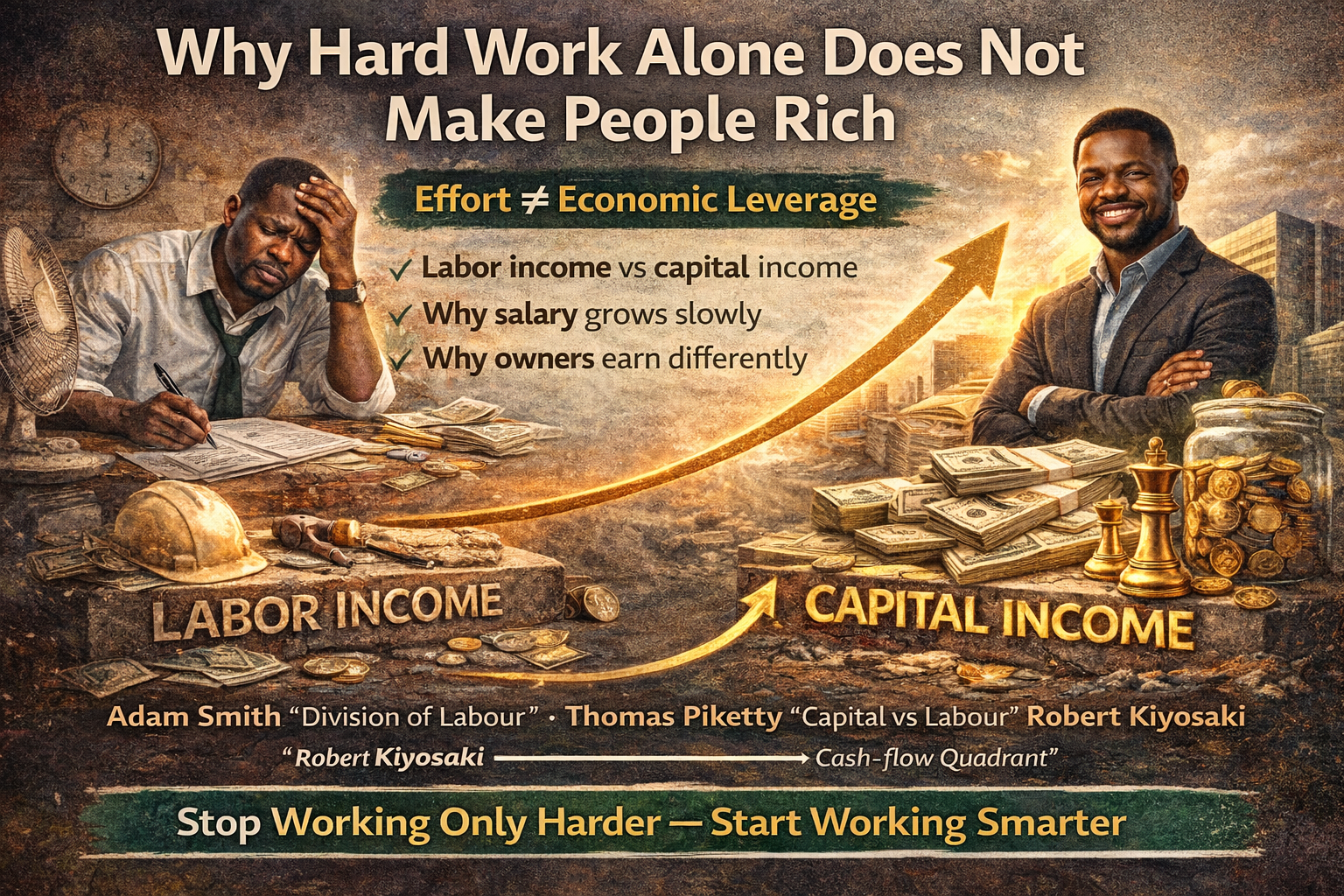

Why Savings Alone Cannot Secure Financial Freedom
Interest Rates, Inflation, Opportunity Cost, and the Necessity of Productive Assets
Introduction
For decades, financial prudence has been distilled into a simple mantra: save your money. Across cultures and generations, savings have been portrayed as the foundation of security, responsibility, and eventual prosperity. While saving is unquestionably important, the belief that savings alone can lead to financial freedom is not only incomplete—it is economically flawed.
In modern economies characterized by inflation, currency depreciation, and low real interest rates, savings function primarily as capital preservation at best and value erosion at worst. Financial freedom, however, requires more than preservation; it requires growth, scalability, and compounding. This article examines why savings alone are structurally insufficient and why they must be transformed into productive assets to secure long-term financial independence.
1. The Economic Purpose of Savings: A Misunderstood Tool
Savings are not wealth; they are deferred consumption. John Maynard Keynes, in The General Theory of Employment, Interest and Money, framed savings as a temporary store of value—a bridge between present income and future expenditure. Their primary function is liquidity, not multiplication.
Savings serve three essential roles:
- Emergency buffering
- Short-term goal funding
- Capital staging for future investment
What they do not do, by design, is create significant wealth. Treating savings as an end goal rather than a transitional tool is a fundamental economic misunderstanding.
2. Inflation: The Silent Tax on Savers
Inflation is the most decisive force working against savings-based financial strategies. As economist Milton Friedman famously observed, “Inflation is taxation without legislation.” It erodes purchasing power quietly and continuously.
The Real Interest Rate Problem
What matters is not nominal interest but real interest:
Real Interest Rate = Nominal Interest Rate – Inflation Rate
In many economies—especially currency-weak or import-dependent countries—savings accounts offer returns that trail inflation. When inflation runs at 15% and savings earn 4%, the saver is losing 11% of purchasing power annually.
Irving Fisher, one of the pioneers of monetary economics, emphasized that ignoring inflation leads to money illusion—the false belief that nominal growth equals real progress. For savers, this illusion is financially destructive.
3. Interest Rates and the Structural Limits of Savings
Interest rates on savings are deliberately low for systemic reasons:
- Banks use deposits as cheap capital
- Central banks suppress rates to stimulate borrowing and consumption
- Risk-free returns are capped by policy design
As a result, savings returns are non-scalable. Whether one saves ₦100,000 or ₦10 million, the percentage return remains fixed and modest, while inflation compounds relentlessly.
Warren Buffett has repeatedly emphasized this structural limitation, noting that cash is “a terrible long-term investment” and should only be held when there is a clear strategic purpose.
4. Opportunity Cost: The Invisible Loss
Every naira, dollar, or pound held idle carries an opportunity cost—the return it could have generated elsewhere.
Charlie Munger described opportunity cost as “the highest price you pay in life.” When funds are locked in low-yield savings, they forgo:
- Equity growth
- Business expansion
- Real asset appreciation
- Skill-based or intellectual capital investments
Over long time horizons, opportunity cost compounds more powerfully than interest. The absence of action becomes more expensive than the presence of risk.
5. Scale and the Ceiling of Savings
Savings strategies do not scale with productivity or ambition. They are limited by:

- Income ceilings
- Contribution caps
- Time constraints
A salaried worker saving 20% of income is mathematically constrained by earnings, regardless of discipline. In contrast, assets—businesses, equities, intellectual property, real estate—are not capped by time. They scale with leverage, networks, systems, and demand.
Thomas Piketty, in Capital in the Twenty-First Century, demonstrated empirically that wealth accumulates faster through ownership of capital than through labor or savings alone. This is not a moral argument—it is a structural one.
6. Savings vs. Productive Assets: A Structural Distinction
| Savings | Productive Assets |
|---|---|
| Preserve liquidity | Generate cash flow |
| Lose value to inflation | Often hedge inflation |
| Linear growth | Compounding growth |
| Time-bound | System-driven |
| Defensive | Offensive |
Savings defend against uncertainty. Assets exploit time.
7. Why the Wealthy Save Differently
Contrary to popular belief, wealthy individuals and institutions do save—but strategically. They hold cash:
- As dry powder for opportunities
- To manage volatility
- To arbitrage timing mismatches
They do not save indefinitely. Savings are parked temporarily before being deployed into income-producing or appreciating assets.
This distinction explains why two individuals with the same income can experience radically different financial outcomes over time.
8. Currency Weakness and Developing Economies
In inflation-prone and currency-weak environments, the danger of over-saving is amplified. Local currency savings face:
- Exchange-rate erosion
- Policy shocks
- Monetary instability
In such contexts, converting savings into assets—particularly those with foreign currency exposure, hard-asset backing, or pricing power—is not speculative; it is defensive.
9. The Proper Role of Savings in a Wealth Strategy
Savings should be viewed as:
- Fuel, not the engine
- A staging ground, not a destination
- A tool, not a strategy
Financial freedom emerges when savings are systematically transformed into:
- Businesses
- Equities
- Rental assets
- Intellectual property
- Scalable skills and platforms
Conclusion
Savings are necessary, but they are not sufficient. They protect, but they do not propel. In an economic environment shaped by inflation, suppressed interest rates, and widening capital returns, saving alone guarantees only one outcome: stagnation disguised as prudence.
True financial freedom requires the courage to move beyond accumulation into ownership, beyond preservation into production, and beyond certainty into calculated risk.
As history, data, and economic theory consistently show:
Wealth is not built by holding money—it is built by putting money to work.