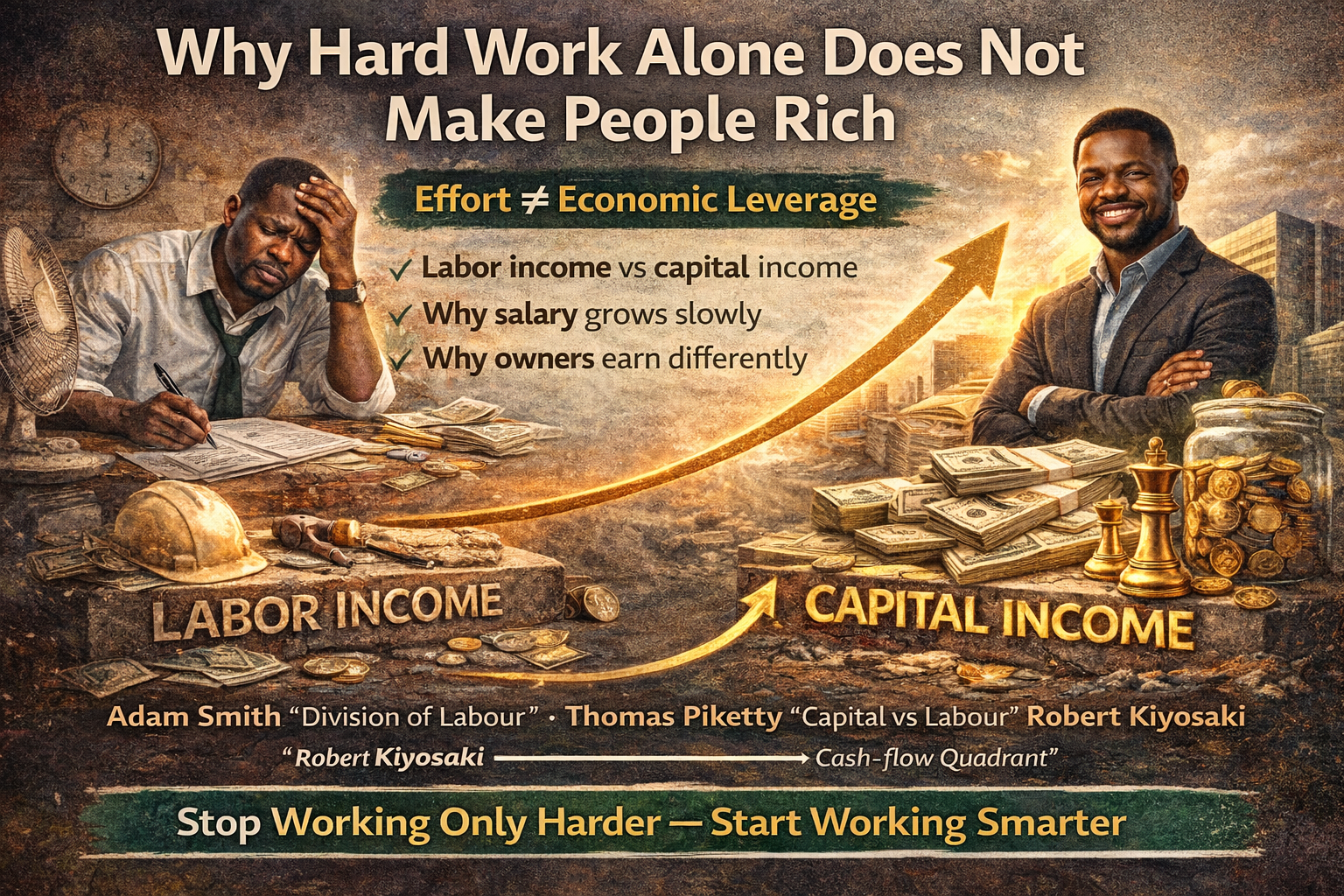
Why Savings Alone Won’t Make You Wealthy — And What Actually Will
Introduction: The Comfort—and the Trap—of Saving
Saving money is often presented as the cornerstone of financial success. From childhood, people are taught that disciplined saving is the path to security and eventual wealth. While saving is essential, it is frequently misunderstood—and dangerously overestimated. In reality, savings alone rarely create wealth. At best, they preserve value; at worst, they quietly erode under inflation.
True wealth is not built by money sitting idle. It is built by money that is deployed productively, takes calculated risk, and participates in value creation. Understanding this distinction is critical for individuals, businesses, and even nations seeking long-term prosperity.
The Role of Savings: Necessary but Insufficient
Savings serve an important function in any financial system. They provide liquidity, stability, and a buffer against uncertainty. Emergency funds, working capital reserves, and short-term savings protect individuals and businesses from shocks.
However, savings are fundamentally defensive, not generative. They do not multiply on their own. In environments with inflation—particularly common across emerging markets—cash savings often lose purchasing power over time. A person who saves diligently but never invests may feel financially responsible, yet steadily fall behind economically.
Savings are the starting point of wealth creation, not the destination.
Inflation: The Silent Wealth Destroyer
One of the most overlooked reasons savings fail to create wealth is inflation. When the general price level rises faster than the interest earned on savings, real value declines. This means that even though the nominal amount of money increases, what it can actually buy decreases.
In many African economies, inflation frequently outpaces savings account yields. As a result, purely saving money can paradoxically make individuals poorer in real terms. Wealth creation, therefore, requires strategies that outperform inflation, not merely avoid spending.
Wealth Is Built Through Capital Deployment
The defining difference between savers and wealth builders is how capital is used. Wealth is created when money is deployed into assets or activities that generate returns over time. These include:
- Productive businesses
- Income-generating real estate
- Equities and private investments
- Scalable skills and human capital
- Technology, innovation, and infrastructure
Capital deployment transforms money from static storage into an active participant in economic growth. It allows individuals to benefit from compounding, productivity gains, and market expansion.

Risk: The Price of Progress
A common reason people rely solely on savings is fear of risk. While this instinct is understandable, it often leads to missed opportunities. Every form of wealth creation involves risk—but not all risk is reckless.
There is a critical difference between speculative risk and calculated risk. Wealth is built by understanding risk, pricing it correctly, and managing it—not by avoiding it entirely. Entrepreneurs, investors, and successful institutions do not eliminate risk; they structure it intelligently.
Ironically, avoiding all risk by holding cash can be one of the riskiest strategies of all, especially in volatile economic environments.
Productivity: The Engine Behind Wealth
At its core, wealth is the result of productivity—producing more value than is consumed. This applies at every level:
- Individuals build wealth by developing skills that command higher economic value.
- Businesses grow by turning inputs into outputs more efficiently than competitors.
- Economies prosper by allocating capital toward sectors that increase national productivity.
Savings alone do not increase productivity. Investment does. When capital is combined with labor, innovation, and efficient systems, it creates surplus—and surplus is the foundation of wealth.
The Power of Compounding in Action
Compounding is often misunderstood as something that only applies to savings accounts. In reality, compounding works most powerfully through reinvested returns in productive assets. Businesses that reinvest profits, investors who reinvest dividends, and professionals who continuously upgrade their skills all benefit from compounding effects.
Time magnifies the difference between idle savings and productive capital. Over long horizons, even modest returns from well-deployed capital can vastly outperform decades of disciplined saving.
What Actually Builds Wealth
Sustainable wealth creation rests on a combination of factors:
- Financial literacy – understanding how money works beyond basic budgeting
- Strategic investing – allocating capital to productive, scalable opportunities
- Income growth – increasing earning capacity through skills and enterprise
- Risk management – protecting downside while pursuing upside
- Long-term thinking – allowing time and compounding to work
Savings support these pillars—but cannot replace them.
Implications for Individuals and African Economies
For individuals, the lesson is clear: saving is prudent, but stopping there is limiting. Financial independence requires participation in value creation, not just money preservation.
For African economies, the same principle applies. Nations that focus solely on reserves without investing in infrastructure, industry, education, and innovation struggle to grow. Those that channel capital into productive sectors build resilience, employment, and long-term prosperity.
WealthQuizzes Perspective: Learning Before Earning
At WealthQuizzes, financial intelligence is viewed as more than knowing how to save—it is about understanding how wealth is actually created. True empowerment comes from knowing when to save, when to deploy capital, and how to evaluate opportunity and risk.
Savings protect you.
Knowledge multiplies you.
And in the modern economy, it is informed decision-making—not passive accumulation—that separates financial survival from lasting wealth.