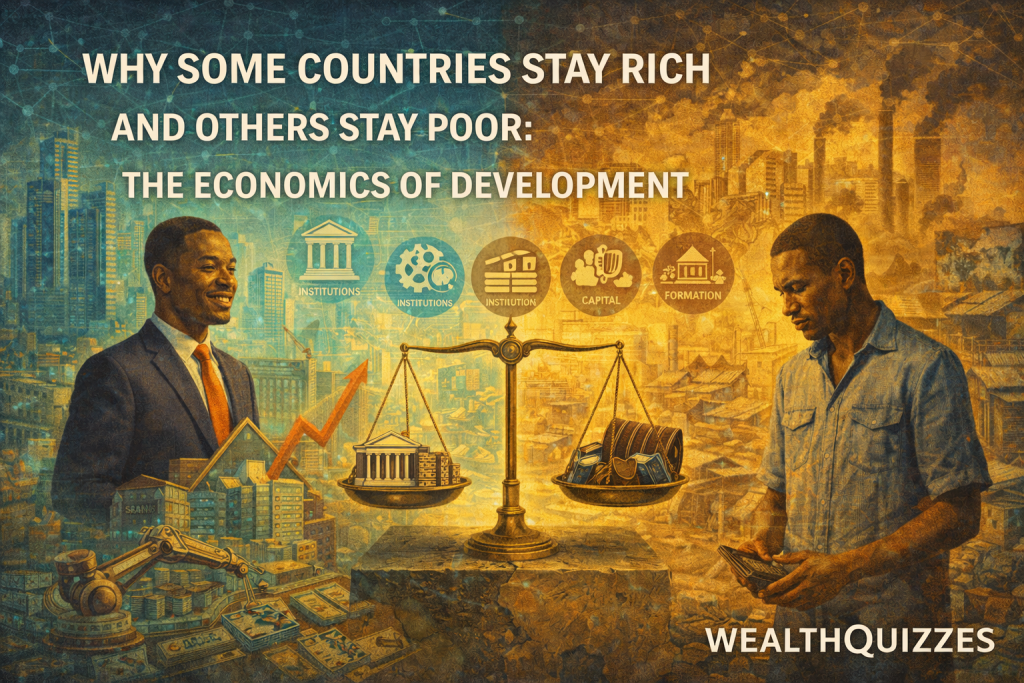
Why Some Countries Stay Rich and Others Stay Poor: The Economics of Development
By WealthQuizzes Editorial Team
Introduction: The Wrong Questions We Keep Asking
Why is Switzerland rich while Congo remains poor?
Why do South Korea and Nigeria, once comparable in income levels, now sit worlds apart economically?
These questions are often answered with clichés:
- “They work harder.”
- “They are more educated.”
- “They are more corrupt.”
- “They were colonized.”
While not entirely false, these explanations are incomplete and misleading. They focus on symptoms, not causes.
Economic development is not accidental. It is the result of systems, incentives, institutions, and long-term choices. This article explains why some countries sustain wealth — and why others struggle to escape poverty.
Development Is Not About Money — It’s About Systems
Contrary to popular belief, development is not simply about having more money or natural resources.
Some of the poorest countries are resource-rich. Some of the richest have none.
What separates rich nations from poor ones is how their systems convert effort into value.
At the center of development economics are four pillars:
- Institutions
- Productivity
- Capital formation
- Governance
When these pillars are strong, wealth compounds. When they are weak, poverty persists.
Institutions: The Invisible Engine of Wealth
Institutions are the rules of the game — laws, property rights, courts, contracts, regulatory bodies, and enforcement mechanisms.
In rich countries:
- Property rights are secure.
- Contracts are enforceable.
- Laws apply predictably.
- Businesses can plan long-term.
In poor countries:
- Ownership is uncertain.
- Rules change arbitrarily.
- Courts are slow or compromised.
- Economic activity shifts toward survival, not growth.
Strong institutions encourage people to:
- Invest
- Innovate
- Save
- Take calculated risks
Weak institutions force people to:
- Extract quickly
- Avoid formal systems
- Operate informally
- Prioritize short-term gains
Development stalls when effort cannot be reliably rewarded.
Productivity: The True Measure of Wealth
A country is rich not because people work harder — but because each hour of work produces more value.
Productivity depends on:
- Skills and education
- Technology
- Infrastructure
- Management quality
- Access to capital
A farmer using modern tools produces more than one using manual labor.
A factory with stable power produces more than one running generators.
High productivity allows countries to:
- Pay higher wages
- Export competitively
- Accumulate savings
- Invest in public goods
Low productivity traps countries in low incomes, regardless of effort.
Development is not about working more — it’s about working better.
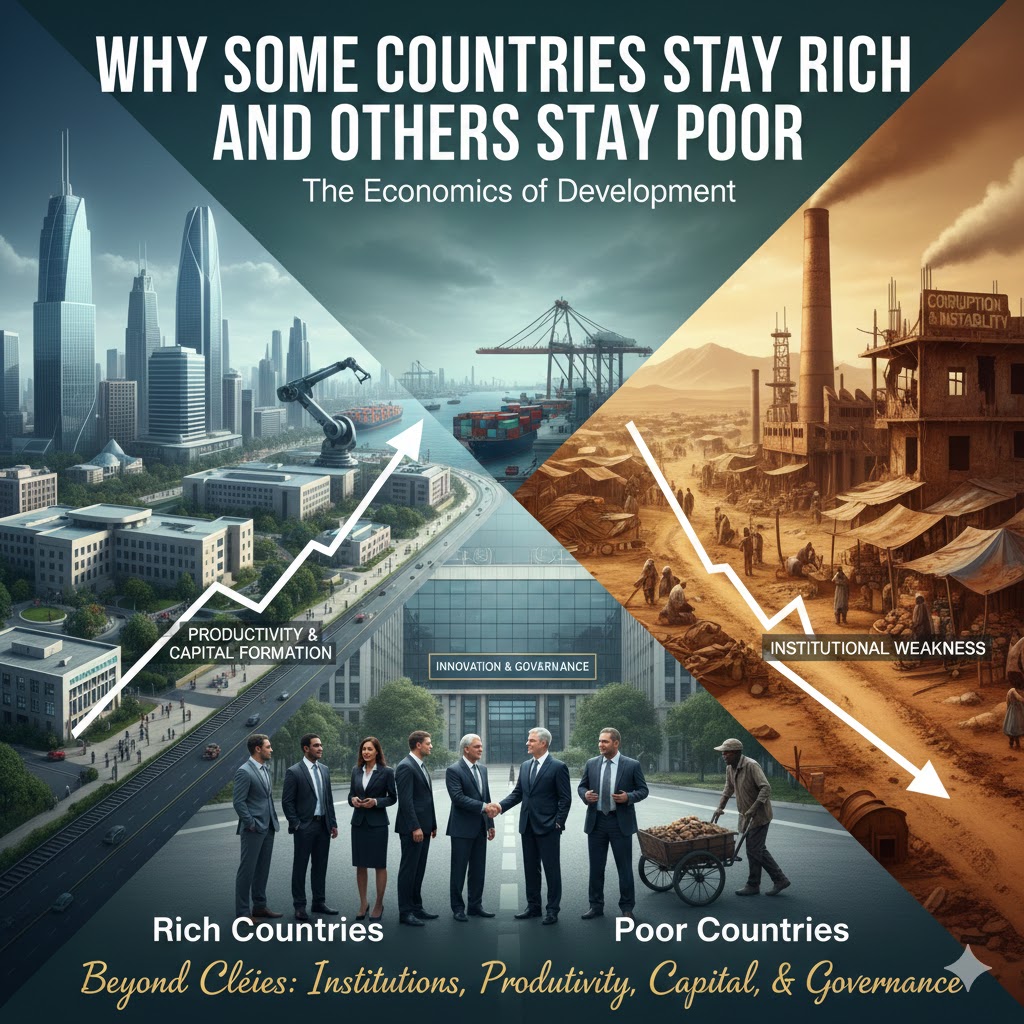
Capital Formation: Why Poor Countries Can’t Grow Fast Enough
Capital formation refers to the accumulation of:
- Machinery
- Infrastructure
- Education
- Technology
- Financial assets
Rich countries continuously reinvest profits into productive assets. Poor countries struggle to do so because:
- Savings are low
- Credit is expensive
- Inflation erodes value
- Capital flees to safer markets
Without capital, productivity stagnates.
Without productivity, incomes remain low.
Without income, savings disappear.
This is the development trap.
Breaking it requires stable financial systems, long-term investment frameworks, and trust in the future.
Governance: Incentives Matter More Than Intentions
Governance is not about good speeches — it is about aligned incentives.
In successful economies:
- Leaders are constrained by institutions.
- Policy mistakes are corrected quickly.
- Corruption carries consequences.
- Public resources are tracked.
In struggling economies:
- Power is concentrated.
- Rules apply selectively.
- Rent-seeking outperforms innovation.
- Policy uncertainty scares investment.
Governance shapes whether talent flows into:
- Entrepreneurship or extraction
- Innovation or politics
- Production or speculation
When the smartest people chase power instead of productivity, development slows.
The Role of History — But Not as an Excuse
History matters. Colonization, slavery, and global inequality have real impacts.
But history explains starting points, not permanent outcomes.
Countries like:
- South Korea
- Singapore
- Rwanda
- Vietnam
All faced severe historical disadvantages — yet made deliberate institutional and policy choices that changed their trajectory.
History influences development. It does not predetermine it.
Why Aid Alone Doesn’t Work
Foreign aid can relieve suffering — but it rarely creates development.
Why?
- It bypasses institutions
- It weakens accountability
- It distorts incentives
- It encourages dependency
Sustainable development comes from internal capacity, not perpetual external support.
Aid without institutional reform treats symptoms, not systems.
Africa’s Development Question: Structure, Not Potential
Africa does not lack:
- Talent
- Resources
- Energy
- Ideas
What it lacks is coherent economic structure.
Informal economies dominate because formal systems are unreliable.
Entrepreneurship exists, but scaling is rare.
Capital flows in, but doesn’t stay.
The development challenge is not ambition — it is architecture.
WealthQuizzes Perspective: Development Starts With Understanding
At WealthQuizzes, we believe financial literacy must extend beyond personal finance into economic awareness.
Understanding why countries develop helps individuals:
- Interpret policy decisions rationally
- Make better investment choices
- Avoid populist economic myths
- Think long-term about wealth creation
Development is not magic.
It is design, discipline, and decision-making over time.
Countries that understand this grow.
Those that don’t keep asking the wrong questions.
And in economics — as in life — asking better questions is the first step toward better outcomes.