
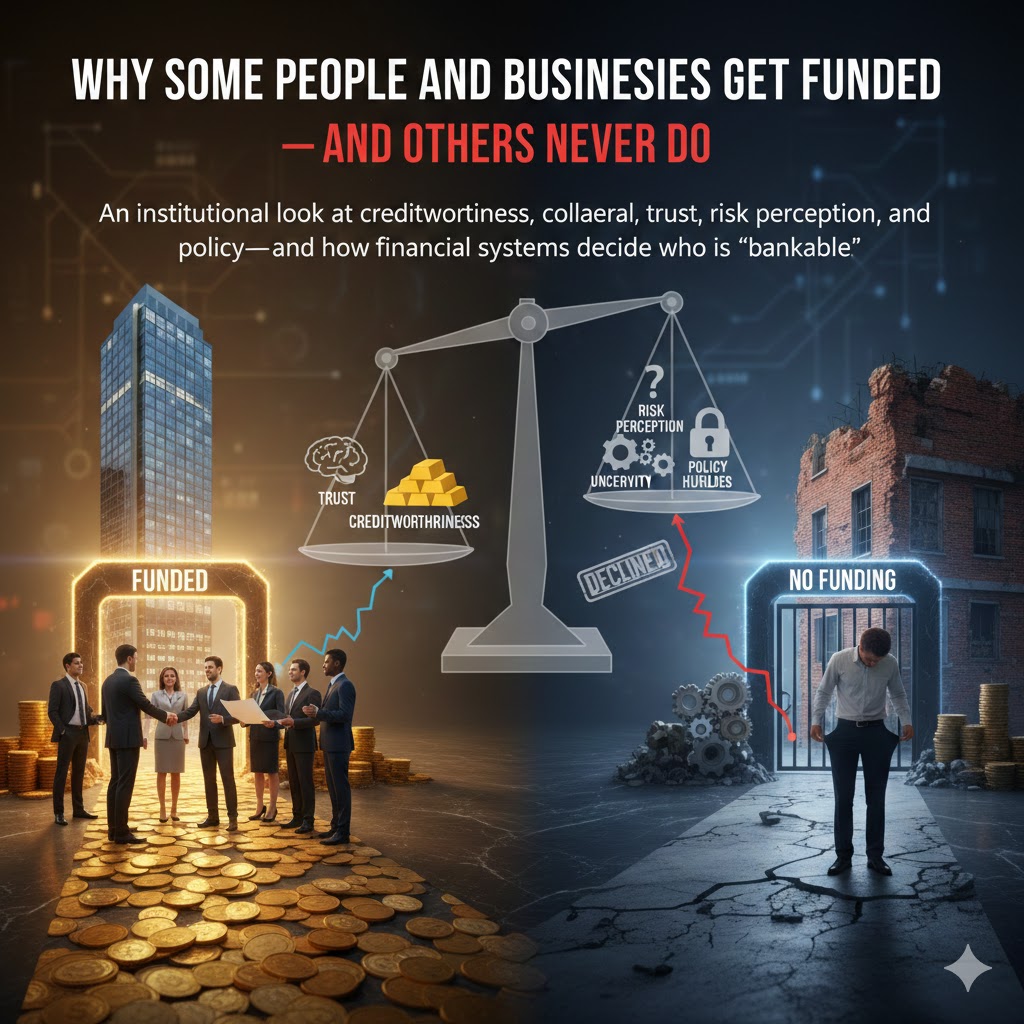
Why Some People and Businesses Get Funded—and Others Never Do
Creditworthiness, Collateral, Trust, and the Hidden Architecture of Financial Access
Access to finance is often presented as a neutral outcome of merit: good ideas get funded, bad ones don’t; disciplined borrowers succeed, reckless ones fail. In reality, funding decisions are rarely about effort, intelligence, or even innovation alone. They are the product of institutional rules, historical trust, asset ownership, and risk perception embedded within financial systems.
This article examines why some people and businesses are considered “bankable” while others are structurally excluded, even when they appear productive, hardworking, or profitable.
1. Funding Is Not About Money — It Is About Trust
At the heart of all financial systems lies trust, not cash.
As economist John Maynard Keynes emphasized, finance operates on expectations about the future, not merely present conditions. Lending is fundamentally an act of belief: the belief that the borrower will repay, that contracts will be enforced, and that the system will remain stable.
Banks do not lend money they already have sitting idle; they create credit against confidence:
- Confidence in the borrower
- Confidence in collateral
- Confidence in legal enforcement
- Confidence in macroeconomic stability
Where trust is weak, funding dries up—regardless of effort or need.
2. Creditworthiness Is Institutional, Not Personal
In theory, creditworthiness reflects a borrower’s ability to repay. In practice, it reflects how institutions measure risk, not how individuals experience reality.
Modern banking systems assess creditworthiness using variables such as:
- Formal income records
- Prior borrowing history
- Asset ownership
- Business registration and compliance
- Predictable cash flows
As Hyman Minsky noted, financial systems favor stability over creativity. Borrowers who resemble past “successful” borrowers are rewarded; those who fall outside standard templates are penalized.
This is why:
- Informal businesses struggle to access loans
- First-time borrowers face higher barriers
- Small enterprises are rejected while large firms refinance easily
Creditworthiness is path-dependent: once excluded, exclusion reinforces itself.
3. Collateral Is the Real Gatekeeper
Collateral—not character—is often the decisive factor in funding.
According to the World Bank, lack of acceptable collateral is the single biggest obstacle to credit access for small and medium enterprises in developing economies.
Collateral performs three functions:
- It reduces lender risk
- It disciplines borrowers
- It signals social and economic status
But collateral requirements favor those who already own assets—land, property, financial securities—creating what economist Thomas Piketty describes as capital reinforcing itself.
Those without assets face a paradox:
- You need assets to get credit
- You need credit to acquire assets
This loop is structural, not moral.
4. Risk Perception Is Not Risk Reality
Financial institutions do not price actual risk; they price perceived risk.
Perceived risk is shaped by:
- Geography
- Industry stereotypes

Why Some People and Businesses Get Funded—and Others Never Do - Demographics
- Currency stability
- Historical defaults
As behavioral economist Daniel Kahneman explains, decision-makers rely on heuristics—mental shortcuts—especially under uncertainty. This leads to systematic bias.
Consequences include:
- African businesses paying higher interest for similar projects
- Small firms labeled “high risk” regardless of performance
- Innovative models rejected because they lack historical data
In short, risk is socially constructed, not purely mathematical.
5. Policy Quietly Decides Who Gets Funded
Financial systems do not operate in a vacuum. Public policy shapes private lending.
Central banks, regulators, and governments influence funding through:
- Interest rate policy
- Reserve requirements
- Credit guarantees
- Sectoral incentives
- Capital adequacy rules
During crises, governments routinely support large institutions under the logic of “systemic importance.” As seen in the 2008 financial crisis, some entities are “too big to fail”, while others are allowed to collapse.
Economist Joseph Stiglitz argues that this creates moral asymmetry:
profits are privatized, losses are socialized—reinforcing inequality in access to capital.
6. Why Informality Is Financially Punished
In many African and emerging economies, large portions of economic activity occur outside formal systems. While productive, these activities lack:
- Verifiable records
- Legal enforceability
- Transparent governance
Banks cannot price what they cannot measure.
As a result:
- Informal workers rely on personal savings
- Informal businesses self-finance slowly
- Growth is constrained regardless of demand
This is not because the informal sector is unproductive, but because financial systems are built for documentation, not improvisation.
7. Access to Credit Determines Economic Power
Economist Mariana Mazzucato emphasizes that modern economies are shaped by who gets funded early, cheaply, and repeatedly.
Access to credit determines:
- Who scales
- Who survives downturns
- Who acquires competitors
- Who shapes markets
Those with credit can:
- Leverage time
- Absorb shocks
- Invest ahead of returns
Those without credit must rely on labor alone—linear, fragile, and exposed to inflation.
8. The Myth of Equal Opportunity in Finance
The idea that “anyone with a good idea can get funded” ignores structural realities.
Financial systems are selective by design, not neutral by default. They reward:
- Existing ownership
- Formal legitimacy
- Historical inclusion
They punish:
- New entrants
- Informality
- Currency weakness
- Institutional fragility
As Piketty warns, when access to capital is unequal, inequality compounds across generations.
9. What Financial Inclusion Really Requires
True financial inclusion is not just about opening accounts or offering apps. It requires:
- Strong property rights
- Reliable legal systems
- Credit registries that include small actors
- Policy frameworks that share risk
- Long-term capital, not just short-term loans
Without institutional reform, inclusion efforts remain cosmetic.
Conclusion: Bankability Is Engineered, Not Earned
Some people and businesses get funded not because they are smarter or harder-working, but because they fit the architecture of finance.
Bankability is produced at the intersection of:
- Trust
- Assets
- Policy
- Perception
- History
Understanding this shifts the conversation from blame to structure—from personal failure to systemic design.
And that understanding is the first step toward building systems where access to capital follows value creation, not inherited advantage.
WealthQuizzes Insight
Knowledge is the first form of capital.
But access to capital determines who can turn knowledge into power.