
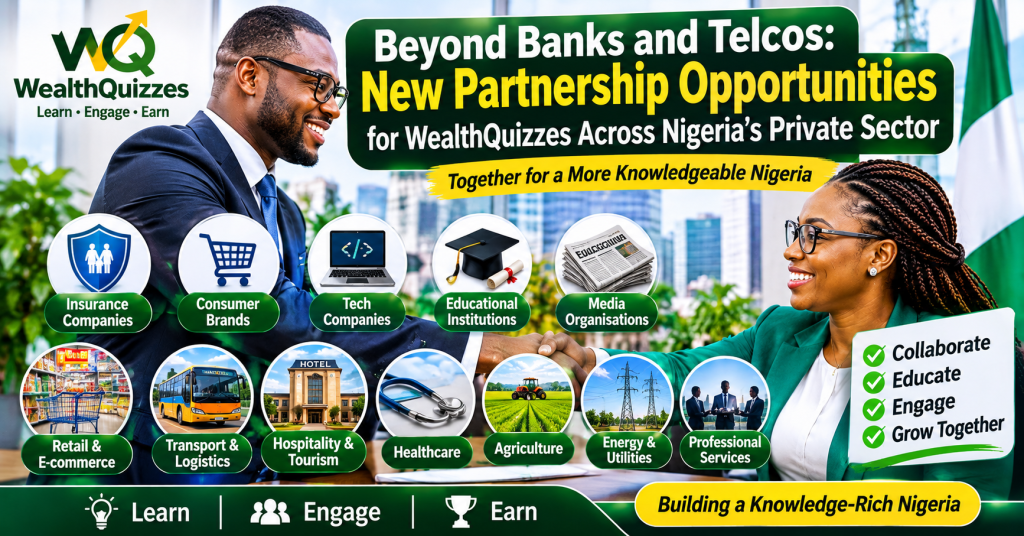
Beyond Banks and Telcos: New Partnership Opportunities for WealthQuizzes Across Nigeria’s Private Sector
Introduction
When businesses consider strategic partnerships with digital platforms, banks and telecommunications companies are often among the first organisations that come to mind. Their large customer bases, established distribution networks, financial resources and extensive communication infrastructure make them attractive partners. However, limiting partnership opportunities to these two sectors would overlook a much wider commercial landscape.
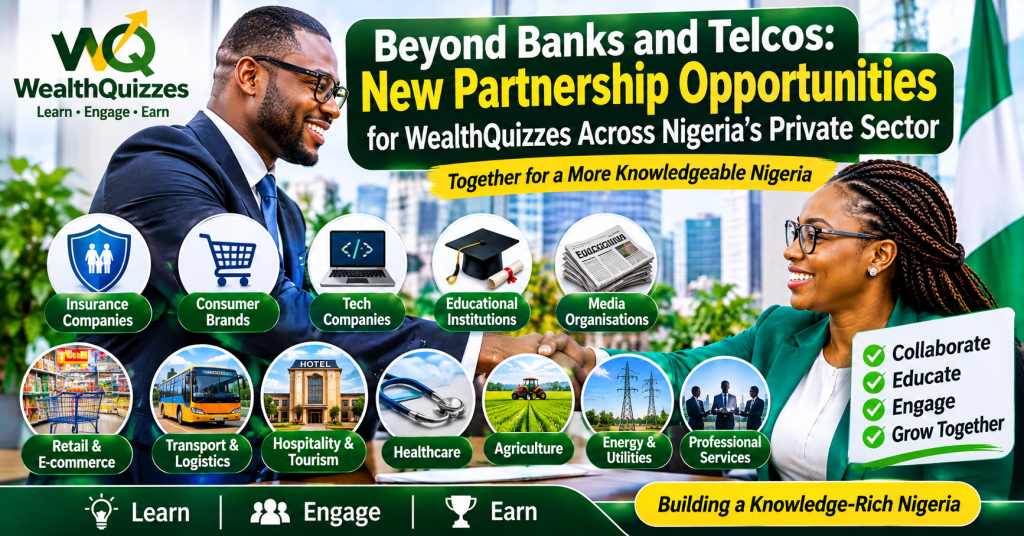
Nigeria’s private sector comprises organisations operating across insurance, consumer goods, retail, technology, education, media, transportation, hospitality, healthcare, agriculture, energy and professional services. These businesses continually seek more effective ways to reach customers, communicate product value, build brand loyalty, improve public awareness and differentiate themselves in competitive markets.
At the same time, consumers increasingly interact with businesses through digital channels. This creates opportunities for companies to explore engagement models that go beyond conventional advertising and promotional campaigns.
This is where WealthQuizzes can present a distinctive proposition.
WealthQuizzes is a Nigerian knowledge-based digital quiz and engagement platform built around the idea that knowledge can become an avenue for participation and conditional rewards. Through its Learn • Engage • Earn concept, it creates an opportunity to connect knowledge, digital participation and brand engagement.
The platform’s partnership potential should not be measured only by the number of organisations willing to sponsor quiz activities. It should also be assessed by its capacity to help businesses communicate useful information, create interactive brand experiences, support public education and develop measurable engagement campaigns.
The opportunity, therefore, extends well beyond banks and telecommunications companies. Nigeria’s wider private sector could provide a substantial pool of potential strategic partners.
1. Why WealthQuizzes Should Look Beyond Traditional Partnership Sectors
Banks and telecommunications companies are important prospective partners, but a sustainable partnership strategy should avoid excessive dependence on a narrow group of industries.
A diversified partnership portfolio offers several advantages.
First, it reduces commercial concentration risk. If a platform depends heavily on a small number of industries, changes in their marketing priorities, budgets or internal approval processes could affect its growth plans. Engaging organisations across different sectors creates more opportunities to develop alternative revenue and collaboration channels.
Second, different industries offer different forms of value. An insurance company may be interested in public awareness and product education. A consumer goods manufacturer may prioritise brand recognition and customer engagement. An educational institution may be interested in learning activities, while a technology company may seek opportunities to demonstrate its products and reach new users.
Third, sector diversity creates opportunities for more relevant quiz content. Questions about consumer awareness, entrepreneurship, technology, agriculture, environmental sustainability, transportation, health literacy and professional development can provide a broader knowledge experience.
The World Bank’s Nigeria Digital Economy Diagnostic identifies digital infrastructure, digital platforms, digital financial services, digital entrepreneurship and digital skills as important foundations for Nigeria’s digital economy. Its analysis reinforces the importance of collaboration across the wider digital ecosystem rather than treating digital development as the responsibility of a single industry.
Source: World Bank — Nigeria Digital Economy Diagnostic.
For WealthQuizzes, the strategic implication is straightforward: the platform should approach organisations based on the relevance of its engagement model to their business objectives, not merely their industry classification.
2. Insurance Companies: Turning Public Awareness into Interactive Engagement
Insurance represents one of the most promising areas for potential collaboration.
Despite the importance of insurance in protecting individuals, families and businesses against financial risks, public understanding and uptake remain significant challenges in Nigeria.
The National Insurance Commission (NAICOM), in its Strategic Plan 2024–2028, identified the need to improve insurance awareness, accessibility and penetration. Its stated objectives include improving insurance literacy and facilitating the development of effective traditional and alternative distribution channels.
The Central Bank of Nigeria’s June 2024 Financial Stability Report also recorded increased insurance-sector assets and premium income, attributing improvements partly to sustained market-development initiatives and increased awareness.
These developments demonstrate why public education and consumer engagement matter to the insurance industry.
Source: NAICOM — Strategic Plan 2024–2028.
WealthQuizzes could collaborate with insurance companies through sponsored knowledge campaigns covering:
- The meaning and purpose of insurance.
- Life, motor, health, property and business insurance.
- The importance of risk management.
- Common misconceptions about insurance.
- The responsibilities of policyholders.
- Claims procedures and documentation.
- The importance of understanding policy exclusions and conditions.
- Insurance for small businesses and informal-sector operators.
For example, an insurance company could sponsor a themed campaign titled How Well Do You Understand Insurance? Participants would answer questions designed to improve their understanding of insurance principles and everyday risk management.
The insurer could gain brand visibility and an opportunity to communicate its products and services in an educational setting. Participants would encounter useful information in an interactive format, while WealthQuizzes would gain a potential commercial partner and relevant sponsored content.
However, such collaboration must preserve accuracy and consumer protection. Insurance questions should be properly researched, and product-specific claims should be verified by the sponsoring insurer. WealthQuizzes should not independently provide insurance advice, guarantee policy benefits or suggest that participation in a quiz constitutes a substitute for reading policy documents or consulting a qualified professional.
The strongest arrangement would combine public education, responsible brand exposure and clear product information without turning the quiz into a misleading sales exercise.
3. Consumer Goods and FMCG Companies: Making Brand Engagement Interactive
Fast-moving consumer goods (FMCG) companies operate in highly competitive markets. Their products compete for attention in supermarkets, retail outlets, online marketplaces and consumers’ everyday purchasing decisions.
Traditional advertising remains important, but brands also need opportunities to encourage active participation and establish stronger relationships with consumers.
WealthQuizzes could provide an additional engagement channel through sponsored quizzes and themed campaigns.
Potential partners include manufacturers and distributors of:
- Food and beverages.
- Household products.
- Personal-care and beauty products.
- Fashion and lifestyle products.
- Consumer electronics and accessories.
- Packaged consumer goods.
A food manufacturer, for example, could sponsor a quiz campaign on nutrition awareness, food safety, responsible consumption or the history of food production. A personal-care brand could support educational content on hygiene and product awareness, provided that any health-related claims are scientifically substantiated.
A campaign could also incorporate brand-related questions, product knowledge challenges and promotional rewards funded by the sponsor.
The commercial benefits may include increased brand recall, consumer interaction, exposure to new audiences and opportunities to communicate product information in a more engaging format.
Nevertheless, sponsored questions should not become disguised endorsements. Product descriptions, promotional claims and any health or performance representations must be accurate and compliant with applicable advertising and consumer-protection requirements.
4. Retail and E-commerce Businesses: Connecting Engagement with Purchasing Decisions
Retailers and e-commerce businesses are another important category of prospective partners.
Online and physical retailers operate in environments where customer attention, repeat purchases, product discovery and customer loyalty are commercially significant.
WealthQuizzes could collaborate with these businesses through:
Sponsored shopping knowledge challenges: Retailers could support quizzes on consumer awareness, product categories, smart shopping, budgeting and responsible purchasing.
Seasonal promotional campaigns: Special campaigns could be organised around festive periods, back-to-school seasons, major retail events and product launches.
Brand-sponsored rewards: Participating retailers could provide approved products, shopping vouchers or other promotional benefits, subject to clear terms and conditions.
Product education: Retailers could sponsor quizzes that help consumers understand product features, appropriate use, warranties, maintenance and purchasing considerations.
For example, an electronics retailer could sponsor a technology-awareness campaign covering smartphone specifications, cybersecurity, device maintenance and responsible technology use.
Such a campaign would create an opportunity for the retailer to demonstrate product knowledge while positioning itself as a brand that supports informed purchasing decisions.
The partnership should, however, distinguish between educational content and direct sales promotion. Participants should understand when content is sponsored, what conditions apply to any promotional benefit and whether a reward is conditional on a particular action.
5. Technology Businesses: Building a Collaborative Digital Ecosystem
Technology companies offer opportunities that extend beyond conventional sponsorship.
Nigeria’s digital economy includes software developers, fintech businesses, cybersecurity firms, cloud-service providers, digital service companies, device manufacturers, artificial intelligence businesses, technology training providers and other innovators.
The World Bank’s work on Nigeria’s digital economy has recognised digital entrepreneurship and digital skills as important components of the country’s digital development. Its research on digital entrepreneurship in Nigeria also documents the diversity of businesses operating across financial technology, education technology, business software, media services and other digital segments.
Source: World Bank — Digital Entrepreneurship in Nigeria.
For WealthQuizzes, potential collaborations could take several forms.
Technology education campaigns: Cybersecurity companies could sponsor quizzes on password security, phishing, online fraud prevention, digital privacy and safe internet use.
Digital skills initiatives: Technology training businesses could support knowledge campaigns on coding, artificial intelligence, data analysis, digital marketing, software development and productivity tools.
Product awareness: Technology companies could sponsor educational quizzes introducing users to their products, services and practical applications.
Technical partnerships: Depending on the parties’ capabilities and commercial arrangements, technology businesses could provide software services, technical expertise, infrastructure, analytics or other forms of operational support.
Innovation challenges: Technology organisations could sponsor competitions or knowledge campaigns designed to identify and encourage interest in emerging technologies.
These collaborations could benefit both parties. WealthQuizzes could strengthen its technology-oriented content and potentially access relevant technical expertise, while partner organisations could reach audiences interested in digital innovation.
Any technical arrangement involving access to user information, integration with the platform or processing of personal data must be governed by appropriate contractual, security and data-protection safeguards.
6. Educational Institutions: Connecting Learning with Practical Knowledge
Universities, polytechnics, colleges of education, secondary schools, vocational institutions, professional training organisations and private education providers are potential partners.
Education is not limited to formal classroom instruction. Students and young professionals also require practical knowledge, critical thinking, digital awareness, financial literacy and the ability to apply what they learn.
WealthQuizzes could explore collaborations with educational institutions through:
- Inter-institutional knowledge competitions.
- Sponsored academic and general-knowledge challenges.
- Financial-literacy and entrepreneurship campaigns.
- Digital-skills awareness activities.
- Career-development and professional-knowledge quizzes.
- Historical, civic and current-affairs knowledge campaigns.
- Public learning initiatives supported by educational organisations.
An institution could sponsor a knowledge competition among participating students, while WealthQuizzes provides the digital engagement platform and quiz framework.
Professional associations and training organisations could also support subject-specific campaigns in law, accounting, engineering, management, information technology and other disciplines.
There is a growing policy emphasis on collaboration in Nigeria’s education and digital-skills ecosystem. The Federal Ministry of Education’s Nigeria National EdTech Strategy identifies collaboration among government, educational institutions, industry, innovators and other stakeholders as an important element of digital transformation.
Source: Federal Ministry of Education — Nigeria National EdTech Strategy.
For WealthQuizzes, the opportunity is to complement formal education with accessible knowledge engagement. It should not, however, present participation as an accredited qualification, formal examination or substitute for institutional teaching unless an appropriate arrangement has been established.
7. Media and Entertainment Organisations: Turning Audiences into Active Participants
Media organisations have traditionally built audiences through television, radio, newspapers, magazines, websites and social media platforms. However, audience engagement increasingly requires more than publishing content and measuring views or impressions.
WealthQuizzes could offer media organisations an opportunity to transform selected content into interactive knowledge experiences.
Potential partners include:
- Television and radio stations.
- Newspaper and magazine publishers.
- Digital media companies.
- Online news platforms.
- Entertainment businesses.
- Film and music industry operators.
- Sports media organisations.
- Content creators and media production companies.
A radio station could support a weekly general-knowledge challenge. A newspaper publisher could sponsor a current-affairs quiz. An entertainment company could organise a campaign around Nigerian music, film, television and popular culture.
Sports media organisations could support quizzes on football history, major competitions, sporting rules and notable achievements.
These arrangements could create value through cross-promotion, audience participation, content diversification and increased brand visibility.
Media partners could promote campaigns through their existing channels, while WealthQuizzes could provide an interactive destination for participation.
Such collaborations should include clear agreements on content ownership, intellectual property, brand usage, promotional responsibilities, editorial standards and the treatment of sponsored material.
8. Transport, Mobility and Logistics: Making Everyday Knowledge Relevant
Transport and logistics businesses are also potential partners.
Their operations affect commuters, vehicle owners, commercial drivers, businesses, delivery operators and consumers. This creates opportunities for public education and brand engagement.
Potential campaign themes include:
- Road safety and responsible driving.
- Vehicle maintenance and ownership.
- Personal safety during travel.
- Logistics and supply-chain awareness.
- Entrepreneurship in transportation.
- Technology in mobility services.
- Consumer awareness when using delivery services.
A transport company could sponsor a road-safety knowledge campaign, while a logistics operator could support questions on supply chains, e-commerce delivery and business operations.
These activities could help companies communicate useful information while building visibility around their brands.
Any collaboration involving transport safety or technical advice should rely on credible sources and appropriate expert review. WealthQuizzes should not present general quiz content as professional driving instruction or technical certification.
9. Hospitality, Healthcare, Agriculture and Other Sectors
The partnership opportunity extends to several other industries.
Hospitality and tourism
Hotels, travel agencies, tourism operators, restaurants and hospitality groups could sponsor quizzes on Nigerian tourism, cultural heritage, destinations, hospitality standards and responsible travel.
A tourism operator, for instance, could support a campaign showcasing Nigeria’s cultural and geographical diversity while introducing participants to relevant destinations and services.
Healthcare and pharmaceutical businesses
Healthcare providers, diagnostic centres, pharmaceutical companies and health-technology businesses could support carefully reviewed public-awareness campaigns on preventive health, hygiene, health literacy and responsible use of healthcare services.
Such campaigns must be based on reliable medical evidence and appropriate professional review. They should not provide individual diagnosis, promote unsubstantiated treatment claims or encourage self-medication.
Agriculture and agribusiness
Agricultural businesses could sponsor campaigns on modern farming, food security, agribusiness entrepreneurship, agricultural technology, food processing and sustainable practices.
Potential partners include agricultural input suppliers, food processors, agricultural technology companies, equipment providers and commodity businesses.
Energy and utilities
Energy companies and renewable-energy businesses could support knowledge campaigns on energy efficiency, electricity safety, renewable energy, environmental sustainability and responsible energy consumption.
Professional services
Law firms, accounting firms, consulting companies, recruitment businesses and professional associations could sponsor knowledge campaigns relevant to their areas of expertise.
For example, a professional-services firm could support an entrepreneurship or business-compliance challenge, provided that the content is properly reviewed and does not create the impression of an individual professional advisory relationship.
The common opportunity across these sectors is the ability to translate relevant information into accessible, interactive engagement.
10. What Makes a WealthQuizzes Partnership Commercially Valuable?
A successful partnership must offer more than visibility for the sponsoring organisation. It must create a credible exchange of value.
For prospective partners, WealthQuizzes could offer the following:
Brand visibility: Sponsors may receive agreed brand exposure through campaign materials, sponsored quiz categories and other approved promotional placements.
Interactive engagement: Instead of relying exclusively on passive advertising, partners can support campaigns in which participants actively respond to questions and engage with relevant information.
Product and service awareness: Businesses can use carefully designed educational content to explain their products, services and industry concepts.
Targeted campaigns: Campaigns can be designed around particular subject areas, audiences, seasons or commercial objectives, subject to the platform’s actual audience and targeting capabilities.
Corporate social responsibility and shared value: Organisations may support financial literacy, digital skills, consumer awareness, entrepreneurship and other public-education initiatives.
Measurable campaign reporting: Subject to the availability and accuracy of platform analytics, agreed reports could cover participation, completed quizzes, repeat engagement, correct responses, campaign reach and other relevant indicators.
The important distinction is that these are potential partnership benefits, not automatic outcomes. Their delivery must be established through agreed campaign designs, operational capacity and reliable reporting.
11. Partnership Models WealthQuizzes Could Offer
Different organisations have different objectives and budgets. A flexible partnership structure would therefore be more commercially attractive than a single sponsorship package.
Potential models include:
A. Sponsored quiz campaigns
A company funds a campaign around a subject relevant to its industry. The sponsor receives agreed visibility and recognition, while WealthQuizzes develops and administers the campaign.
B. Sponsored categories
An organisation supports a particular knowledge category, such as technology, insurance awareness, entrepreneurship, agriculture or consumer education.
C. Brand-sponsored reward campaigns
A partner provides an agreed reward budget or approved products and promotional benefits for a defined campaign. All eligibility requirements, reward conditions and fulfilment responsibilities should be documented.
D. Co-branded public-awareness initiatives
WealthQuizzes and a partner jointly develop a campaign addressing a relevant public-education issue. The parties agree on branding, content approval, funding, distribution and reporting.
E. Media and promotional partnerships
A media organisation supports campaign publicity through agreed advertising or editorial channels, while WealthQuizzes provides the interactive quiz experience.
F. Technology and operational partnerships
A technology company provides defined technical services, expertise or infrastructure under a commercial or strategic agreement.
G. Institutional and educational partnerships
An educational institution, professional association or training provider supports knowledge competitions and subject-specific campaigns.
These models can be combined where appropriate. For example, an insurance company could sponsor an insurance-literacy campaign, a media organisation could promote it, and a technology partner could provide supporting digital services.
However, every arrangement should have a clearly defined scope, budget, responsibilities, intellectual-property provisions, data-protection obligations and performance measures.
12. The Importance of Trust, Compliance and Editorial Independence
Partnership growth must not come at the expense of credibility.
WealthQuizzes must maintain clear distinctions between educational content, sponsored content and commercial advertising. Sponsorship should not give a partner unrestricted control over factual answers or permit misleading product claims.
The Federal Competition and Consumer Protection Act 2018 provides an important framework for consumer rights and fair commercial conduct in Nigeria. The Advertising Regulatory Council of Nigeria (ARCON) is the statutory regulator of advertising and marketing communications and promotes responsible advertising practice and consumer protection.
Sources:
- Federal Competition and Consumer Protection Commission — FCCPA 2018 and regulatory resources
- Advertising Regulatory Council of Nigeria — ARCON
Data protection is equally important. Where a campaign involves personal information, the parties should establish their respective responsibilities under the Nigeria Data Protection Act 2023. They should address lawful processing, transparency, data minimisation, security, retention, third-party access and any necessary data-sharing or processing agreements.
The OECD’s work on consumer policy and digital technologies also highlights risks associated with online markets, including unclear disclosures, data handling, payment security and manipulative commercial practices.
Source: OECD — Consumer Policy and Digital Technologies.
These considerations are not merely regulatory obligations. They are commercial safeguards. A partner is more likely to value a platform that takes user trust, content accuracy, responsible communication and accountability seriously.
WealthQuizzes should also protect its editorial independence. Sponsors may propose campaign themes and review their own product information, but factual quiz answers must remain accurate and independently verifiable.
13. A Practical Strategy for Building the Partnership Pipeline
The existence of potential partners does not automatically translate into signed agreements. WealthQuizzes therefore needs a disciplined approach to identifying, approaching and converting prospective organisations.
A practical strategy would involve five steps.
First, prioritise sectors according to strategic fit. WealthQuizzes should identify industries whose products, services or public-education objectives naturally align with knowledge-based engagement. Insurance, consumer goods, technology, education and media are strong starting points.
Second, develop sector-specific proposals. A generic partnership proposal may introduce the platform, but it is unlikely to demonstrate the full value of collaboration to every prospective partner. An insurance company should receive an insurance-literacy concept; a technology company should receive a digital-skills or cybersecurity campaign concept; and a consumer brand should receive an appropriate brand-engagement proposal.
Third, offer a defined pilot programme. A limited campaign with a clear duration, budget, audience assumptions, deliverables and evaluation criteria can reduce the perceived risk of entering a new partnership. It also allows both parties to assess operational performance before considering a larger arrangement.
Fourth, establish measurable performance indicators. Relevant indicators may include campaign participation, completed quizzes, repeat participation, engagement rates, user feedback, campaign referrals where properly tracked, and sponsor satisfaction. Where the objective is education, knowledge assessments should be designed to measure more than participation alone.
Fifth, build relationships beyond the initial campaign. A successful pilot should create the basis for renewal, expanded campaigns, additional sponsored categories or a longer-term strategic partnership.
The process should be supported by professional proposals, clear commercial terms, credible reporting and consistent communication.
14. Measuring Success: Beyond Sponsorship Revenue
A partnership strategy should not be judged solely by the amount of sponsorship revenue generated.
For WealthQuizzes, commercial sustainability is essential, but the platform should also evaluate whether partnerships improve its overall value proposition.
Useful indicators include:
- Number of qualified prospective partners approached.
- Number of partnership discussions progressing to formal proposals.
- Proposal-to-agreement conversion rate.
- Sponsorship and partnership revenue.
- Cost of acquiring and servicing each partner.
- Campaign participation and completion.
- Repeat engagement during and after campaigns.
- Partner renewal and retention.
- User satisfaction and complaints.
- Accuracy and educational quality of sponsored content.
- Fulfilment of agreed rewards and promotional obligations.
The platform should avoid reporting impressions, reach or conversions that it cannot reliably verify. Measurement must be based on actual platform capabilities and agreed methodologies.
A credible reporting framework will help WealthQuizzes demonstrate value, identify weak campaigns, improve future proposals and build confidence among prospective partners.
Conclusion: A Wider Private-Sector Opportunity
The future of WealthQuizzes should not be defined by the number of banks or telecommunications companies willing to collaborate with it. Those sectors remain important, but they represent only part of the potential partnership landscape.
Insurance companies can support financial-risk awareness. Consumer brands can create interactive product-engagement campaigns. Retailers can promote informed purchasing. Technology businesses can support digital-skills initiatives and technical collaboration. Educational institutions can extend learning beyond conventional classrooms. Media organisations can turn content into active participation. Transport, hospitality, healthcare, agriculture, energy and professional-services businesses can all explore relevant knowledge-based campaigns.
The opportunity is to create a platform through which businesses can communicate, educate, engage and build relationships with audiences in a more participatory way.
For prospective partners, WealthQuizzes should be presented not simply as another advertising channel, but as a potential strategic engagement platform capable of supporting carefully designed campaigns around knowledge, brand visibility, public awareness and measurable participation.
For WealthQuizzes, the task is to convert that proposition into commercially sound relationships through sector-specific proposals, credible pilot programmes, responsible content, transparent agreements and reliable performance reporting.
The strongest partnerships will not necessarily be those with the largest budgets. They will be those in which the partner’s objectives align with the platform’s capabilities, participants receive meaningful value, and both parties can demonstrate tangible results.
Nigeria’s private sector is diverse, competitive and constantly evolving. WealthQuizzes should approach that market with an equally broad vision: one that recognises opportunities across industries and builds partnerships around shared value.
The next phase of growth may not come from approaching more organisations in the same sectors. It may come from recognising the opportunities in sectors that have not yet considered what a knowledge-based digital engagement platform can offer.
WealthQuizzes — Learn • Engage • Earn. Where Knowledge Becomes Wealth.
Selected Authorities and Further Reading
- World Bank, Nigeria Digital Economy Diagnostic: A Plan for Building Nigeria’s Inclusive Digital Future. Read the report and overview.
- World Bank, Digital Entrepreneurship in Nigeria. Access the report.
- National Insurance Commission (NAICOM), Strategic Plan 2024–2028. Read the strategy.
- Central Bank of Nigeria, Financial Stability Report — June 2024, including its review of the Nigerian insurance sector. Access the report.
- Federal Ministry of Education, Nigeria National EdTech Strategy. Access the strategy.
- UNESCO, UNESCO Supports Nigeria in Advancing the Digital Transformation of TVET and Skills Development (2026). Read the update.
- UNICEF Nigeria, TECNO and UNICEF Release Second-Year Results of Partnership: The Learning Passport Now Reaches Over 2.3 Million Children and Youth in Nigeria (10 September 2026). This provides an example of private-sector and development-sector collaboration in digital learning. Read the announcement.
- OECD, Consumer Policy and Digital Technologies. Read the OECD overview.
- Federal Competition and Consumer Protection Commission, Federal Competition and Consumer Protection Act 2018 and Regulatory Resources. Access the official resource library.
- Advertising Regulatory Council of Nigeria (ARCON). Official website and regulatory information.


