From Users to a Community: How Digital Platforms Can Build Long-Term Participation and Loyalty
Introduction
In the competitive digital economy, attracting users is only the beginning of building a successful platform. The more difficult challenge is giving those users compelling reasons to return, participate consistently, interact with one another and develop a lasting relationship with the platform.
Many digital businesses concentrate heavily on downloads, registrations, advertising reach and promotional campaigns. Although these measures are useful indicators of initial growth, they do not necessarily demonstrate that a platform has established a loyal user base. A person may download an application, register for an account, participate in a promotional activity and never return. Another may remain registered for months without meaningful engagement. Neither situation necessarily represents a strong customer relationship.
The real opportunity emerges when a platform moves beyond treating people as individual accounts and begins developing a community around shared interests, experiences and objectives. A community creates opportunities for interaction, knowledge exchange, recognition, collaboration and a sense of belonging. It can strengthen the relationship between a business and its users while encouraging users to contribute to the value of the platform themselves.
For digital platforms such as WealthQuizzes, this distinction is particularly important. A knowledge-based platform can offer more than access to quizzes and performance-based rewards. It can create an environment in which users learn, exchange ideas, participate in knowledge challenges, receive useful information and interact with others who share similar interests.
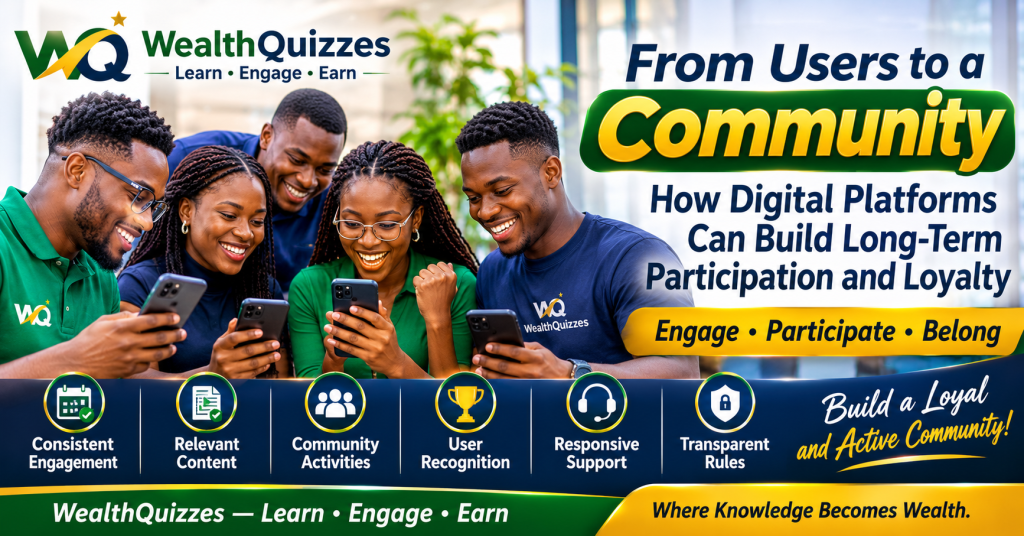
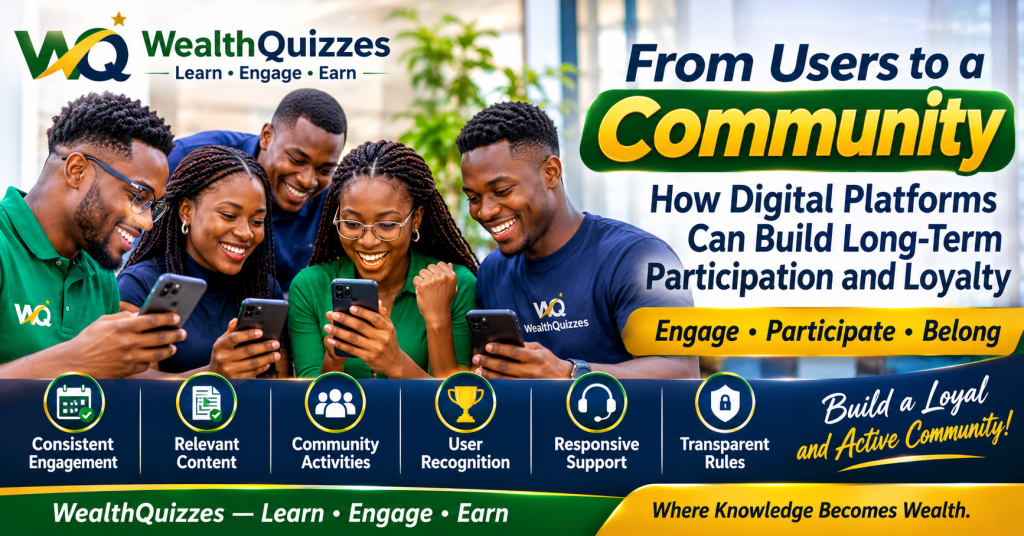
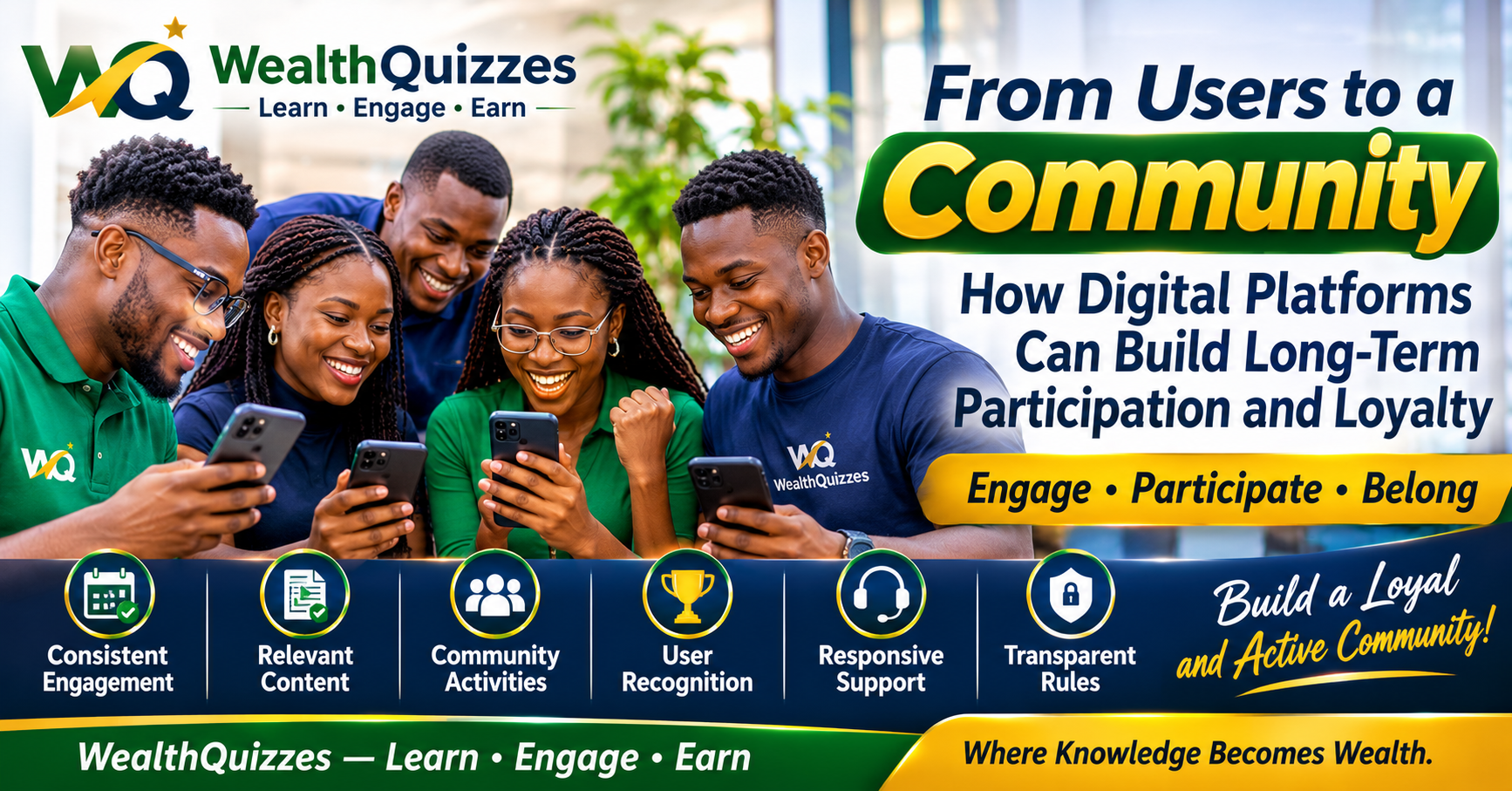
Building such a community, however, does not happen automatically. It requires consistent engagement, relevant content, meaningful activities, user recognition, responsive support, transparent rules and effective community management.
A platform may attract users through advertising, but it earns long-term loyalty by consistently giving people reasons to stay.
1. Understanding the Difference Between Users, Engagement and Community
A user is someone who accesses or registers on a digital platform. Engagement goes further: it involves the user’s interaction with the platform, its content, services, activities or other participants. A community represents a deeper relationship in which users develop a sense of connection around shared interests, values or experiences.
These concepts are related, but they are not interchangeable.
A platform may have a large number of registered users but limited engagement. It may also record substantial engagement without developing a genuine community. For example, thousands of people may respond to promotional notifications without forming relationships with the platform or one another.
In their influential 2001 study, Brand Community, Albert M. Muniz Jr. and Thomas C. O’Guinn examined communities formed around brands. They identified three important characteristics: a shared consciousness, rituals and traditions, and a sense of moral responsibility among members. Their research demonstrates that a community is more than a collection of consumers; it is a network of relationships and shared meanings. Read the study.
Similarly, Roderick J. Brodie, Linda D. Hollebeek, Biljana Jurić and Ana Ilić, in their 2011 article, Customer Engagement: Conceptual Domain, Fundamental Propositions, and Implications for Research, explained customer engagement through interactive experiences and value co-creation. Their work highlights the importance of relationships in which customers participate in creating value rather than simply receiving a service. Read the research.
The practical lesson is that digital platforms should not measure success exclusively through registrations or downloads. They should also examine the quality, frequency and depth of user participation.
A community-oriented platform asks a different question from a conventional acquisition-focused business. Instead of asking only, “How many people have joined?”, it asks, “What reasons do members have to participate, contribute and remain connected?”
2. Consistent Engagement: Giving Users Reasons to Return
Consistency is one of the foundations of long-term participation. Users are more likely to develop habits around a platform when they know what to expect and can identify recurring opportunities for participation.
This does not mean overwhelming users with notifications or constantly demanding their attention. Excessive notifications can become intrusive and may cause users to disengage, mute communication channels or uninstall applications.
Effective engagement should be purposeful, predictable and relevant.
Digital platforms can establish consistent engagement through:
Daily or weekly knowledge challenges.
Scheduled competitions and interactive sessions.
Regular announcements and product updates.
Themed discussions and community conversations.
Educational posts and practical learning resources.
Member polls, surveys and feedback sessions.
Periodic recognition of valuable contributions.
A predictable engagement calendar helps users understand when activities take place and how they can participate. It also enables the platform to plan content, allocate resources and evaluate participation.
For example, a knowledge platform might organise weekly financial literacy challenges, monthly general knowledge competitions and scheduled community discussions. Such activities create recurring opportunities for users to return without making every interaction dependent on a financial incentive.
Consistency must also extend to the platform’s service delivery. If users repeatedly encounter technical failures, unanswered enquiries, unexplained changes or unreliable activities, their willingness to participate may decline.
The objective is to establish a dependable experience in which users can reasonably expect the platform to deliver what it communicates.
3. Relevant Content: Community Participation Must Offer Real Value
Content is one of the strongest reasons people visit and remain connected to digital platforms. However, content volume should not be confused with content value.
Publishing numerous posts does not necessarily create engagement if the material is repetitive, irrelevant, inaccurate or disconnected from the interests of the intended audience.
A successful platform must understand its users and develop content that responds to their needs, interests and expectations.
For a knowledge-based platform, relevant content may include:
Financial literacy and personal money management.
Business, entrepreneurship and investment awareness.
Information about opportunities, challenges and community activities.
Content should be accurate, accessible and appropriately presented. Where a platform publishes educational or factual material, it should establish editorial standards, verify sources and correct errors when identified.
It is also important to understand that users have different motivations. Some may seek education, others entertainment, competition, networking or practical information. A platform that recognises these differences can organise its content into relevant categories and activities.
In 2013, Brodie and his co-authors examined consumer engagement in virtual brand communities. Their research found that engagement is multidimensional and dynamic, involving different levels of interaction and value co-creation among participants. This supports the view that meaningful community participation cannot be reduced to a single activity or metric. Read the study.
For digital businesses, the implication is clear: content should not merely occupy space on a platform. It should give users a reason to think, learn, interact, contribute or return.
4. Community Activities: Turning Passive Audiences into Active Participants
A community becomes stronger when members have opportunities to interact rather than merely receive announcements.
Many digital platforms make the mistake of treating their community channels as additional advertising outlets. They publish promotional messages, share links and announce products but provide few opportunities for genuine discussion or participation.
A meaningful community requires two-way communication.
Possible activities include:
Knowledge challenges: Members participate in quizzes, themed competitions and educational exercises that encourage learning and friendly competition.
Question-and-answer sessions: Users ask questions, seek clarification and receive responses from administrators or knowledgeable community members.
Interactive discussions: Members discuss relevant subjects, exchange experiences and learn from different perspectives.
Polls and surveys: Users express opinions on proposed features, content categories, activities and platform improvements.
Member contributions: Participants share useful information, practical experiences, educational resources and constructive suggestions, subject to appropriate moderation.
Special community events: Scheduled sessions, expert discussions, webinars and recognition events can provide additional reasons for members to participate.
These activities should have clear objectives. A quiz challenge may promote knowledge retention; a financial literacy discussion may improve awareness; a feedback session may identify product weaknesses.
The platform should also avoid creating activities that generate participation without providing meaningful value. A community should not become a constant stream of promotional demands.
Research by Ying-Feng Kuo and Lien-Hui Feng, published in the International Journal of Information Management in 2013, examined relationships between community interaction, perceived benefits and community commitment. Their findings indicated that social, learning and enjoyment benefits can contribute positively to community commitment. Read the research.
The lesson is that community activities should offer benefits that extend beyond the immediate commercial interests of the platform.
5. User Recognition: Making Members Feel Valued
People are more likely to contribute to a community when they believe their participation is noticed and appreciated.
Recognition is therefore an important element of community management. It communicates that the platform values members not merely as sources of traffic or revenue, but as participants whose contributions matter.
Recognition does not always require cash rewards or expensive incentives. It can take several forms:
Acknowledging constructive contributions.
Highlighting useful member suggestions.
Celebrating knowledge challenge achievements.
Featuring outstanding community contributions.
Awarding certificates or non-cash recognition.
Providing opportunities for experienced members to assist newcomers.
Publicly thanking members who contribute positively to community activities.
Recognition should be fair, transparent and based on identifiable contributions. It should not become a popularity contest or encourage artificial engagement.
For instance, rewarding members solely for posting frequently may encourage repetitive, low-quality messages. A better approach is to recognise helpfulness, accuracy, constructive participation, creativity and consistent positive conduct.
Recognition should also accommodate different forms of participation. Some members may contribute through discussions, while others may prefer completing challenges, sharing feedback or quietly learning from published content.
The objective is to encourage meaningful contribution without making recognition the sole reason for participation.
6. Responsive Technical and Customer Support: Trust Is Built Through Service
A digital community cannot flourish where users consistently encounter unresolved problems.
Technical difficulties, payment disputes, account-access issues, delayed responses and unclear instructions can weaken confidence in a platform. If users feel ignored when problems arise, they may eventually withdraw their participation.
Responsive support is therefore not simply an administrative function. It is part of the platform’s relationship with its community.
An effective support structure should provide:
Clearly identified communication channels.
Accessible instructions and frequently asked questions.
A process for reporting technical problems.
Timely acknowledgement of complaints.
Realistic response and resolution timelines.
Escalation procedures for unresolved matters.
Clear communication where an issue requires additional investigation.
Support teams should also maintain records of recurring complaints. If many users report the same difficulty, the problem may indicate a wider product or system weakness rather than isolated user error.
For example, repeated complaints about registration, payment confirmation, navigation or reward eligibility should prompt investigation and, where necessary, product improvements.
Platforms should measure support performance through response times, resolution times, complaint volumes, recurring issue categories and user satisfaction.
Importantly, support should not be limited to resolving complaints. It should help users understand how the platform works, how to participate responsibly and how to obtain the best value from available features.
A community that knows it can obtain assistance when necessary is more likely to develop confidence in the platform.
From Users to a Community: How Digital Platforms Can Build Long-Term Participation and Loyalty
7. Transparent Rules and Fair Community Governance
Trust is difficult to establish where users do not understand the rules governing their participation.
Digital platforms must communicate their terms of use, community standards, eligibility requirements, moderation policies, privacy practices and reward conditions in clear and accessible language.
Transparency is particularly important where a platform involves subscriptions, competitions, referrals, incentives or performance-based rewards.
Users should understand:
What the platform offers and what it does not offer.
What participation requires.
Whether charges apply and how they are calculated.
How rewards are earned and what conditions govern eligibility.
What conduct is prohibited.
How complaints and disputes are handled.
How personal information is collected and used.
What happens where a user breaches community rules.
Rules should be applied consistently. Selective enforcement, unexplained restrictions and arbitrary decisions can undermine the credibility of administrators.
Community governance should also balance order with participation. Excessive control may discourage members from expressing legitimate opinions, while inadequate moderation can allow harassment, misinformation, spam, impersonation and abusive conduct to flourish.
A 2025 study by Beril Bulat, Governance Dynamics in Online Communities: Autonomy, Control, and Sense of Virtual Community, examined the relationship between governance and community belonging. The research highlights the importance of participatory governance and peer-enforced social norms in strengthening a sense of community. It also cautions against assuming that formal control alone creates community strength. Read the research.
For platform operators, this suggests that members should have reasonable opportunities to understand community standards, report concerns and contribute constructive feedback about how the community is managed.
Transparent rules do not eliminate disagreement, but they provide a defensible framework for addressing it.
8. Building a Sense of Belonging Without Losing Professional Control
A strong community is not simply a large group in which people exchange messages. It is an environment in which members feel connected to a shared purpose.
That sense of belonging can emerge through common interests, recurring activities, shared experiences and positive relationships.
Digital platforms can strengthen belonging by:
Giving the community a clear identity and purpose.
Welcoming new members and helping them understand how to participate.
Establishing recurring activities and traditions.
Encouraging constructive interaction among members.
Creating opportunities for members to contribute.
Maintaining respectful and inclusive communication.
Recognising achievements and positive conduct.
However, belonging must not be confused with unrestricted communication. Community administrators remain responsible for maintaining appropriate standards of conduct and protecting users from abuse, fraud, harassment and other harmful behaviour.
Where platforms provide group discussions or private messaging, they should establish suitable reporting, moderation and escalation procedures. They should also communicate the limits of moderation and avoid promising that every harmful interaction can be prevented.
The objective is to create an environment that is welcoming without becoming ungoverned.
9. Measuring Community Health: Beyond Membership Numbers
A platform cannot manage what it does not measure. Community growth should therefore be evaluated through indicators that reflect actual participation, value and retention.
Useful metrics include:
Metric
What it measures
Active members
Members participating within a defined period
Engagement rate
The proportion of relevant users interacting with content or activities
Repeat participation
Users returning for subsequent activities
Retention rate
Users who remain active over a specified period
Churn rate
Users who discontinue participation
Content interaction
Responses, comments, shares and meaningful contributions
Support resolution time
How quickly user problems are resolved
Member satisfaction
Users’ assessment of their experience
Referral activity
Members introducing new users
Complaint trends
Recurring issues affecting confidence or participation
These measures should be interpreted carefully. A large number of messages may indicate active discussion, but it may also reflect spam, arguments or unresolved complaints. High notification open rates do not necessarily demonstrate loyalty. Similarly, an increase in membership does not automatically mean that the community is becoming healthier.
Platforms should combine quantitative indicators with qualitative feedback, including surveys, interviews, support records and direct observations of community interactions.
A particularly useful approach is cohort analysis: examining the behaviour of users who joined during the same period to determine how their engagement and retention develop over time.
This helps management identify whether improvements in onboarding, content, support or community activities are producing lasting results.
10. WealthQuizzes: Turning Knowledge Participation into Community Value
For WealthQuizzes, the opportunity extends beyond providing a platform where users test their knowledge and qualify for performance-based rewards. Its broader potential lies in developing a community centred on learning, engagement, constructive competition and the exchange of useful information.
A sustainable community strategy could incorporate several complementary activities.
Regular knowledge engagement: Consistent quizzes and themed challenges can encourage users to return and develop an ongoing interest in different knowledge categories.
Educational content: Articles, explanations, financial literacy resources and practical knowledge materials can give members value beyond participation in a particular quiz.
Community interaction: Well-managed WhatsApp and Telegram groups, channels and in-platform communication features can support announcements, discussions, questions and member interaction.
Recognition: Highlighting constructive participation, knowledge achievements and helpful contributions can encourage positive community behaviour.
Responsive support: A dependable support structure can help users resolve account, payment, technical and participation-related enquiries.
Transparent participation rules: Clear information about subscriptions, quiz stages, reward eligibility, verification and withdrawal requirements can strengthen user confidence.
Member feedback: Regular feedback exercises can help management identify content preferences, technical weaknesses and opportunities for improvement.
These initiatives should be coordinated rather than treated as unrelated promotional activities. For example, a weekly knowledge challenge could be supported by an educational article, followed by a moderated discussion and a feedback exercise. This creates a connected experience in which users have several reasons to participate.
WealthQuizzes should also distinguish between community growth and commercial performance. A larger community may improve awareness and create opportunities for sponsored campaigns, but those outcomes should be measured rather than assumed. The platform should assess active participation, retention, user satisfaction, campaign performance and the cost of maintaining community activities.
Most importantly, rewards should complement the platform’s educational and engagement objectives. A community built entirely around financial incentives may become difficult to sustain when those incentives change. A community built around useful knowledge, fair participation, reliable service and shared interests has a stronger foundation for long-term loyalty.
Conclusion: Building Relationships That Outlast Individual Transactions
The transition from users to community members represents an important stage in the development of a sustainable digital platform.
Registrations may indicate initial interest, but meaningful engagement demonstrates participation. A genuine community goes further by creating relationships, shared experiences and a sense of belonging that can encourage people to remain connected over time.
Achieving this requires deliberate investment in consistent engagement, relevant content, interactive activities, user recognition, responsive support and transparent governance. It also requires continuous measurement, responsible moderation and a willingness to improve the user experience in response to feedback.
Digital platforms should remember that loyalty cannot be demanded, purchased indefinitely through incentives or created by promotional messages alone. It is earned through repeated experiences in which users receive value, feel respected and have confidence in the platform.
For emerging digital businesses, the commercial benefits can be significant. A healthy community can support retention, referrals, product improvement, brand credibility and opportunities for strategic partnerships. Nevertheless, these benefits depend on genuine participation and consistent delivery, not merely the size of a membership list.
The ultimate objective is not simply to get people to join a platform. It is to create an environment they have good reasons to return to, contribute to and remain part of.
For WealthQuizzes and other digital engagement platforms, the long-term opportunity is to transform participation into relationships, relationships into community and community into sustainable value.