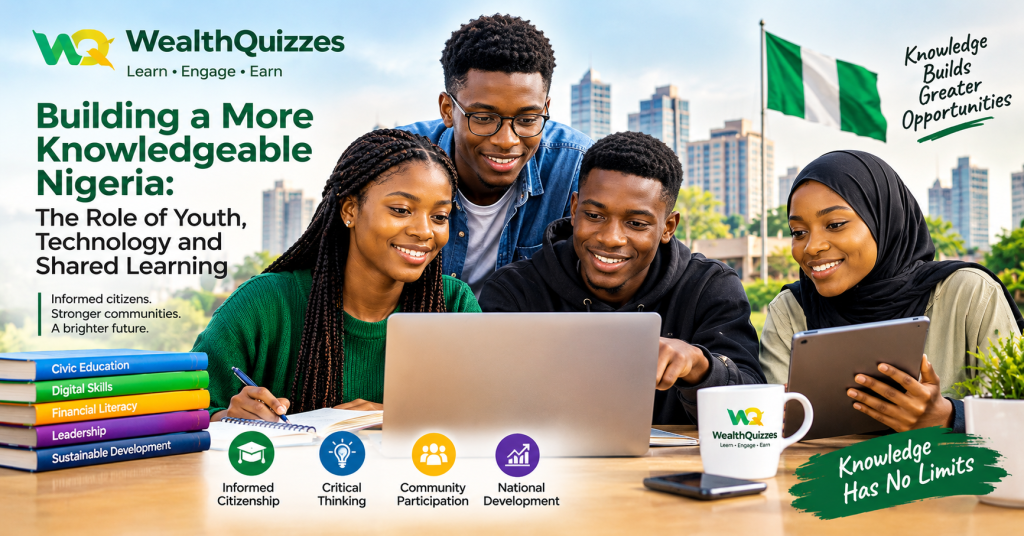
Building a More Knowledgeable Nigeria: The Role of Youth, Technology and Shared Learning
Youth Empowerment and National Development
WealthQuizzes Blog | Learn • Engage • Earn
Introduction: Knowledge as a Foundation for National Progress
A nation’s development depends on more than its natural resources, economic output or physical infrastructure. It also depends on the knowledge, judgement, creativity and civic responsibility of its people. Roads, industries, hospitals and digital networks are important, but their long-term value is influenced by the quality of the decisions made by the people who build, manage and use them.
For Nigeria, building a more knowledgeable society is both an educational priority and a national development imperative. Young Nigerians need opportunities to acquire useful knowledge, question assumptions, understand public issues, exchange ideas and apply what they learn to the challenges facing their communities. At the same time, technology offers new ways to make learning more accessible, while shared learning can help transform individual understanding into collective progress.
The objective should not be to produce citizens who merely memorise facts. Nigeria needs people who can distinguish evidence from rumour, understand their rights and responsibilities, evaluate competing arguments, participate constructively in public life and contribute practical solutions to social and economic problems.
The United Nations’ approach to Global Citizenship Education recognises the importance of equipping learners to understand complex issues, respect diversity and become responsible, active participants in society. These principles are relevant to Nigeria, where national development requires informed participation across different communities, cultures and generations. United Nations: Global Citizenship Education.
1. Why a More Knowledgeable Nigeria Matters
Knowledge influences how individuals make decisions, how communities solve problems and how institutions respond to public needs. A citizen who understands basic health information is better positioned to evaluate health claims. A young entrepreneur who understands financial management can make more informed business decisions. A voter who evaluates candidates’ records and policy proposals is better equipped to participate meaningfully in an election.
These examples demonstrate that knowledge is not confined to classrooms or examinations. It affects everyday life.
For Nigeria, the benefits of a more knowledgeable population can extend across several areas:
- Economic development: Practical knowledge can support entrepreneurship, workplace performance, innovation and more informed financial decisions.
- Public accountability: Citizens who understand public institutions, budgets and civic processes are better equipped to ask relevant questions and assess official claims.
- Social cohesion: Knowledge of history, different cultures and shared national experiences can encourage dialogue and reduce misunderstandings.
- Public health and safety: Reliable information helps people assess health guidance, recognise dangerous claims and make better-informed choices.
- Environmental responsibility: Understanding waste management, pollution, climate risks and resource conservation can strengthen local environmental action.
- Digital resilience: Digital and media literacy help citizens recognise misleading content, online fraud and manipulative narratives.
Knowledge alone cannot eliminate poverty, corruption, unemployment or institutional weakness. Nor does education automatically guarantee responsible behaviour. However, when knowledge is combined with sound institutions, practical skills, ethical judgement and opportunities for participation, it can strengthen society’s capacity to address these challenges.
The World Bank’s 2026 report, State of the Nigerian Youth, examines young people’s education, skills, employment, digital inclusion and civic engagement as connected dimensions of youth development. Its broad perspective reinforces an important point: Nigeria’s youth agenda must address not only access to education, but also the capabilities and opportunities young people need to participate productively in society. World Bank: State of the Nigerian Youth.
2. Youth as Participants in Knowledge Creation
Young Nigerians are often described as the country’s future. Although this expression recognises their importance, it can overlook their contribution to the present. Young people are already students, workers, entrepreneurs, creators, volunteers, community organisers and participants in public debate. Their knowledge and energy can contribute to national progress today.
The role of youth should therefore extend beyond receiving information. Young people should be encouraged to produce knowledge, investigate local problems, share practical experience and participate in decisions affecting their communities.
A university student might research barriers to educational access in a rural area. A young software developer might create a simple digital tool for a community organisation. A youth group might organise a public discussion about waste disposal, road safety or financial fraud. A young journalist or content creator might explain a complicated public policy in language that ordinary citizens can understand.
These activities turn learning into action.
Young people can also help bridge the gap between formal education and practical understanding. Classroom instruction provides structured foundations, but community experience can reveal how concepts operate in real life. Learning about public finance, for example, becomes more meaningful when learners can examine how public budgets are prepared, how local projects are funded and how citizens can seek information about expenditure.
This does not mean that every young person must become an activist or public commentator. It means that education should cultivate the capacity to understand society and contribute responsibly in whatever field an individual chooses.
Nigeria’s youth development efforts will be stronger when young people are treated as partners in learning and problem-solving rather than as passive recipients of programmes designed entirely by others.
3. Technology: Expanding Access to Knowledge
Technology has changed how people obtain, organise and exchange information. Smartphones, online libraries, digital courses, educational videos, discussion forums and interactive learning platforms can bring learning opportunities to people who might otherwise have limited access to them.
For Nigerian learners, digital tools can help supplement conventional education, provide exposure to new subjects and support learning beyond the classroom. A young person can study coding, explore Nigerian history, practise financial literacy, learn a language or investigate a scientific concept using digital resources.
Technology can also support flexible learning. Recorded lessons can be revisited, online assessments can provide immediate feedback, and digital communities can connect learners across geographical boundaries. Where connectivity is limited, offline resources and downloadable learning materials can help reduce dependence on continuous internet access.
Nigeria’s Federal Ministry of Education has outlined a National EdTech Strategy for 2025–2030 that addresses digital infrastructure, teacher capacity, educational content, data systems, financing and governance. The strategy recognises that effective educational technology requires more than distributing devices: it also requires the infrastructure, institutional capacity and safeguards necessary to support meaningful learning. Nigeria National EdTech Strategy.
UNICEF’s work on the Nigeria Learning Passport provides another example of digital learning initiatives designed to expand access. In September 2026, UNICEF and TECNO reported continued development of the programme, including approaches that combine online and offline learning to address barriers such as weak connectivity and shortages of educational resources. UNICEF Nigeria and TECNO: Learning Passport Programme.
Nevertheless, technology is a means, not an outcome in itself. Owning a smartphone does not automatically make someone digitally literate, and having access to large amounts of information does not guarantee understanding.
Effective digital learning requires relevant content, reliable sources, clear explanations, opportunities to practise, constructive feedback and the ability to apply knowledge. It also requires attention to affordability, electricity, accessibility for persons with disabilities, language diversity, privacy and online safety.
A genuinely knowledgeable Nigeria must ensure that technology reduces educational exclusion rather than deepening the gap between those who have reliable digital access and those who do not.
4. Critical Thinking in an Age of Information Overload
One of the greatest challenges of the digital age is not simply obtaining information. It is determining whether that information is accurate, relevant and presented in good faith.
Social media enables news, opinions, photographs, videos and public claims to circulate rapidly. Yet content that is popular or widely shared is not necessarily true. Misleading investment offers, fabricated quotations, manipulated images, false health claims and politically charged rumours can influence decisions before their accuracy has been established.
This makes critical thinking an essential civic and personal skill.
Critical thinking involves examining claims, assessing evidence, identifying assumptions, considering alternative explanations and reaching conclusions proportionate to the available facts. It also requires intellectual humility: the willingness to revise an opinion when stronger evidence emerges.
Young Nigerians can practise these habits by asking several questions whenever they encounter a significant claim:
- Who is making the claim? Is the source identifiable, qualified and accountable?
- What evidence supports it? Are there documents, credible data or independent confirmations?
- Can it be verified elsewhere? Do reliable sources support the same conclusion?
- What might be missing? Does the presentation omit important context or opposing evidence?
- What action is being encouraged? Is the content using fear, anger, urgency or unrealistic promises to influence behaviour?
The OECD identifies misinformation and disinformation as threats to public trust and informed democratic engagement. It emphasises the value of media, digital and civic literacy in strengthening people’s ability to assess information and recognise manipulative techniques. OECD: Disinformation and Misinformation.
Critical thinking should not be confused with automatic distrust of public institutions or rejection of views with which one disagrees. It is a disciplined process of evaluation. A knowledgeable citizen should be willing to question authority where evidence warrants it, while also being willing to accept well-supported findings.
This ability is particularly important when citizens assess election-related information, public expenditure, security reports, economic announcements and claims circulating within their communities. Responsible participation begins with the effort to understand before reacting or sharing.
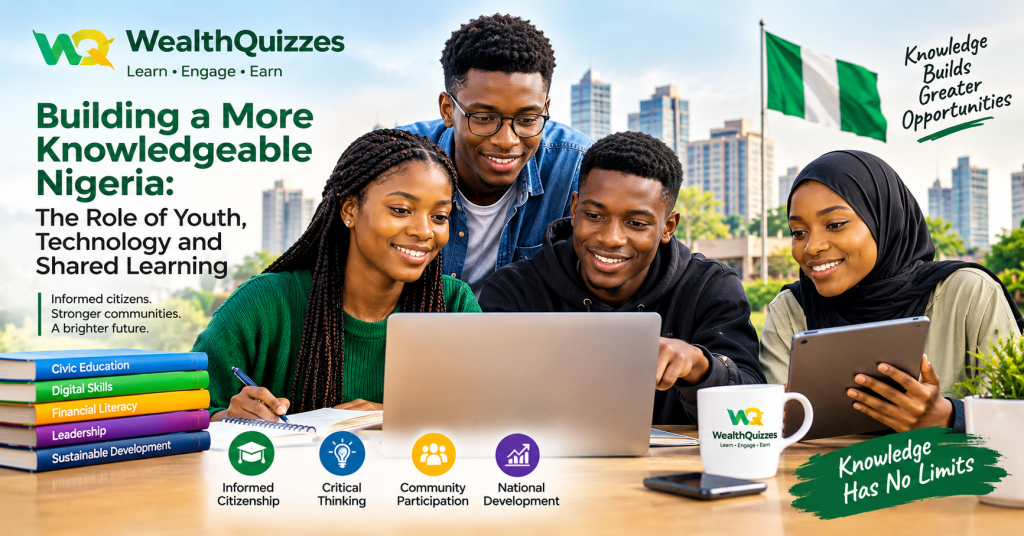
5. Knowledge and Informed Citizenship
Citizenship involves more than possessing legal status or participating in an election. It also involves understanding the relationship between individual rights, public responsibilities, institutions and the wider community.
Informed citizens are better positioned to understand how public decisions affect them, identify appropriate channels for raising concerns and evaluate whether policies are achieving their stated objectives. They can participate in town-hall meetings, community associations, public consultations, professional bodies, school committees and lawful civic initiatives with greater confidence.
For example, a community concerned about an unreliable water supply can move beyond general complaints by documenting the problem, gathering residents’ experiences, identifying the responsible authority and submitting a clear, evidence-based request for action. Residents may still encounter institutional barriers, but organised and informed engagement can make their concerns more specific and easier to evaluate.
Civic knowledge also helps people understand that democratic participation does not end when voting concludes. Public accountability, respectful debate, lawful advocacy and sustained community involvement are part of an ongoing relationship between citizens and institutions.
The United Nations’ Global Citizenship Education framework places active participation, human rights, respect for diversity and the ability to address social challenges among the objectives of education. United Nations: Global Citizenship Education.
For Nigeria, civic learning should also encourage constitutional awareness, peaceful disagreement, respect for lawful processes and an understanding of the responsibilities that accompany freedom of expression. These values can help create a public culture in which people debate policies and evidence rather than relying exclusively on ethnic, religious, partisan or regional loyalties.
Informed citizenship does not require every citizen to become an expert in every public issue. It requires people to develop enough knowledge to ask relevant questions, recognise the limits of their understanding and seek dependable information before making consequential decisions.
6. Shared Learning: Turning Individual Knowledge into Community Progress
Knowledge becomes more powerful when people exchange it, test it and apply it collectively. Shared learning allows individuals to benefit from the experience of others, correct misunderstandings and develop solutions that might not emerge through isolated effort.
In Nigeria, shared learning can take many forms: reading clubs, school debates, university societies, community workshops, professional mentoring, local history projects, digital discussion groups, public lectures and peer-to-peer skills sessions.
A group of young people learning financial literacy, for instance, can compare budgeting methods, discuss common fraud tactics and practise evaluating financial claims. A community health discussion can help participants identify questions to raise with qualified health professionals. Young entrepreneurs can share practical lessons about customer service, inventory, record-keeping and business planning.
The effectiveness of shared learning depends on its quality. A group discussion can spread misinformation just as easily as it can correct it. Productive learning therefore requires credible materials, respectful questioning, fact-checking and a willingness to correct errors openly.
Shared learning should also be inclusive. Women and girls, persons with disabilities, rural residents, out-of-school youth and people with limited digital access should not be excluded from opportunities to learn and contribute. Their experiences may reveal needs and solutions that more privileged groups overlook.
A strong learning community does not assume that one person possesses all the answers. It creates conditions in which people can contribute different forms of knowledge, test ideas constructively and improve their understanding together.
7. Interactive Learning and the Role of WealthQuizzes
Interactive learning can help make knowledge acquisition more engaging by requiring participants to recall information, make choices and receive feedback. Well-designed quizzes can encourage curiosity, reveal gaps in understanding and motivate learners to revisit subjects they have not fully mastered.
The potential value of quizzes extends beyond entertainment. Questions about Nigerian history, public institutions, geography, science, financial literacy, technology and current affairs can encourage users to explore subjects outside their immediate experience. Scenario-based questions can also test judgement rather than mere memorisation.
For example, a civic literacy quiz might ask participants to identify an appropriate way to verify a public claim before sharing it. A financial literacy question might require a learner to distinguish a realistic savings plan from an offer promising implausible returns. A Nigerian history question might encourage participants to investigate the source and context of an event rather than simply memorising a date.
WealthQuizzes, a Nigerian knowledge-based digital engagement platform, operates within this broader opportunity to make learning interactive. Its Learn • Engage • Earn approach connects knowledge, participation and performance-based rewards. Properly designed, such an environment can give users another reason to engage with educational content and explore different subjects.
However, an interactive quiz platform should be understood as a supplement to education and wider civic learning—not a substitute for schools, professional training, authoritative public information or sustained community engagement. Quiz performance alone cannot establish that a person has become a well-informed citizen, and rewards should never be presented as guaranteed income.
The quality of the learning experience matters. Questions should be accurate, unambiguous and appropriately challenging; explanations should help participants understand why an answer is correct; and content should be reviewed to avoid reinforcing stereotypes or circulating false information. Accessibility, fair participation and responsible communication are equally important.
The wider opportunity is to connect digital engagement with practical knowledge: encouraging people not merely to answer questions, but to think carefully, verify information, discuss issues and apply what they learn.