
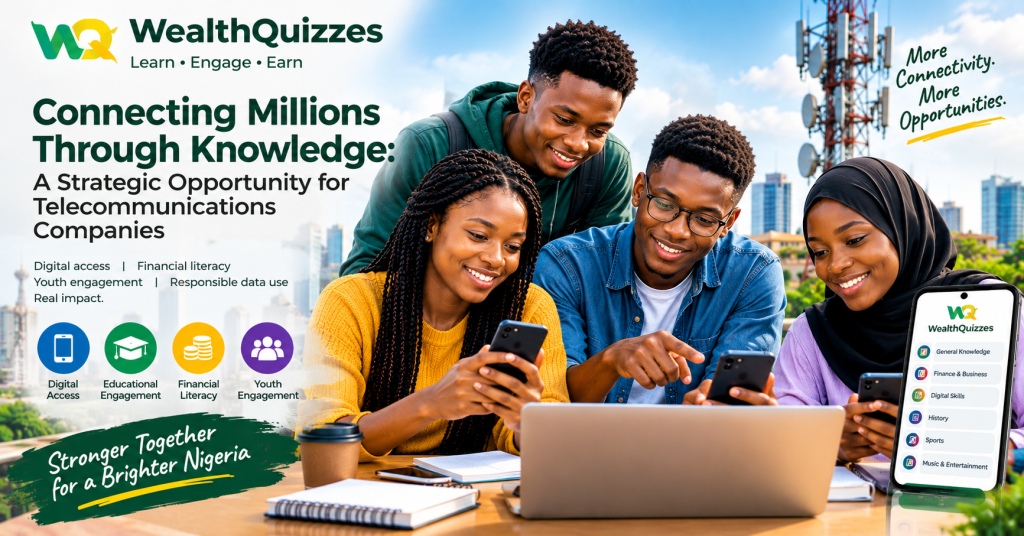
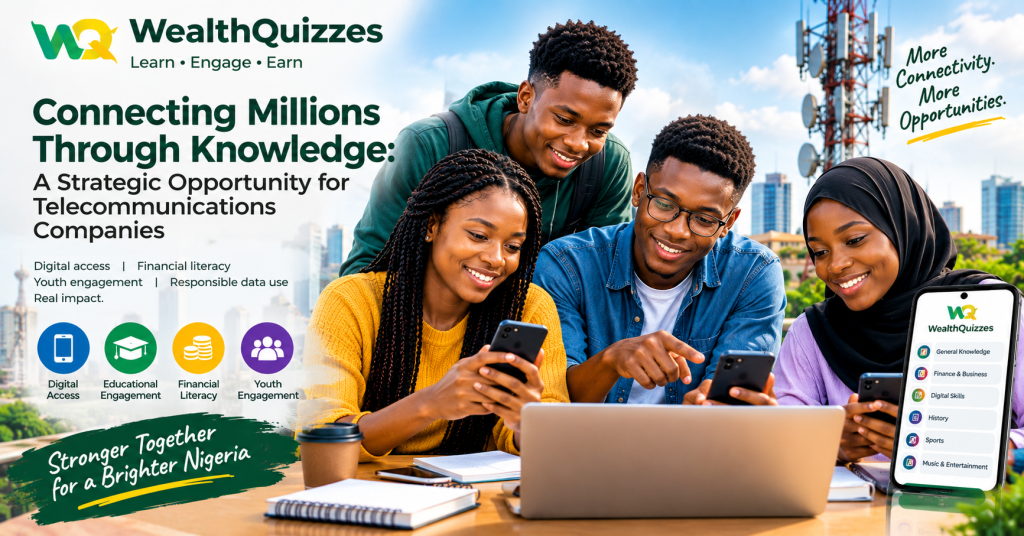
Connecting Millions Through Knowledge: A Strategic Opportunity for Telecommunications Companies
Category: Strategic Partnerships, Digital Inclusion and Youth Engagement
Introduction: Beyond Connectivity to Meaningful Connection
Telecommunications companies have become indispensable to modern life. They connect families, enable businesses, support digital payments, facilitate education and provide access to information that influences how people work, learn and participate in society. Yet, as the telecommunications industry evolves, an important strategic question deserves greater attention: how can connectivity be transformed into meaningful engagement that creates lasting value for customers, communities and telecommunications brands?
For telecommunications operators serving Nigeria and the wider African market, the answer may extend beyond network coverage, data bundles, voice calls and conventional advertising. There is an opportunity to build digital experiences that encourage learning, develop practical knowledge, promote responsible technology use and strengthen relationships with younger audiences.
This is where collaboration between telecommunications companies and knowledge-based digital platforms such as WealthQuizzes could become valuable.
WealthQuizzes, operating under TOPBRAINS Knowledge Teasers Company Limited, is a Nigerian digital knowledge and engagement platform built around the principle “Learn • Engage • Earn.” Its model uses interactive quizzes and knowledge-based participation to create opportunities for users to engage with educational and general-interest content.
A carefully designed partnership could enable telecommunications companies to explore interactive customer engagement, digital literacy campaigns, youth-focused educational initiatives and responsible data-use awareness programmes.
The opportunity is not simply to advertise a telecommunications brand through another digital channel. It is to explore how connectivity can become a more active instrument for learning, participation and social impact.
1. The Digital Opportunity: Connectivity Must Lead to Meaningful Participation
The International Telecommunication Union (ITU), the United Nations agency responsible for telecommunications and information and communication technologies, has consistently highlighted the continuing divide between those who can access the internet and those who remain excluded.
In its Facts and Figures 2024 report, the ITU estimated that 5.5 billion people were online, while approximately 2.6 billion remained offline. Its findings also showed that young people aged 15–24 were more likely to use the internet than the rest of the population, although significant differences remained between regions and income groups. These figures demonstrate both the scale of digital opportunity and the continuing challenge of inclusion. ITU, Facts and Figures 2024.
The GSMA, the global industry association for mobile operators, has similarly drawn attention to the gap between mobile network coverage and actual mobile internet adoption. Its research on Sub-Saharan Africa identifies affordability, access to suitable devices, digital skills and online safety as important barriers to meaningful participation. GSMA, The Mobile Economy Sub-Saharan Africa 2024.
These findings have important implications for telecommunications companies.
Providing network access is fundamental, but the wider value of connectivity depends partly on what people can do with it. A young person who uses mobile data to learn about digital safety, financial management, entrepreneurship, science or civic responsibility is engaging with connectivity in a way that may support personal development as well as commercial activity.
Telecommunications companies can therefore explore initiatives that encourage customers to use digital services productively, while preserving the entertainment, convenience and communication benefits they already value.
Knowledge-based digital engagement offers one possible route.
2. Why Youth Engagement Deserves Strategic Attention
Young people are among the most important audiences in the digital economy. They use mobile devices to communicate, consume content, pursue education, explore employment opportunities and develop social and commercial networks.
However, reaching young people is not the same as engaging them meaningfully.
A conventional advertisement may communicate a brand message, but an interactive campaign can invite participation. Rather than merely seeing a promotional message about a data plan, a customer might participate in a digital-literacy challenge, answer questions about online security or explore a series of short educational activities sponsored by a telecommunications provider.
This creates a different relationship between the audience and the brand.
The telecommunications company becomes associated not only with access to communication services but also with experiences that encourage curiosity, learning and responsible digital participation.
For brands competing in crowded telecommunications markets, this approach could provide a useful complement to existing advertising, sponsorships, campus activations, loyalty programmes and social media campaigns.
The objective should not be to abandon conventional advertising. Rather, it is to expand the available engagement toolkit by incorporating interactive experiences that can be tested, measured and improved.
3. WealthQuizzes and the Possibility of Interactive Telecommunications Campaigns
WealthQuizzes provides a potential platform through which telecommunications companies could explore knowledge-led engagement with digital audiences.
Its quiz-based format creates opportunities for campaigns built around participation rather than passive exposure. Depending on technical compatibility, commercial arrangements and campaign design, a telecommunications partner could support selected educational challenges, sponsor thematic quiz events or participate in a structured youth-engagement programme.
Possible campaign themes include:
- Digital literacy and responsible internet use.
- Online privacy, password security and fraud awareness.
- Basic financial literacy and safe digital payments.
- Entrepreneurship, employability and digital skills.
- Science, technology and innovation.
- Nigerian history, culture and civic knowledge.
- Career awareness and lifelong learning.
For example, a telecommunications company could sponsor a Digital Confidence Challenge featuring questions about identifying suspicious links, protecting personal information, recognising fraudulent messages and using online services responsibly.
A separate Young Innovators Knowledge Challenge could introduce participants to technology, entrepreneurship and emerging career opportunities.
These are illustrative proposals, not existing WealthQuizzes partnerships or confirmed telecommunications campaigns. Their feasibility would depend on the objectives of the participating company, the platform’s technical capabilities, agreed budgets and appropriate safeguards.
The central proposition is straightforward: telecommunications brands could use interactive knowledge experiences to create additional reasons for young people to participate, learn and engage with the brand.
4. Digital Access: Making Participation More Inclusive
A successful digital engagement strategy must recognise that not every customer has the same device, network quality, purchasing power or level of digital confidence.
The GSMA’s work on digital inclusion emphasises that connectivity gaps cannot be understood solely through the availability of network coverage. Affordability, skills, accessibility and trust also affect whether people can benefit from mobile internet services. Its 2025 guidance on digital inclusion encourages mobile operators to integrate inclusion into business strategy and to measure outcomes credibly. GSMA, The Business Imperative for Digital Inclusion.
Telecommunications partnerships involving knowledge platforms should reflect these realities.
Potential initiatives could include:
Sponsored data access for selected activities. Subject to technical feasibility, operator policies and commercial agreements, a telecommunications company might support limited data access for a defined educational campaign. Any zero-rating or sponsored-data arrangement would need to be assessed against applicable regulations, competition considerations and network policies.
Low-data campaign design. Partners could prioritise lightweight pages, compressed media, limited video requirements and efficient mobile interfaces, where the platform supports them. This would help reduce unnecessary data consumption and make participation more practical for users with limited resources.
Community-based digital engagement. Campaigns could be promoted through schools, tertiary institutions, youth organisations, community groups and digital-skills programmes, allowing the operator to reach audiences beyond its most digitally active customers.
Accessible educational content. Content could be designed with clear language, mobile-friendly presentation and, where appropriate, local-language adaptations and accessibility features.
These approaches would not eliminate the digital divide by themselves. They could, however, contribute to a more inclusive model in which connectivity is supported by relevant content, appropriate skills and practical opportunities to participate.
5. Responsible Data Use: Building Trust in the Digital Economy
Telecommunications companies operate in an environment where customer trust is fundamental. Users need confidence that their personal information, communications and digital activities are handled appropriately.
As partnerships introduce additional digital platforms and campaign technologies, responsible data use becomes particularly important.
In Nigeria, the Nigeria Data Protection Act 2023 establishes a legal framework for the protection of personal data and the regulation of its processing. The Nigeria Data Protection Commission identifies fairness, lawful processing, accountability and protection of data-subject rights among the objectives of the legislation. Organisations involved in a collaborative campaign must therefore assess their respective obligations and ensure that personal data is handled in accordance with applicable law. Nigeria Data Protection Commission.
Potential telecommunications–knowledge-platform initiatives could use educational engagement to promote better public understanding of digital privacy.
For example, sponsored quizzes might help participants understand why they should avoid sharing one-time passwords, how to recognise suspicious requests for personal information, why app permissions matter and how to identify misleading online offers.
A campaign could also explain the difference between information necessary to deliver a service and information requested for optional marketing purposes.
The partnership itself must follow the same principles it promotes. Before a campaign launches, participating organisations should establish clear rules concerning data collection, purposes of processing, access permissions, retention periods, security, data sharing and responsibility for handling complaints.
Where consent is the appropriate legal basis for processing, it should be informed and freely given, rather than hidden within confusing terms or made a condition of unrelated services. Data collection should be limited to what is necessary for the stated purpose, and campaign reporting should use aggregated or appropriately anonymised information wherever practicable.
Responsible data use is not merely a compliance exercise; it is part of building a digital environment in which customers can participate with confidence.
6. Turning Educational Engagement into a Corporate Social Impact Opportunity
Telecommunications companies increasingly operate at the intersection of commerce, technology and social development. Digital inclusion, education, employability and online safety can form part of a company’s wider community engagement and sustainability priorities.
The GSMA’s Mobile Industry Impact Report on the Sustainable Development Goals documents how mobile technology contributes to areas including education, financial services and access to information. Its findings reinforce the potential for mobile connectivity to support development outcomes when people can use digital services meaningfully. GSMA, 2024 Mobile Industry Impact Report: Sustainable Development Goals.
WealthQuizzes could be considered as a potential delivery partner for carefully scoped educational engagement initiatives, particularly those that use quizzes to encourage participation and reinforce key messages.
A telecommunications company might, for instance, sponsor a series of digital-safety challenges for young adults, support a knowledge competition during a youth-focused campaign or collaborate on financial-literacy activities that explain safe and responsible use of digital financial services.
Such programmes could create value in several ways:
- For participants: opportunities to test their knowledge, encounter educational content and strengthen awareness of relevant digital issues.
- For telecommunications companies: an additional channel for audience engagement, brand visibility and the delivery of defined educational messages.
- For communities: a potential contribution to digital literacy and awareness of online risks.
- For campaign partners: a framework for testing new approaches to engagement and reporting on defined outputs and outcomes.
These benefits should be treated as objectives to evaluate, not guaranteed results. A credible programme would establish a baseline, define measurable targets and assess whether participants actually improve their knowledge or behaviour.
UNICEF’s report Pulse Check on Digital Learning similarly argues for digital-learning approaches that are safe, equitable, engaging and effective, with attention to digital skills, inclusion and evidence of results. Although its focus is education, the principles are relevant to any campaign that uses digital participation to support learning. UNICEF, Pulse Check on Digital Learning.
7. Measuring Results Beyond Impressions and Clicks
For a telecommunications company, any proposed collaboration must offer a credible way to evaluate performance.
Traditional advertising metrics remain useful, but an interactive educational campaign can be assessed through a broader set of indicators.
Depending on the programme, these could include:
- Number of participants reached and unique participants engaged.
- Participation and completion rates.
- Repeat engagement over the campaign period.
- Responses to pre-campaign and post-campaign knowledge questions.
- Changes in participants’ ability to recognise selected digital risks.
- Participant feedback and satisfaction.
- Cost per engaged participant.
- Reach across defined demographic or geographic groups, where collection and use of such information are lawful and appropriate.
- Brand awareness or perception changes, measured through a suitable research design.
It is important to distinguish activity from impact. A high number of quiz attempts, for example, demonstrates participation; it does not automatically prove improved knowledge. A post-campaign assessment may provide stronger evidence of learning, while a well-designed follow-up can help determine whether the knowledge is retained.
Where feasible, an independent evaluator or research partner could strengthen the credibility of the findings.
The objective should be to produce evidence that helps the telecommunications company decide whether the initiative deserves to be expanded, redesigned or discontinued.
8. A Practical Partnership Framework
A telecommunications company interested in exploring collaboration with WealthQuizzes could begin with a limited pilot rather than immediately committing to a large-scale national programme.
A practical model might involve the following stages.
Stage One: Define the objective. The company identifies the principal goal: youth engagement, digital-safety education, financial literacy, brand visibility, community impact or a combination of these.
Stage Two: Design the campaign. The parties agree on the target audience, subject matter, duration, promotional channels, content responsibilities, participation rules and any proposed incentives. Claims about rewards or benefits must be transparent and consistent with the applicable terms.
Stage Three: Confirm technical and legal readiness. The parties assess platform compatibility, user experience, data protection, cybersecurity, accessibility, intellectual property, brand use and applicable telecommunications requirements.
Stage Four: Conduct a pilot. A campaign is launched within a defined audience or period, with clear targets, budget controls and procedures for handling technical problems and user complaints.
Stage Five: Evaluate the evidence. Results are reviewed against agreed indicators, including participation, learning outcomes, cost and user feedback.
Stage Six: Decide on expansion. The parties determine whether the evidence supports a wider rollout, further testing or a revised approach.
This structure gives the telecommunications company a practical way to assess the commercial and social value of the collaboration without assuming that the proposed model will automatically succeed.
9. Protecting Brand Integrity and Participant Confidence
Any partnership that connects a recognised telecommunications brand with an external digital platform must protect both the company’s reputation and the interests of participants.
The agreement should clearly define each party’s responsibilities, approval rights, financial obligations, customer-support arrangements, dispute-resolution procedures and termination rights.
Campaign communications must not imply that a telecommunications company endorses every feature of a partner platform unless that endorsement has been expressly agreed. Equally, the platform must not suggest that a proposed partnership is operational before it has been formally approved and launched.
If incentives or rewards are included, the rules should be easy to understand. Eligibility, conditions, limitations and fulfilment arrangements should be disclosed in advance. Participation should not be promoted as a guaranteed source of income or as a substitute for education, employment or responsible financial decision-making.
These safeguards are particularly important when a campaign targets young audiences, whose circumstances and levels of digital experience may vary considerably.
Trust is strengthened when a campaign is transparent about what it offers, what it collects, what it measures and what it cannot promise.
Conclusion: From Connecting People to Creating Opportunities
Telecommunications companies have already transformed the way people communicate, work, learn and access services. The next opportunity is to explore how connectivity can support deeper forms of participation.
By combining mobile reach with interactive knowledge experiences, telecommunications operators could develop campaigns that do more than advertise products. They could create additional opportunities for young audiences to learn about digital safety, explore practical knowledge, participate in educational challenges and engage with brands through experiences that offer value beyond a promotional message.
For WealthQuizzes, this presents a potential avenue for collaboration with telecommunications companies seeking innovative approaches to youth engagement, digital inclusion and responsible technology awareness.
For telecommunications companies, the proposition is equally practical: test whether a knowledge-based engagement model can complement existing marketing and community initiatives, generate measurable participation and contribute to clearly defined educational objectives.
The opportunity should be approached with commercial discipline, technical readiness, responsible data governance and evidence-based evaluation. No platform or campaign can independently solve the challenges of digital exclusion, and no partnership should promise outcomes it has not demonstrated.
Nevertheless, collaboration between telecommunications providers and knowledge-based digital platforms deserves serious consideration as one component of a broader digital-inclusion strategy.
The future of telecommunications will depend not only on how many people networks can reach, but also on the meaningful opportunities those connections help create.
Through carefully designed partnerships, connectivity can become more than access to a network: it can become a channel for knowledge, participation and shared progress.
Selected Authorities and Further Reading
- International Telecommunication Union (ITU). Facts and Figures 2024 — global internet adoption, youth connectivity and continuing digital divides. https://www.itu.int/itu-d/reports/statistics/facts-figures-2024/
- GSMA. The Mobile Economy Sub-Saharan Africa 2024 — mobile adoption, economic contribution and barriers to meaningful connectivity. https://www.gsma.com/solutions-and-impact/connectivity-for-good/mobile-economy/sub-saharan-africa-2024/
- GSMA. The Business Imperative for Digital Inclusion (2025) — integrating digital inclusion into mobile operators’ business strategy and measuring outcomes. https://www.gsma.com/solutions-and-impact/connectivity-for-good/external-affairs/sustainability/the-business-imperative-for-digital-inclusion/
- GSMA. 2024 Mobile Industry Impact Report: Sustainable Development Goals — mobile technology and development outcomes. https://www.gsma.com/solutions-and-impact/connectivity-for-good/external-affairs/2024-mobile-industry-impact-report-sustainable-development-goals/
- UNICEF. Pulse Check on Digital Learning (2022) — safe, equitable and effective digital learning. https://www.unicef.org/reports/pulse-check-digital-learning
- Nigeria Data Protection Commission (NDPC). Nigeria Data Protection Act and data-protection guidance. https://ndpc.gov.ng/
About WealthQuizzes: WealthQuizzes is a Nigerian knowledge-based digital engagement platform operated by TOPBRAINS Knowledge Teasers Company Limited. Learn more at https://wealthquizzes.com/.


