
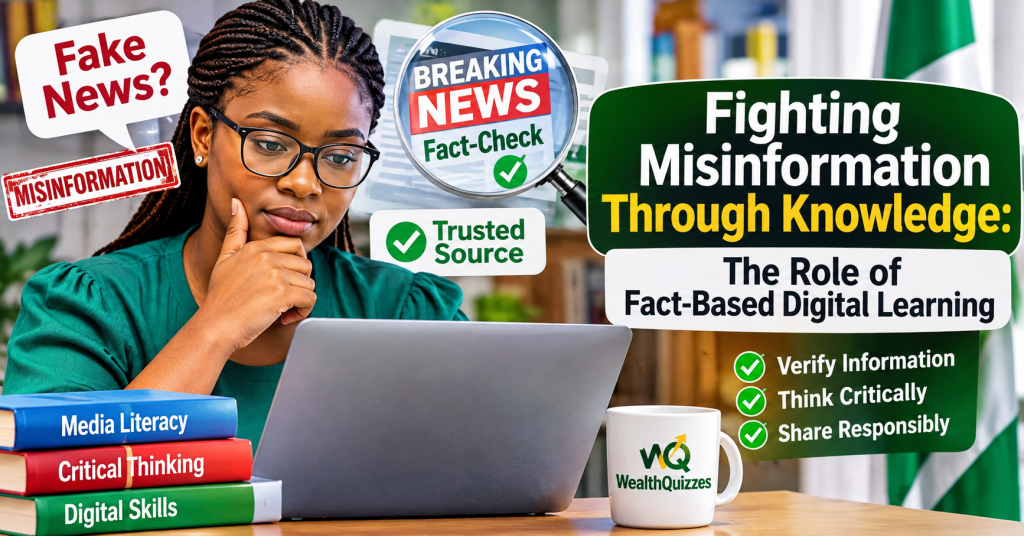
Fighting Misinformation Through Knowledge: The Role of Fact-Based Digital Learning
Introduction
The digital age has transformed how people access, produce and share information. News, educational materials, public announcements, financial advice, health information and political commentary now circulate through websites, social media platforms, messaging applications and online communities. Information that once passed through established editorial or professional channels can now reach thousands of people within minutes, often without adequate verification.
This development has created enormous opportunities for education and public participation. However, it has also made misinformation one of the defining challenges of the modern information environment. False claims, manipulated images, misleading headlines, fabricated statistics and content taken out of context can influence personal decisions, damage reputations, undermine public confidence and create unnecessary social tension.
The problem is not simply that false information exists. It is that many people encounter information without having the skills, time or resources to assess its accuracy. A convincing headline may be mistaken for evidence. A widely circulated message may be treated as credible because it has been shared repeatedly. An impressive-looking website may be trusted without examining who operates it or whether its claims are supported by independent sources.
Addressing this challenge requires more than telling people to avoid false information. It requires equipping them with the knowledge and practical skills to recognise, investigate and evaluate information before accepting or sharing it.
Fact-based digital learning can make an important contribution. By integrating media literacy, source verification, critical thinking and evidence-based reasoning into accessible learning experiences, digital platforms can help people become more discerning consumers and responsible communicators of information.
1. Understanding Misinformation and Disinformation
Misinformation generally refers to false or inaccurate information shared without necessarily intending to deceive. It may arise from misunderstanding, poor research, mistaken interpretation or the careless repetition of an unverified claim.
Disinformation, by contrast, involves the deliberate creation or dissemination of false or misleading information with the intention of deceiving, manipulating or influencing an audience.
The distinction matters because not every person who shares an inaccurate message is deliberately spreading falsehoods. Someone may forward a fabricated announcement because they genuinely believe it is true. Another person may knowingly circulate the same announcement to create panic, damage an organisation or influence public opinion.
Digital information environments make both problems more difficult to manage. Content can be copied, edited, repackaged and redistributed across multiple platforms. Images may be presented without their original context, old videos may be described as recent events, and fabricated quotations may be attributed to public figures.
The Organisation for Economic Co-operation and Development (OECD), in its 2024 report, Facts not Fakes: Tackling Disinformation, Strengthening Information Integrity, explains that disinformation can undermine public trust, aggravate social divisions and affect areas ranging from public health to national security. It emphasises the importance of strengthening people’s ability to navigate information critically rather than relying exclusively on attempts to control content.
The lesson is straightforward: people need the ability to evaluate information independently, not merely the ability to receive it.
2. Why Media and Information Literacy Matters
Media and information literacy is the ability to access, understand, evaluate and use information responsibly across different forms of media and communication.
It goes beyond knowing how to operate a smartphone, browse the internet or use social media. A person may be highly proficient with digital technology and still lack the ability to determine whether an online claim is reliable.
Media and information literacy involves asking important questions:
- Who created or published this information?
- What evidence supports the claim?
- Is the source qualified or credible in the subject being discussed?
- Is the information current, or has it been taken from an earlier event?
- Are other independent and reputable sources reporting the same facts?
- Does the content distinguish between fact, opinion, interpretation and speculation?
- Is the headline consistent with the actual content?
- Could the information have been manipulated or presented without context?
UNESCO recognises media and information literacy as an essential competency for navigating the contemporary information environment. Its global Media and Information Literacy Curriculum provides educators and learners with a structured framework for developing critical evaluation, responsible information use and the ability to recognise misinformation and disinformation.
The importance of these competencies is particularly evident in societies where digital communication is increasingly central to education, business, public affairs and everyday decision-making. In Nigeria, for example, citizens encounter online claims concerning employment opportunities, financial investments, public health, government policies, elections, education and consumer products. The consequences of accepting false information in these areas can be substantial.
Digital learning platforms can help close this knowledge gap by making information literacy a practical and continuous learning experience.
3. Teaching People How to Verify Information
One of the most valuable contributions of digital learning platforms is their ability to teach practical fact-checking techniques.
Fact-checking should not be presented as an activity reserved for professional journalists or researchers. Ordinary internet users can learn simple methods for investigating claims before accepting or sharing them.
A structured digital learning programme can teach learners to:
Check the original source: Rather than relying on a forwarded message, learners should identify where the information first appeared. They should examine the author, organisation, publication date and original document or statement where available.
Consult independent sources: A claim should not be considered verified simply because several websites repeat it. Learners should look for independent reporting or authoritative primary sources that provide corroborating evidence.
Examine supporting evidence: Where a report contains statistics, quotations or research findings, learners should investigate the underlying study, official record, publication or dataset. A numerical claim without a traceable source deserves particular scrutiny.
Verify images and videos: Learners should understand that photographs and videos can be old, edited, miscaptioned or taken from unrelated events. Reverse image searches, original publication records and contextual checks can help establish whether visual material is being represented accurately.
Check dates and context: A genuine statement or photograph can become misleading when presented as if it relates to a different date, location or event.
A particularly useful technique is lateral reading. Instead of remaining on an unfamiliar website and relying on its own claims about its credibility, the reader opens other independent sources to investigate the organisation, author and information being presented.
Research by Sam Wineburg and Sarah McGrew found that professional fact-checkers were more likely to use lateral reading than historians and university students in their study. Fact-checkers left unfamiliar websites to investigate what other sources said about them, allowing them to reach more reliable judgments efficiently.
Further research by Wineburg and colleagues, published in the Journal of Educational Psychology in 2022, found that students who received instruction in lateral-reading techniques improved their ability to assess the credibility of online information.
These findings demonstrate that information verification is a learnable skill. Digital platforms can teach it through short lessons, practical exercises, demonstrations and repeated assessments.
4. Encouraging Evidence-Based Thinking
Fact-based digital learning should do more than teach people how to identify unreliable websites. It should develop a habit of reasoning from evidence.
Evidence-based thinking requires individuals to distinguish between what is known, what is claimed, what is inferred and what remains uncertain.
For example, a statement that a particular business has increased its revenue by 40 per cent is a factual claim that should be supported by verifiable financial information. A statement that the business is likely to become the market leader is a prediction. The two statements should not be treated as equivalent.
Similarly, a personal opinion may be legitimate without being an established fact. A learner should understand that disagreement does not automatically make a statement false, just as popularity does not automatically make it true.
Digital learning platforms can encourage this discipline through questions and activities that require learners to:
- Identify the evidence supporting a statement.
- Distinguish facts from opinions and assumptions.
- Compare competing explanations of an event.
- Recognise unsupported generalisations.
- Identify misleading use of statistics.
- Evaluate whether a conclusion reasonably follows from the available evidence.
- Acknowledge when the available information is insufficient to reach a definite conclusion.
This approach is valuable beyond media literacy. It improves financial decision-making, business judgment, civic participation, academic research and everyday problem-solving.
A person who learns to question the evidence behind an online investment opportunity, for instance, is better positioned to recognise unrealistic returns, fabricated testimonials and misleading promotional claims.
5. Using Quizzes and Interactive Learning to Strengthen Critical Thinking
Quizzes can provide an effective way of turning information literacy principles into practical exercises.
Instead of presenting learners with definitions alone, digital platforms can expose them to realistic examples of online content and ask them to assess the reliability of the information.
A learning exercise might present two reports about the same public issue. One may rely on an official report and identifiable evidence, while the other may contain anonymous claims, unsupported statistics or an exaggerated headline. Learners would be asked to identify which report is more reliable and explain the reasons for their conclusion.
Other exercises could include:
- Identifying the difference between a factual statement and an opinion.
- Recognising misleading headlines.
- Detecting fabricated quotations.
- Matching claims with authoritative sources.
- Identifying when an image has been used outside its original context.
- Assessing whether a statistic is supported by the cited research.
- Recognising common manipulation techniques, including emotional language and false comparisons.
The educational value should not be measured solely by whether a learner selects the correct answer. The platform should also explain why the answer is correct, identify the weaknesses in the alternatives and provide links to credible sources where appropriate.
This feedback is important. A learner who repeatedly guesses correctly without understanding the underlying reasoning may perform well in a quiz but remain vulnerable to misinformation outside the learning environment.
UNESCO’s Media and Information Literacy Curriculum includes practical activities on fact-checking, information disorder and the assessment of claims. Its approach demonstrates how structured exercises can help learners translate abstract principles into usable competencies.
6. Developing the Habit of Questioning Before Sharing
A significant part of the misinformation problem arises not only from believing false information but also from sharing it without verification.
People often forward messages because they appear urgent, alarming, entertaining or consistent with what they already believe. Some share information to warn friends and relatives, without considering whether the original claim has been established.
Digital learning can encourage a simple but valuable habit: pause, assess and verify before sharing.
Learners should be encouraged to consider:
- Is the information accurate?
- Can I identify its original source?
- Is there independent evidence supporting it?
- Does sharing it serve a legitimate informational purpose?
- Could sharing it mislead, unfairly damage or unnecessarily alarm another person?
This approach does not require people to become professional investigators before participating in online discussions. It encourages reasonable care and responsible communication.
Research on digital media literacy also provides evidence that educational interventions can influence sharing behaviour. A 2022 study by Pamela Thomas and colleagues, published in First Monday, examined an online social media literacy campaign involving 1,000 participants in Indonesia. The researchers reported that participants who engaged with the training materials and educational videos were more likely to identify misinformation than those in the control group.
Although the study was a pilot and should not be treated as proof that every digital literacy programme will produce identical results, it illustrates the potential of online education to strengthen people’s ability to recognise false information.
7. Understanding Algorithms, Artificial Intelligence and Manipulated Content
The modern information environment is shaped not only by the people who create content but also by the technologies that distribute it.
Recommendation systems influence what users see, while engagement-driven platforms may give visibility to content that attracts strong reactions. A person who frequently interacts with particular subjects may encounter increasingly similar material, limiting exposure to alternative perspectives.
Artificial intelligence has introduced additional opportunities and risks. AI tools can assist with research, translation, summarisation and education. However, they can also generate fabricated quotations, misleading images, synthetic audio, inaccurate explanations and convincing but unsupported answers.
Digital learning platforms should therefore teach learners that technology-generated content is not automatically accurate.
Learners should understand that:
- AI-generated answers require verification.
- Images and audio can be synthetically created or altered.
- Search-engine rankings are not guarantees of credibility.
- High engagement does not establish factual accuracy.
- Automated summaries may omit important qualifications or context.
- A convincing presentation is not a substitute for reliable evidence.
The OECD’s 2024 report identifies understanding digital platforms and their information systems as part of the broader effort to strengthen societal resilience against disinformation. UNESCO’s updated Media and Information Literacy Curriculum also addresses artificial intelligence and the changing digital information environment.
The objective should not be to make people distrust every digital tool. It should be to help them use technology intelligently, with appropriate scrutiny.
8. How Digital Learning Platforms Can Make a Practical Difference
Digital learning platforms are particularly well placed to make information literacy accessible because they can deliver learning in short, interactive and repeatable formats.
However, the effectiveness of such platforms depends on the quality of their educational design.
A responsible platform should consider the following measures:
Integrate media literacy into different subject areas. Financial literacy, health education, history, technology, entrepreneurship and civic awareness all present opportunities to teach learners how to assess information.
Use credible and traceable sources. Educational content should be based on reliable publications, recognised institutions, primary documents and properly identified research. Sources should be reviewed periodically.
Provide explanations, not just answers. Correct responses should be supported by clear explanations that help learners understand the evidence and reasoning.
Teach verification as a process. Learners should practise checking sources, comparing independent accounts, investigating original claims and identifying uncertainty.
Encourage responsible digital conduct. Learning should reinforce the importance of not spreading unverified allegations, fabricated announcements or manipulated content.
Update content regularly. Information can become outdated, especially in areas such as public policy, technology, finance and health. Platforms should review material and correct errors when identified.
Measure learning outcomes. Completion rates and participation figures are useful operational indicators, but they do not establish that users have become better at identifying misinformation. Platforms should also assess whether learners can apply verification techniques to unfamiliar examples.
These measures can help transform digital platforms from channels of content distribution into environments for developing informed and responsible citizens.
9. WealthQuizzes: Making Knowledge More Useful
For WealthQuizzes, the subject presents an opportunity to strengthen the educational value of knowledge-based digital engagement.
WealthQuizzes is built around the principle that knowledge should be accessible, engaging and useful. Its quiz-based approach can provide a practical foundation for introducing learners to media literacy, fact-checking, critical thinking and evidence-based decision-making.
This opportunity extends beyond creating questions about misinformation. It involves developing a more deliberate approach to the quality, verification and educational value of quiz content.
For example, WealthQuizzes could introduce questions and learning modules covering:
- How to identify credible online sources.
- How to distinguish misinformation from deliberate disinformation.
- How to verify public announcements and viral claims.
- How to recognise manipulated photographs and videos.
- How to interpret statistics and research findings.
- How to distinguish facts, opinions and assumptions.
- How to identify misleading financial and investment claims.
- How to evaluate information generated by artificial intelligence.
Where appropriate, correct answers could be accompanied by short explanations and references to reliable sources. Questions could also be designed to test practical judgment rather than simple memorisation.
The platform could further consider themed knowledge challenges on media literacy, responsible digital citizenship and information verification. Such initiatives would connect knowledge-based engagement with an important educational need.
However, credibility must remain central. WealthQuizzes should ensure that questions have defensible answers, that sources are traceable, that time-sensitive information is reviewed and that corrections are made when errors are identified. A platform seeking to promote reliable knowledge must demonstrate those standards in its own content.
This also creates potential opportunities for collaboration with educational institutions, media organisations, fact-checking initiatives, technology companies and development organisations interested in digital literacy and public education. Such partnerships would need clearly defined objectives, appropriate editorial independence and measurable outcomes.
10. Measuring Progress: Beyond Participation
A digital learning platform should not assume that increased participation automatically translates into improved media literacy.
If the objective is to strengthen people’s ability to resist misinformation, the platform should measure whether learners actually acquire and apply the relevant skills.
Useful indicators may include:
- Improvement in learners’ ability to identify unreliable sources.
- Accuracy in distinguishing facts from opinions.
- Ability to identify unsupported claims and misleading statistics.
- Ability to locate original sources and corroborating evidence.
- Recognition of manipulated or miscontextualised visual content.
- Reduced willingness to share unverified information in simulated exercises.
- Retention of verification skills over time.
- User confidence in explaining why a source is or is not reliable.
Pre-assessment and post-assessment exercises can help establish whether learners have improved. Follow-up assessments can test whether those skills are retained and applied to unfamiliar examples.
The OECD has specifically emphasised the importance of evaluating the effectiveness of media and information literacy initiatives, including through behavioural indicators and longer-term assessment.
For WealthQuizzes and other digital learning platforms, this distinction is important: the objective should not simply be to attract attention to educational content, but to help users develop competencies they can apply beyond the platform.
Conclusion
Misinformation cannot be eliminated simply by publishing more information. In an environment where false and misleading claims can circulate rapidly, people need the ability to evaluate what they encounter, investigate its origins and distinguish evidence from assertion.
Fact-based digital learning offers a practical way to develop these competencies. By teaching media literacy, fact-checking, source verification, critical thinking and responsible information sharing, digital platforms can help individuals make better decisions and participate more responsibly in society.
The challenge is not to encourage blind acceptance of information from institutions, websites or digital platforms. It is to cultivate informed judgment: the ability to question claims fairly, examine evidence, compare credible sources and recognise uncertainty.
For Nigeria, where digital communication increasingly influences education, business, public affairs and everyday life, these skills are especially valuable. A more informed population is better equipped to recognise fraudulent opportunities, resist manipulation, evaluate public claims and make decisions based on reliable evidence.
WealthQuizzes can contribute to this objective by making fact-based knowledge engaging, accessible and practical. Through carefully researched questions, credible references, explanatory feedback and continuous content improvement, it can help promote a culture in which people do not merely consume information but learn to evaluate it.
Ultimately, the most effective response to misinformation is not simply to tell people what is true. It is to equip them with the knowledge and skills to investigate the truth for themselves.
Learn • Engage • Earn — because knowledge is most valuable when it improves how we think, decide and act.
Selected Authorities and Further Reading
- OECD (2024), Facts not Fakes: Tackling Disinformation, Strengthening Information Integrity. A major policy report examining the effects of disinformation and the importance of media literacy, information integrity and societal resilience.
https://doi.org/10.1787/d909ff7a-en - UNESCO, Media and Information Literacy Curriculum – E-version. A structured competency framework for educators and learners, including modules on misinformation, disinformation, hate speech, fact-checking and digital citizenship.
https://www.unesco.org/mil4teachers/en/curriculum - UNESCO (2018), Cherilyn Ireton and Julie Posetti (eds.), Journalism, Fake News & Disinformation: Handbook for Journalism Education and Training. A practical resource addressing verification, information disorder and the responsibilities of information professionals.
https://www.unesco.org/en/articles/journalism-fake-news-disinformation - Wineburg, S. and McGrew, S. (2019), Lateral Reading and the Nature of Expertise: Reading Less and Learning More When Evaluating Digital Information. Research explaining how professional fact-checkers evaluate unfamiliar online sources.
https://doi.org/10.1177/016146811912101102 - Wineburg, S. et al. (2022), Lateral Reading on the Open Internet: A District-Wide Field Study in High School Government Classes. Journal of Educational Psychology, 114(5), 893–909. Research on the effectiveness of teaching students to evaluate online information through lateral reading.
https://eric.ed.gov/?id=EJ1372738 - Breakstone, J. et al. (2021), Students’ Civic Online Reasoning: A National Portrait. Educational Researcher. Research examining students’ ability to distinguish credible online information from unreliable material.
https://doi.org/10.3102/0013189X211017495 - Thomas, P., Hogan-Taylor, C., Yankoski, M. and Weninger, T. (2022), Pilot Study Suggests Online Media Literacy Programming Reduces Belief in False News in Indonesia. First Monday, 27(1). An empirical pilot study on online media literacy training.
https://doi.org/10.5210/fm.v27i1.11683 - UNESCO (2024), Global Citizenship Education in a Digital Age: Teacher Guidelines. Guidance connecting digital competencies, critical engagement with information and responsible participation.
https://www.unesco.org/en/articles/global-citizenship-education-digital-age-teacher-guidelines - UNESCO, Media and Information Literacy. An overview of UNESCO’s work to empower citizens to access, critically evaluate and create information ethically and responsibly.
https://www.unesco.org/en/communication-information/priorities/media-information-literacy


