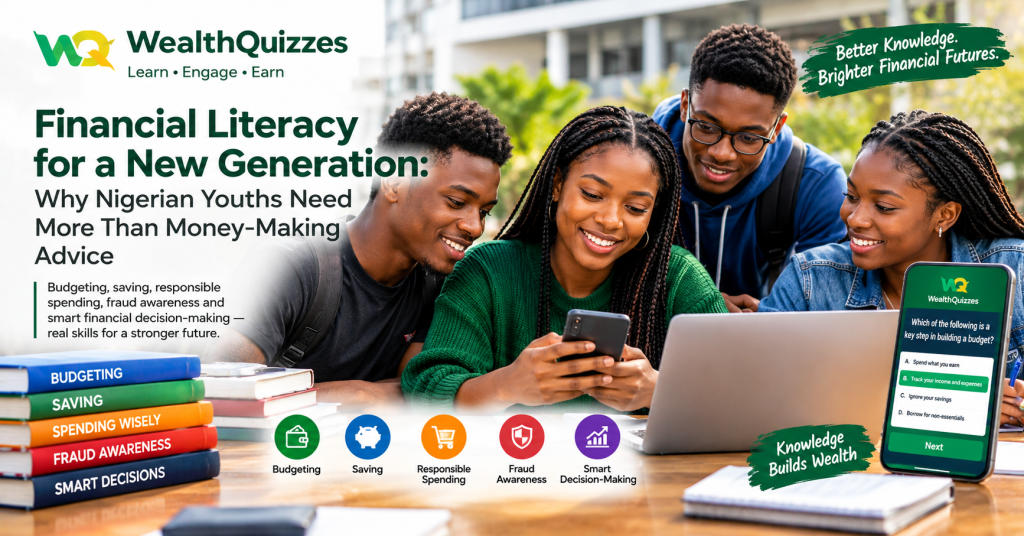
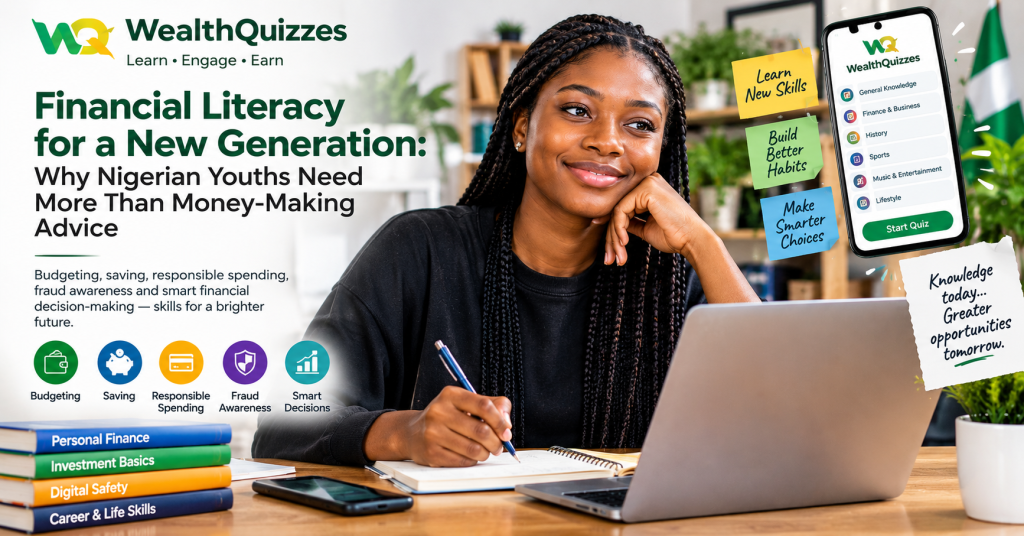
Financial Literacy for a New Generation: Why Nigerian Youths Need More Than Money-Making Advice
Youth Empowerment and National Development
WealthQuizzes Blog | Learn • Engage • Earn
Introduction: Making Money Is Only Half the Story
In today’s digital economy, young Nigerians are constantly exposed to messages about making money, starting businesses, investing, trading financial assets and achieving financial independence. Social media is filled with success stories, business opportunities and promises of rapid wealth creation. Yet an essential question often receives less attention: How well are young people equipped to manage, protect and make informed decisions about the money they earn?
Earning money is important, but financial well-being requires more than the ability to generate income. It also requires the discipline to budget, the patience to save, the judgement to spend responsibly, the awareness to recognise fraud and the ability to evaluate financial risks before making decisions.
A young person may earn a substantial income and still struggle financially through uncontrolled spending, unsuitable borrowing, poor planning or falling victim to fraud. Another may earn a modest income but gradually build greater financial stability by managing available resources carefully and making informed choices.
For Nigeria’s emerging generation, financial literacy is therefore not simply a subject for economics students or banking professionals. It is a practical life skill relevant to students, employees, entrepreneurs, freelancers, traders and anyone who handles money.
WealthQuizzes, a Nigerian knowledge-based quiz and digital engagement platform, offers an opportunity to explore how interactive quizzes can support engagement with financial knowledge. While quizzes cannot replace comprehensive financial education or professional advice, they can provide a structured way for people to test what they know and identify areas for further learning.
The broader objective is to encourage a generation that understands not only how money can be earned, but also how it can be managed, protected and used responsibly.
1. What Financial Literacy Really Means
The Central Bank of Nigeria (CBN) identifies financial literacy as an important component of financial inclusion and consumer protection. Its financial literacy framework emphasises developing the knowledge and skills required to manage financial resources effectively and make informed decisions about financial products and services. Read the CBN’s financial literacy guidance.
Financial literacy extends beyond recognising banknotes, calculating percentages or knowing how to operate a banking application. It involves understanding financial choices and their consequences.
A financially literate person should be better equipped to answer practical questions:
- How much money comes in, and where does it go?
- How much should be set aside for essential expenses and future needs?
- What is the difference between a need and a want?
- When is borrowing appropriate, and what will it actually cost?
- How can suspicious financial offers and digital scams be identified?
- What should be checked before choosing a financial product?
- How can financial decisions today affect future opportunities?
The Organisation for Economic Co-operation and Development (OECD) treats financial literacy as a combination of financial knowledge, behaviour and attitudes that supports sound decision-making and financial well-being. Its work also highlights the growing importance of digital financial literacy as more financial activities move online. Explore the OECD’s financial education resources.
This broader understanding matters because financial knowledge has limited value if it never influences behaviour. Knowing that saving is important does not automatically produce a saving habit. Understanding that an online offer may be fraudulent does not guarantee that a person will recognise a sophisticated scam.
Effective financial literacy therefore combines understanding, judgement and practical habits.
2. Budgeting: Giving Every Naira a Purpose
Budgeting is one of the foundations of responsible financial management.
A budget is a plan for allocating expected income across expenses, savings, debt obligations and other priorities. It helps people understand their financial position and make deliberate choices before money is spent.
For a Nigerian student, a budget may cover transport, food, accommodation, educational materials, data and other necessities. An employee may need to account for rent, family responsibilities, utilities, transport, debt repayments and savings. A small-business owner may need to distinguish personal expenditure from business operating costs.
The figures differ, but the principle remains the same: spending decisions should be made with an understanding of available resources and competing obligations.
Budgeting can help people distinguish between essential expenses and discretionary purchases. It can also reveal recurring costs that appear small individually but become significant over time.
Consider a young person who receives a monthly income but frequently runs short before the next payment. Without keeping records, they may attribute the problem entirely to inadequate income. Tracking expenditure could reveal that the difficulty also involves unplanned purchases, subscriptions or spending that could have been reduced.
Budgeting cannot eliminate financial hardship when income is genuinely insufficient. It should not be used to blame people for structural economic challenges. Its value is that it helps individuals understand what they can control, identify financial pressures and make better-informed decisions with the resources available to them.
An interactive quiz could reinforce this lesson by presenting a hypothetical monthly budget and asking participants to identify essential expenses, calculate the remaining balance or determine which spending decisions could create a shortfall.
The educational benefit lies in practising financial reasoning rather than simply memorising a definition.
3. Saving: Preparing for Tomorrow While Living Today
Saving is the practice of setting aside part of one’s available resources for future needs, planned purchases or unexpected expenses.
For young people, saving may seem difficult when income is irregular or living costs consume most available funds. In such circumstances, financial education must be realistic. It should not suggest that everyone can save the same percentage of income or accumulate substantial funds quickly.
Instead, the first step is understanding the purpose of saving and developing a habit that is appropriate to one’s circumstances.
Savings can serve several functions:
- Emergency preparedness: helping cover unexpected expenses without immediately resorting to borrowing.
- Planned purchases: preparing for educational costs, equipment, rent or other anticipated needs.
- Financial flexibility: providing resources when opportunities or unexpected responsibilities arise.
- Long-term goals: supporting future plans, depending on income, time horizon and individual circumstances.
The OECD’s analysis of financial literacy among students found an association between stronger financial literacy and more responsible financial behaviours, including a greater likelihood of saving. Such findings support the importance of financial education, although an association does not by itself prove that education alone causes better outcomes. See the OECD’s PISA 2022 financial literacy findings.
Young Nigerians also need to understand that saving and investing are not identical. Savings generally prioritise access to money and preservation of funds, subject to the account or product’s terms. Investments involve different risks, time horizons and potential returns, including the possibility of losing money.
A person should understand those differences before committing funds.
Knowledge-based quizzes can reinforce the distinction through scenarios involving emergency savings, planned purchases, investment risk and short-term financial needs. Participants can then investigate the underlying concepts more deeply.
4. Responsible Spending: Understanding Needs, Wants and Trade-Offs
Spending is not inherently irresponsible. Money exists partly to meet needs, enjoy life and pursue meaningful goals. Financial responsibility involves making spending decisions that reflect priorities and available resources.
A common challenge is the difference between a purchase that is affordable and one that is financially sensible in the circumstances.
A young person may be able to purchase a new phone but need the same funds for examination fees or essential bills. Someone may qualify for a loan but discover that the repayments would leave insufficient money for other obligations.
These decisions require more than arithmetic. They require an understanding of opportunity cost: the value of what must be given up when one option is chosen over another.
Digital marketing and social pressure can make these choices more complicated. Influencer promotions, limited-time offers and the desire to maintain a particular lifestyle may encourage spending without adequate consideration of the consequences.
Responsible spending does not require avoiding every non-essential purchase. It requires recognising priorities, comparing alternatives, checking the total cost and avoiding decisions driven entirely by pressure or impulse.
Young people should also learn to distinguish between promotional claims and verified information. A discount does not automatically make a purchase necessary, and a popular product is not necessarily the best option for every budget.
An interactive financial-literacy quiz could present two competing spending choices and ask users to consider their consequences. The aim would not be to dictate a single answer in every personal situation, but to encourage deliberate thinking about affordability, priorities and trade-offs.
5. Fraud Awareness: Protecting Money in a Digital Economy
As more people use mobile banking, digital payments, online marketplaces and other financial services, financial literacy must include fraud awareness.
Fraudsters may exploit urgency, fear, trust, greed or the promise of extraordinary returns. They may impersonate banks, public institutions, businesses, relatives or customer-support personnel. Others may advertise fake jobs, fraudulent investments, phishing links or opportunities requiring unexplained advance payments.
Young people who are active online are not automatically equipped to recognise these threats. Digital confidence and financial judgement are different capabilities.
The OECD’s 2023 International Survey of Adult Financial Literacy identified important relationships between financial literacy and exposure to financial fraud and scams. The report also highlighted gaps in knowledge about safe digital financial behaviour. Read the OECD/INFE survey report.
Practical safeguards include the following:
- Never disclose a bank PIN, password or one-time password (OTP) to someone who contacts you unexpectedly.
- Verify payment requests through an independent, trusted channel.
- Be suspicious of guaranteed high returns, artificial urgency and pressure to recruit others.
- Check the identity and regulatory status of financial providers where applicable.
- Avoid clicking suspicious links or installing unknown applications sent by unverified contacts.
- Contact the relevant financial institution promptly if you suspect that your account has been compromised.
These practices do not eliminate every risk, but they can help people recognise warning signs and respond more carefully.
Interactive quizzes are particularly suitable for practising fraud awareness. A participant might be shown a fictional message claiming that a bank account will be blocked unless an OTP is supplied. The question could ask which action is safest and explain why sharing the code creates a risk.
Such exercises can help users practise recognising suspicious patterns before encountering similar situations in real life. They should complement, rather than replace, up-to-date guidance from financial institutions and relevant authorities.
6. Financial Decision-Making: Looking Beyond Immediate Rewards
Financial decisions often involve competing objectives, uncertainty and incomplete information.
A person deciding whether to borrow money, buy an expensive item, support a family member or commit funds to a business must consider more than the immediate attraction of an option.
Useful questions include:
- What is the total cost, including fees and interest?
- What happens if income falls or an unexpected expense arises?
- Can the commitment be reversed, and what would that cost?
- Is the information reliable and independently verifiable?
- Does the decision support a genuine priority?
- What are the risks if the expected outcome does not occur?
Financial literacy should also address the difference between risk and reward. Higher potential returns may come with greater uncertainty. No legitimate explanation of an investment should imply that high returns are automatically assured.
Young people should be particularly cautious about borrowing to participate in speculative schemes, relying on unverified online advice or committing money needed for essential expenses.
The CBN’s consumer education work emphasises helping people understand financial products, risks, rights and obligations so they can make informed choices. Read about the CBN’s Consumer Education and Evaluation Division.
The objective is not to make every person a financial expert. It is to develop the judgement needed to ask the right questions, compare options and seek reliable guidance when a decision exceeds one’s knowledge.
7. How Interactive Quizzes Can Reinforce Financial Education
Financial literacy is most useful when people can apply concepts to realistic decisions. Interactive quizzes offer one possible way to practise that application.
A well-designed quiz can present a financial scenario, ask the participant to choose an appropriate response and provide an explanation of the relevant principle.
For example, a budgeting question might ask a user to calculate how much remains after essential expenses. A savings question could explore the difference between an emergency fund and money set aside for a planned purchase. A fraud-awareness question could ask users to identify warning signs in a suspicious message.
These activities can encourage active recall and decision-making. Research by Henry L. Roediger III and Jeffrey D. Karpicke on retrieval practice suggests that testing can support the retention of previously learned information under appropriate conditions. Read their study in Psychological Science.
However, a quiz should not be mistaken for a complete financial education programme. Users may answer correctly without understanding the underlying principle, and a short question cannot capture every detail of a complex financial decision.
For quizzes to contribute more meaningfully to financial learning, they should use accurate scenarios, clear explanations and, where possible, links to trusted resources. Their effectiveness should be assessed through evidence of learning and improved understanding rather than participation numbers alone.
8. WealthQuizzes and the Opportunity to Make Financial Knowledge Engaging
WealthQuizzes provides a knowledge-based digital environment in which users can participate in quizzes across different subject categories. This format creates an opportunity to make financial concepts part of a broader culture of interactive learning.
Financial-literacy content could explore budgeting, saving, responsible spending, consumer rights, digital payment safety, fraud prevention and basic financial decision-making.
The platform could also explore partnerships with financial institutions, educational organisations and youth-development programmes interested in responsible financial education. Such collaborations would require accurate content, appropriate oversight and clearly defined learning objectives.
The key distinction is between engagement and demonstrated impact. Offering a financial quiz does not automatically mean that a participant has become financially literate. The platform would need to consider whether questions are accurate, whether explanations are useful and whether users demonstrate improved understanding.
WealthQuizzes also needs to communicate its own reward model responsibly. Participation may provide an opportunity to qualify for applicable rewards under the platform’s rules, but those rewards are conditional on qualifying performance. They are not guaranteed income, and users should not treat them as a dependable financial plan or substitute for employment.
That distinction reinforces the broader message of this article: financial literacy is about making informed decisions, understanding risks and managing resources responsibly—not simply pursuing opportunities to earn more money.
Explore the platform at www.wealthquizzes.com.
9. Building a Financially Informed Generation
Improving financial literacy requires cooperation among families, schools, universities, employers, financial institutions, public authorities and digital platforms.
Parents and guardians can encourage conversations about needs, wants, saving and responsible spending. Schools can integrate practical financial concepts into learning. Universities and employers can offer relevant workshops. Financial institutions can provide clear consumer education and transparent information about their products. Digital platforms can supplement these efforts with accessible, engaging learning activities.
In Nigeria, the CBN’s established financial-literacy framework recognises the importance of coordinated education and consumer protection. The Federal Ministry of Youth Development’s 2025 announcement of a programme intended to train young Nigerians in financial literacy and related skills also reflects the continuing relevance of the subject to youth development. Read the Federal Ministry’s announcement.
These efforts should be judged by the quality and accessibility of their content, the extent to which participants understand key concepts and whether they are better equipped to make informed choices.
For WealthQuizzes, the opportunity is to contribute to this wider ecosystem through knowledge-based engagement and, where appropriate, partnerships that support responsible financial education.
Conclusion: A Generation That Knows How to Earn, Manage and Protect Money
Financial empowerment requires more than advice about making money. It requires the knowledge and discipline to manage income, prepare for future needs, spend responsibly, recognise fraud and evaluate financial decisions.
Budgeting helps people understand their resources. Saving supports preparation for future needs. Responsible spending helps align choices with priorities. Fraud awareness can reduce exposure to common threats. Sound financial decision-making encourages people to examine costs, risks and alternatives before committing their money.
Interactive quizzes can reinforce these lessons by providing opportunities to practise recalling information and responding to realistic scenarios. Their value is greatest when they complement accurate instruction, practical experience and reliable financial guidance.
WealthQuizzes has an opportunity to contribute to this effort by making knowledge-based participation engaging and by exploring responsible ways to incorporate financial-literacy content into its broader platform.
The goal should be a generation that does more than chase income: a generation capable of understanding money, making informed choices and protecting its financial future.
WealthQuizzes — Learn • Engage • Earn.
Participation and rewards are subject to the platform’s applicable terms and conditions. Rewards are conditional on qualifying performance and are not guaranteed income.
Selected Authorities and Further Reading
- Central Bank of Nigeria. Financial Literacy. Official CBN resource.
- Central Bank of Nigeria. Consumer Education and Evaluation Division. Official CBN resource.
- OECD (2023). OECD/INFE 2023 International Survey of Adult Financial Literacy. Read the report.
- OECD (2023). PISA 2022 Results, Volume IV: How Financially Smart Are Students? Read the report.
- Roediger, H. L. III, & Karpicke, J. D. (2006). “Test-Enhanced Learning: Taking Memory Tests Improves Long-Term Retention.” Psychological Science, 17(3), 249–255. https://doi.org/10.1111/j.1467-9280.2006.01693.x.
- Federal Ministry of Information and National Orientation, Nigeria (2025). FG Commences Registration to Train 100,000 Youths in Financial Literacy and Investment Skills. Read the announcement.
- WealthQuizzes. Official website and platform information. Visit WealthQuizzes.