
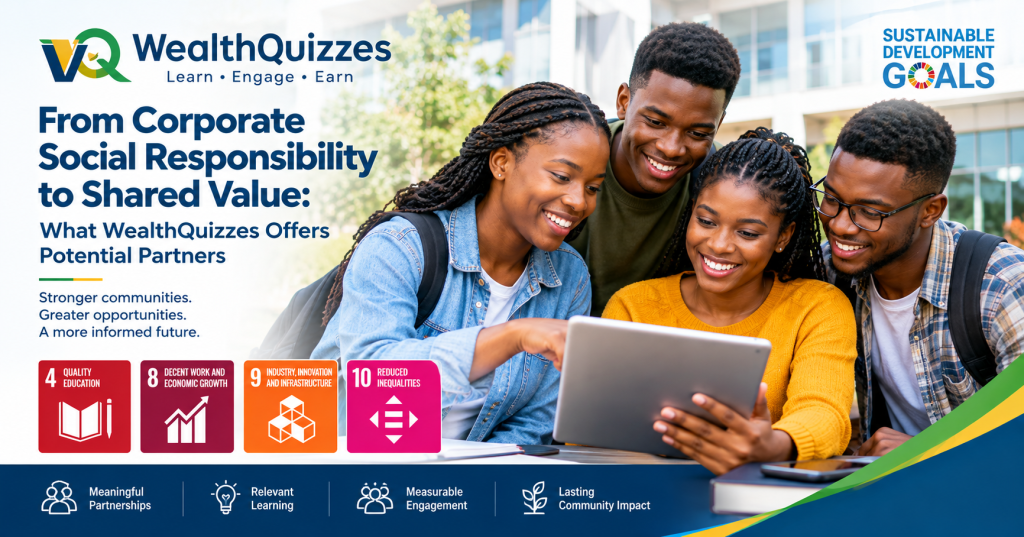
From Corporate Social Responsibility to Shared Value: What WealthQuizzes Offers Potential Partners
Category: Corporate Partnerships, Social Impact and Sustainable Development
Introduction: Rethinking the Purpose of Corporate Social Responsibility
Corporate Social Responsibility (CSR) has become an important part of modern business strategy. Across industries, organisations invest in educational programmes, youth empowerment, community development, environmental initiatives, financial literacy and other activities intended to improve the welfare of the communities in which they operate.
However, an important question arises: can corporate social responsibility achieve more when it is deliberately connected to an organisation’s business objectives, rather than treated principally as a philanthropic obligation?
Increasingly, businesses are exploring approaches that combine commercial value with measurable social benefits. This thinking is commonly associated with the concept of Creating Shared Value (CSV), popularised by Harvard Business School professor Michael E. Porter and management expert Mark R. Kramer.
For organisations seeking innovative ways to engage young people, support education and demonstrate meaningful community impact, this approach creates an opportunity to consider partnerships with digital platforms that combine participation, learning and technology.
WealthQuizzes, a Nigerian knowledge-based digital engagement platform operated by TOPBRAINS Knowledge Teasers Company Limited, presents one potential avenue for such collaboration.
Built around the principle “Learn • Engage • Earn,” WealthQuizzes uses interactive knowledge-based quizzes to encourage participation and engagement with educational and general-interest content. Its model creates possibilities for organisations to support carefully designed campaigns that connect their brands with relevant learning experiences and youth-focused initiatives.
The proposition is not that WealthQuizzes can independently solve social challenges or guarantee commercial returns. Rather, it is that a well-structured partnership could provide a practical mechanism through which an organisation and its beneficiaries derive complementary value.
1. From Corporate Social Responsibility to Creating Shared Value
The traditional understanding of CSR is often associated with philanthropy, charitable donations, sponsorships and community-support initiatives. These activities remain important, particularly where they address urgent social needs.
Professor Archie B. Carroll’s influential 1991 article, The Pyramid of Corporate Social Responsibility: Toward the Moral Management of Organizational Stakeholders, identifies four dimensions of corporate responsibility: economic, legal, ethical and philanthropic responsibilities. His framework demonstrates that responsible business conduct extends beyond making profits to include compliance with the law, ethical behaviour and contributions to society.
The framework remains relevant because it recognises that organisations have responsibilities to multiple stakeholders, including employees, customers, communities and shareholders.
However, the discussion has evolved.
In their influential 2011 Harvard Business Review article, Creating Shared Value, Michael E. Porter and Mark R. Kramer argued that businesses can create economic value in ways that also create value for society by addressing social needs and challenges.
They identified three broad routes to shared value:
- Reconceiving products and markets.
- Redefining productivity in the value chain.
- Enabling local cluster development.
The central distinction is that shared value seeks to integrate social progress into the creation of economic value, rather than treating community investment as an activity entirely separate from business strategy.
This does not mean that philanthropy, legal compliance or ethical obligations become unnecessary. Nor should organisations use the language of shared value to disguise ordinary advertising or pursue commercial interests at the expense of beneficiaries.
Instead, it encourages organisations to identify areas where their legitimate business interests and the needs of society can reinforce one another.
For example, a financial institution supporting financial literacy may improve public understanding of financial products while helping prospective customers make better-informed decisions. A telecommunications company supporting digital literacy may contribute to safer internet use while strengthening its relationship with digitally active customers.
Similarly, an organisation partnering with WealthQuizzes could explore how interactive educational engagement can support its corporate objectives while delivering relevant learning experiences to participants.
2. The Partnership Opportunity: Turning Corporate Support into Active Engagement
One limitation of some conventional CSR initiatives is that beneficiaries may remain passive recipients of assistance.
A company may sponsor an educational event, distribute learning materials or fund a community project. These activities can be valuable, but their effectiveness depends on implementation, participation and the extent to which they address the actual needs of the intended beneficiaries.
Digital engagement offers another possibility.
Rather than simply communicating a message, an organisation can invite its target audience to participate in an activity, test their knowledge, receive feedback and engage with relevant educational content.
This is an area in which WealthQuizzes could potentially complement existing corporate programmes.
A partnership could involve an organisation sponsoring a series of knowledge-based activities around subjects relevant to its industry, social-impact priorities or target audience.
Illustrative themes include:
- Financial literacy and responsible money management.
- Digital literacy, cybersecurity and online safety.
- Entrepreneurship, innovation and business development.
- Career awareness, employability and workplace readiness.
- Science, technology and general knowledge.
- Nigerian history, citizenship and civic awareness.
- Health awareness and responsible lifestyle choices.
The sponsoring organisation could contribute funding, subject-matter expertise, campaign visibility, educational resources or access to relevant networks. WealthQuizzes could, subject to agreed technical and operational capabilities, provide the interactive engagement environment.
The result would be a programme in which corporate support is connected to active participation and defined educational objectives.
3. What Potential Partners Could Gain
A viable partnership must offer more than an attractive social-impact narrative. It must provide identifiable value to the organisation committing its resources.
A well-designed WealthQuizzes partnership could offer several potential benefits.
A. Measurable audience engagement
Conventional advertising often measures impressions, reach, clicks and brand exposure. These remain useful indicators, but interactive programmes can provide additional information about how audiences respond to a campaign.
Depending on the agreed programme and available platform analytics, a partner could assess:
- Number of participants reached.
- Number of unique participants.
- Quiz participation and completion rates.
- Repeat engagement during the campaign.
- Performance across selected educational topics.
- Participant feedback and satisfaction.
- Cost per engaged participant.
These indicators could help an organisation understand whether its campaign generated meaningful participation rather than merely attracting attention.
B. Brand visibility through relevant experiences
A corporate brand is more likely to establish a meaningful connection with an audience when its visibility is associated with an experience that the audience considers useful.
For example, a bank sponsoring a financial-literacy challenge could be associated with responsible financial education. A telecommunications company supporting digital-safety quizzes could reinforce its commitment to responsible connectivity. An educational organisation sponsoring a knowledge competition could strengthen its association with learning and intellectual development.
This approach allows brand visibility to be integrated into the programme without making every educational activity a direct advertisement.
The distinction is important: the educational value must remain genuine, and sponsorship should be transparent.
C. Stronger youth engagement
Young people are important participants in the digital economy. They use technology for communication, education, entertainment, business and personal development.
Organisations seeking to reach this audience must consider engagement methods that reflect contemporary digital behaviour.
An interactive quiz-based programme could provide an additional channel through which a corporate partner engages young audiences in a structured and participatory manner.
This may complement existing social media campaigns, campus activities, sponsorships, customer-engagement programmes and community outreach.
D. Evidence to support corporate reporting
Organisations increasingly need credible information about the outcomes of their social-impact initiatives.
A structured partnership could generate campaign data that supports internal performance reviews, sustainability reporting and stakeholder communications.
However, the distinction between outputs and outcomes must be respected. The number of participants who complete a quiz is an output. An improvement in participants’ understanding of a subject, demonstrated through suitable assessment, is an outcome.
A credible partner should report what the programme actually achieved rather than exaggerating its impact.
4. What Beneficiaries Stand to Gain
Shared value must create genuine benefits for the people and communities a programme is intended to serve.
For WealthQuizzes, the principal opportunity lies in developing engaging experiences through which participants can encounter relevant information, test their knowledge and explore educational subjects.
Potential beneficiary value includes:
Relevant learning: Participants could engage with carefully developed questions and supporting educational content on subjects such as financial literacy, digital safety, entrepreneurship and general knowledge.
Active participation: Interactive quizzes may encourage participants to engage with information rather than merely receive it passively.
Knowledge assessment: Well-designed questions and feedback can help participants identify areas of strength and subjects requiring further learning.
Access to opportunities: Where a partner provides additional learning resources, mentoring, workshops or career information, the campaign could connect participants with opportunities beyond the quiz itself.
Recognition and incentives: A partner may choose to support appropriate awards, certificates or other incentives, subject to transparent eligibility conditions and agreed rules.
It is important to maintain a realistic understanding of these benefits. Participation in a quiz does not automatically produce professional qualifications, employment, financial independence or measurable improvements in long-term behaviour.
Where a programme intends to deliver deeper learning outcomes, it should incorporate suitable educational content, feedback mechanisms, assessment and, where appropriate, follow-up activities.
5. Illustrative Partnership Models Across Different Industries
The flexibility of knowledge-based engagement creates opportunities for collaboration across different sectors.
Financial institutions: Financial literacy and responsible financial behaviour
Banks, payment companies and financial-technology organisations could support quizzes addressing budgeting, savings, responsible borrowing, digital payments, fraud prevention and financial planning.
A campaign might be structured around a Financial Confidence Challenge, with questions developed or reviewed by qualified subject-matter professionals.
For the financial institution, the initiative could support customer education, youth engagement and brand visibility. For participants, it could provide an accessible introduction to important financial concepts.
Telecommunications companies: Digital literacy and online safety
Telecommunications operators could support campaigns addressing cybersecurity, digital privacy, responsible internet use, misinformation and digital skills.
A Digital Safety Knowledge Challenge could help participants recognise common online threats and understand practical steps for protecting personal information.
This would complement existing digital-inclusion and responsible-connectivity programmes.
Educational institutions and technology companies: Learning and innovation
Educational institutions, technology companies and professional organisations could support knowledge challenges involving science, technology, innovation, critical thinking and emerging career opportunities.
A Young Innovators Challenge could encourage participants to explore technology-related subjects and connect them with relevant learning resources.
Consumer brands: Lifestyle education and community engagement
Consumer-facing organisations could sponsor carefully designed campaigns around health awareness, environmental responsibility, nutrition, consumer rights and other subjects relevant to their products or corporate priorities.
The key is to ensure that the subject matter is appropriate, educationally credible and consistent with the sponsor’s legitimate interests.
These examples are proposed models for exploration, not representations of existing WealthQuizzes partnerships.
6. Measuring Shared Value: From Activity to Evidence
A partnership should not be judged solely by the publicity it generates or the number of people who encounter its promotional materials.
It should be evaluated against clearly defined objectives.
The Organisation for Economic Co-operation and Development (OECD) provides a useful framework through its six evaluation criteria: relevance, coherence, effectiveness, efficiency, impact and sustainability.
These criteria can guide the design and evaluation of a WealthQuizzes partnership.
| Evaluation area | Practical question | Possible indicator |
|---|---|---|
| Relevance | Does the programme address a genuine need? | Alignment with beneficiary and partner priorities |
| Engagement | Are people participating? | Unique participants and completion rates |
| Learning | Are participants gaining knowledge? | Pre- and post-campaign assessment |
| Efficiency | Are resources being used effectively? | Cost per participant or completed activity |
| Impact | What difference does the programme make? | Demonstrated improvement in defined knowledge or behaviour |
| Sustainability | Can the benefits continue? | Repeat participation and continued access to learning resources |
A particularly important measure is learning improvement.
For example, a campaign on digital fraud awareness could begin with a short baseline assessment. Participants would then engage with the educational challenge, followed by a second assessment covering the same learning objectives.
The results could provide an indication of whether participants’ understanding improved.
For stronger evidence, the assessment should use well-designed questions, consistent scoring and appropriate methods of analysis. Where the programme is sufficiently substantial, an independent evaluator could be engaged.
The OECD cautions against treating its evaluation criteria as a mechanical checklist. They should be applied thoughtfully, according to the context and objectives of the particular intervention.
This is an important principle for any organisation considering a partnership: measure what matters, and report only what the evidence supports.
7. A Practical Model for Implementing a WealthQuizzes Partnership
A potential partner does not need to begin with a nationwide programme or a substantial long-term commitment.
A phased pilot may offer a more defensible starting point.
Phase One: Strategic alignment
The organisation identifies the social or commercial objective it wishes to pursue. This could be youth engagement, financial literacy, digital inclusion, brand visibility or a defined community-development priority.
Phase Two: Programme design
The parties agree on the target audience, campaign theme, educational content, participation rules, duration, promotional arrangements, budget and performance indicators.
Phase Three: Technical, legal and operational review
Before launch, the parties assess platform capabilities, cybersecurity, data protection, intellectual property, brand approvals, accessibility, customer support and applicable regulatory requirements.
Where personal data is processed, the parties should establish their respective responsibilities under the Nigeria Data Protection Act 2023 and other applicable requirements. Data collection should be lawful, transparent and limited to what is necessary for the programme.
Phase Four: Pilot implementation
The campaign is launched within a defined period and audience. Participation, technical performance, complaints and other relevant indicators are monitored.
Phase Five: Evaluation and reporting
The results are assessed against the agreed targets. The report should distinguish between reach, participation, learning outcomes and longer-term impact.
Phase Six: Expansion or redesign
Where the evidence supports it, the programme may be extended to additional locations, audiences, subject areas or campaign periods.
This approach gives the partner an opportunity to assess the programme’s feasibility and value before making a wider commitment.
8. Credibility, Governance and Responsible Implementation
The transition from CSR to shared value must not become an excuse for superficial impact claims.
A partnership is only credible if its social objectives are genuine, its commercial arrangements are transparent and its implementation protects participants.
The parties should establish clear contractual provisions addressing:
- Scope of work and respective responsibilities.
- Funding, sponsorship and resource commitments.
- Ownership and approval of educational content.
- Brand use and publicity rights.
- Data protection and cybersecurity.
- Participant eligibility and incentive rules.
- Monitoring, evaluation and reporting.
- Complaints, dispute resolution and termination.
The organisation should also ensure that the programme does not mislead participants about the nature of any rewards or benefits.
In the case of WealthQuizzes, the platform’s knowledge-based participation model should be communicated accurately. Any reward associated with participation must remain subject to the applicable programme rules and conditions. It should not be presented as guaranteed income or an assured financial outcome.
Similarly, the sponsor should not be represented as having endorsed the entire platform or its operations beyond the scope of the agreement.
These safeguards are essential to protecting corporate reputation, beneficiary confidence and the long-term viability of the partnership.
Conclusion: Building Partnerships That Deliver Value on Both Sides
Corporate social responsibility remains an important expression of an organisation’s obligations to society. However, organisations have an opportunity to make their community initiatives more strategic by connecting social objectives with their legitimate business priorities.
The shared-value approach provides a useful framework for achieving this.
For potential partners, WealthQuizzes presents an opportunity to explore a digital engagement model that combines interactive participation, relevant learning and corporate visibility. Through carefully designed programmes, organisations could support youth-focused educational activities while creating additional opportunities for meaningful audience engagement.
For beneficiaries, the potential value lies in accessible knowledge-based experiences, opportunities to test their understanding and connections to wider educational resources.
For WealthQuizzes, collaboration could support platform development, audience growth and the delivery of programmes aligned with its broader mission of making knowledge more engaging and valuable.
The proposition is not that every CSR initiative must generate immediate commercial returns, nor that every digital campaign will produce lasting social change. Rather, it is that corporate resources can be deployed more strategically when organisations identify common ground between their objectives and the needs of their communities.
A successful partnership must therefore be built on more than visibility. It must be relevant, properly governed, measurable and capable of demonstrating genuine value.
The future of corporate responsibility should not be defined solely by what organisations give to communities, but also by what they can build with them.
Through thoughtful collaboration, WealthQuizzes could become a potential partner in that process—helping organisations turn corporate support into meaningful engagement, relevant learning and measurable shared value.
Selected Authorities and Further Reading
- Carroll, A. B. (1991). “The Pyramid of Corporate Social Responsibility: Toward the Moral Management of Organizational Stakeholders.” Business Horizons, 34(4), 39–48. Read the article.
- Porter, M. E. and Kramer, M. R. (2011). “Creating Shared Value.” Harvard Business Review, January–February 2011. Harvard Business Review.
- Harvard Business School, Institute for Strategy and Competitiveness. Creating Shared Value. Read more.
- International Organization for Standardization (ISO). ISO 26000:2010 — Guidance on Social Responsibility. Read more.
- Organisation for Economic Co-operation and Development (OECD). Applying Evaluation Criteria Thoughtfully (2021). Read more.
- Nigeria Data Protection Commission (NDPC). Nigeria Data Protection Act 2023 and related guidance. Official website.
About WealthQuizzes: WealthQuizzes is a Nigerian knowledge-based digital engagement platform operated by TOPBRAINS Knowledge Teasers Company Limited. Its guiding principle is Learn • Engage • Earn. Further information is available at www.wealthquizzes.com.


