
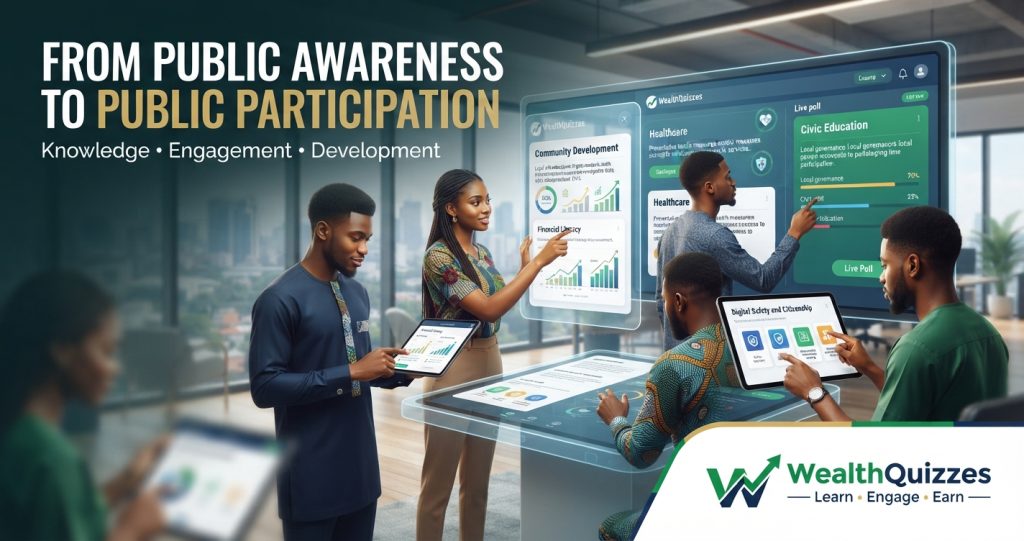
From Public Awareness to Public Participation: How Development Organisations Could Use Digital Knowledge Platforms
Transforming Awareness Campaigns Into Interactive, Inclusive and Measurable Engagement
Public awareness has long been an important component of development programmes. Governments, non-governmental organisations (NGOs), international development agencies, foundations and civil society organisations regularly invest in campaigns designed to educate communities about health, financial literacy, civic responsibilities, environmental protection, digital safety, education and other social priorities.
These campaigns serve an important purpose: they help disseminate information, introduce new ideas, communicate public services and encourage people to make informed decisions.
However, a fundamental question remains: How can awareness be translated into meaningful public participation?
Disseminating information does not necessarily mean that the intended audience has understood it, retained it, engaged with it or applied it in practical situations. A campaign may reach thousands or millions of people without establishing whether the audience actually learned anything or whether the information influenced behaviour.
The increasing availability of digital technology presents an opportunity to rethink public engagement. Digital knowledge platforms can potentially provide structured, interactive experiences through which individuals do more than receive information. They can participate in quizzes, knowledge challenges, educational activities, discussions, assessments and other engagement programmes designed around specific development objectives.
For development organisations seeking greater participation, measurable outcomes and more effective communication, such platforms could represent an additional tool for complementing traditional awareness campaigns.
1. The Limitations of Traditional Public Awareness Campaigns
Public awareness campaigns often rely on posters, radio broadcasts, television advertisements, social media posts, public events, flyers, seminars and community outreach programmes.
These approaches remain valuable, particularly where they are adapted to local contexts and target populations. Radio, for example, can reach communities with limited internet access, while physical outreach may be essential for populations facing digital exclusion.
Nevertheless, many conventional campaigns are primarily designed around information dissemination.
The organisation produces a message, distributes it through selected channels and measures activities such as impressions, attendance, distribution numbers, media coverage or reach.
Although these indicators may demonstrate that information was disseminated, they do not necessarily establish that recipients understood the information, retained the key messages or were capable of applying them.
This distinction is important in development communication.
A financial literacy campaign may explain the importance of budgeting, but understanding whether participants can distinguish income from expenditure or identify a fraudulent financial offer requires a different form of assessment.
A digital safety campaign may warn people about online scams, but participants may benefit more from interactive scenarios that require them to identify suspicious messages, recognise warning signs and make informed decisions.
A civic education programme may explain voting rights, public accountability or constitutional responsibilities, but meaningful participation may require additional opportunities for individuals to engage with these subjects, test their understanding and explore practical applications.
The opportunity, therefore, is to complement awareness with participation, assessment, reinforcement and feedback.
2. Digital Knowledge Platforms: From Information Delivery to Interaction
Digital knowledge platforms offer an opportunity to introduce structured forms of engagement into public awareness programmes.
Instead of limiting campaigns to articles, videos, advertisements or informational posts, organisations could design activities that invite participants to respond to questions, solve problems, test knowledge, explore scenarios and engage with educational content.
Possible formats include:
Knowledge quizzes relating to specific development priorities.
Interactive awareness challenges.
Themed educational competitions.
Scenario-based learning activities.
Short assessments designed to test understanding.
Digital campaigns with recurring participation.
Question-and-answer programmes.
Knowledge challenges linked to community initiatives.
These activities could be integrated into campaigns organised by development agencies, NGOs, government institutions, foundations, educational organisations and corporate social responsibility programmes.
The potential value lies in transforming a one-way communication process into an interactive experience.
A campaign on financial literacy, for example, could invite participants to answer questions about budgeting, savings, responsible borrowing, fraud prevention and financial planning.
A health awareness programme could introduce educational questions concerning preventive health practices, symptoms requiring professional attention, hygiene or public health information.
A digital safety campaign could present scenarios involving suspicious links, phishing attempts, online privacy and misinformation.
Participants would not merely receive information. They would be required to engage with it.
However, digital engagement should not be mistaken for meaningful participation automatically. A quiz completed by a participant demonstrates an activity, but whether that activity improved understanding or influenced behaviour must be assessed separately.
3. Financial Literacy and Economic Empowerment
Financial literacy represents one of the most practical applications of structured digital knowledge engagement.
Many development organisations, financial institutions, government agencies and NGOs conduct financial education programmes aimed at improving people’s understanding of money management, savings, budgeting, credit, financial services, consumer protection and entrepreneurship.
The World Bank’s work on financial education recognises the potential of innovative delivery methods, digital technologies, interactive channels, games, competitions and educational programmes to support financial literacy.
Its Financial Education and Financial Literacy project documentation discusses the use of interactive delivery approaches, including games, competitions and digital technology, alongside the importance of grassroots initiatives and partnerships involving public institutions, educational organisations, NGOs and professional associations.
Digital knowledge platforms could potentially complement these programmes through:
Budgeting and personal finance quizzes.
Savings and financial planning challenges.
Financial fraud and scam-awareness competitions.
Entrepreneurship and small-business knowledge programmes.
Consumer rights and financial services awareness.
Digital banking and payment safety challenges.
Themed campaigns during financial literacy events.
For example, an NGO promoting financial inclusion could organise a digital campaign where participants encounter questions relating to financial decision-making, savings habits, responsible borrowing and common financial scams.
Such programmes could provide opportunities to reinforce financial education messages while allowing organisers to measure participation and identify topics where participants may require additional educational support.
Financial literacy activities must remain educational rather than becoming disguised financial product promotions. Where a sponsor is involved, the campaign should clearly distinguish educational content from commercial advertising and avoid misleading or unsuitable financial advice.
4. Health Awareness and Preventive Education
Health communication is another area where interactive engagement could potentially complement conventional awareness programmes.
Public health organisations frequently seek to educate populations about preventive health, hygiene, nutrition, disease awareness, maternal health, vaccination, mental wellbeing, environmental health and other important subjects.
Digital knowledge activities could help reinforce these messages through appropriately researched quizzes, interactive scenarios and educational challenges.
For example:
Hygiene awareness: Participants answer questions about handwashing, sanitation, food hygiene and safe water practices.
Nutrition education: Knowledge challenges explore balanced diets, food groups, nutrition misconceptions and healthy food choices.
Disease awareness: Educational questions introduce relevant information about prevention, transmission, symptoms and when to seek professional medical attention.
Maternal and child health: Campaigns could reinforce approved information about antenatal care, maternal wellbeing, child nutrition and available healthcare services.
Health misinformation: Participants could be challenged to identify misleading claims and understand the importance of consulting credible health authorities.
The World Health Organization emphasises evidence-based health information and the importance of communicating reliable information during public health challenges.
For digital health-awareness programmes, content should be developed or reviewed by appropriately qualified health professionals. Quizzes should not replace medical consultation, diagnosis, treatment or professional guidance.
The purpose should be to improve public understanding and encourage appropriate health-seeking behaviour—not to create a false sense of medical competence.
5. Digital Safety, Cybersecurity and Online Awareness
As more Nigerians participate in digital banking, social media, online commerce, mobile communication and other technology-enabled activities, digital safety has become an increasingly important development priority.
Digital safety programmes could address:
Phishing and fraudulent messages.
Online scams and impersonation.
Password security.
Personal information protection.
Privacy settings.
Safe online transactions.
Cyberbullying and responsible digital communication.
Misinformation and deceptive content.
Digital identity protection.
Knowledge-based platforms could make these subjects more interactive through practical scenarios.
Participants might be presented with a fictional message and asked to identify warning signs of fraud. They could be challenged to distinguish legitimate communication from suspicious requests for passwords, PINs, verification codes or sensitive personal information.
A digital safety challenge could also test whether participants understand the importance of strong passwords, secure authentication, privacy settings and cautious handling of unsolicited links.
Such activities may help make abstract cybersecurity concepts more relatable.
Nevertheless, the design of these programmes should be careful not to expose participants to harmful content, teach dangerous techniques or create a false impression that completing a quiz guarantees protection against cyber threats.
Digital safety education should complement practical guidance, accessible reporting mechanisms and appropriate support services.
6. Civic Education, Governance and Public Participation
Development is not exclusively about economic growth, education or healthcare. It also involves civic participation, public accountability, institutional responsiveness, rights awareness and the relationship between citizens and public institutions.
Digital knowledge platforms could potentially support civic education by creating opportunities for people to learn about:
Constitutional rights and responsibilities.
Government institutions and their functions.
Public service delivery.
Civic participation.
Environmental responsibilities.
Community development.
Public accountability.
Electoral awareness and democratic processes.
Access to public information.
For example, a civic knowledge challenge could explore the functions of different government institutions, the responsibilities of public officials, constitutional principles or mechanisms through which citizens can engage public authorities.
A community development programme could organise themed challenges relating to local environmental issues, sanitation, infrastructure, public services or community responsibilities.
The World Bank recognises citizen engagement as an important component of development, emphasising the potential for engagement to improve accountability, public service delivery, citizen-state relationships and development outcomes. Its work also identifies digital technologies as potential tools for strengthening citizen engagement.
However, civic participation should not be reduced to answering quiz questions.
Knowledge is an important foundation for participation, but meaningful civic engagement may also require opportunities to express opinions, submit feedback, participate in consultations, report problems, contribute to decisions and receive responses from relevant institutions.
A digital knowledge platform could potentially serve as an entry point into broader participation programmes, provided appropriate mechanisms exist to connect learning with actual opportunities for engagement.
7. Supporting NGOs and Development Organisations With Structured Campaigns
NGOs and development organisations often operate programmes with specific objectives, target populations, timelines, geographic areas and indicators of success.
Digital engagement programmes could be designed around these objectives rather than developed as generic awareness campaigns.
For instance, an organisation implementing a financial inclusion programme could sponsor a series of financial knowledge challenges over several weeks.
An NGO working on environmental sustainability could organise recurring challenges covering waste management, conservation, climate awareness and responsible environmental practices.
A youth development organisation could sponsor knowledge competitions covering entrepreneurship, employability, digital skills, leadership and personal development.
A public institution could organise an awareness campaign relating to public services, rights, responsibilities or the proper use of government programmes.
A development partner could support a themed programme across multiple communities, institutions or demographic groups, subject to the platform’s capabilities and the programme’s operational requirements.
This approach could allow campaign organisers to define objectives, select relevant topics, establish participation periods, develop content, identify target audiences and evaluate results.
The programme could be structured as a standalone activity or as a supplementary component of a broader development initiative.
The critical requirement is alignment between the engagement activity and the development objective.
A campaign should not use quizzes merely because quizzes are available. It should use them where interactive knowledge engagement is reasonably suited to the subject, audience and intended outcome.
8. Digital Participation and Inclusion: Reaching Beyond Conventional Audiences
One of the potential advantages of digital knowledge engagement is the ability to create additional participation opportunities for audiences who may not regularly attend physical seminars, workshops, conferences or organised community events.
Digital programmes may allow participants to engage at different times and from different locations, potentially reducing some logistical barriers associated with physical attendance.
This may be particularly relevant to:
Young people.
Students.
Informal sector workers.
Entrepreneurs and small-business owners.
Rural and underserved communities.
People with limited access to conventional educational programmes.
Individuals who prefer mobile-based engagement.
However, digital access is not universal, and participation should not be assumed simply because a programme is available online.
Connectivity costs, device availability, literacy, disability, language, digital familiarity and geographical disparities may affect the ability of individuals to participate.
The UNESCO, UNICEF and International Telecommunication Union Charter for Public Digital Learning Platforms, published in 2026, emphasises inclusion, accessibility, affordability, low-cost devices, limited connectivity, safety, trustworthiness and the importance of designing digital platforms around public needs. Although its primary focus is digital learning platforms, these principles offer useful guidance for wider development-oriented digital engagement programmes.
Development organisations should therefore consider whether their digital programmes are accessible to the intended audience, whether participation requires expensive devices or data, whether the content is understandable and whether alternative engagement methods are necessary.
The objective should be to expand participation—not inadvertently exclude those whom the programme is intended to reach.
9. Partnerships Between Development Organisations and Digital Knowledge Platforms
Structured digital engagement programmes may create opportunities for collaboration between development organisations and knowledge platforms.
Potential partners could include:
International development agencies.
NGOs and civil society organisations.
Government ministries, departments and agencies.
Foundations and philanthropic organisations.
Educational institutions.
Financial institutions supporting financial inclusion.
Health organisations and public health agencies.
Telecommunications companies.
Corporate social responsibility programmes.
Youth development and skills organisations.
Partnership arrangements could involve programme sponsorship, educational content development, campaign funding, subject-matter expertise, rewards or incentives, outreach, technical collaboration and evaluation.
A development organisation could provide the subject expertise, programme objectives, relevant educational resources and funding, while a digital platform could potentially provide an interactive participation mechanism, content presentation, campaign administration and participation reporting.
The responsibilities of each partner should be clearly defined.
Particularly important issues include:
Programme objectives and target audience.
Content ownership and approval.
Campaign duration.
Funding and budget.
Participation requirements.
Participant privacy and data protection.
Safeguarding arrangements.
Accessibility.
Communications and branding.
Measurement and evaluation.
Reporting.
Complaints and incident management.
Intellectual property rights.
Termination and post-campaign responsibilities.
Such clarity can help reduce operational uncertainty and protect the credibility of both organisations.
10. WealthQuizzes and the Development Engagement Opportunity
For WealthQuizzes, development-oriented digital engagement represents a potential strategic opportunity to explore collaborations with organisations seeking additional ways to educate, engage and involve their target audiences.
The platform’s knowledge-based quiz format could potentially be adapted to support programmes covering financial literacy, health awareness, digital safety, civic education, entrepreneurship, environmental awareness and other development priorities.
Potential programme concepts include:
Financial Inclusion and Literacy
Knowledge challenges covering savings, budgeting, financial safety, consumer awareness and financial decision-making.
Health Awareness Campaigns
Educational activities developed with appropriate health professionals and organisations around relevant public health priorities.
Digital Safety and Awareness
Interactive challenges covering online scams, cybersecurity, privacy, responsible digital behaviour and misinformation.
Knowledge programmes addressing citizenship, public awareness, environmental responsibility, governance and community development.
Youth Empowerment and Skills
Challenges involving entrepreneurship, employability, digital literacy, communication, business knowledge and personal development.
These are potential partnership opportunities and programme concepts. Their implementation would depend on institutional interest, programme funding, technical suitability, content quality, operational capacity, safeguarding requirements and agreed partnership arrangements.
The value proposition should not be based simply on the availability of a quiz platform. It should be based on the ability to help an organisation translate a development objective into a structured, engaging, appropriately designed and measurable digital programme.
11. Measuring Outcomes: From Participation to Development Impact
For development organisations, the credibility of a digital engagement programme depends significantly on its ability to demonstrate results.
Participation statistics may provide useful information, but they should not be confused with development impact.
A programme may record thousands of participants without demonstrating improved knowledge, changed behaviour or better development outcomes.
Measurement should therefore be designed around the programme’s objectives.
| Measurement area | Possible indicators |
|---|---|
| Reach | Number of participants, geographic reach and target-group representation |
| Participation | Registrations, completed challenges and repeat participation |
| Engagement | Completion rates, interaction and campaign retention |
| Knowledge | Pre- and post-programme assessment results |
| Awareness | Understanding of relevant concepts or programme information |
| Behaviour | Self-reported or independently measured behaviour changes where appropriate |
| Inclusion | Participation across relevant demographic or underserved groups |
| Feedback | Participant satisfaction, complaints and suggestions |
| Efficiency | Cost per participant or completed engagement |
| Programme effectiveness | Achievement of predefined objectives |
Where knowledge improvement is an objective, a properly designed pre- and post-assessment may provide stronger evidence than participation figures alone.
Where behavioural change is the objective, more comprehensive evaluation may be necessary.
For example, a digital safety programme could measure participants’ ability to identify fraudulent messages before and after participation, while a financial literacy programme could assess understanding of budgeting or financial risk.
However, improved quiz performance should not automatically be interpreted as evidence of lasting behavioural change.
Development organisations should use proportionate, credible evaluation methods and distinguish between immediate learning, longer-term behavioural outcomes and broader social impact.
12. Responsible Design: Trust, Privacy and Programme Integrity
Development-oriented digital programmes must be designed with the interests of participants in mind.
This includes transparency about programme objectives, participation conditions, incentives, data collection, privacy, security, content accuracy and the responsibilities of participating organisations.
Where sensitive subjects are involved, content should be reviewed by appropriate specialists.
Where children or vulnerable populations participate, safeguarding and appropriate consent arrangements should be addressed.
Where campaigns involve public institutions or civic issues, content should be accurate, impartial where required, accessible and consistent with the programme’s stated objectives.
Where rewards or incentives are offered, their conditions should be clearly communicated and should not undermine the educational or development purpose of the programme.
Organisations should also avoid collecting unnecessary personal information merely because a digital platform makes collection technically possible.
Trust, accountability and responsible data management are not peripheral considerations. They are essential to sustainable public engagement.
13. A Practical Framework for Implementing Digital Engagement Programmes
Development organisations considering digital knowledge engagement could adopt a phased approach.
Step One: Identify the Development Objective
Define the specific issue the programme seeks to address. The objective should be clear, measurable and relevant to the target population.
Step Two: Identify the Target Audience
Determine who the programme is intended to reach, including their educational background, digital access, language, interests and participation barriers.
Step Three: Develop Credible and Relevant Content
Work with subject-matter experts to develop accurate, engaging and appropriate content. Questions and activities should reflect the programme’s objectives rather than merely generate participation.
Step Four: Implement a Pilot Programme
Begin with a manageable campaign, defined duration and realistic participation target. A pilot allows organisers to evaluate content, technical performance, audience response, accessibility and operational feasibility.
Step Five: Evaluate and Improve
Assess the results, identify deficiencies, obtain participant feedback and determine whether the programme should be modified, continued or expanded.
This approach is consistent with broader development practice that prioritises evidence, adaptation, accountability and learning rather than assuming that a particular technology will automatically produce positive outcomes.
Conclusion: Making Public Awareness More Participatory
Public awareness remains an essential component of development. However, in an increasingly digital society, organisations have opportunities to explore engagement approaches that move beyond the passive dissemination of information.
Digital knowledge platforms can potentially provide additional mechanisms through which people interact with development messages, test their understanding, participate in educational activities, receive feedback and remain connected to relevant programmes.
Financial literacy, health awareness, digital safety, civic education, environmental responsibility, entrepreneurship and youth development are among the areas where structured knowledge engagement could complement existing development initiatives.
For NGOs, public institutions, development agencies and corporate social responsibility programmes, the opportunity lies in creating campaigns that are not merely visible, but participatory, relevant, accessible and measurable.
For WealthQuizzes, this represents a potential avenue for strategic collaboration with organisations seeking innovative approaches to public education and engagement.
The ultimate objective should not simply be to make more people aware of a development issue. It should be to create opportunities for people to understand it better, participate meaningfully and, where appropriate, translate that understanding into informed decisions and constructive action.
Awareness introduces an issue. Knowledge deepens understanding. Participation creates an opportunity for action.
When these elements are thoughtfully connected, digital engagement can become a valuable complement to development programmes—not merely another communication channel, but a potential instrument for public education, participation and measurable progress.
Selected Authorities and Further Reading
1. World Bank — Citizen Engagement
Examines approaches to strengthening citizen engagement, participation, accountability and public service delivery.
World Bank Citizen Engagement2. World Bank — Civic and Citizen Engagement
Discusses citizen participation, civil society partnerships, accountability and development outcomes.
Read more3. UNESCO, UNICEF and ITU — Charter for Public Digital Learning Platforms (2026)
Provides principles for inclusive, trustworthy, accessible and public-interest digital platforms. While focused on public digital learning, its principles are relevant to the design of development-oriented engagement programmes.
Read the Charter4. UNICEF — Gateways to Public Digital Learning
An international initiative supporting accessible digital learning platforms and knowledge exchange.
Explore the initiative5. World Bank — Financial Education and Financial Literacy Project
Discusses innovative financial education approaches, digital technology, interactive learning, games and community engagement.
World Bank Documents and Reports6. World Bank — Evaluating Digital Citizen Engagement: A Practical Guide
Provides guidance on evaluating digital engagement tools and their contribution to citizen engagement processes.
Access the guide7. UNICEF — Digital Education Strategy and Resources
Explores inclusive, safe, evidence-informed digital engagement and learning.
WealthQuizzes — Learn • Engage • Earn
Where Knowledge Becomes Wealth.


