
More Than Players: How Knowledge Platforms Can Create Opportunities for Contributors and Digital Creators
Impact, Innovation and Organisational Opportunities
Introduction: Beyond Participation to Contribution
When people think about a digital quiz platform, they naturally imagine users answering questions, competing with one another and testing their knowledge. That is an important part of the experience, but it represents only one dimension of what a growing knowledge platform can become.
Behind every engaging knowledge platform is an ecosystem of people who research information, develop questions, review content, write educational materials, manage communities, create promotional campaigns and communicate with audiences.
These activities create an opportunity that deserves greater attention: a knowledge platform can become more than a destination for players; it can also become an environment in which writers, researchers, educators, editors, digital marketers and other creative professionals contribute their skills and potentially earn from their work.
For WealthQuizzes, a Nigerian knowledge-based digital engagement platform operated by TOPBRAINS Knowledge Teasers Company Limited, this represents an important opportunity for growth.
Built around the principle “Learn • Engage • Earn,” WealthQuizzes seeks to make knowledge-based participation more engaging through interactive quizzes and conditional rewards. However, as its content library, audience and partnership activities expand, the platform may require a wider network of contributors to sustain quality, variety and relevance.
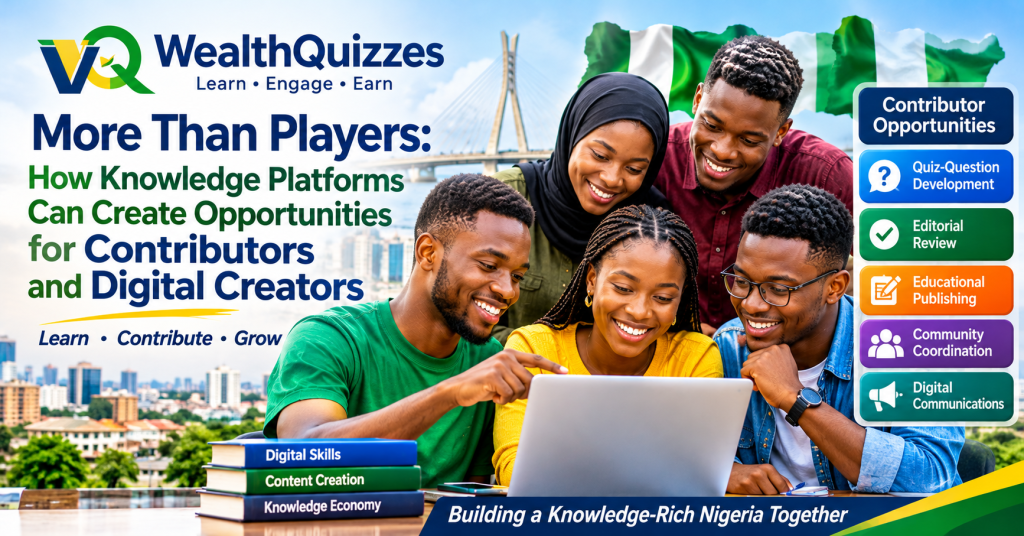
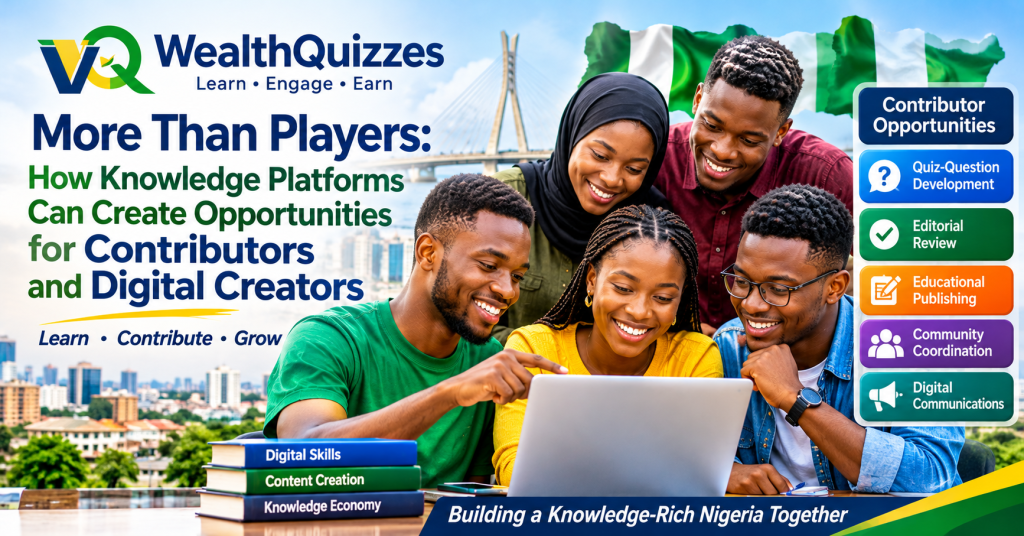
This creates potential opportunities in quiz-question development, editorial review, educational publishing, community coordination and digital communications.
The opportunity is not to promise employment or guaranteed income to everyone who expresses interest. It is to establish a structured contributor ecosystem in which people with relevant skills can access clearly defined assignments, develop professional experience and participate in the growth of a digital knowledge business.
1. The Growing Importance of Digital Creators and Knowledge Contributors
The global digital economy has changed how information is produced, distributed and consumed. Individuals can now create educational content, publish articles, manage online communities, produce multimedia materials and reach audiences without necessarily working within traditional media or publishing organisations.
The International Labour Organization (ILO), in its 2024 working paper Balancing Act: The Role of Digital Platforms in Shaping the Conditions of Creative Work, examines how digital platforms have transformed creative occupations, including blogging, photography, podcasting and other forms of digital content production.
The ILO recognises that digital platforms can expand creative opportunities, improve access to audiences and facilitate flexible working arrangements. However, it also identifies important concerns, including irregular income, limited job security, unequal bargaining power and the concentration of influence among major platforms. ILO, 2024.
This is an important lesson for emerging digital businesses.
A platform should not simply attract contributors by advertising opportunities. It should establish a system that defines the work required, communicates expectations, protects intellectual property and provides fair and transparent arrangements for completed assignments.
For WealthQuizzes, this could mean creating opportunities for people who possess knowledge, research abilities, writing skills, educational experience and digital communication capabilities.
The objective would be to build an ecosystem in which the platform benefits from diverse expertise while contributors gain opportunities to demonstrate and develop their abilities.
2. Quiz-Question Development: Creating Opportunities for Researchers and Subject Specialists
One of the most direct opportunities within a knowledge platform is the development of quiz questions.
A growing platform needs a continuous supply of accurate, relevant, appropriately structured and intellectually stimulating questions across different categories.
This creates potential opportunities for:
- Subject-matter specialists.
- Researchers and fact-checkers.
- Teachers and lecturers.
- University students and graduates.
- Professional writers.
- Individuals with specialised knowledge of particular subjects.
For example, contributors with knowledge of finance could help develop questions on budgeting, savings, business management and financial intelligence. Those with expertise in history could research Nigerian and international historical events, personalities and institutions. Sports enthusiasts with strong research skills could contribute questions on football history, competitions, records and sporting personalities.
Other subject areas could include science, technology, entertainment, geography, literature, entrepreneurship and general knowledge.
However, quiz development is not simply about writing questions and providing answer options.
A professionally managed question-development process should consider:
- Accuracy: Every factual question must have a defensible correct answer.
- Verifiability: Questions should be supported by reliable sources.
- Clarity: Wording should avoid unnecessary ambiguity.
- Difficulty: Questions should reflect the intended stage and audience.
- Originality: Questions should not improperly reproduce copyrighted material.
- Relevance: Content should remain appropriate to the subject and intended audience.
- Fairness: Questions should not depend on obscure assumptions or misleading wording.
WealthQuizzes could introduce a structured question-development programme through which approved contributors submit questions for editorial assessment.
Accepted questions could attract an agreed fee, a contractual payment or another clearly defined form of recognition, depending on the programme’s commercial structure.
This would create a potential income opportunity while helping the platform expand its question library.
3. Editorial Review and Fact-Checking: Building a Culture of Accuracy
The value of a knowledge platform depends heavily on the reliability of its content.
Incorrect answers, poorly worded questions, outdated information and ambiguous options can undermine user confidence. Consequently, content quality assurance should be treated as a core operational function rather than an administrative afterthought.
This creates a distinct opportunity for editors, proofreaders, researchers and fact-checkers.
Their responsibilities could include:
- Reviewing submitted questions for factual accuracy.
- Checking sources and supporting references.
- Correcting grammatical and structural errors.
- Identifying ambiguous questions and answer options.
- Detecting duplicated or substantially similar questions.
- Checking the relevance and suitability of content.
- Reviewing sensitive or potentially misleading material.
- Updating questions when facts, records or circumstances change.
Different categories may require different levels of expertise. A question involving Nigerian constitutional history, for example, may require a different review process from one concerning football statistics or financial concepts.
A specialist review system would therefore improve reliability.
UNESCO’s research on digital content creators reinforces the importance of this approach. Its 2024 Behind the Screens study examined 500 digital content creators across 45 countries and found significant weaknesses in systematic fact-checking and the assessment of information credibility. The study also found strong interest among creators in receiving training in media and information literacy. UNESCO, Behind the Screens.
For WealthQuizzes, this presents an opportunity to develop a contributor culture that values evidence, verification and responsible information-sharing.
Contributors should be encouraged to cite authoritative sources, distinguish established facts from disputed claims and flag information that requires specialist review.
This would benefit both the platform and the contributors, particularly those seeking to build careers in research, editing, publishing and educational content development.
4. Educational Publishing: Creating Opportunities for Writers and Knowledge Communicators
A digital knowledge platform does not have to limit its educational activities to multiple-choice questions.
It can also publish explanatory articles, learning guides, subject summaries, educational features and other materials that help users understand the subjects they encounter.
This creates opportunities for writers, journalists, educators, researchers and aspiring publishers.
For example, a quiz category on financial intelligence could be supported by articles explaining budgeting, financial planning, responsible borrowing and basic business concepts.
A history category could feature educational articles on Nigerian political development, historical personalities, constitutional milestones and significant national events.
Sports quizzes could be complemented by articles on football history, tactical developments, sporting institutions and the economics of professional football.
Educational publishing could also support the platform’s wider visibility through search-engine-friendly articles, newsletters and social media content.
Potential contributor roles include:
Educational writers: Develop accessible articles explaining complex subjects.
Research writers: Produce evidence-based material supported by credible sources.
Proofreaders and copy editors: Improve clarity, grammar, structure and consistency.
Technical writers: Prepare instructional materials, user guides and explanatory content.
Digital publishers: Format, organise and prepare content for online publication.
The platform could operate a contributor programme in which approved writers receive assignments based on editorial needs, subject expertise and demonstrated writing ability.
Where articles are commissioned, the parties should agree on the scope, length, deadlines, payment and ownership or licensing of the completed work before publication.
5. Community Coordination: Turning Audiences into Active Communities
A digital platform’s relationship with its audience should not end when a user completes a quiz.
Communities can support engagement, customer retention, feedback, learning and brand advocacy. However, effective communities require organisation and responsible management.
This creates potential opportunities for community coordinators and digital engagement professionals.
Their responsibilities could include:
- Welcoming new community members.
- Communicating campaign announcements.
- Explaining participation rules.
- Coordinating scheduled knowledge activities.
- Responding to routine enquiries.
- Collecting feedback and reporting recurring issues.
- Encouraging constructive discussions.
- Escalating complaints and technical problems.
- Enforcing community standards.
For WealthQuizzes, community coordinators could support activities such as knowledge challenges, educational discussions, special quiz events and partner-sponsored campaigns.
The role requires more than posting messages in a WhatsApp group or social media channel. It involves communication skills, consistency, sound judgement and the ability to manage different personalities.
Appropriate training would therefore be important.
Community coordinators should understand the platform’s rules, privacy expectations, escalation procedures and standards of professional conduct. They should also be trained to avoid making unauthorised promises about rewards, withdrawals or other platform services.
A structured community programme could create practical opportunities for young people interested in digital communications, customer experience, public relations and online community management.
6. Digital Communications and Creative Production
As WealthQuizzes expands its audience and partnership activities, the need for consistent and effective communication is likely to increase.
A digital platform must communicate its services, explain features, promote campaigns, educate users and maintain a recognisable brand identity.
This creates potential opportunities for:
- Graphic designers.
- Video editors.
- Social media managers.
- Digital marketers.
- Copywriters.
- Content strategists.
- Brand communication assistants.
- Search-engine optimisation specialists.
- Photographers and multimedia creators.
For example, a campaign promoting a new quiz category may require a written announcement, a branded graphic, a short promotional video, social media captions and a landing-page description.
A corporate partnership campaign may require more extensive materials, including educational content, campaign banners, newsletters and progress reports.
These assignments could provide contributors with opportunities to demonstrate practical skills through real projects.
However, creative work should be commissioned professionally. Briefs should specify the required deliverables, dimensions, formats, deadlines, revision limits, approval procedures and agreed fees.
The platform should also maintain consistent brand guidelines to ensure that independently produced materials preserve the WealthQuizzes identity.
7. Developing a Contributor Ecosystem Rather Than Offering Unstructured Opportunities
The long-term opportunity is not merely to recruit people whenever a content requirement arises. It is to build an organised contributor ecosystem.
Such an ecosystem could contain different levels of participation.
Level One: Open contributor interest
Individuals express interest in contributing and identify their skills, subject areas and relevant experience.
Level Two: Assessment and onboarding
Prospective contributors complete an appropriate assessment or sample assignment. Those selected receive guidance on editorial standards, platform procedures and professional expectations.
Level Three: Project-based assignments
Approved contributors receive clearly defined assignments according to the platform’s requirements.
Level Four: Specialist contributor status
Contributors who consistently produce accurate and high-quality work may be considered for more specialised assignments, editorial responsibilities or coordination roles.
Level Five: Long-term collaboration
Where operational needs and funding permit, WealthQuizzes could establish recurring contractual arrangements with selected contributors.
This model would allow the platform to expand its contributor network without immediately assuming the financial burden of employing a large permanent workforce.
It would also enable individuals to build experience and demonstrate their capabilities through defined assignments.
Importantly, the nature of each engagement must be accurately classified. A genuinely independent contractor should not automatically be described as an employee, and contractual labels should not be used to avoid employment obligations where the actual working relationship creates them.
8. The Importance of Fair Compensation and Intellectual Property Protection
A contributor programme will only be credible if people understand how their work will be treated and what they receive in return.
The International Labour Organization’s 2024 study on creative work warns that platform-based opportunities can coexist with irregular income, weak bargaining power and precarious working conditions.
WealthQuizzes should therefore avoid building its contributor model around vague promises of future exposure or unspecified opportunities.
A fair framework should address:
- The nature and scope of each assignment.
- Whether compensation is fixed, milestone-based or otherwise structured.
- Payment timelines and acceptance criteria.
- Permitted revisions and additional work.
- Attribution and recognition.
- Confidentiality requirements.
- Ownership or licensing of submitted material.
- Procedures for resolving disagreements.
Intellectual property deserves particular attention.
Nigeria’s Copyright Act 2022 provides the legal framework governing copyright protection in Nigeria. Contributors and the platform should agree on the applicable ownership and licensing arrangements for commissioned articles, graphics, videos, question banks and other original works.
The agreement should clarify whether copyright is assigned, licensed or retained by the creator subject to specified permissions. It should also address the use of third-party materials, quotations, images and other content that may require permission.
A transparent intellectual-property framework protects both the business and the people whose creative efforts contribute to its growth.
9. Training and Professional Development: Building Contributors’ Capabilities
An effective contributor programme should not focus exclusively on obtaining work from people. It should also consider how participation can help them improve their skills.
UNESCO’s work on media and information literacy emphasises the importance of helping digital creators assess information credibility, verify facts and communicate responsibly.
Its 2025 recommendations on professionalising digital content creators’ work in Africa highlight the need for training, stronger professional practices and collaboration between creators and established information institutions. UNESCO, 2025.
WealthQuizzes could explore a modest contributor-development programme covering:
- Research methods and source verification.
- Question-writing techniques.
- Grammar, editing and proofreading.
- Educational content development.
- Copyright awareness and responsible sourcing.
- Digital communication and brand consistency.
- Community management and customer experience.
- Ethical use of artificial intelligence in content production.
Training should be practical and connected to actual assignments.
For example, a prospective quiz contributor could learn how to develop a question, identify authoritative sources, construct plausible answer options and explain why the correct answer is defensible.
A prospective community coordinator could receive training in communication, moderation, complaint escalation and data privacy.
Where appropriate, the platform could collaborate with universities, professional associations, training providers and experienced practitioners to strengthen the programme.
10. Measuring the Value of the Contributor Ecosystem
A contributor programme should be evaluated through measurable indicators rather than the number of people who register an interest.
Useful indicators could include:
| Area | Suggested performance indicator |
|---|---|
| Content development | Number of questions and educational materials submitted and approved |
| Quality assurance | Acceptance rate, correction rate and factual-error rate |
| Contributor participation | Number of active contributors and completed assignments |
| Compensation | Payments made within agreed timelines |
| Publishing | Articles and educational materials published |
| Community management | Response times, issue-resolution rates and engagement quality |
| Creative production | Campaign materials delivered and approved |
| Professional development | Training completed and improvement in assessment results |
| Business value | Content coverage, audience engagement and cost per accepted deliverable |
These indicators would help WealthQuizzes determine whether the programme is improving content quality, expanding operational capacity and creating genuine opportunities.
They would also help identify weaknesses. For example, a high volume of submissions accompanied by a low acceptance rate may indicate a need for clearer contributor guidelines or better training.
Similarly, a growing contributor network without sufficient paid assignments could create unrealistic expectations. Recruitment should therefore be linked to actual or reasonably anticipated work requirements.
11. A Practical Starting Point: The WealthQuizzes Contributor Programme
Rather than launching a large recruitment exercise immediately, WealthQuizzes could begin with a focused pilot.
A proposed WealthQuizzes Contributor Programme could initially cover five workstreams:
- Quiz Content Contributors: Research and develop original questions across approved categories.
- Editorial and Research Reviewers: Verify facts, check sources and assess content quality.
- Educational Writers and Publishers: Produce articles, learning materials and explanatory content.
- Community Coordinators: Support user engagement, communication and community activities.
- Digital Creators and Communications Contributors: Develop graphics, videos, promotional content and digital campaigns.
The pilot could begin with a small number of contributors selected according to demonstrated ability and actual operational requirements.
Each role should have a written description, selection criteria, assignment procedures, compensation terms where applicable and performance expectations.
After an initial evaluation period, WealthQuizzes could determine which workstreams should be expanded, redesigned or suspended.
This would allow the platform to build capacity gradually while maintaining control over quality, expenditure and operational commitments.
Conclusion: Building a Platform That Creates Opportunities Beyond the Screen
A growing knowledge platform should not be viewed solely as a digital destination for people who want to answer questions. It can also become an ecosystem supported by researchers, writers, editors, educators, designers, communicators and community professionals.
For WealthQuizzes, this creates an opportunity to connect knowledge participation with knowledge production.
As the platform expands, its demand for original questions, reliable research, educational publications, community coordination and digital communications could create opportunities for contributors with relevant skills.
The potential benefits extend beyond the platform itself. Contributors could gain practical experience, develop professional portfolios, improve their capabilities and access paid assignments where genuine work and funding are available.
WealthQuizzes, in turn, could benefit from a broader content pipeline, stronger editorial standards, improved community engagement and greater operational capacity.
However, the success of this model will depend on responsible implementation. Contributor opportunities must be genuine, compensation arrangements transparent, intellectual property protected and quality standards consistently applied. The platform should never confuse the creation of a contributor database with the creation of actual employment or income opportunities.
The broader ambition should be to develop a digital environment in which people do not merely consume knowledge but can also contribute to its creation, verification, communication and distribution.
The future of a knowledge platform should not be measured only by how many people answer its questions, but also by how many people it enables to participate in creating, organising and sharing knowledge.
Through a structured and professionally managed contributor ecosystem, WealthQuizzes could become more than a quiz platform. It could develop into a broader knowledge and digital-content enterprise—one that creates value for users, contributors, partners and the wider Nigerian digital economy.
Selected Authorities and Further Reading
- International Labour Organization (ILO). (2024). Balancing Act: The Role of Digital Platforms in Shaping the Conditions of Creative Work. ILO Working Paper No. 123. Examines opportunities and risks associated with platform-based creative work, including income insecurity, worker autonomy and intellectual property. https://www.ilo.org/publications/balancing-act-role-digital-platforms-shaping-conditions-creative-work
- UNESCO. (2024). Behind the Screens: Insights into the World of Digital Content Creators. Research involving 500 creators across 45 countries, examining content-production practices, credibility assessment and professional development needs. https://www.unesco.org/en/digital-content-creators
- UNESCO. (2025). Five Recommendations to Professionalize Digital Content Creators’ Work in Africa. Discusses training, professional standards and collaboration between creators and information professionals. https://www.unesco.org/en/articles/five-recommendations-professionalize-digital-content-creators-work-africa
- World Bank. Nigeria Digital Economy Diagnostic: A Plan for Building Nigeria’s Inclusive Digital Future. Examines digital skills, entrepreneurship, digital infrastructure and the opportunities and constraints affecting Nigeria’s digital economy. https://www.worldbank.org/en/country/nigeria/publication/nigeria-digital-economy-diagnostic-a-plan-for-building-nigerias-inclusive-digital-future
- UNESCO. Media and Information Literacy. Explains the importance of critical evaluation, information verification, responsible content creation and safe participation in digital environments. https://www.unesco.org/en/media-information-literacy
- World Intellectual Property Organization (WIPO). Copyright. Provides information on copyright protection and the rights of creators in original literary, artistic and other creative works. https://www.wipo.int/copyright/en/
- Federal Republic of Nigeria. Copyright Act 2022. Nigeria’s principal statutory framework for copyright protection and the rights of creators.
About WealthQuizzes: WealthQuizzes is a Nigerian knowledge-based digital engagement platform operated by TOPBRAINS Knowledge Teasers Company Limited. Its guiding principle is Learn • Engage • Earn. Further information is available at www.wealthquizzes.com.


